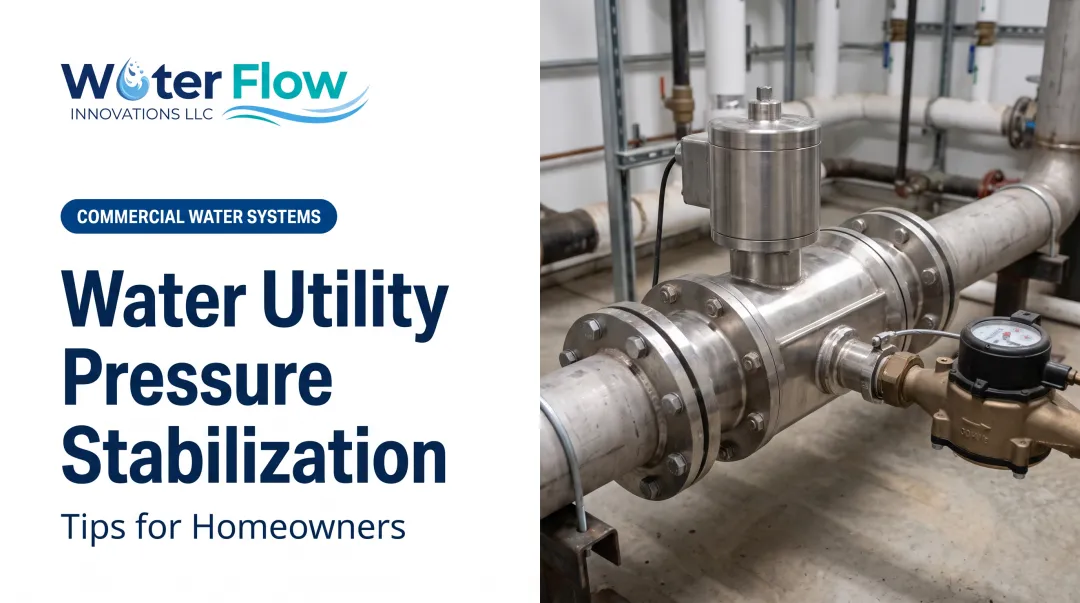
That's a fair question, but it's the wrong starting point. Water meters and pressure regulators sit inches apart in your plumbing line, and most homeowners and facility managers have no idea which one actually controls what. Mixing them up leads to replacing the wrong part — and missing a bigger issue that's quietly inflating water bills.
This guide breaks down how each component works, where they overlap, what causes pressure problems, and why commercial facilities in particular need to look past the pressure gauge and at the bill itself.
Key Takeaways
- Water meters measure usage, not pressure, though clogs or stuck valves nearby can mimic regulator failure
- Pressure regulators (PRVs) reduce municipal supply pressure and are the property owner's responsibility to maintain
- Turbulence and air at the meter cause over-reading, inflating water and sewer bills with no change in actual usage
- Commercial and industrial facilities face amplified risk due to variable, high-volume demand
- Correcting flow issues at the meter can lower water and sewer charges simultaneously
What Is a Water Meter and How Does It Work?
A water meter measures the volume of water flowing into a property, and that reading is what your utility bills you on. It's an accounting device, not a pressure-regulating one.
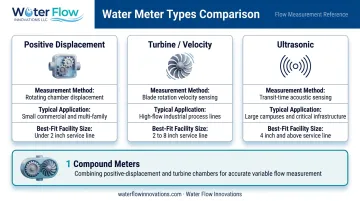
Three main types are in common use:
- Positive displacement meters — mechanically measure discrete volumes of water as they pass through an internal chamber; best suited for smaller commercial applications
- Turbine (velocity) meters — measure water velocity and convert it to volume, typically used for continuous, high-flow service
- Ultrasonic meters — use acoustic signals to calculate flow rate, suitable for most commercial applications
Larger facilities often use compound meters, which combine positive-displacement and turbine chambers to handle both low and high flow accurately. as demand shifts throughout the day. This is standard practice according to EPA guidance on commercial water metering.
Where the Meter Sits in the Line
Meters are almost always installed near the curb or property line, upstream of both the main shutoff valve and the pressure regulator. A dedicated isolation valve, often required within a foot of the meter, lets technicians service or remove the meter without shutting off the whole property.
Can a Meter Actually Cause Pressure Problems?
Not by design. But three things can create the illusion of a pressure problem:
- A clogged inline strainer meant to catch debris before it reaches the measuring chamber
- Aging internal gears creating extra resistance in older mechanical meters
- A partially closed isolation valve right next to the meter
None of these are technically pressure regulation problems; they're resistance issues. Resistance feels exactly like low pressure at the tap, and it can also distort flow patterns enough to affect how accurately the meter reads.
What Is a Water Pressure Regulator and How Does It Work?
A pressure regulator — also called a pressure-reducing valve (PRV) — is a spring-loaded diaphragm valve that takes high incoming municipal pressure and steps it down to a safer, more consistent range for the building's plumbing.
Unlike the meter, the PRV belongs to the property owner. It's installed downstream of both the meter and the main shutoff, and maintaining it is entirely on you (or your facility team) — not the utility.
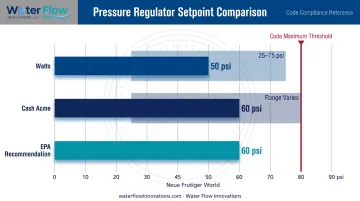
Code requirements set the ceiling, not the target. Plumbing codes such as the 2021 IPC and 2015 UPC require a regulator once static pressure exceeds 80 psi, and mandate that downstream pressure be brought below that threshold, per the International Plumbing Code standard on water distribution.
For a facility managing water costs across multiple fixtures and systems, knowing your actual setpoint matters — it affects everything downstream, from fixture longevity to flow consistency. Actual setpoints vary by manufacturer:
| Manufacturer | Typical Factory Setting | Adjustable Range |
|---|---|---|
| Watts | 50 psi | 25–75 psi |
| Cash Acme | 60 psi | Varies by model |
| EPA recommendation | 45–60 psi | — |
Signs a Regulator Is Failing
Watch for these red flags:
- Fluctuating pressure — strong one minute, weak the next
- Sudden spikes or drops with no obvious cause
- Water hammer — banging or knocking in the pipes
- Leaking fixtures or dripping faucets that weren't leaking before
- Appliance noise or premature wear on water heaters and washing machines
PRVs are long-lasting, "life-of-mortgage" products that can often be rebuilt with a service kit rather than replaced outright. There's no universal expiration date — but persistent symptoms after ruling out other causes point to the valve itself.
The Relationship Between Meters and Pressure: What Most Guides Miss
Here's where things get interesting, and where most plumbing guides stop too early.
A partially closed meter isolation valve, a clogged strainer, or an aging meter can restrict flow enough to mimic a bad regulator's symptoms exactly. Because these two components sit within a few feet of each other, staff often replace the regulator first. The pressure problem persists anyway.
Meter Over-Reading: The Hidden Cost
But there's a second, less obvious problem: turbulent flow and air entrainment at the meter can cause it to record more water than actually passed through.
Positive displacement and turbine meters can't tell the difference between water and air. Any bubble, vortex, or pressure surge that reaches the measuring chamber gets counted as billable volume. Academic testing has confirmed that installation issues, including partial blockages, disturbed velocity profiles, and improper orientation, can produce measurable positive registration errors, according to research on water meter accuracy factors.
Why This Hits Commercial Facilities Harder
High-volume, variable-demand facilities generate more turbulence at the meter than a typical residence:
- On-off cycling from CIP (clean-in-place) processes
- Sudden demand spikes from irrigation or sprinkler systems
- Tank filling and draining cycles
- Cooling tower and HVAC loop operation
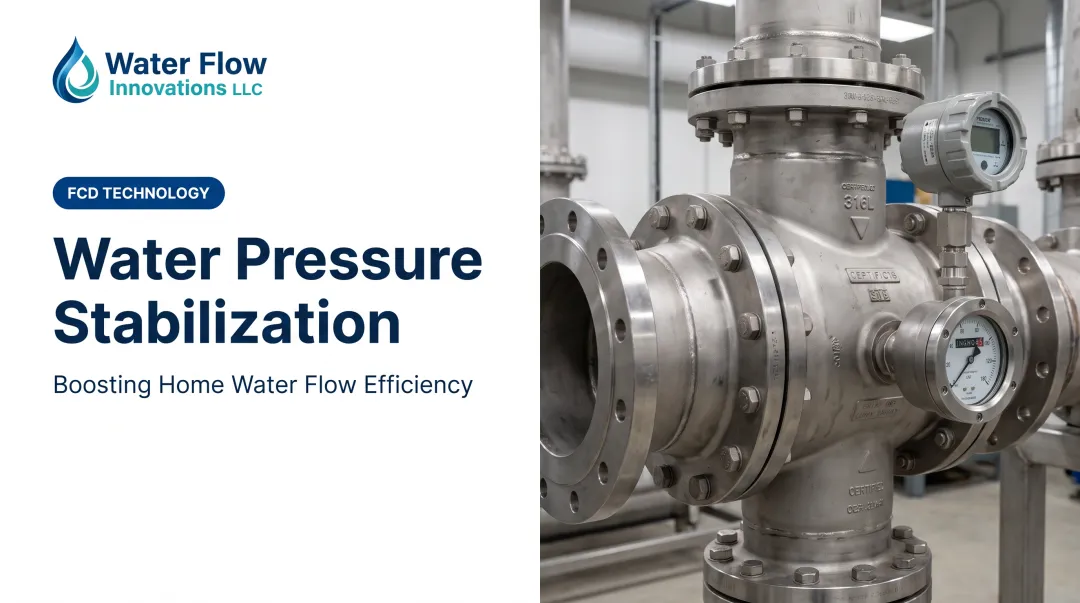
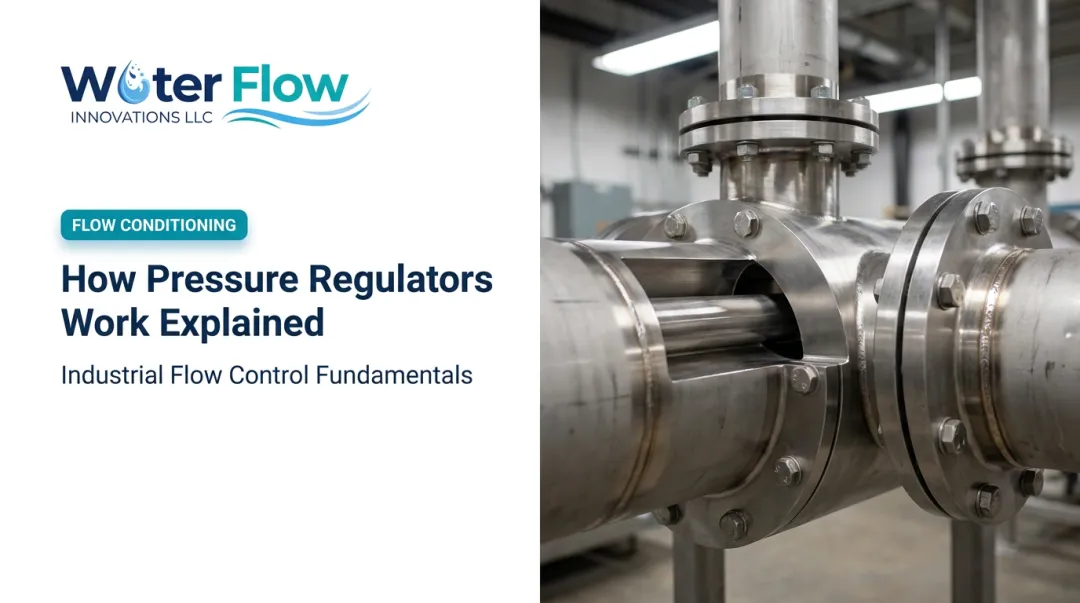
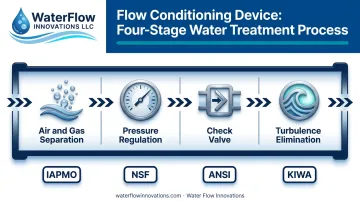
This is exactly the environment Water Flow Innovation built its Flow Conditioning Device (FCD) to address. Rather than functioning as a standard single-purpose regulator, the FCD combines four components in one unit:
- Air and gas separation: creates back-pressure that produces laminar flow, ensuring a homogeneous water column reaches the meter
- Pressure regulation — smooths surges from on-off cycling and variable demand
- Check valve — blocks reverse flow, which prevents air from re-entering the line after it's been removed
- Turbulence elimination — slows velocity just enough to prevent the vortex flow that causes over-counting
The device is certified to IAPMO, NSF, ANSI, CAN 61, KIWA, GMP, and SQF, and is designed around a negligible pressure loss design, meaning system pressure at every downstream connection stays essentially unchanged before and after installation.
Common Causes of Low or Fluctuating Water Pressure
Beyond the meter and regulator, several other culprits show up constantly in utility service records:
- Clogged or corroded pipes — mineral buildup in older galvanized plumbing restricts flow over time
- Partially closed valves — the main shutoff, an individual fixture valve, or the meter isolation valve
- Leaks — anywhere in the line, reducing pressure at the point of use
- High simultaneous demand — multiple fixtures running at once, especially during peak hours
- Municipal main work or shared supply lines — pressure dips during utility construction or repairs
- Well pump issues — for properties not on municipal supply
The City of Phoenix's water services guidance specifically lists peak-use periods, infrastructure work, mineral deposits, closed valves, and clogged regulators among the most common causes reported by utility customers.
Quick Self-Diagnosis Checklist
Before assuming equipment failure, work through the causes above with this quick diagnostic process:
- Test pressure with a gauge at an outdoor spigot or hose bib
- Determine scope — is it one fixture or the whole property?
- Check every valve — main, meter isolation, and individual fixture valves — to confirm they're fully open
- Note the pattern — does pressure fluctuate, or is it a fixed drop?
How to Diagnose and Fix Water Pressure Problems
Start simple. Test pressure at multiple points and at different times of day — pressure that's fine at 6 a.m. but weak at 6 p.m. points to demand-related causes, not equipment failure.
Turbulent flow is often the hidden culprit behind erratic pressure readings, and it's worth noting this same turbulence is what causes many commercial meters to over-register usage on the utility bill.
What facility maintenance staff can safely check:
- Adjust the regulator's setscrew clockwise to increase pressure, counterclockwise to decrease it
- Fully open any valves that appear partially closed or restricted
- Clean accessible aerator screens and strainers on fixtures
What requires a licensed plumber:
- Regulator replacement or internal rebuild
- Valve replacement on main lines
- Any work near or on the meter itself
The meter itself is typically utility property, so don't attempt to service it yourself. Instead, contact your water utility to request a pressure test or meter accuracy check — most utilities will verify static pressure at the service connection at no charge.
If pressure and demand checks out but your water bills still seem high relative to actual usage, the issue may be turbulent flow causing the meter to over-read rather than a pressure problem at all. That's a separate diagnosis worth investigating with a flow conditioning specialist.
Why This Matters More for Commercial and Industrial Facilities
For high-volume water users, pressure inconsistency shows up as a direct line item on the utility bill.
Sewer charges are frequently calculated as a percentage of metered water use. Chicago, for example, bills sewer service at 100% of the water charge for metered properties. Nashville uses a similarly structured volumetric sewer rate tied directly to the water meter reading, per Nashville Water's published rate structure. That means a meter over-reading problem doesn't just inflate your water bill — it doubles up on the sewer side too.
This compounding effect is why hotels, healthcare facilities, multifamily buildings, and manufacturing plants stand to gain the most from correcting flow issues at the source. For these facility types, Water Flow Innovation's FCD addresses the root cause directly:
- Installation in roughly 1–2 hours, with zero impact on guests, patients, tenants, or production
- Works with any pipe size from NPS ½" to 12" and any meter type
- Buy or lease options, with every unit custom made to facility specifications
- Warranty transfers for life with the property, surviving any change in ownership
- 6-month money-back guarantee, no questions asked
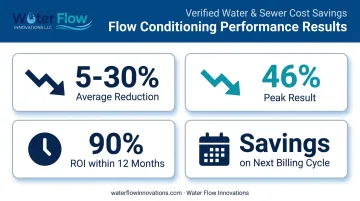
Documented results across the installed customer base show a 5–30% average reduction in combined water and sewer costs, with a 46% peak result on record. 90% of customers reach ROI within 12 months, and savings typically appear on the very next billing cycle. There's no ramp-up period and no change in actual water usage.
Frequently Asked Questions
Can a water meter reduce water pressure?
Not by design. Meters aren't built to regulate pressure. But a clogged strainer, worn internal components, or a partially closed isolation valve near the meter can restrict flow enough to feel exactly like low pressure.
Why is my water pressure randomly so low?
The most common causes are high simultaneous demand, municipal supply fluctuations, a failing regulator, or a partially closed valve somewhere in the line. Test pressure at different times of day to spot the pattern.
How long can a water meter affect water pressure?
Indefinitely, until the underlying cause (a clog, valve position, or aging meter) is fixed. If you suspect the meter itself is defective, contact your utility for a test.
Where is a pressure regulator installed relative to the water meter?
Almost always downstream of the meter and main shutoff, on the property owner's side of the plumbing. The utility owns the meter; the facility owns the regulator.
How do I know if my pressure regulator is failing?
Watch for fluctuating pressure, water hammer, unexplained leaks, and pressure that won't respond to adjustment. Any one of these on its own isn't conclusive, but two or more together usually point to the PRV.
Can fixing water pressure and meter issues lower my water bill?
Yes. Correcting turbulence and air entrainment at the meter reduces over-reading, which lowers both water and sewer charges, without any change in actual water consumption. Savings are typically documented through a straightforward before-and-after utility bill comparison.
Is a flow conditioning device a pressure regulator by another name?
No. A regulator exists to lower downstream pressure and a restrictor to cap flow, so both deliberately change what the building receives. Negligible pressure loss is a fundamental design characteristic of the conditioning device — it corrects measurement while delivering the same water at the same pressure.
What savings does correcting the meter actually deliver?
Documented installations average a 5–30% reduction in combined water and sewer charges, with a highest documented single result of 46%, appearing on the very next billing cycle.