
This isn't a billing error in the traditional sense. It's fluid dynamics.
Two elbows in series—especially when they're out-of-plane, meaning the second bend turns in a different direction than the first—create swirl and turbulence that most meters were never calibrated to handle. Facility managers rarely think about pipe geometry until the invoice forces the question.
This post breaks down what's happening inside that pipe, how it skews meter readings, and what facilities can actually do about it.
Key Takeaways
- Double elbows create 3D swirl single elbows don't — and it can last 10–40+ pipe diameters downstream
- Most meters assume symmetric, fully developed flow; disturbance breaks that and skews readings
- Guidance often calls for 5–20+ diameters of straight pipe, but real sites rarely have the room
- Flow conditioners correct the distortion without a full re-pipe
Understanding Flow Disturbance After a Double Elbow
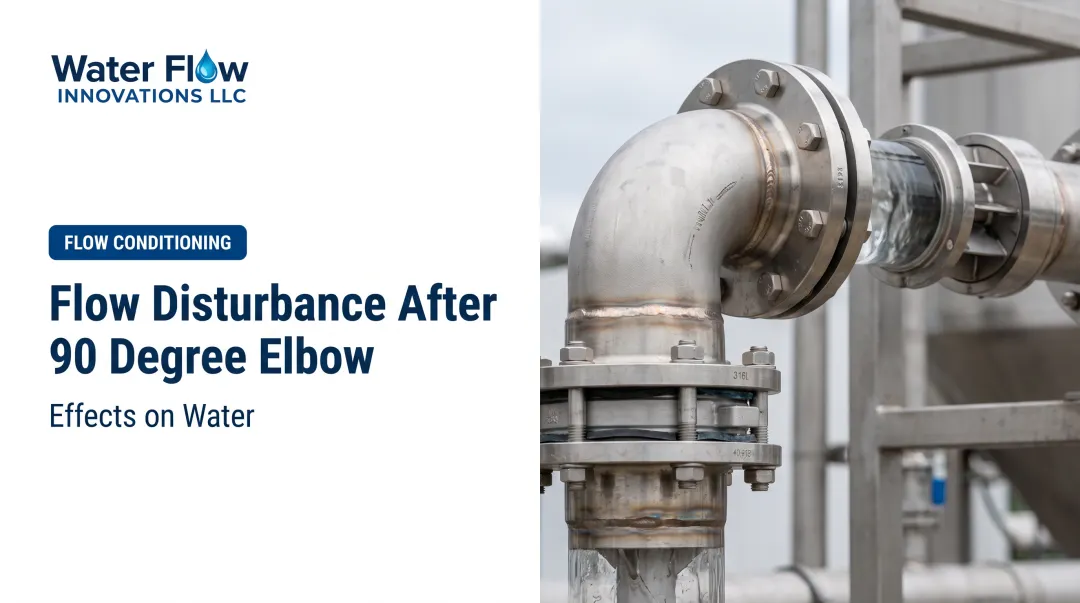
Flow disturbance is any deviation from a fully developed, axisymmetric velocity profile. That smooth, predictable pattern is what meters are designed around. A single 90-degree elbow already knocks the profile off balance, pushing velocity toward the outer wall and generating a pair of counter-rotating Dean vortices.
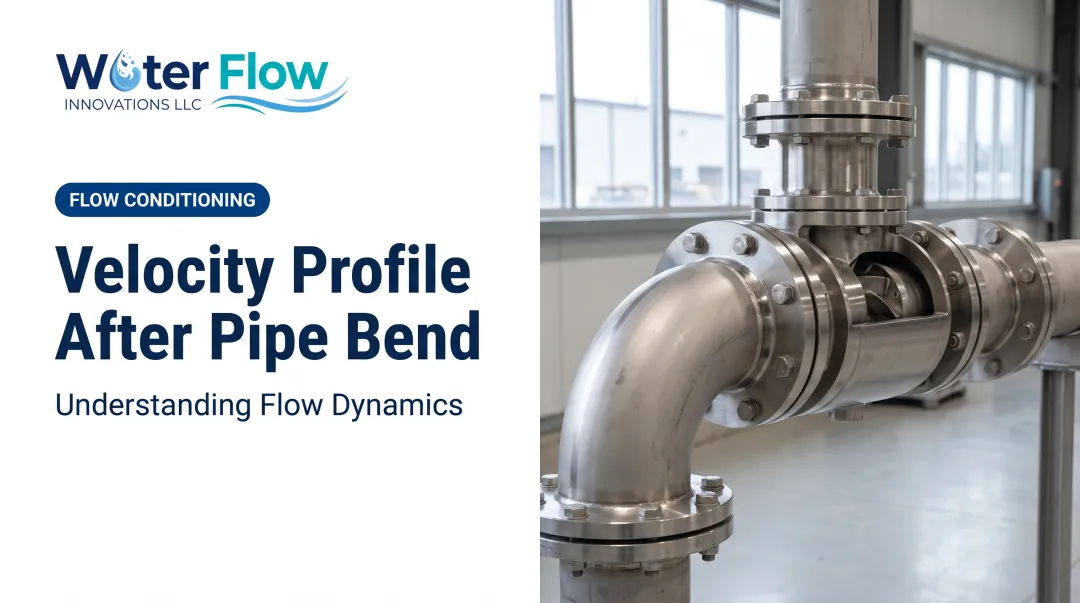
Double elbows compound the problem. When a second bend follows the first, especially out-of-plane, the two bends superimpose their swirl-inducing effects.
Research on Z-type, spatial-Z, and U-type double-bend configurations shows secondary flow structures vary sharply by geometry. Some setups produce oppositely directed vortices. Out-of-plane arrangements create inclined swirl that evolves into a tilted, four-vortex structure downstream (Han et al., 2022).
What this means in practice:
- Recirculation zones and eddies form at elbow corners and immediately downstream
- Wall shear stress peaks near elbows and inside recirculation zones
- Asymmetric, sickle-shaped velocity profiles can persist ~5 diameters after an out-of-plane double elbow and only approach symmetry near 17 diameters downstream (Weissenbrunner et al., 2016)

Unlike a single elbow, a double-elbow disturbance doesn't settle on any predictable schedule. Geometry, spacing between the bends, and flow velocity all change the outcome.
Why Orientation Changes Everything
Researchers testing close-coupled elbows found that Z-configuration and U-configuration double bends place the velocity deficit in opposite quadrants of the pipe just one diameter downstream.
Both setups produced flattened profiles with strong swirl on the perpendicular axis. The distortion does not only persist. It rotates.
How Double-Elbow Turbulence Distorts Flow Profiles
The physics here comes down to three things: velocity skewing, secondary swirl, and non-uniform distribution across the pipe's cross-section.
- Velocity skewing: High-velocity zones shift toward the outer wall of each bend, leaving a deficit near the inner wall
- Secondary swirl: Counter-rotating vortices spin water around the pipe's central axis, not just along it
- Non-uniform distribution: The combined effect means no single point in the pipe represents "average" flow anymore
In-Plane vs. Out-of-Plane: The Worst-Case Scenario
Out-of-plane double elbows are the worst configuration for meter placement. Because the second bend turns in a different plane than the first, the flow gets twisted in three dimensions rather than simply redirected. This produces persistent swirl that's harder to predict and slower to dissipate than an in-plane (same-direction) double bend.
Engineers quantify the extra resistance these bends create using minor loss coefficients (K). When elbows are butted close together, the combined K doesn't behave predictably:
- Z-configurations (elbows turning opposite directions) can exceed twice the single-elbow K value at close spacing
- U-configurations (elbows turning the same direction) can fall below twice that value
- The two configurations tend to converge only around 12 diameters of separation (Salehi, Idem & Sleiti, 2017)
No single formula captures every geometry. That is why generic "add 10 diameters and you're fine" advice often fails in the field.
How much straight pipe is actually needed? Study-specific findings put full profile redevelopment anywhere from 10 to 40+ diameters, depending on Reynolds number and how "recovered" is defined. That's a wide range, and it's rarely available in a real mechanical room.

Turbulent junctions like these also introduce or worsen air entrainment: pockets of air or micro-bubbles trapped in the water stream. Most meters cannot tell air from water, so those pockets register as extra volume and push readings further off true flow.
Effects on Metering Accuracy
Here's the core issue: mechanical, ultrasonic, and turbine meters all assume a fully developed, symmetric flow profile to calculate volume. Swirl and skewed profiles from double elbows break that assumption at the source.
When the velocity profile is off-center or spinning, the meter's internal math (built around uniform, predictable flow) no longer matches reality. Depending on meter type, orientation, and distance from the elbows, this can push readings in either direction.
What the research shows:
- A CFD ultrasonic-meter study found bias errors of roughly 1.5% to 4.5% near a double-elbow setup, plus 2–2.4% systematic uncertainty (Weissenbrunner et al., 2016)
- Large-meter testing found one model under-registering by up to 12% at zero-diameter spacing; it needed 5 diameters of straight pipe to recover normal accuracy (Albaina et al., 2023)
- Other meters in that same study stayed within a tighter ±4% band regardless of orientation
Whether the meter over-reads or under-reads depends heavily on design and installation specifics. For commercial and industrial accounts, over-reading is often the costlier outcome: billed volume goes up even though real consumption does not.
That profile distortion is the same class of upstream disturbance Water Flow Innovation targets with flow conditioning. Turbulence after fittings such as double elbows can push a meter to register more volume than passed through, so the facility pays for water it never used.
Why This Goes Undetected for Years
Usage patterns often "look normal" even when a meter is reading inaccurately. A hotel's water use naturally fluctuates with occupancy. A manufacturing plant's use shifts with production schedules.
Because the pattern looks consistent with operations, nobody suspects the meter itself. They assume the bill reflects real consumption, and every billing cycle compounds the overcharge.
Industry Standards for Straight-Run Requirements
Meter manufacturers and standards bodies publish minimum straight-pipe requirements, but they vary widely by meter type and manufacturer:
| Source | Requirement |
|---|---|
| PNNL/FEMP federal guidance | 5D upstream/5D downstream (compound meters); 10D upstream for many turbine meters |
| Neptune HP Turbine (without strainer) | 8D-10D upstream, 2D-4D downstream |
| Georgia EPD ultrasonic guidance | ~10D upstream, 5D downstream |
| Lanry WM9100 ultrasonic manual | 5D upstream after a single elbow; 10D after a valve or pump outlet |
None of these sources specifically separate single-elbow from double-elbow requirements, so facilities are often left estimating how much straight run a double elbow actually needs.
NSF/ANSI 61 and NSF/ANSI/CAN 372 certifications address drinking water safety and lead content. They do not certify meter accuracy under disturbed flow. A fully certified meter can still register incorrectly if it sits too close to fittings like double elbows.
That gap shows up most in retrofits. Mechanical rooms built decades ago rarely planned for meter accuracy. Pipes were routed for space efficiency, not fluid dynamics—which is why disturbance-related inaccuracy is so common in older commercial and industrial buildings.
Solutions: Straight Runs, Flow Conditioners, and Certified Devices
The standard fix is more straight pipe upstream of the meter. In practice, that's often impossible. Mechanical rooms are cramped, pipe runs are fixed, and tearing out infrastructure for 15–20 diameters of straight run isn't realistic for most facilities.
Flow conditioners take a different path. Instead of waiting for turbulence to die out on its own, they break up swirl and vortices mechanically and straighten the velocity profile the meter sees. Perforated-plate designs, for example, can bring flow within 5% of fully developed conditions in as little as 11 diameters—far less than natural recovery needs.
Water Flow Innovation's Flow Conditioning Device (FCD)
The FCD is built to correct over-reading from turbulence and air entrainment after fittings like double elbows. Four components do the work:
- Air & gas separation — back-pressure moves air and gas out of the measurement zone for a more homogeneous water column
- Pressure regulation — dampens surges and water hammer from cycling demand
- Check valve — limits reverse flow that can pull air back in (optional by installation)
- Turbulence elimination — slows velocity at the meter so vortex flow doesn't drive over-counting

Practical details that matter for retrofits:
- Custom-fabricated in 316L stainless steel to the facility's exact pipe size (NPS ½" to 12")
- Certified to IAPMO, NSF, ANSI, CAN 61, KIWA, GMP, and SQF
- Typical install about 1–2 hours; simpler jobs near one hour of water shutoff
- Negligible pressure loss — downstream pressure and flow rate stay the same in normal operation
Documented installations show a 5–30% average drop in water and sewer bills, with a high of 46%. About 90% of customers hit full ROI in under 12 months.
Because the FCD corrects the meter rather than the plumbing, savings usually appear on the next billing cycle.
Water Flow Innovation backs the FCD with a 6-month, no-questions-asked money-back guarantee on the device (installation costs are non-refundable). A lifetime transferable warranty stays with the property through ownership changes.
Signs Your Facility's Metering May Be Affected
A few red flags are worth checking before assuming your bill is accurate:
- Water or sewer charges have increased with no corresponding change in occupancy, production, or operations
- The meter sits close to elbows, valves, or other fittings with little straight pipe upstream
- The mechanical room is older and was retrofitted rather than designed around the meter
- Piping modifications or a meter swap happened recently: new geometry can introduce new disturbance patterns even if nothing else changed
A simple audit: Map the piping configuration upstream of your meter, noting elbow count, spacing, and orientation. Then compare several billing cycles of actual consumption against what's billed. If usage patterns look flat but bills keep climbing, the meter, not your operations, deserves a closer look.
Frequently Asked Questions
How much straight pipe is needed after a double elbow before a water meter?
Requirements vary by meter type and standard, but double elbows typically need more straight run than a single elbow: often 10–20+ pipe diameters. Flow conditioners can shorten that run.
Can a double elbow really cause a water meter to over-read?
Yes. Swirl and turbulence from double elbows disrupt the flow profile that meters rely on to calculate volume accurately. Documented testing shows measurable reading errors as a result, including cases of over-registration.
Is flow disturbance from elbows a temporary or permanent issue?
It's permanent as long as the piping configuration stays unchanged. The disturbance (and any resulting inaccuracy) repeats on every billing cycle until something corrects it.
What's the difference between a single elbow and a double elbow in terms of flow disturbance?
Double elbows, especially out-of-plane configurations, create compounded three-dimensional swirl. This is more severe and takes longer to dissipate than the disturbance from a single elbow.
How can I tell if my facility's meter is affected by upstream turbulence?
Review your piping layout for elbows, valves, and fittings close to the meter, then audit several billing cycles against expected use from operations or production data.
Do flow conditioning devices affect water pressure or system performance?
Certified devices like the FCD are engineered for negligible pressure loss. They correct meter accuracy without disrupting downstream pressure, flow rate, or normal facility operations.
Why does compounded swirl cost twice on the bill?
Because sewer is normally derived from metered intake rather than measured discharge, commonly at 80–120% of the water charge. Volume the meter registers in error therefore appears on both lines, every cycle, until the swirl is corrected.
What protection applies if correcting it changes nothing?
A 6-month money-back guarantee covers the device purchase price, with installation cost non-refundable, so it can be returned if metered consumption does not measurably fall. A lifetime transferable warranty against manufacturing defects also applies.