
Most people assume a high bill means they used more water. Often, the real culprit is a hidden leak, an inefficient fixture, or even a meter that's misreading how much water actually passed through it.
This guide covers seven practical tips — starting with free daily habits and ending with a professional-grade fix for larger properties. Some you can do today. Others take a bit more investment but pay for themselves fast.
Key Takeaways
- Daily habit changes like leak checks and shorter showers lower bills without spending anything
- WaterSense-certified fixtures deliver long-term savings without any lifestyle change
- Outdoor irrigation is often where the biggest warm-weather water savings hide
- On larger properties, meter over-registration can inflate bills without any real increase in use
Why Your Water Bill Is Higher Than It Should Be
A high water bill rarely traces back to one cause. It usually comes from a mix of:
- Fixture inefficiency: old showerheads, faucets, and toilets that use more water than necessary
- Water-wasting habits: long showers, running taps, half-loaded appliances
- Undetected leaks: running toilets or dripping pipes that waste water around the clock
- Rate increases: utilities raising rates to cover aging infrastructure and treatment costs
Some of these show up in day-to-day operations. Others stay hidden until a spike appears on a bill or a leak becomes obvious.
One factor catches many property operators off guard: on properties with a single meter, sewer charges are typically calculated as a percentage of metered water intake, not measured separately.
That means whatever inflates your water reading, a leak, an inefficient fixture, or meter over-reading, also inflates your sewer charge by roughly the same amount. Fix the root cause, and both charges drop together.
7 Easy Tips to Lower Your Water Bills
These tips are ordered from the simplest, no-cost fixes to more advanced solutions built for bigger properties. Start at the top if you're not sure where to begin.
Tip 1: Find and Fix Hidden Leaks Fast
A single running toilet or dripping faucet can waste an enormous amount of water without anyone noticing. The average household leak wastes more than 9,300 gallons per year, and roughly 9% of homes have leaks severe enough to waste at least 50 gallons daily, according to the EPA's Fix a Leak Week data.
To put that in perspective:
- A faucet dripping once per second wastes over 3,000 gallons/year
- A showerhead leaking 10 drips per minute wastes over 500 gallons/year
- A tiny irrigation leak (1/32 inch) can waste 6,300 gallons/month
How to check for leaks yourself:
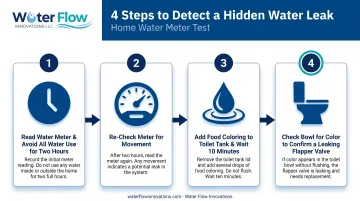
- Read your water meter, then avoid using any water for two hours
- Read the meter again. If the number moved, you have a leak
- Add food coloring to your toilet tank and wait 10 minutes without flushing
- If color appears in the bowl, your flapper valve is leaking
Most leak repairs cost little to nothing and often show up as savings on your very next bill. This is usually the highest-ROI fix on this entire list.
Tip 2: Install WaterSense-Certified Fixtures and Appliances
Low-flow fixtures sound like a compromise. In practice, they're engineered to perform just as well while using a fraction of the water.
| Fixture | Standard Flow | WaterSense Flow | Annual Savings |
|---|---|---|---|
| Showerhead | 2.5 gpm | ≤2.0 gpm | 2,700 gallons |
| Bathroom faucet | 2.2 gpm | ≤1.5 gpm | 700 gallons |
| Toilet | Up to 6 gal/flush | ≤1.28 gal/flush | Nearly 13,000 gallons |
Replacing an old, inefficient toilet with a WaterSense-labeled model can save close to 13,000 gallons and more than $170 a year, according to EPA data on residential toilets.
Worth checking before you buy:
- Many local utilities offer rebates or free fixture giveaways for WaterSense products. Check your utility's website first
- ENERGY STAR-certified washing machines use about 20% less water than standard models
Tip 3: Shorten Showers and Turn Off Running Taps
Showers account for a large share of indoor water use, and most people shower longer than they think. Consumer Reports, citing EPA data, found the average U.S. shower lasts about 8 minutes. At a standard 2.5 gpm flow rate, that single habit can add up fast.
Simple changes that add up:
- Shave two minutes off your average shower: up to 5 gallons saved per shower with a standard head
- Turn off the tap while brushing your teeth, shaving, or scrubbing dishes
- Pair a shower timer with a low-flow WaterSense showerhead for compounding savings
None of this requires spending money. It just requires breaking a habit most of us never think about.
Tip 4: Only Run Full Loads in Washers and Dishwashers
Here's something counterintuitive: most dishwashers use roughly the same amount of water whether they're half-full or packed. ENERGY STAR confirms that water and energy use stay largely constant regardless of load size — so running partial loads simply wastes unused capacity.
- Wait until the dishwasher is full before running it
- If you can't wait, use the correct load-size setting on your washing machine
- Skip pre-rinsing dishes. ENERGY STAR notes it increases water and energy use; scrape food off instead
A full dishwasher load also beats hand-washing by a wide margin. A new ENERGY STAR model saves about 8,400 gallons a year compared to washing the same dishes by hand.
Tip 5: Audit and Upgrade Outdoor and Irrigation Water Use
Outdoor watering can spike your usage dramatically once summer hits. The EPA estimates outdoor use makes up anywhere from 30% to 70% of total household water use, depending on region and climate. For HOAs, golf courses, and large residential estates, this is often where the biggest savings are hiding.
- Install a smart irrigation controller — WaterSense-labeled models can save an average home up to 15,000 gallons per year
- Switch to drip or microirrigation — it uses 20% to 50% less water than conventional sprinklers by delivering water directly to root zones
- Water early morning or evening to cut evaporation loss
- Consider drought-tolerant landscaping or a rain barrel for non-potable outdoor use
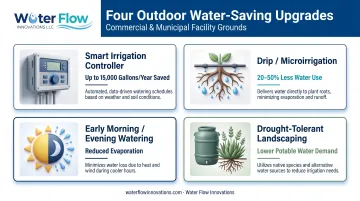
Roughly half of all residential outdoor water is wasted through overwatering and inefficient systems. Auditing your irrigation setup once a season can catch most of it.
Tip 6: Monitor Your Water Meter and Bill for Anomalies
Comparing your current bill against your usage history is one of the easiest ways to catch a problem early — before it becomes an expensive one.
- Many municipalities, including Tempe, Santa Barbara, and San Diego, offer free online usage dashboards with hourly or daily tracking
- Some utilities send automatic alerts when consumption spikes above your normal pattern
- A sudden jump with no change in your habits or the weather almost always points to a leak or billing error
Set a reminder to check your usage graph monthly. It takes two minutes and can save you from months of overpaying before anyone notices.
Tip 7: Correct Water Meter Over-Reading With Certified Flow Conditioning
Here's a cause of high water bills that many facility managers never hear about: meters can over-register usage even when nothing is wrong with your plumbing or habits.
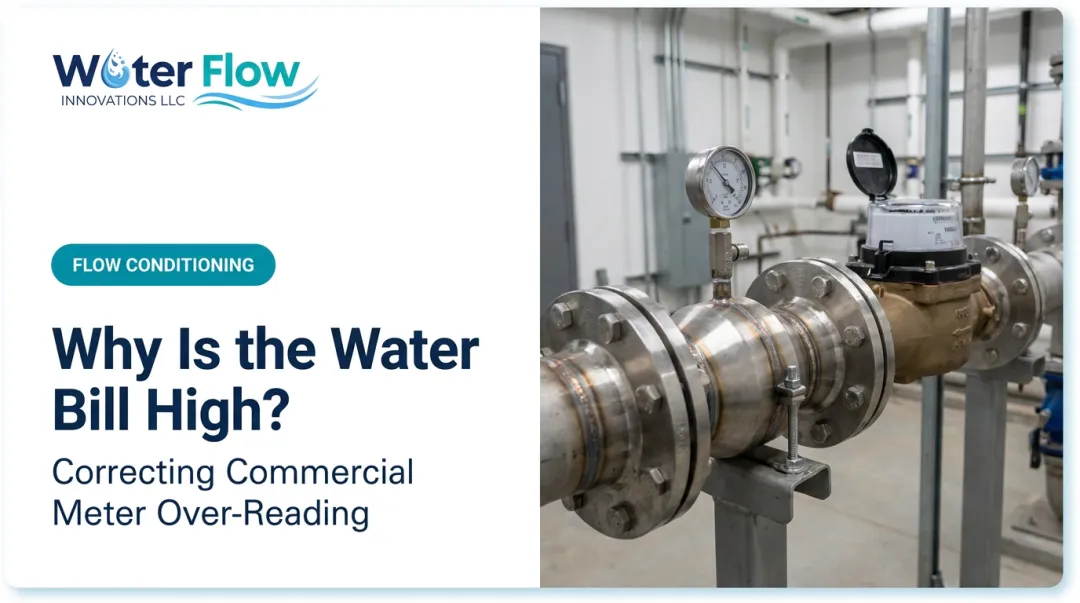
Commercial and industrial water meters measure total volume passing through them, and they can't tell the difference between water and air. Entrained air, micro-bubbles from pressure changes, and turbulent vortex flow from on-off cycling all get counted as billable water.
That's not a malfunction. It's how these meters are built. The result: you're billed for water that never reached your building, then billed again on your sewer charge, which is usually calculated from the same metered figure.
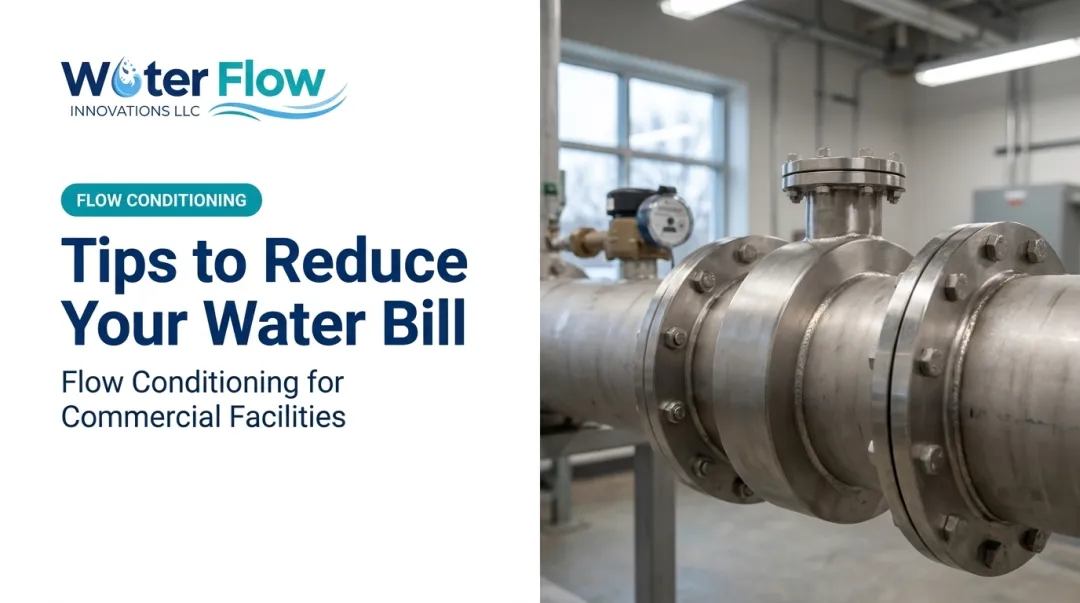
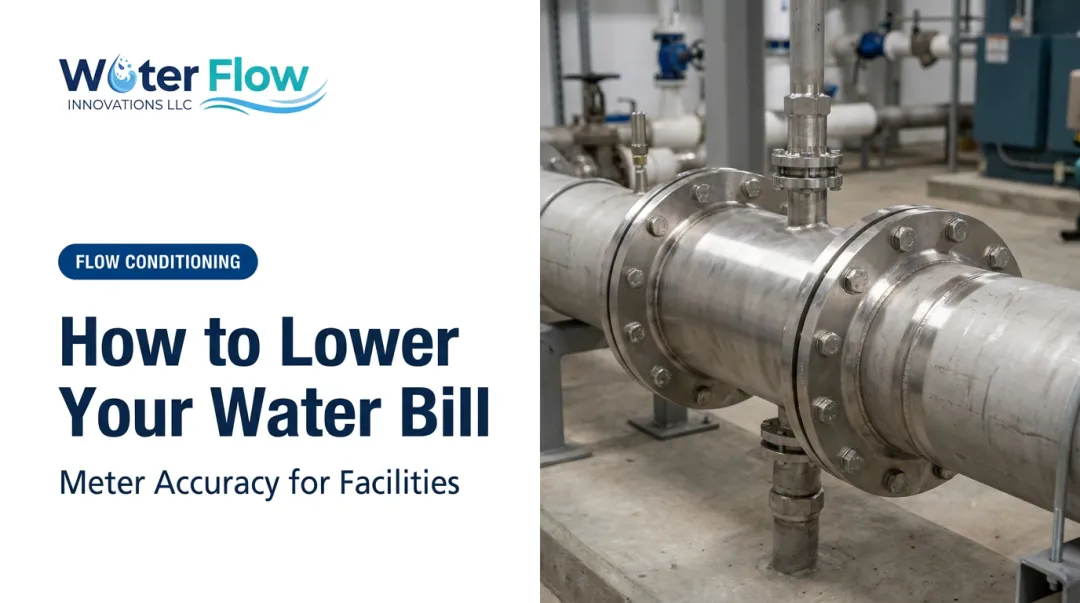
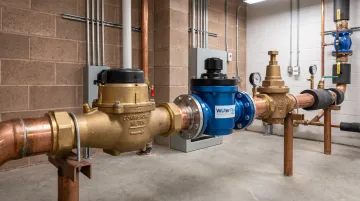
Water Flow Innovation's Flow Conditioning Device (FCD) addresses this directly. Installed immediately after the water meter, it uses a four-part system: air and gas separation, pressure regulation, a check valve, and turbulence elimination. That creates smooth, laminar, bubble-free flow through the measurement zone so the meter registers only the water that actually passed through.
Customers see an average water and sewer bill reduction of 5–30%, with the highest documented single result at 46%. Savings show up on the first billing cycle, with no change to water use or facility operations. 90% of customers reach full ROI in under 12 months.
This fix matters most for larger water users, where small percentage corrections translate into real dollars:
- Hotels and hospitality properties
- Multifamily and high-rise apartment buildings
- Commercial and industrial facilities
- Municipal and government buildings
The FCD is IAPMO, NSF, ANSI, CAN 61, KIWA, GMP, and SQF-certified, so facility managers can trust its safety and reliability before install. Installation typically takes about an hour with no disruption to daily operations.
Conclusion
Lowering your water bill is rarely about one single fix. It's a combination of daily habits, periodic upgrades, and catching hidden issues like leaks or meter inaccuracies before they cost you months of overpayment.
If you're managing multifamily, commercial, or industrial properties, behavior changes alone won't capture the full opportunity. A professional water audit or a certified flow conditioning solution can uncover savings that habit changes simply can't reach.
Frequently Asked Questions
How can I tell if I have a hidden water leak?
Read your water meter, avoid using any water for two hours, then check it again. Any movement signals a leak. Also watch for unexplained bill spikes or damp spots near pipes and fixtures.
What is considered a normal water bill for a household?
There's no single "normal" number. It depends on property size, occupancy, region, and season. A better benchmark is comparing your current bill to your own rolling 12-month average.
Do low-flow fixtures actually reduce water pressure?
Modern WaterSense-certified fixtures are engineered to maintain strong performance while using significantly less water. They're independently tested against EPA efficiency and performance standards before earning the label.
How much can simple water-saving habits realistically save on a bill?
Shorter showers, full loads, and quick leak repairs often cut usage enough to show on the next bill. Meter over-reading is different: it inflates charges without raising real consumption, so it needs a structural fix rather than habit changes alone.
Can commercial or multifamily properties reduce water bills without disrupting operations?
Yes. A certified flow conditioning device (FCD) corrects meter over-reading at the master meter with no change to downstream pressure or tenant experience, and pairs well with efficiency upgrades like WaterSense fixtures.
Does fixing a single leaky toilet really make a noticeable difference?
Yes. A running toilet can waste hundreds of gallons a day, and fixing it often shows up as savings on the very next bill.
Why does an inflated reading cost twice over?
Because utilities rarely meter discharge. Sewer is derived from metered intake, usually 80–120% of the water charge, so a phantom gallon generates a water charge and a sewer charge together despite never having entered a drain.
Which heavy-process sites share this pattern?
Oil and petroleum refineries, chemical manufacturing, paint and coating formulation plants, rubber and plastics, metal finishing, and mining and mineral processing — operations where cooling and wash-down demand cycles hard against a single meter.