For greenhouses, nurseries, and agricultural irrigation operations, this matters more than most facility managers realize. Fertigation dosing depends on knowing exactly how much water is flowing through the line. Utility billing depends on that same number. When it's wrong, everything downstream, nutrient ratios, cost forecasts, compliance reports, is wrong too.
Confusion often creeps in here. Flow conditioning gets mixed up with chemical water treatment or softening. They're not the same thing. One adjusts water chemistry. The other corrects a hydraulic measurement problem. Mixing them up leads to spending money on the wrong fix.
This guide covers what flow conditioning actually is, why it matters in horticulture specifically, how the mechanical process works, where it gets installed, and when it might not be worth pursuing at all.
Key Takeaways
- Flow conditioning stabilizes turbulence and trapped air at meters and injectors for accurate readings and consistent delivery
- Inaccurate readings can distort fertigation ratios, inflate water and sewer bills, and skew irrigation scheduling
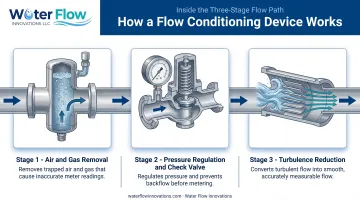
- Air removal, pressure regulation, and turbulence straightening combine in an in-line mechanical setup
- Install at meter entry points, before fertigation injectors, and on pump-heavy irrigation systems
- Mechanical correction—not chemical treatment—keeps compliance and operations straightforward for facility managers
What Is Water Flow Conditioning?
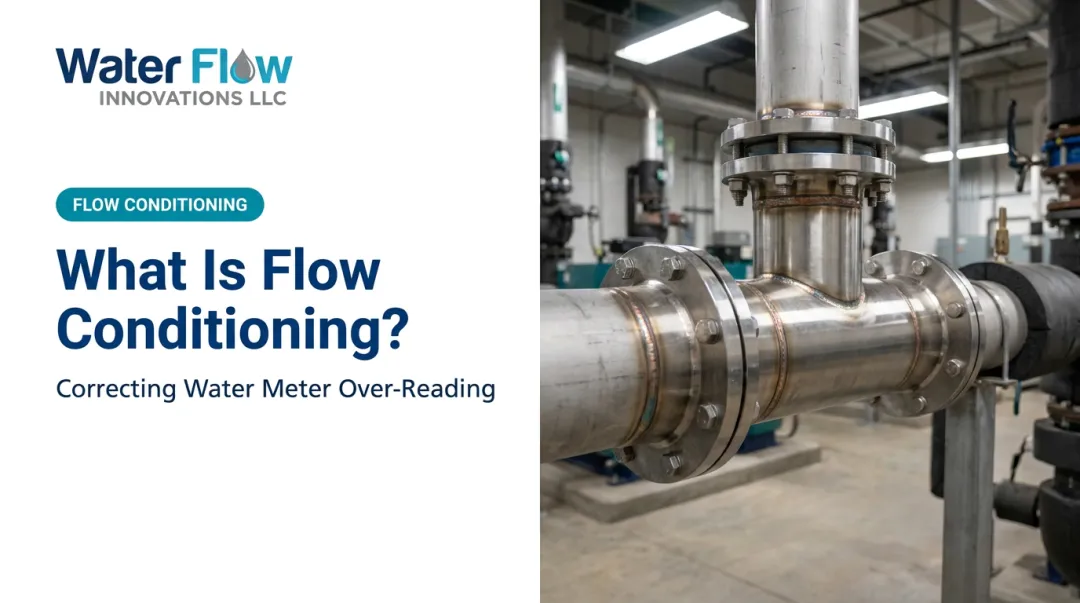
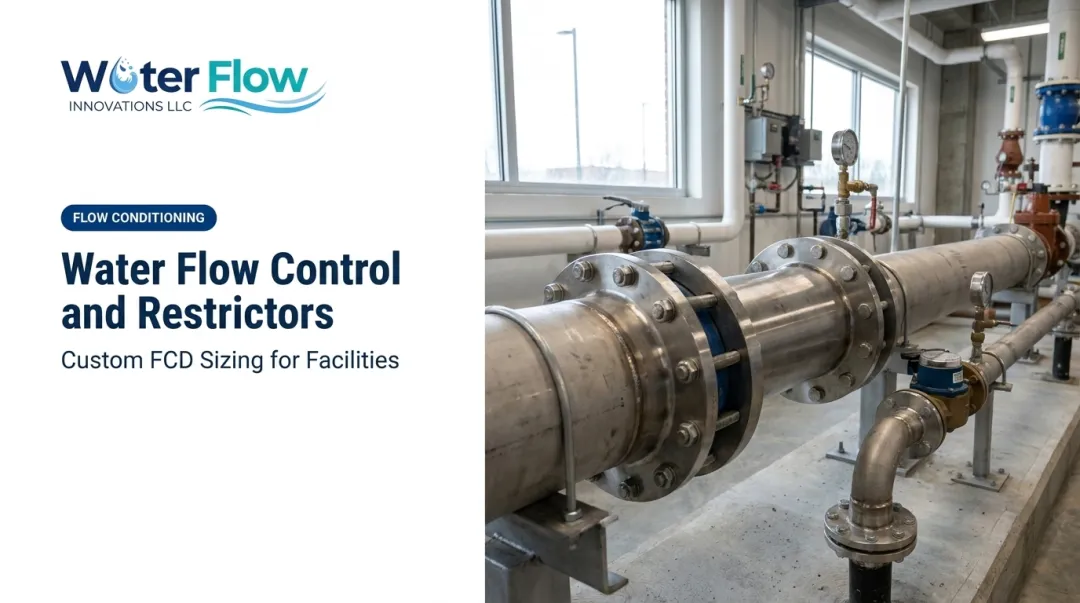
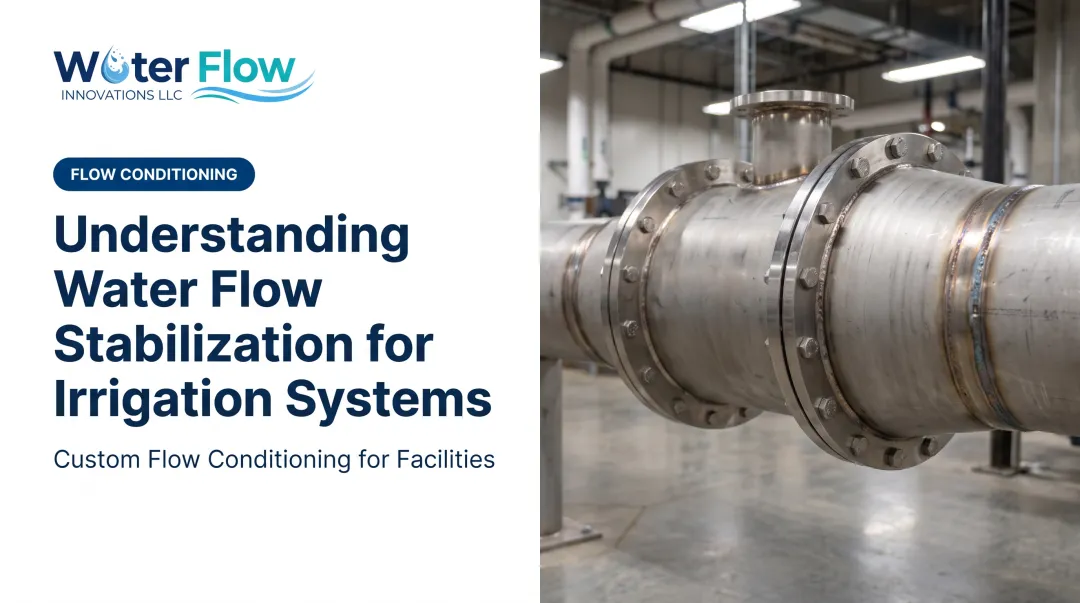
Water flow conditioning happens inline. Mechanical components such as straightening vanes, air/gas separators, and pressure regulators normalize a turbulent or aerated flow profile at the meter or piece of equipment.
The intended outcome is a stable, laminar-like flow profile. Meters read it accurately. Irrigation equipment uses it predictably. Nothing about the water's chemistry changes, and the actual volume delivered to the crop stays exactly the same. Only the flow's physical behavior gets corrected.
How It Differs From Water Conditioning and Water Softening
The name overlap causes real confusion in the field. Water conditioners and softeners are chemical or physical treatment systems. They:
- Remove hardness minerals like calcium and magnesium through ion exchange
- Strip chlorine or adjust pH
- Alter the water's chemical composition through treatment
Flow conditioning does none of that. It never touches water chemistry. Instead, it corrects how water behaves physically as it moves through a pipe. It eliminates turbulence, entrained air, and pressure spikes that would otherwise distort a meter reading or throw off a fertigation injector's dosing calculation.
Many horticultural operations run both systems side by side, and that's not redundant. They solve different problems.
Think of a nursery running well water high in dissolved minerals. Without a softener, scale collects inside injector nozzles and emitter lines, throttling flow over time. Without a flow conditioner, entrained air and turbulence common in well-pump systems cause the meter to register more volume than actually passed through, inflating both the water bill and the sewer charge calculated from it.
Why Water Flow Conditioning Is Critical for Accurate Horticulture Management
Greenhouses, nurseries, and large irrigation networks run on precise flow data. Fertigation injectors calculate nutrient concentrations against a specific water volume passing through the line every minute. When that reading is off, even by a small margin, the error doesn't stay small. It compounds across every zone, every cycle, every acre under cultivation.
The numbers underline the stakes. USDA's most recent Census of Agriculture counted nearly 55 million acres of irrigated cropland and pastureland across the U.S., with irrigated farms generating over half of total crop-sales value despite covering less than a fifth of harvested acreage.
Pumps, elbows, valves, and pressure changes throughout agricultural irrigation systems introduce turbulence and entrained air into the water stream. Mechanical meters can misread that air as additional water.
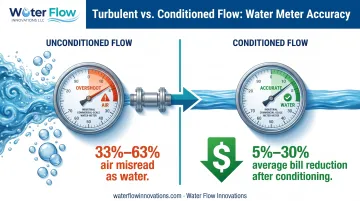
Laboratory testing on intermittent-supply systems found meters registered 33% to 63% of displaced air as though it were water. Results vary by system type and operating conditions, but air entrainment consistently skews the reading.
For agricultural operations, this shows up as a water bill that climbs with no matching increase in acreage or production output. Certified flow conditioning providers have documented average bill reductions of 5% to 30% once turbulence-driven over-reading gets corrected, with savings that appear without any change to actual water usage.
That gap hits fertigation-heavy greenhouses, nurseries, and larger agricultural estates on tight margins as a real, avoidable cost on every billing cycle.
Inaccurate flow data typically drives:
- Inflated water and sewer charges with no usage increase
- Nutrient dosing errors when injectors trust a bad volume signal
- Weaker audit trails for water-rights, ESG, and LEED reporting
There's a compliance angle too. LEED v5's Advanced Water Metering credit requires weekly meter recording and manufacturer-interval calibration, and ESG frameworks increasingly expect disclosed methodology behind every consumption figure. Corrected flow data supports that documentation instead of undermining it.
None of this is regulatory-mandated. Flow conditioning is adopted mainly as an operational and financial best practice, taken on proactively rather than because a regulation demands it. Adoption is accelerating fastest in water-scarce agricultural regions, where every unit of metered water carries growing cost and scrutiny.
Key Factors That Affect Flow Conditioning Performance in Horticulture Settings
Performance varies by facility. The details that matter most:
- Water source and inputs: pump type, well versus municipal supply, and dissolved gas content all affect how much turbulence reaches the meter
- Operating conditions: variable pressure from irrigation cycling and seasonal pump usage changes across the growing calendar
- Equipment dependencies: meter type, pipe diameter, and upstream fittings like elbows or valves
- Scale and throughput: large-acreage fertigation systems behave differently than a small greenhouse loop
- Regulatory and documentation needs: water-rights reporting and the records required for ESG or LEED certification
How Water Flow Conditioning Works (Conceptual Flow)
Picture raw water entering a facility from a well pump or municipal line. It's carrying turbulence from bends and valves, entrained air from pump cycling, and pressure fluctuations from irrigation zones switching on and off. None of that is unusual—it's normal for water moving through any active irrigation system.
The conditioning process intercepts that water at the meter or fertigation injector. A sequence of mechanical components acts on the flow stream:
- Air/gas separator
- Pressure regulator
- Check valve
- Turbulence-reduction chamber
Each works passively—no electronics, no controls to program, no moving parts to fail. Performance depends entirely on sizing the device to the pipe diameter and expected flow rate.
The result: water reaching the meter or injector arrives stable and representative of the volume actually delivered. Meter over-reading drops out of the equation, so fertigation dosing runs on accurate flow data instead of an inflated number.
Step 1: Air and Gas Removal
Entrained air and gas bubbles are common in horticultural water systems. They come from well pumps, cavitation at valve throats, and elevation changes across sloped or terraced growing sites. A meter reads volume, not composition, so air passing through often gets misread as additional water. Removing that air is the first correction point.
Step 2: Pressure Regulation and Check Valve Function
Pump cycling and valve operation create pressure surges that ripple through the line. The conditioning device dampens those surges at the meter. A check valve function also prevents backflow, which can skew a reading in the opposite direction and throw off a fertigation injector's dosing accuracy.
Step 3: Turbulence Elimination
The final stage straightens flow into a more uniform velocity profile, correcting over-registration at the source. Water Flow Innovation's FCD, for example, combines these stages in a proprietary design engineered for negligible pressure loss. Irrigation performance, emitter output, and zone pressure remain unchanged after installation.
Where It's Typically Installed in Horticultural Operations
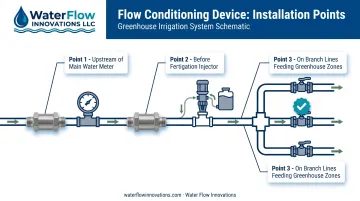
In horticultural operations, flow conditioning devices are typically installed at a few points:
- Immediately immediately after the main water meter, where municipal or well supply enters the facility
- Before a fertigation injector or dosing pump, where accurate flow directly affects nutrient calculation
- On branch lines feeding individual greenhouse zones, in facilities with separate metering per zone
Most installations sit at the main meter. One correctly sized device there stabilizes flow feeding every downstream zone, drip line, and mist cycle, so a greenhouse running 30 irrigation zones typically needs one installation, not thirty.
A few patterns tend to trigger the decision:
- Water bills climbing with no matching increase in acreage or production
- A new pump installation that changes flow characteristics
- A meter upgrade that doesn't resolve suspected over-reading
- A water-use audit that confirms high consumption but can't locate a source
That last pattern often means the "missing" water was never real water, just air and turbulence the meter counted as volume.
Installation itself is a one-time inline job, not a recurring treatment or consumable. Most facilities complete it in about an hour, with minimal disruption to ongoing irrigation cycles.
Common Misconceptions and When Flow Conditioning May Not Be Necessary
Common Misconceptions
Three myths come up often:
- "It changes the water." It doesn't. Flow conditioning corrects measurement accuracy and flow stability, not water chemistry or how much water reaches the crop.
- "The meter must be defective." Many facilities replace a meter when the real issue is upstream turbulence. A new meter in the same conditions will misread just as badly.
- "A long straight pipe run fixes it." Manufacturers recommend straight upstream runs, but requirements vary by meter and disturbance type. Most retrofit facilities lack the pipe length needed, so a dedicated conditioning device is usually the practical fix.
When Flow Conditioning May Not Be the Right Fit
It's not universally necessary. Question it in these situations:
- Minimal turbulence sources: very short pipe runs, no pumps, or gravity-fed low-flow systems where there's little to correct and ROI is limited
- Water quality is the actual problem: hardness, chlorine, or pathogens call for a water conditioner or filtration system, not a flow correction device
- No audit has confirmed the problem: buying a device before a flow or utility audit means guessing whether turbulence-driven over-reading is happening on your system
Any horticultural operation considering this investment should confirm the underlying issue first, not assume the fix based on someone else's results.
Conclusion
Water flow conditioning is a mechanical, hydraulic correction—not a chemical treatment and not a method to cut actual water use. It stabilizes turbulent, aerated flow so horticultural operations get meter readings and fertigation dosing data that reflect what's really moving through the pipe.
For greenhouses, nurseries, and irrigation-heavy agricultural operations, that accuracy drives nutrient dosing precision, utility cost control, and the documentation needed for ESG reporting or LEED certification.
Start by auditing the specific pump, pipe, and meter setup—then decide whether turbulence-driven over-reading is inflating the numbers. Water Flow Innovation offers a free water bill review for exactly that reason, confirming the problem before recommending a fix sized to the facility's actual pipe and meter configuration.
Frequently Asked Questions
What is an autofill water conditioner system?
An autofill water conditioner automatically adjusts water chemistry—such as softening—in tanks or reservoirs that refill on their own. That is different from flow conditioning, which corrects flow measurement rather than water chemistry.
What is the artificial application of water to crops?
Irrigation is the deliberate supply of water to crops through systems such as drip, sprinkler, or flood. Flow conditioning helps those systems measure and deliver water more precisely.
Does water flow conditioning change how much water my plants actually receive?
No. It corrects flow measurement and stability, not delivered volume. Irrigation output stays the same; only the readings and bills change to reflect the true amount used.
How is a flow conditioner different from a water softener or filter?
Flow conditioners address physical flow behavior: turbulence, air, and pressure. Softeners and filters change water chemistry by removing minerals, chlorine, or particulates. Some operations use both.
How quickly can facilities see results after installing a flow conditioning device?
Corrected readings typically appear on the very next billing cycle. The correction is immediate and mechanical, not dependent on operational changes.
Can water flow conditioning improve fertigation dosing accuracy?
Yes. Stabilized flow at the injector point ensures nutrient concentrations are calculated against true water volume, reducing the risk of over- or under-dosing.
Where does fertigation-driven cycling hit hardest?
Hydroponic and cannabis grows, greenhouse and nursery operations, agriculture and irrigation businesses, and golf courses — anywhere fertigation cycles and zone switching drive constant demand change against one meter.
What does the correction typically deliver on a grower's bill?
Documented installations average a 5–30% reduction in combined water and sewer charges, with a highest documented single result of 46%, with no change to irrigation schedules or crop water delivery.