Water flow conditioning is the set of techniques breweries use to stabilize, straighten, and normalize that flow for brewing equipment and water meters. Because brewing is one of the most water-intensive processes in food and beverage manufacturing, getting this right isn't a minor plumbing detail. It's tied directly to your utility bill and your batch consistency.
This article breaks down the core flow conditioning techniques, why they matter specifically for breweries, and how to choose the right approach for your facility.
Key Takeaways
- Turbulent or aerated flow distorts meter readings and strains sensitive brewhouse equipment.
- Four techniques solve distinct problems: turbulence reduction, air removal, pressure regulation, and backflow prevention.
- Most breweries need a combination of fixes based on plumbing layout—not a single solution.
- Water and sewer charges often move together, so flow problems can hit twice on one bill.
- Integrated devices can correct all four problems in one install without pausing production.
What Is Water Flow Conditioning?
Water flow conditioning refers to engineering techniques applied directly to a pipeline to normalize flow velocity, remove entrained air or gas, and stabilize pressure at a point of use or measurement.
It's a physical, mechanical intervention—not a chemical treatment like softening or reverse osmosis. You install it once, and it works continuously without ongoing chemical dosing.
In a brewery, flow conditioning typically happens at one of three points:
- On the incoming municipal water supply line, right after the meter
- Ahead of the brewhouse, before mash tuns and heat exchangers
- Before CIP (clean-in-place) systems that cycle rapidly between high-flow and shutoff states
Where It Fits in the Plumbing Sequence
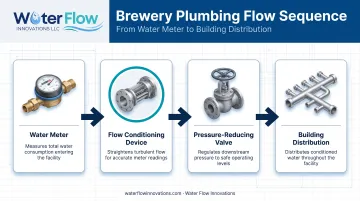
Placement matters. A device installed after the meter but before internal distribution intercepts every downstream demand event. That includes a plate chiller pulling cold water for wort cooling or a CIP burst cycle on fermenters.
The standard sequence looks like this: water meter, flow conditioning device, pressure-reducing valve, then building distribution. This order maximizes correction at the measurement point without touching a single piece of brewing equipment. No mash tun setting changes. No CIP recipe adjustments. Just cleaner flow at the source.
Why Is Flow Conditioning Important in Brewing?
Water-use intensity in brewing varies dramatically by scale. According to the Brewers Association's 2017 Sustainability Benchmarking Report, median water-use ratios ranged from 17.97 barrels of water per barrel of packaged beer at breweries under 1,000 barrels a year down to 4.89 barrels per barrel at facilities producing over 100,000 barrels annually.
That's a wide range, but the takeaway is consistent: smaller breweries often use far more water per unit of product, making every gallon on the meter count.
Turbulence and Metering Accuracy
Installation conditions affect flowmeter performance. Industry standards such as ASME MFC-10M define how flow disturbances, elbows, valves, and swirl patterns can distort meter readings relative to true flow.
Breweries with wort chillers and CIP systems cycling on and off create exactly the kind of turbulent, variable-demand conditions these standards address.
Beyond metering, unconditioned flow affects process consistency too:
- Pressure surges during CIP startup can alter rinse effectiveness
- Air entrainment during wort cooling can make chilling cycles inconsistent
- Fluctuating supply pressure can stress heat exchangers over time
The Double-Hit on Utility Bills
Here's the part that catches brewers off guard: sewer charges are frequently calculated based on metered water intake, not actual discharge. If your meter reads high, your sewer bill often rises right alongside it. A single flow disturbance can inflate two separate line items on the same invoice.
Flow conditioning matters because it stabilizes flow at the meter and process equipment—cutting over-reads, protecting rinse and chill cycles, and trimming both halves of that utility bill.
Types of Water Flow Conditioning Techniques
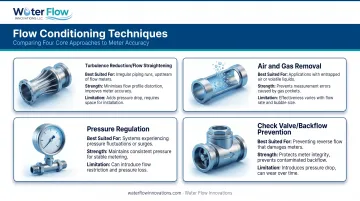
Flow conditioning is a category of distinct techniques, each solving a different disturbance: turbulence, entrained air, pressure instability, or reverse flow. Most breweries end up needing more than one, depending on their piping layout, water source, and where problems originate.
Turbulence Reduction / Flow Straightening
This technique uses internal geometry, such as vanes or perforated structures, to convert chaotic, swirling flow into smooth, linear movement. It acts purely on flow pattern, not air content or pressure.
- Best suited for: Short pipe runs after elbows, valves, or pumps where turbulence is unavoidable before a meter
- Strength: Improves metering accuracy and sensor reliability
- Limitation: Doesn't address dissolved air or pressure swings on its own
Air and Gas Removal (De-aeration)
De-aeration mechanically separates entrained air or gas bubbles from the water stream. Where it differs from turbulence reduction is the target: composition, not geometry.
- Best suited for: Municipal supply lines prone to air pockets, or lines downstream of booster pumps
- Strength: Prevents air-inflated meter readings and reduces pipe noise and vibration
- Limitation: Air-release valve systems often need periodic maintenance; other de-aeration methods may not
Pressure Regulation
Pressure-reducing or pressure-sustaining valves maintain consistent downstream pressure regardless of what's happening upstream. This technique controls energy in the system rather than flow shape or air content.
- Best suited for: Breweries on variable municipal pressure, or facilities where the brewhouse, CIP, and cooling systems all draw simultaneously
- Strength: Protects sensitive equipment like heat exchangers and instrumentation
- Limitation: Can add pressure drop if improperly sized or poorly maintained
Check Valve and Backflow Prevention Systems
These are one-way valve assemblies that stop reverse flow, which can cause contamination risks, equipment damage, or irregular meter behavior. They protect against directional reversal, not forward flow quality.
- Best suited for: Breweries required to meet cross-connection control codes, such as those in the 2024 Uniform Plumbing Code
- Strength: Supports regulatory compliance and contamination prevention
- Limitation: Doesn't resolve turbulence, air, or pressure problems on its own
How to Choose and Verify the Right Flow Conditioning Technique
The right approach depends on what's actually going wrong. An inflated water bill usually means turbulence or air problems. Premature equipment wear suggests pressure instability. Start with the symptom, then work backward to the cause.
Consider these factors before selecting a technique:
- Available straight-run length - Your existing pipe layout may limit installation options for certain straightening devices.
- Water source characteristics - Municipal supply with known pressure swings behaves differently than a well system.
- Primary goal - Metering accuracy, equipment protection, and process consistency each call for different priorities.
- Downtime tolerance - Most breweries can't pause production for an extended retrofit.
- Long-term maintenance and warranty coverage - Some solutions require ongoing servicing; others don't.
For breweries that would rather solve this once instead of stacking multiple point fixes, some certified devices combine turbulence elimination, air and gas removal, pressure regulation, and check valve protection into a single unit.
Water Flow Innovation offers a Flow Conditioning Device built this way. Each unit is custom-fabricated to the facility's pipe size and meter specifications and carries IAPMO, NSF, ANSI, CAN 61, KIWA, GMP, and SQF certifications. Installation typically takes about an hour, with no changes to wort chilling performance, CIP effectiveness, or water chemistry.
Common Mistakes to Avoid
- Assuming a single fix solves everything. A standalone check valve stops reverse flow and water hammer, but it does nothing for entrained air or vortex turbulence—the issues most tied to inflated meter readings.
- Ignoring the sewer cost connection. Diagnosing a "high water bill" without checking whether sewer charges rose in lockstep misses half the financial picture.
- Choosing on price alone. The cheapest option upfront isn't always the one with verified savings, proper certifications, or minimal installation disruption.
Conclusion
Water flow conditioning supports accurate metering, consistent process water delivery, and equipment protection across brewing operations. Breweries face different mixes of turbulence, air, pressure, and backflow, and no single fix covers all four.
Match the technique to the conditions in your plant. That choice keeps you on a cost-effective, certified path instead of a generic guess.
Frequently Asked Questions
How much does a flowmeter cost?
Industrial flowmeter pricing depends on size, technology, and facility scale, so quotes are almost always site-specific. Flow conditioning still matters: without it, even an expensive meter can over-read under turbulent brewery conditions.
What are the two most common types of flowmeters?
Electromagnetic and transit-time ultrasonic meters are the two types most often specified in commercial and industrial plants. Both read more accurately when upstream swirl and turbulence are removed.
What causes water meter over-reading in a brewery?
Entrained air, micro-bubbles, and turbulent flow near the meter are the primary culprits, often triggered by wort cooling cycles and CIP demand events. These conditions cause the meter to register more volume than actually passed through.
Does installing a flow conditioning device affect water pressure or brewing performance?
Properly designed devices add negligible pressure loss and do not change wort chilling, CIP effectiveness, or water chemistry. Brewing and sanitation cycles run as they did before install.
Is flow conditioning the same as water softening or filtration?
No. Flow conditioning fixes flow behavior—turbulence, entrained air, and unstable pressure—while softening and filtration change water chemistry and composition. They solve different problems.
Can flow conditioning savings be used for sustainability or ESG reporting?
Yes. Documented water and sewer reductions from before-and-after utility bill comparisons can support ESG disclosures, LEED water metering credits, and other sustainability program requirements.
How much can a brewery reduce its water and sewer bill?
Documented installations average a 5–30% reduction in combined water and sewer charges, with a highest documented single result of 46%, appearing on the very next billing cycle. Installation takes about an hour, with water off for that hour only.
What signs suggest a brewery's meter is over-reading?
Water bills that no longer track with barrels produced, sewer charges disproportionate to actual discharge, wort cooling and CIP demand cycling on a single connection, and bills that stayed high after the utility replaced the meter.