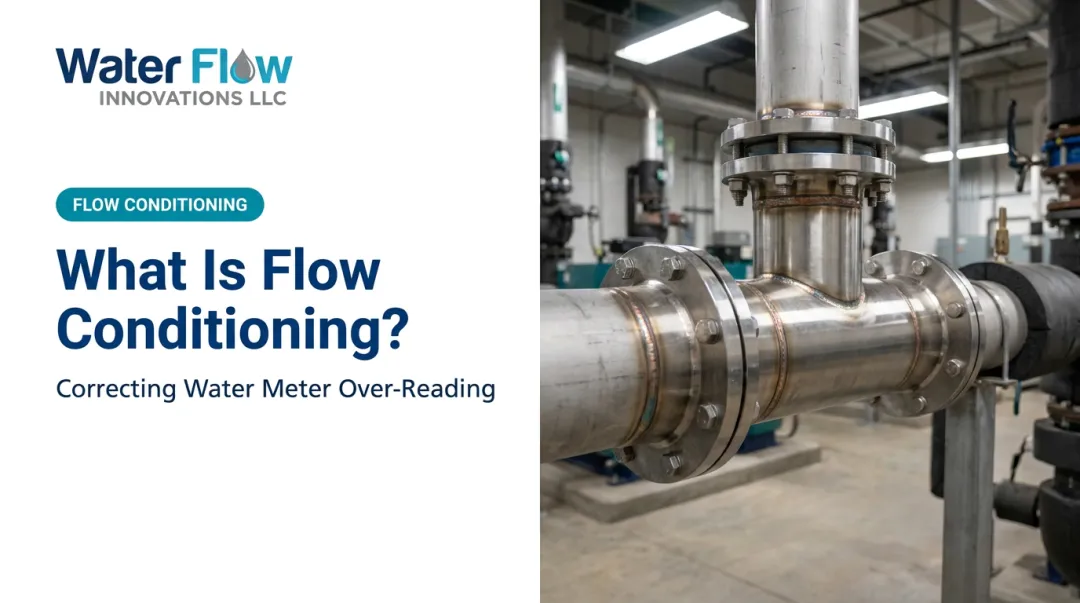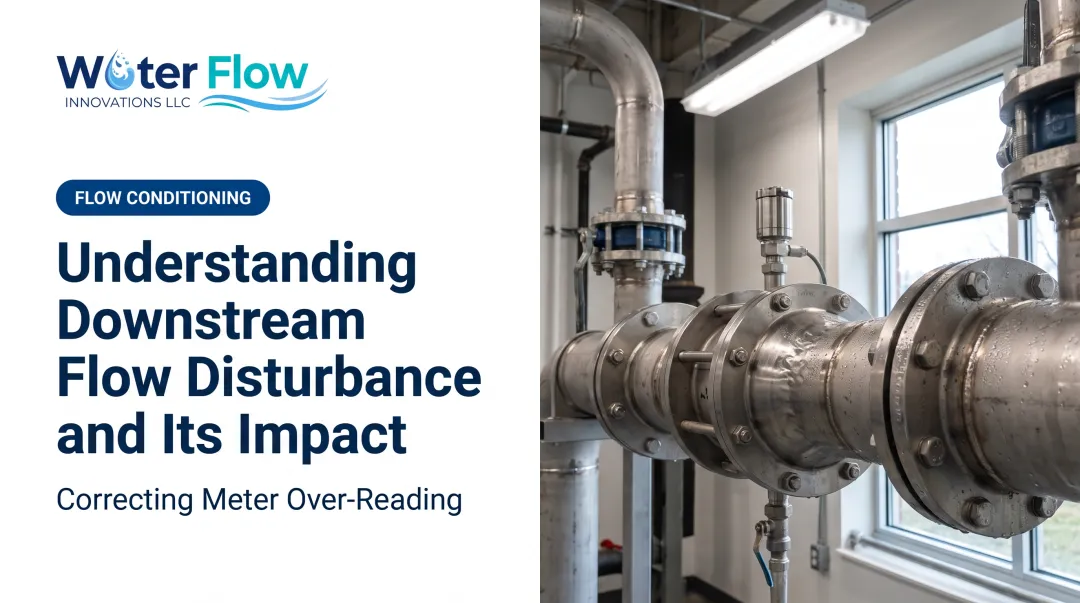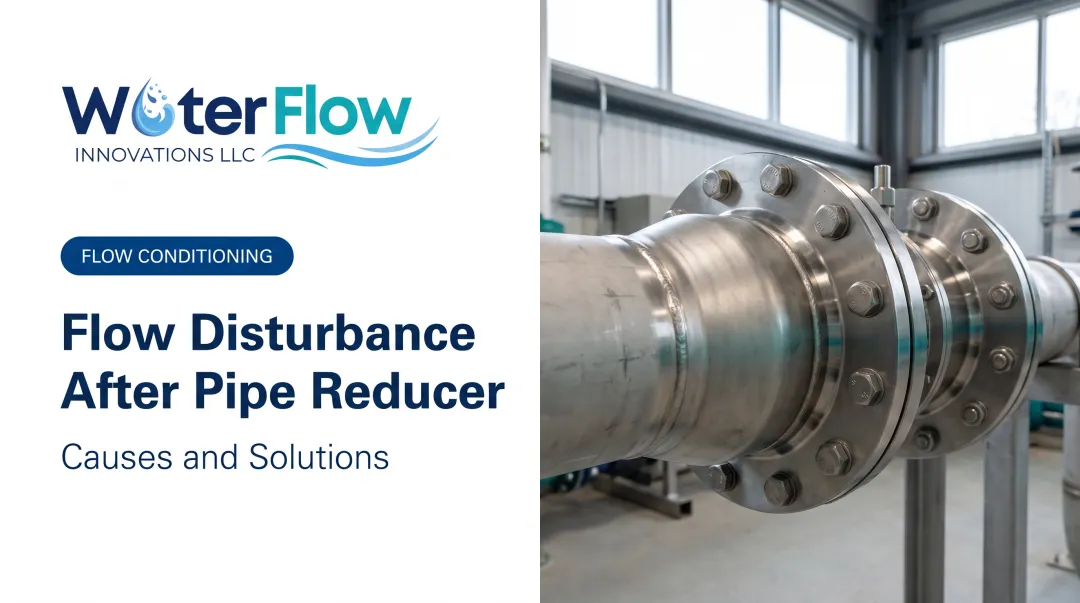

Fittings and valves positioned close to a water meter introduce turbulence and reduce measurement accuracy for most meter types, according to Pacific Northwest National Laboratory. That single fact explains why so many facilities pay for water they never actually used.
This guide breaks down what disturbed flow actually is, how it develops inside your pipes, and what it means for your operations, your equipment, and your utility bills.
Key Takeaways
- Disturbed pipe flow is smooth, fully developed flow broken up by fittings, equipment, or other pipe disruptions
- Common causes: elbows, tees, partially open valves, sudden diameter changes, and rough interiors
- Impacts include meter misreads, higher pressure drop, and inflated energy and utility costs
- Reynolds number classifies flow as laminar, transitional, or turbulent
- Flow conditioning corrects disturbed flow without long straight pipe runs
What Is Disturbed Pipe Flow?
Disturbed pipe flow is any deviation from a fully-developed, symmetric flow profile. It shows up as velocity fluctuations, eddies, or swirl instead of a smooth, predictable pattern.
No commercial piping system avoids this entirely. Every elbow, tee, valve, or meter fitting introduces some disruption to the water moving through it. That disruption is an unavoidable byproduct of real-world pipe geometry.
Disturbed flow is not the same thing as high flow rate or high pressure. Flow rate is simply volume moving over time. Pressure reflects force within the system. Disturbed flow describes the shape of the velocity profile, uniform or distorted, regardless of speed or force.
Disturbance typically shows up in three degrees:
- Mild swirl — a slight rotational component, often from a single elbow
- Asymmetric velocity profiles — uneven speed across the pipe cross-section, common after tees or partially closed valves
- Fully chaotic flow — widespread eddies and irregular motion, often from compounded fittings or high velocity
Correction strategies differ by degree. Mild swirl might resolve itself over a short straight run. Fully chaotic flow usually needs engineered correction.
How Does Disturbed Flow Develop?
Disturbed flow doesn't appear randomly. It develops through a predictable sequence: something triggers it, it propagates downstream, and it either settles out or persists depending on what's in its path.
Initiation
Disturbance starts at physical obstructions or velocity changes: elbows, valves, reducers, pump inlets, and meters themselves. This is geometry-driven, not intermittent; it happens continuously wherever these components exist.
The problem compounds when multiple sources sit close together. An elbow positioned right before a meter, for example, doesn't just add its own disruption. It prevents the flow from having any chance to recover before measurement.
Core Development
The Reynolds number is the key indicator of whether flow stays smooth or turns chaotic. It's a dimensionless ratio of inertial to viscous forces, and it depends on velocity, pipe diameter, and fluid properties.
Academic references, including the USGS, place the thresholds at approximately:
- Below Re 2,000–2,100: laminar (smooth, orderly)
- Re 2,000–4,000: transitional (unstable)
- Above Re 4,000: turbulent (chaotic)

Physically, this means the velocity profile flattens or skews, eddies form, and air can become entrained in the water column. The flow loses uniformity right where accuracy matters most.
This has real consequences. A distorted profile passing through a meter can cause it to misread actual volume, sometimes by a wide margin.
One peer-reviewed test of a clamp-on ultrasonic meter found errors of 7.9%–8.6% immediately after a 90-degree bend with no straight-pipe recovery, dropping below 2% only after 8 pipe diameters of recovery distance (Synowiec et al., Sensors, 2021).
Regulation and Correction
Engineers have traditionally managed this with straight pipe runs, giving flow enough distance to "settle" before reaching a meter.
Requirements vary by meter type: some compound and turbine meters call for 5 diameters upstream and downstream, while many turbine and ultrasonic installations call for closer to 10 diameters upstream and 5 downstream, per PNNL guidance. There's no single universal rule; it depends on the meter and the disturbance.
Straight pipe isn't always available. That's where flow conditioning comes in as an engineered alternative. Water Flow Innovation's Flow Conditioning Device (FCD) uses a 4-component system:
- Air/gas removal — creates back-pressure that pushes air and gas out of the measurement zone, producing a homogeneous water column
- Pressure regulation — smooths surges and water-hammer events at the meter entry point
- Check valve — prevents reverse flow that could reintroduce air (not needed on every installation)
- Turbulence elimination — slows velocity enough to prevent vortex formation

This matters because uncorrected disturbed flow at a meter typically causes over-registration: facilities pay for water they never used.
Output and Result
Well-managed disturbed flow supports stable, accurate measurement and efficient operation. Left uncorrected, it drives inflated readings, higher energy draw, and premature wear on valves, meters, and joints.
Accurate metering also feeds billing, utility reporting, and system diagnostics downstream. Certified flow conditioning solutions typically reduce metered water and sewer charges by 5–30% on average, without any change in actual water usage. The highest documented single result reaches 46%, and most customers see the difference on their next billing cycle.
Common Causes and Warning Signs of Disturbed Flow
Several common piping features create the conditions for disturbed flow.
Primary physical causes:
- Pipe bends and elbows
- Tees and reducers
- Partially open or throttled valves
- Pump discharges and nearby fittings
- Sudden pipe expansions or contractions
- Rough or corroded pipe interiors
McCrometer documents these same fittings, along with poorly installed flange gaskets, as common flow disturbers (McCrometer, 2023). Two elbows positioned out-of-plane can generate swirl that persists for many pipe diameters downstream.
Velocity plays a role too. Faster-moving water reacts more violently when it hits an obstruction or bend, pushing the Reynolds number higher and increasing turbulence intensity.
Warning signs facility managers should watch for:
- Water bills that don't match actual usage patterns
- Vibration or unusual noise in piping near fittings or meters
- Inconsistent or erratic meter readings between billing periods
- Pressure fluctuations at fixtures or equipment
None of these signs are dramatic on their own. That's exactly why disturbed flow goes unnoticed for months, sometimes years, in facilities without dedicated monitoring.
Where Disturbed Flow Has the Biggest Impact
Disturbed flow concentrates its damage in a few predictable spots: near water meters, at pump inlets, and around valve clusters where multiple fittings sit close together.
Impact is greatest in facilities with high water throughput and complex piping layouts:
- Manufacturing plants running continuous process water
- Hospitals with round-the-clock clinical and institutional demand
- Hotels cycling through laundry, pools, kitchens, and variable guest occupancy
- Multifamily buildings with dozens or hundreds of units on shared risers

Some industries face pressure on both cost and process control. Food and beverage facilities deal with turbulence from CIP (clean-in-place) systems, pasteurization cycles, and pressure changes. Data centers continuously cycle cooling-tower makeup water. In both cases, inaccurate flow measurement hits the utility bill and can mask real operational issues.
Healthcare facilities carry a median water use of 315 gallons per bed per day, according to EPA ENERGY STAR data drawn from over 53,000 properties. At that scale, even modest meter over-registration compounds into significant annual overpayment.
Conclusion
Disturbed pipe flow is a predictable, geometry-driven byproduct of real-world piping. Every elbow, valve, and meter connection contributes to it in some way.
Understanding how it develops—from initiation through propagation to measurement error—helps facility managers spot over-reading before it compounds on the bill. For many buildings, that means evaluating certified flow conditioning solutions that correct meter error and deliver savings on the next cycle, without changing water usage or operations.
Frequently Asked Questions
How can you tell if pipe flow is laminar or turbulent?
Reynolds number is the key indicator: below roughly 2,000 is laminar, above roughly 4,000 is turbulent, with a transitional zone in between. Visually, laminar flow moves in smooth, parallel layers while turbulent flow shows chaotic, mixing motion.
How do you determine the flow rate in a pipe?
Common methods include velocity-area calculations, differential-pressure meters, and ultrasonic or mechanical meters. Choice depends on pipe size, fluid type, and required accuracy.
What causes turbulent flow in pipes?
Fittings like elbows and tees, high velocity, rough or corroded pipe walls, and obstructions such as partially closed valves all contribute. The more of these factors present, and the closer together they sit, the more severe the turbulence becomes.
Can disturbed flow damage pipes or equipment?
Yes. Turbulence increases friction, vibration, and wear on valves, meters, and joints over time. Left unaddressed, it can shorten equipment lifespan and increase maintenance frequency.
How much straight pipe is needed to eliminate disturbed flow before a meter?
Industry guidelines vary by meter type, often citing 5 to 10 pipe diameters upstream and 5 diameters downstream. This isn't always practical in tight mechanical rooms, which is why flow conditioning devices offer a space-saving alternative.
Does disturbed flow actually affect my water bill?
Yes. Turbulence and entrained air can cause meters to over-register usage, leading to inflated bills for water you never actually received. Certified flow conditioning typically corrects this, reducing bills by 5–30% on average, with a highest documented result of 46%.
Does the inflated reading carry through to the sewer charge?
In most cases yes. Utilities generally calculate sewer as a share of metered intake rather than measuring discharge, commonly 80–120% of the water charge, so the same error is billed twice each cycle.
What approvals should a device on the supply line carry?
Certification to IAPMO, NSF, ANSI, CAN 61, KIWA, GMP, and SQF, plus EPA WaterSense compliance. The unit is fabricated from 316L stainless steel in the USA.