
That usage adds up fast. Between rising municipal rates, labour costs, and energy bills already squeezing margins, water and sewer charges have become a line item hotel operators can no longer ignore. Denver Water benchmarks show 4-5-star hotels using more than 21,000 gallons per bed-space annually, roughly double the consumption of a bed-and-breakfast.
Hotels are inherently water-intensive. But unmanaged waste, aging equipment, and inaccurate metering often push bills higher than actual usage justifies. This guide breaks down where those costs originate and the full playbook for cutting them without touching guest experience.
Key Takeaways
- Water costs stack up across guest rooms, laundry, kitchens, cooling towers, pools, and landscaping
- Aging infrastructure, guest behaviour, inefficient equipment, and weak monitoring drive most overages
- Strongest levers include fixture upgrades, active management, and meter over-reading corrections
- Lasting savings come from stacking monitoring, efficiency, and meter accuracy fixes, not isolated upgrades
How Costs Around Hotel Water Bills Typically Build Up
Hotel water spend isn't one expense. It's several running simultaneously, according to EPA's commercial end-use research:
- Guest rooms — around 30% of total use
- Kitchen — around 25%
- Laundry — around 20%
- Cooling and heating — around 15%
- Landscaping — around 10%
- Swimming pools — around 1%

These figures shift by property type, but the pattern holds: costs accumulate quietly across multiple systems.
That's what makes hotel water bills so deceptive. A slow leak in a guest-room supply line or a meter over-reading from turbulent flow doesn't announce itself. It just sits there, adding a few dollars a day, until a facility manager notices a bill 20% higher than last quarter with no obvious explanation.
Seasonal swings compound the problem. Summer occupancy spikes irrigation and pool refill needs. Peak cooling season pushes cooling towers into overdrive, cycling makeup water valves dozens of times per hour. Without regular auditing, these surges blend into the "normal" baseline until someone asks why the water bill keeps climbing.
Key Cost Drivers for Hotel Water Bills
Not every hotel bleeds money the same way. Three categories of factors typically determine the size of the bill.
Decisions made early:
- Fixture selection: showerheads, faucets, toilets
- Plumbing design and pipe sizing
- Meter type and equipment choice
These set a cost baseline that is expensive to revisit later, since retrofitting plumbing after construction costs far more than specifying efficient fixtures upfront.
Ongoing operational conditions:
- Maintenance quality on cooling towers and pool systems
- Leak monitoring frequency
- Staff training on reporting irregular usage
External factors outside a hotel's direct control:
- Municipal rate hikes, with Portland for example announcing 8.1% water and 5.15% sewer rate increases effective July 2026
- Regional water scarcity driving conservation surcharges
- Meter accuracy issues, including over-reading from turbulent flow
Which driver dominates depends on the property. A boutique hotel with older plumbing usually feels early design decisions the most. A large resort with a cooling tower and commercial laundry sees ongoing mechanical systems drive the bulk of spend. Pinpoint the primary driver at your property before you invest in fixes.
Cost-Reduction Strategies for Hotel Water Bills
Strategies for reducing hotel water bills fall into three buckets: decisions, management, and context. Each addresses a different layer of the cost problem.

Strategies That Change Decisions
These are proactive, upfront choices made during renovations, procurement cycles, or capital planning. They lower the cost baseline before waste even starts.
- Upgrade to WaterSense-labelled fixtures. WaterSense showerheads cap flow at 2.0 gpm versus the 2.5 gpm standard, a 20% cut. Bathroom faucets max out at 1.5 gpm, at least 30% below standard fixtures.
- Replace aging laundry equipment with ENERGY STAR commercial washers. These use about 45% less water than standard machines, a real cut given laundry is roughly a fifth of total hotel water use.
- Install water-saving pool covers. Covers prevent up to 95% of pool-water evaporation, directly cutting refill frequency and the chemical costs that come with it.
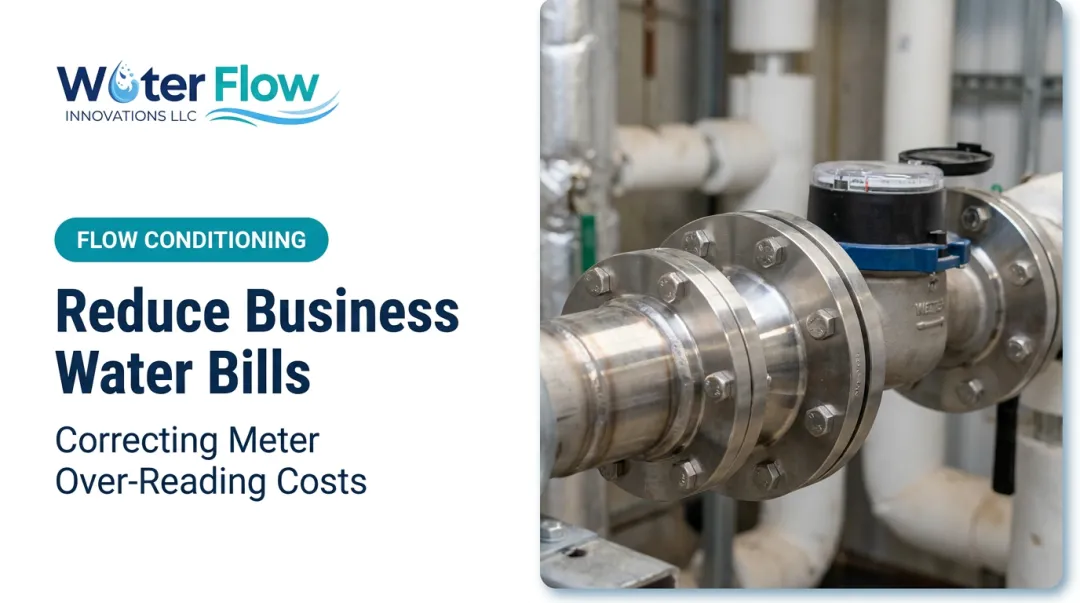
- Correct meter accuracy issues at the source. Cooling-tower makeup and laundry fill cycles introduce air and turbulence that make standard meters over-read. Water Flow Innovation's certified Flow Conditioning Device (FCD) creates static back pressure that forms a laminar flow through the meter, producing a homogeneous water column so hotels pay only for water actually delivered.
Strategies That Change How Water Is Managed
Once systems are running, the focus shifts to visibility and control without disrupting guests.
- Deploy leak detection and sub-metering across guest rooms, laundry, kitchen, and cooling systems. Instead of discovering a leak on a bill three months later, you catch it within days.
- Launch towel and linen reuse programmes. AHLA reports these programmes cut laundry loads by an average of 17%. The 2024 Green Lodging Trends report, surveying over 11,000 properties, found 98.9% already run linen-reuse programmes. This is table stakes, not innovation.
- Maintain cooling towers and pool systems on a fixed schedule to prevent scaling and biofouling, which force unnecessary blowdown and refill cycles.
- Train housekeeping and engineering staff to flag irregular consumption or visible leaks immediately, rather than waiting for the monthly utility statement.
Hyatt Regency Atlanta cut water use 35% over three years and saved $1 million annually after optimising its mechanical systems, per EPA case study data. That's the ceiling active management can reach when applied consistently.
Strategies That Change the Context Around Water Use
Sometimes cost sits outside usage, in the billing structure or the infrastructure around it.
- Apply for municipal sewer credits on water that never reaches the sewer, such as cooling tower evaporation, irrigation, and pool loss. Several cities, including Seattle and Pearland, Texas, offer commercial sewer-deduction programmes for exactly this scenario.
- Audit for meter over-reading. Flow conditioning corrects the error at the meter, so hotels stop paying for phantom flow without changing usage or disrupting operations. Documented hotel-sector results show 5–30% average reductions in combined water and sewer bills, with a high of 46%, and about 90% of customers reach full ROI in under 12 months.
- Modernise aging plumbing during capital improvement cycles rather than waiting for failures.
- Benchmark against peer properties. EPA's H2Otel WaterUSE Tool, launched in 2014, lets facility teams compare their consumption against similar hotels to spot when costs are structurally out of line.
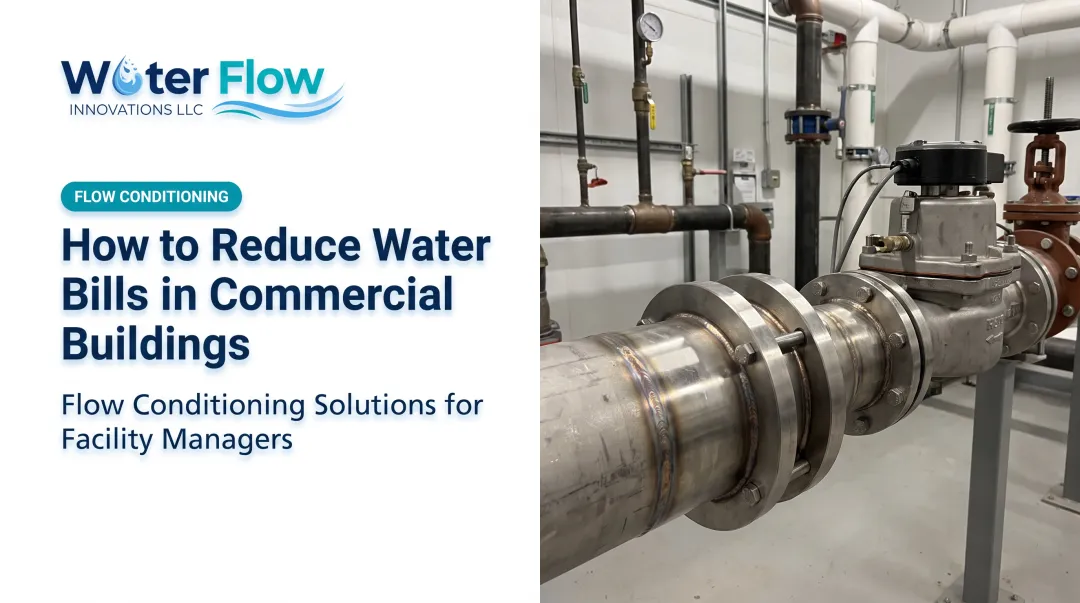
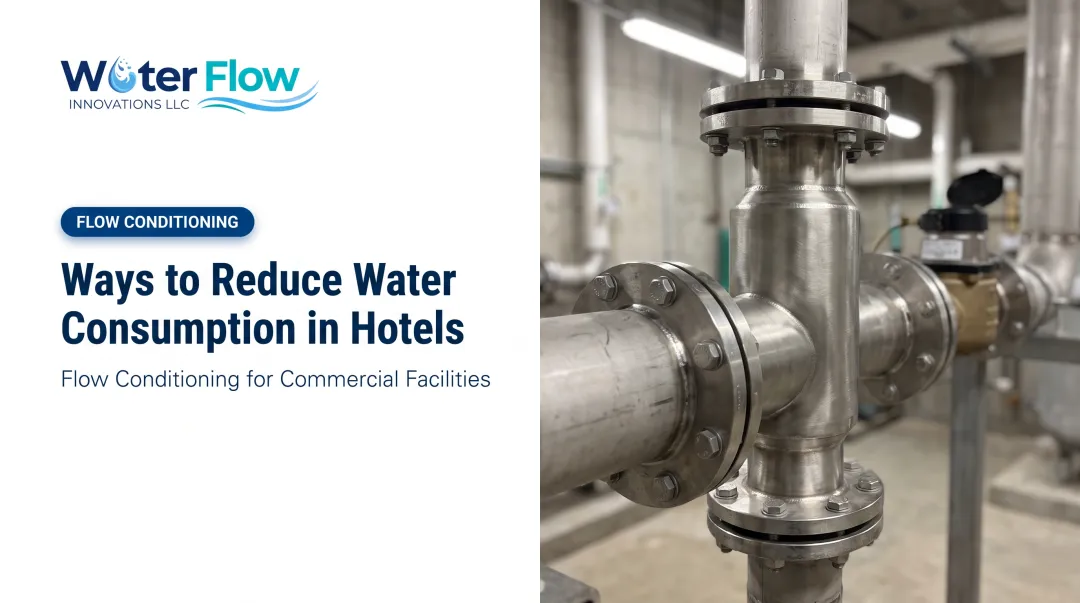
Meter-side fixes are also practical to deploy. An FCD installs immediately after the water meter, on the consumer side of the connection, in about one hour, confined to the mechanical room or meter vault. Where a pressure-reducing valve is present, the preferred order is Water Meter → FCD → PRV → Building. Installing after the PRV is a fallback only, and runs roughly 20–40% less effective. Guest rooms, kitchens, laundry, and pools stay untouched, and most hotels schedule the brief shutoff at the meter connection before opening or after closing.
Worth noting the boundary: the FCD corrects the metered municipal supply reading. It is not a general fix for turbulence elsewhere in the plumbing, and it has no effect on regulated discharge lines.
Conclusion
Cutting hotel water bills starts with finding where the money actually leaks: guest behaviour, aging equipment, billing errors, or meters that register volume never delivered to the property.
Hotels that lock in the largest, most durable savings work all three layers at once: smarter fixture and equipment choices, tighter day-to-day management, and fixes for structural billing issues like meter over-reading. Address those together and the reductions compound on every cycle instead of stalling after the first round of easy wins.
Frequently Asked Questions
Do hotels charge you a water bill?
No. Hotels absorb water costs into room rates and operating overhead rather than billing guests directly. The hotel itself, however, pays substantial municipal water and sewer bills based on total property consumption.
Can a hotel tell how much water you use?
Most hotels have only a single main meter and cannot isolate individual room usage. Sub-metering technology is changing this, letting facility teams track consumption by area such as laundry or guest floors, though the master meter is still what the utility bills from.
How much can a hotel realistically save on water bills?
Documented results for hotels using flow conditioning show 5–30% average reductions in combined water and sewer bills, with a highest documented case of 46%. Actual savings depend on existing meter accuracy and equipment efficiency.
What is water meter over-reading and how does it affect hotel bills?
Turbulence and entrained air from cooling tower cycling, commercial laundry fill events, kitchen demand, and pool backwash can cause meters to register more flow than what is actually delivered. Hotels end up paying for water they never received.
How long does it take to see savings after implementing water-saving measures?
Fixture and behavioural changes take months to show measurable impact. Meter corrections like flow conditioning typically show up on the very next billing cycle since they fix the reading itself, with no ramp-up period.
Are hotel water-saving investments eligible for sustainability certifications?
Yes. Documented, bill-verified water savings can support LEED water-metering requirements, ENERGY STAR reporting, and broader ESG water-intensity disclosures.
How does meter over-reading affect a hotel's sewer bill?
Most utilities calculate sewer as a percentage of metered water intake, typically 80–120% of the water charge. Every phantom gallon is therefore billed twice, once as water and once as sewer, even though it never entered a drain. At a hotel where laundry, kitchens, cooling towers, and irrigation all cycle on one meter, that multiplier compounds every over-read event.
Does installing a flow conditioning device disrupt guest service?
Installation takes about an hour, with a brief water shutoff at the meter connection and no access to internal facility systems, process equipment, or operational areas required. Hotels, resorts, and vacation rentals normally schedule it overnight or during low occupancy. Guest rooms, kitchens, laundry, and pool systems are unaffected afterwards, since negligible pressure loss is a design characteristic.