
Introduction
Water leaks alone waste nearly 900 billion gallons annually across U.S. households, according to EPA WaterSense data. The average family loses 180 gallons a week to leaks they never notice—and commercial sites multiply that waste across restrooms, process lines, cooling, and irrigation.
That waste shows up on the bill. EPA estimates the typical household spends more than $1,000 per year on water, and a meaningful share is avoidable. A slow drip or running toilet can add $10 to $20 a month—$150+ a year for water nobody used. On multifamily, hospitality, and industrial accounts, the same failure modes scale into thousands.
Most U.S. households pay $30 to $45 a month for water alone, with sewer charges often tied to the same usage. Commercial and multifamily bills run far higher, and sewer fees frequently match or exceed water charges. Water itself isn't expensive. What gets expensive is inefficiency: aging fixtures, undetected leaks, or a meter that over-reads turbulent flow.
This article breaks down how water and sewer costs build up, what drives them, and what facility operators, property managers, and building owners can do about each cause.
Key Takeaways
- Water bills creep up from daily habits—and spike fast when hidden leaks go unnoticed
- Biggest cost drivers: usage habits, fixture efficiency, leaks, and outdoor irrigation
- Cut costs with three levers: smarter purchases, tighter daily management, and infrastructure fixes
- Habit changes are free; bigger savings often need upgrades or a professional meter review
How Costs Around Water Bills Typically Build Up
Water costs rarely arrive as one big surprise. They accumulate through hundreds of small, repeated actions: long showers across units or guest rooms, extra laundry cycles, a faucet left running at a prep sink.
None of these feel expensive in the moment. Multiply daily use across every unit, floor, or shift, though, and you are looking at real volume and real cost every single month.
Then there's the other kind of cost build-up: sudden and hard to see. A toilet flapper that starts leaking on a Tuesday. A sprinkler valve that sticks open overnight. A pipe that develops a hairline crack behind a wall. These events don't announce themselves.
- Gradual waste: fixture run-time, process and kitchen habits, laundry frequency: compounds slowly and shows up as a steady upward drift on the bill
- Episodic waste: leaking toilets, burst pipes, stuck irrigation valves: compounds fast and shows up as a sudden spike
The frustrating part is that most of this stays invisible until the bill lands. Standard meters only tell you what happened after the fact. Unless you're checking your meter manually between billing cycles, you won't catch a problem until it's already cost you money.
Key Cost Drivers for Water Bills
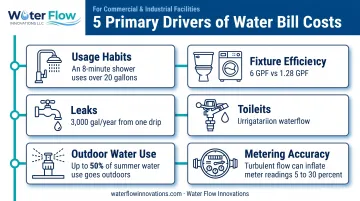
Not every dollar on your water bill comes from the same source. Five factors typically drive the total, and which one matters most depends on your property type and how much control you have over fixtures, systems, and metering.
Usage habits are the most direct and controllable driver. Shower length, laundry frequency, kitchen practices, and equipment left running all add up. Many of these changes need no equipment purchase.
Fixture and appliance efficiency shapes how much water any given task requires. An older toilet can use up to 6 gallons per flush, compared to 1.28 gallons or less for a WaterSense-labeled model. Across a multifamily building, hotel, or campus, that gap multiplies fast.
Leaks drain budgets with little warning. According to EPA's Fix a Leak Week program, a faucet dripping once per second wastes more than 3,000 gallons a year. An irrigation leak as small as 1/32 inch can waste 6,300 gallons a month.
Outdoor water use is seasonal but substantial. Irrigation, vehicle washing, and landscaping often account for more than 30% of total water use, and up to 60% in arid climates.
Metering and billing accuracy affects what you pay, not only what you use. Turbulent flow and air in the line can cause meters to over-read, so commercial and multifamily properties may be billed for water they never received.
Which driver to tackle first depends on your role:
- Residents and tenants: Cut waste in daily habits and report drips or running fixtures quickly
- Property operators: Prioritize efficient fixtures, leak response, and irrigation schedules
- Facility managers: Focus on leaks, aging infrastructure, and meter accuracy—issues that scale with building size
Cost-Reduction Strategies for Water Bills
Cutting a high water bill usually takes three kinds of moves, matched to where the waste actually comes from. Some savings come from what you buy or plant before water is used. Others come from day-to-day habits. The rest come from fixing the system itself, not from changing behavior alone.
Upfront Choices That Lock In Lower Use
These are the choices you make once, before water even flows.
- Choose WaterSense-labeled fixtures. They use at least 20% less water than standard models while matching performance. Showerheads capped at 2.0 gallons per minute versus the standard 2.5 GPM save the average family 2,700 gallons a year.
- Pick ENERGY STAR appliances. Certified washing machines use about 14 gallons per load versus 20 for standard units — roughly 30% less water per load.
- Go xeriscape instead of turf. A Southern Nevada Water Authority study found drought-tolerant landscaping cut outdoor use by 76% compared to traditional turf, saving an average of 96,000 gallons per property annually.
- Build efficiency into procurement. Property owners and facility managers should specify water-efficient fixtures during renovation planning, not retrofit them later.
Management Habits That Cut Waste
No new equipment required here — just better habits and closer attention.
- Run a two-hour meter test. Turn off all water in the property, note the meter reading, wait two hours, and check again. Any movement means you have a leak.
- Try the toilet dye test. Add food coloring to the tank. If color shows up in the bowl within 10 minutes, the flapper is leaking.
- Adjust small daily habits. Shorter showers, turning off the tap while brushing teeth, scraping plates instead of rinsing under running water.
- Run full loads only. Start dishwashers and washers when full, and use the cycle that matches the soil level instead of the max setting every time.
- Time irrigation for early morning or evening. Watering at midday loses more to evaporation, and seasonal adjustments prevent overwatering.
- Track usage trends, not just totals. Many utilities offer apps showing daily or weekly consumption. Catching a spike early beats discovering it three billing cycles later.
EPA estimates that fixing readily repairable leaks alone can cut a typical bill by around 10% — often the single fastest win available.
System and Meter Fixes Beyond Behavior
Sometimes the problem isn't usage at all. It's what's happening in the pipes and at the meter.
- Insulate water heaters and hot water pipes so less water runs down the drain while you wait for it to heat up.
- Address aging plumbing infrastructure. Old supply lines and pressure imbalances waste water regardless of how careful occupants are.
- Review your utility's rate structure. Tiered pricing means each additional block of usage costs more per gallon — understanding where you sit on that scale can change how you budget.
For businesses, multifamily properties, and larger facilities, there's a fourth issue worth investigating: is the meter itself over-reading?
Commercial water meters can't always tell the difference between actual water and the air, micro-bubbles, or turbulent flow moving alongside it. Air enters lines through repairs, pump cycling, and pressure shifts. Turbulence forms naturally once water travels more than 30 feet through a pipe. Both get counted as billable volume, even though neither is water your facility actually used.
A certified flow conditioner corrects that measurement error at the source. Water Flow Innovation builds a Flow Conditioning Device (FCD) that installs right after the meter and smooths flow in the measurement zone so readings reflect real consumption, not air and turbulence.
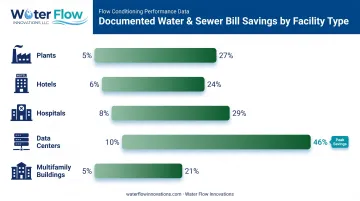
Sewer charges usually use the same metered figure, so a corrected read often lowers water and sewer costs together, starting on the next billing cycle. Documented results in plants, hotels, hospitals, data centers, and multifamily buildings typically fall in the 5% to 30% range, with a high of 46%. Install time is about an hour, with no operational disruption and no change to actual water use.
Conclusion
Cutting a water bill starts with finding the real source of the cost. Is it coming from daily habits? Outdated fixtures? A leak you haven't found yet? Or something at the meter itself, unrelated to how much water you use?
Lasting savings rarely come from one fix. They come from stacking small daily habits with periodic leak checks. On commercial properties, also examine the infrastructure and metering behind the bill. Work through each layer and the reductions add up.
If your usage looks normal but the bill does not, a free water bill review can show whether meter over-reading is driving the cost.
Frequently Asked Questions
What can you do to minimize your water bill?
Fixing leaks, adopting shorter showers and full-load habits, and upgrading to WaterSense-labeled fixtures deliver the fastest, most reliable reductions. Start with a leak check : it's free and often the biggest single win.
How can I quickly tell if I have a hidden leak?
Try the two-hour meter test: turn off all water, note your meter reading, then check again in two hours. For toilets specifically, add food coloring to the tank and watch for color in the bowl within 10 minutes.
Do water-efficient fixtures really make a noticeable difference?
Yes. WaterSense-labeled fixtures use at least 20% less water than standard models while performing just as well, which adds up to meaningful annual savings with no behavior change required.
Why did my water bill suddenly spike?
Sudden spikes almost always trace back to a new leak, a stuck irrigation valve, or a running toilet — not a gradual change in usage. Check your fixtures and irrigation system first.
Can businesses or multifamily properties reduce water bills the same way homeowners do?
The same fixture and habit strategies apply, but larger properties should also check metering accuracy and infrastructure. At commercial volumes, even a small measurement error scales into a significant dollar amount.
Is there a way to fix water bill overcharges that aren't caused by usage?
Yes. Certified flow conditioning devices correct water meter over-reading caused by air entrainment and turbulence, delivering verifiable bill reductions without any change to actual water consumption.
Which residential-scale properties qualify for a meter-side fix?
Master-metered ones: multifamily and apartment communities, HOAs, luxury high-rise buildings, senior living communities, university dormitories, vacation rentals, and large properties and estates — not individual single-family homes.
Does an inflated reading affect the sewer portion too?
In most cases yes, because sewer is calculated from metered intake rather than measured discharge, commonly at 80–120% of the water charge. Water used outdoors is often billed on the sewer line too unless a separate irrigation meter is fitted.