
Introduction: Why Water Flow Conditioning Matters in Cold Storage Warehouses
Cold storage warehouses run on water as much as they run on refrigeration. Evaporative condensers, cooling towers, sanitation stations, equipment washdown, and defrost cycles all pull from the same municipal line.
Every gallon shows up on a bill that often includes a matching sewer charge. When the meter over-reads, you pay twice—for water and sewer—on volume that never reached the process.
Metered volume and water actually used are not always the same number. Turbulent flow, air entrainment, and pressure surges can make a meter log more than passed through, especially with frequent pump cycling and on-off equipment patterns common in cold storage.
Correcting that gap has cut water and sewer bills 5–30% in documented commercial cases, with no change in real consumption. This article covers how to spot the warning signs, where a flow conditioning device fits in a cold storage water system, and how to confirm whether the investment pays off.
Key Takeaways
- Cold storage faces double exposure: inflated water charges often carry matching sewer charges
- Turbulent flow and air entrainment differ from leaks, faulty equipment, or genuine high demand
- Establish a 12-month billing baseline before attributing cost spikes to meter behavior
- Conditioning devices correct flow profile at the meter; they don't reduce actual consumption
- Verify savings by comparing equivalent billing periods, not a single month
Water Use and Billing Challenges in Cold Storage Warehouses
Where the Water Actually Goes
Cold storage facilities draw water for more purposes than most people assume:
- Evaporative condensers and cooling towers — continuous makeup water plus blowdown
- Chilled-water support systems — circulation feeding refrigeration equipment
- Sanitation and washdown stations — demand on fixed cleaning schedules
- Ice production — process water for certain product-handling applications
- Defrost cycles — water among defrost methods in ASHRAE refrigerated-facility guidance
Some of this water recirculates in closed loops. Some leaves the building through the sewer line. That distinction matters directly for billing, since water and wastewater charges are frequently calculated from the same metered intake figure rather than actual discharge volume.
Why Flow Gets Turbulent
Cold storage operations create unusually variable flow conditions compared to a typical commercial building:
- Refrigeration load swings trigger pump cycling throughout the day
- Automatic valves open and close in rapid succession during defrost or makeup cycles
- Simultaneous washdown events spike demand unpredictably
- Frequent starts and stops disrupt the steady-state flow that meters are designed to measure accurately

None of this is automatically a problem. But it creates the exact conditions (turbulence, pressure fluctuation, and sometimes air entrainment) that can interfere with accurate meter registration.
A flow conditioning device is not a substitute for leak detection, submetering, water reuse programs, or routine equipment maintenance. Those still need their own reviews.
Signs Worth Investigating
Consider an engineering review if your facility shows:
- Water or sewer bills that spike without a matching change in production or occupancy
- Billing volatility that doesn't track seasonal or operational patterns
- Unusual meter activity during low-demand overnight periods
- Visible air in transparent pipe sections or audible surging
- Mismatches between a master meter and submeter readings
Commercial water meters are built to tight tolerances. NIST Handbook 44 specifies acceptance and maintenance tolerances for utility-type meters used at business establishments. Those figures are laboratory test limits, not a guaranteed error rate at any specific site. The only way to know what's happening at your meter is site-specific testing under NIST's measurement standards, not assumption.
How Water Flow Conditioning Devices Work
What a Flow Conditioning Device Actually Is
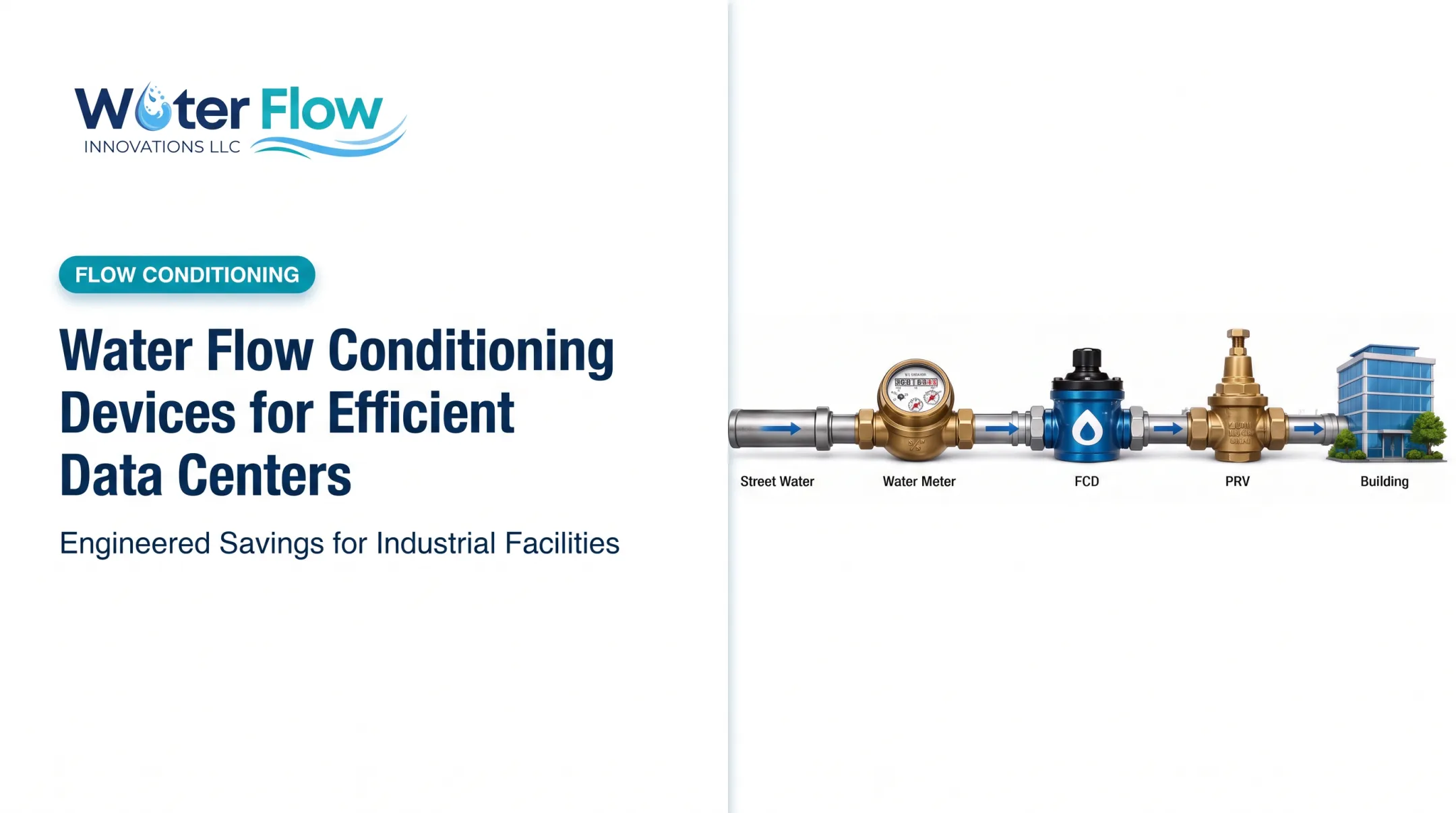
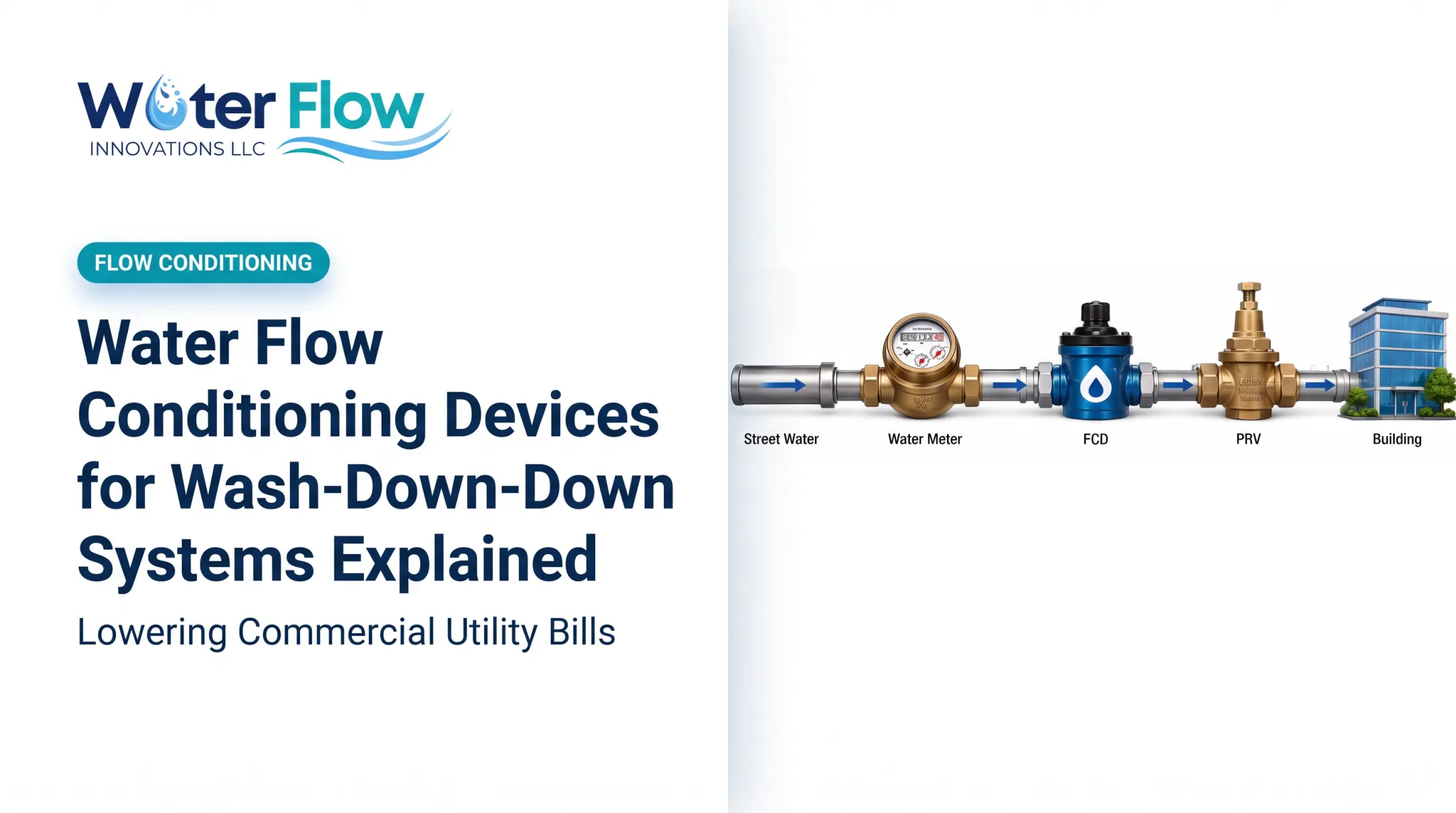
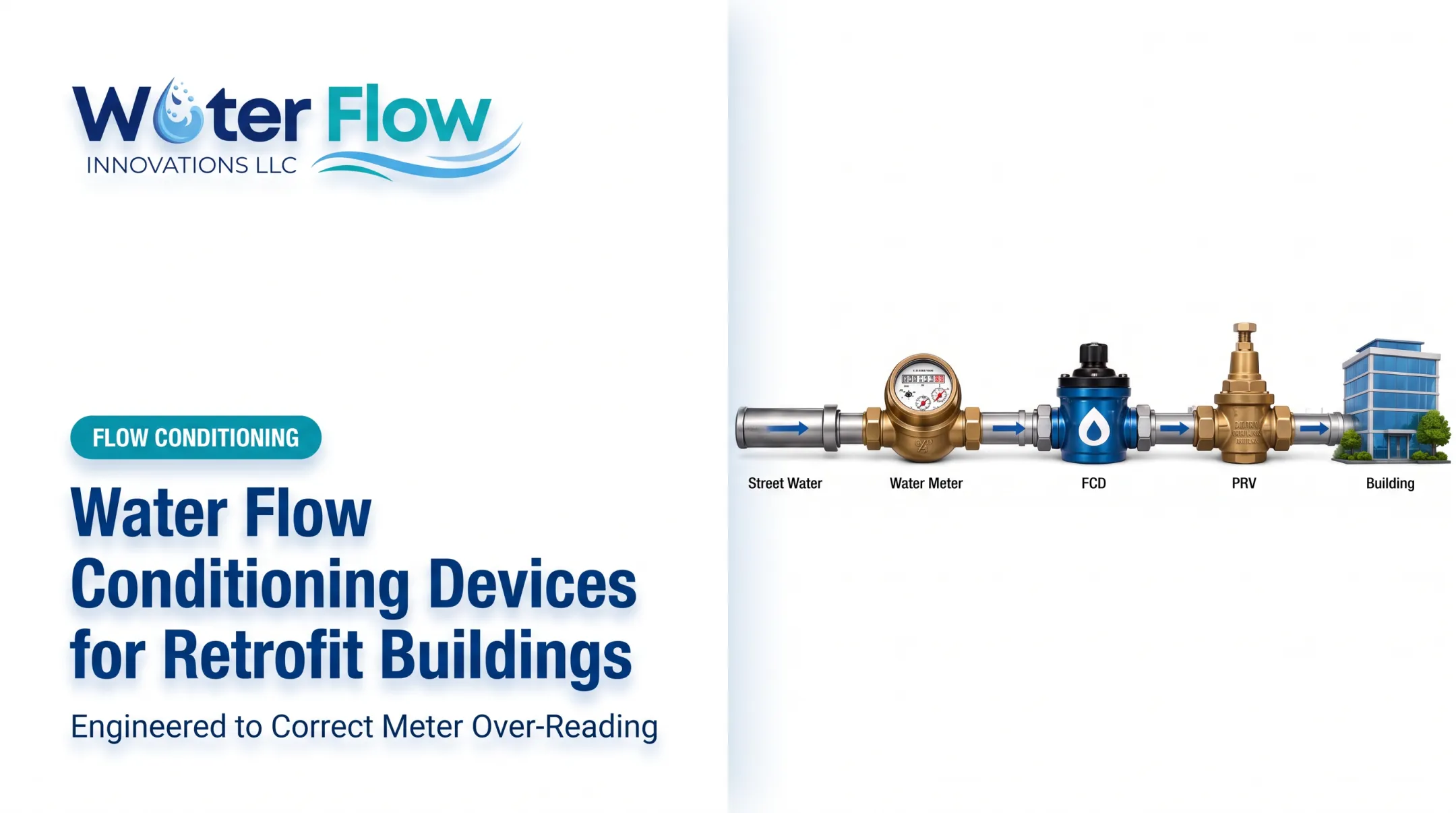
A water flow conditioning device is a mechanical inline component installed to stabilize the flow profile before water reaches the meter. It is distinct from filters, water softeners, chemical treatment systems, backflow preventers, pressure-reducing valves, pumps, and refrigeration controls.
It doesn't treat water quality or regulate refrigeration performance. Its job is narrower: create more consistent flow conditions at the point of measurement.
The Four Functions
Most conditioning devices, including the Flow Conditioning Device (FCD) manufactured by Water Flow Innovation, are built around four mechanical functions:
- Air and gas separation — reducing entrained air and micro-bubbles before they reach the measurement zone
- Pressure regulation — smoothing surges caused by on-off cycling and variable demand
- Check-valve function — preventing reverse flow through the meter (not always required, depending on system design)
- Turbulence reduction — slowing velocity enough to discourage vortex flow, particularly during tank filling, washdown events, or cooling-tower demand spikes
These four functions work together to create a more homogeneous flow column ahead of the meter. The device does not reduce the amount of water your refrigeration, sanitation, or process equipment actually requires. It improves the relationship between real water movement and what the meter records.
Where It Gets Installed
The FCD installs on the main water line immediately before the meter, within existing piping at a pipe joint. No piping replacement is required.
Exact placement must always follow manufacturer engineering instructions, local plumbing code, and site-specific pipe configuration. Cold storage facilities with cooling-tower branches or dedicated high-volume lines may need a different evaluation than a single-meter office building.
Before-and-after comparison matters more than the installation itself. A useful evaluation tracks meter behavior under three conditions: steady demand, changing demand (like a shift change or washdown event), and equipment start-up, when pressure surges are most likely.

A Note on Certifications
Water Flow Innovation's FCD carries IAPMO, NSF, ANSI, CAN 61, KIWA, GMP, and SQF certifications. These are meaningful credentials, but their actual scope matters. NSF/ANSI/CAN 61, for example, evaluates drinking-water-contact health effects — it doesn't certify a specific bill-savings percentage. Facility managers evaluating any conditioning device should confirm which certification applies to which product model and application before relying on it in a procurement decision.
Potential Benefits and Practical Limitations for Cold Storage Facilities
The Double-Charge Opportunity
Here's the financial logic: if a meter over-registers by a certain percentage, and sewer charges are calculated from that same metered volume, correcting the meter can reduce both bills simultaneously.
Some municipalities price wastewater at a substantial multiple of the water rate. New York City's FY2027 schedule, for instance, sets wastewater charges at 159% of water charges, subject to its own allowance rules. That's a local example, not a national benchmark. Your own tariff structure determines whether this double-savings effect applies to your facility.
Use your facility's own water and sewer bills to evaluate potential impact. Don't treat any published range as a guaranteed outcome for your specific meter and piping setup.
What Doesn't Change
When correctly specified and installed, a conditioning device shouldn't change cold storage operations:
- Refrigeration setpoints or product temperatures
- Sanitation procedures or washdown schedules
- Water quality or treatment chemistry
- Production workflow or throughput
Sustainability Reporting Value
Documented reductions in metered consumption can support ESG initiatives, LEED water-metering requirements, or internal efficiency programs, but only when backed by actual utility records and a defensible measurement method.
A changed meter reading alone does not prove physical water use dropped. Frameworks like GRI 303 treat withdrawal, discharge, and consumption as separate disclosures.

When It's Not the Answer
A conditioning device won't fix:
- Active leaks anywhere in the system
- A genuinely faulty or miscalibrated meter
- Excessive cooling-tower blowdown or weak tower control logic
- Inefficient washdown practices wasting real water
- Undersized piping or inadequate pressure
- Legitimately high water demand from expanded operations
If any of these apply, they need separate corrective action, not a flow device.
How to Evaluate, Install, and Verify a Device
Build Your Baseline First
Before evaluating any device, gather:
- 12 months of water and sewer bills (EPA's WaterSense program recommends one to two years of water-use history for reliable baseline planning)
- Meter make, model, and size
- Pipe diameter, material, and operating pressure
- Flow range and water temperature
- Backflow protection configuration and any treatment chemicals in the line
- Connected equipment and available straight-pipe length upstream of the meter
Then correlate meter data with what actually drives demand in a cold storage plant:
- Production volume and refrigeration load
- Cooling-tower cycles and washdown schedules
- Occupancy and seasonal weather
A July spike that matches last July is expected. A spike that breaks the pattern needs explanation.
Rule Out Other Causes First
Before attributing elevated billing to meter over-reading, have a facilities engineer or licensed plumber review:
- Air-entry points: runs longer than about 30 feet can turn turbulent; cavitation, temperature swings, micro-leaks, and vacuum pockets all pull air into the line
- Pump suction and valve operation under normal and peak load
- Pipe configuration between the meter and the backflow device
- Pressure fluctuations at the meter and downstream of backflow
- Residual leak risk: a clean leak check does not rule out over-reading, because over-reading is not a leak
Plan Installation Around Operations
Cold storage sites cannot absorb unplanned downtime, so treat install planning as an operations task—not an afterthought.
Align refrigeration, plumbing, facilities, and sanitation on isolation or bypass timing, and book the work in a low-activity window. Straightforward FCD installs often take about an hour; larger pipe sizes or tight access can take longer. Your contractor handles fit-up; use manufacturer specs for meter match, orientation, and clearance.
Verify After Installation
- Record meter readings and compare equivalent billing periods (same month, similar production volume)
- Normalize for weather and seasonal variation where relevant
- Inspect pressure and flow conditions post-installation
- Document water and sewer charges separately—sewer rates do not always track the water bill one-for-one
Decision Framework: Purchase, Lease, or Review First
| Consideration | What to check |
|---|---|
| Procurement model | Purchase or lease; ask about volume and financing options |
| Certifications | Confirm current IAPMO/NSF/ANSI (and related) listings for your model |
| Pressure impact | Verify negligible pressure loss across your real flow range |
| Risk protection | Confirm 6-month money-back terms and lifetime transferable warranty |
| Support model | U.S.-wide sales support plus remote bill review and savings analysis |
Start with a free water bill and savings analysis that reviews billing data, meter type, pipe size, and facility layout before you buy or lease.

Conclusion: A Practical Path to Better Water-Billing Control
Start by mapping where your cold storage facility actually uses water. Separate real consumption from potential metering issues, and rule out leaks or equipment inefficiencies before looking at a conditioning device.
The sequence that works:
- Establish a billing and flow baseline using at least 12 months of data
- Inspect the piping and meter environment for air entry and pressure issues
- Confirm compatibility with your meter type, pipe size, and configuration
- Install with minimal disruption to refrigeration and sanitation operations
- Verify results using comparable billing periods
If your facility shows unexplained billing volatility, visible air in the lines, or meter readings that don't match operational patterns, treat those as warning signs. Request an application review with Water Flow Innovation to confirm whether a Flow Conditioning Device fits your water meter and piping configuration.
Frequently Asked Questions
What are the devices used for cold storage?
Cold storage facilities rely on refrigeration equipment, chilled-water systems, cooling towers, evaporative condensers, dehumidifiers, and monitoring controls for temperature management. Water flow conditioning devices are separate: they address meter accuracy, not refrigeration performance.
What is a chilled water air conditioning system?
A chilled-water system circulates chilled water to air-handling coils to cool a space, with a refrigerant extracting heat from the loop. It's a cooling mechanism, entirely different from a water flow conditioning device, which only stabilizes flow at the meter.
What are three important items to consider in the design of commercial refrigeration systems?
Required cooling load, temperature and humidity control, and system reliability/maintenance are core design factors. Water-system design (supply, defrost methods, and wastewater disposal) can also affect long-term operating costs.
What is TR in chiller capacity?
TR stands for "ton of refrigeration," a unit of cooling capacity rather than a water quantity. One ton of refrigeration equals 12,000 Btu/h of cooling capacity, a standard engineering conversion.
How can a water flow conditioning device help a cold storage warehouse?
It stabilizes flow at the meter and reduces over-reading from turbulence or air entrainment, which can lower water and sewer charges. Confirm results with a site evaluation and post-installation billing check.
How do you know if a cold storage facility could benefit from water flow conditioning?
Signs a site is a fit include:
- Unexplained water or sewer billing variation
- Turbulent or air-entrained flow at the meter
- Meter and piping conditions compatible with a conditioning device
- A documented 12-month baseline for before-and-after comparison