
For facility managers, that trend line matters more than it might seem. Water costs get far less scrutiny than energy or labor line items, yet they compound quietly year after year, eating into operating budgets without anyone flagging the problem.
Here's the reality: water bills rarely spike because of usage alone. Overlooked decisions, poor system management, and infrastructure conditions all inflate charges behind the scenes. This article breaks down all three, along with practical steps to address each one.
Key Takeaways
- Water bills reflect visible usage plus hidden factors like leaks and meter inaccuracies
- Indoor fixtures, irrigation, leaks, and metering errors drive most excess costs
- Lowering water bills requires action across decisions, operations, and system conditions
- Meter over-reading from air entrainment can inflate bills by 5-30% with no usage change
How Water Costs Typically Build Up
Water costs rarely show up as one obvious line item. They accumulate through daily habits, seasonal swings, and billing structures that charge for both water supply and sewer discharge at the same time.
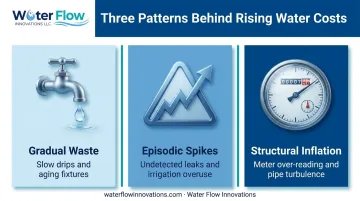
Most facilities experience a mix of recurring patterns:
- Gradual waste: slow drips, aging fixtures, and inefficient equipment that lose small amounts constantly
- Episodic spikes: undetected leaks, irrigation overuse, or equipment failures that cause sudden jumps
- Structural inflation: meter over-reading, pipe-level turbulence, and incorrect rate classifications that inflate charges regardless of actual usage
The tricky part is visibility. A single monthly bill rarely tells the full story. Most facilities only notice a problem when they line up 12 months of bills side by side and see a pattern they can't explain.
By that point, the damage has often been accumulating for months or years, adding real cost long before anyone triggers a formal audit or investigation.
Key Cost Drivers for Water Bills
Three broad categories explain most of what shows up on a water bill:
- Consumption volume: how much water actually gets used across the facility
- Metering and billing accuracy: how much water the facility gets charged for, which may exceed what was actually delivered
- Rate structure: how the utility calculates charges, including tiered pricing and sewer fees
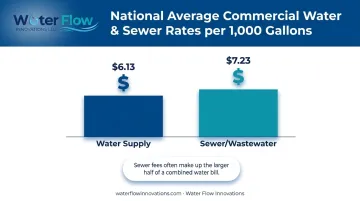
Sewer charges deserve special attention here. According to EPA's 2024 national commercial rate data, wastewater runs about $7.23 per 1,000 gallons against $6.13 for water supply, meaning sewer fees often make up the larger half of a combined bill.
Which driver dominates depends entirely on facility type:
| Facility Type | Primary Driver |
|---|---|
| Hotels | Guest showers, laundry volume |
| Manufacturers | Process water, cooling systems |
| Offices | Restroom fixtures, HVAC makeup water |
| Multifamily buildings | Master-metered common systems |
Identifying which driver dominates at your facility is the prerequisite for fixing anything. Decisions made at the design or procurement stage often catch facility managers off guard. Fixture specs, meter sizing, and pipe layout lock in a cost profile that gets harder to reverse the longer it sits unaddressed.
Cost-Reduction Strategies for Water Bills
Effective water bill reduction means matching the right strategy to the right cost driver, rather than picking one tactic and hoping it works. Behavioral fixes solve consumption waste, while management improvements catch operational inefficiencies. System-level changes correct structural problems that no amount of good behavior can fix on its own.
Strategies That Reduce Costs by Changing Decisions
These are the choices made before or during fixture selection, procurement, and billing setup: the ones that shape your cost baseline for years.
Specify WaterSense-labeled fixtures at every upgrade opportunity. Commercial toilets certified by WaterSense use no more than 1.28 gallons per flush, compared to the federal standard of 1.6 gallons. EPA modeled a 10-story, 1,000-occupant office building and found upgrading to WaterSense toilets saved nearly 1.2 million gallons per year, based on data from EPA's Commercial Toilets program.
Beyond fixtures, a few other decisions matter just as much:
- Set water-use policies and consumption targets by department, occupant count, or square footage; facilities without explicit benchmarks tend to default toward maximum use
- Review your billing structure and rate classification, since many facilities sit on the wrong tier or meter size and overpay without knowing it
- Evaluate high-consumption processes like cooling systems or laundry operations against current equipment standards; legacy specs often assume far more water than modern equivalents need
Strategies That Reduce Costs by Changing How Water Is Managed
Once systems are in place, how you monitor and maintain them determines whether efficiency holds or erodes over time.
Leak detection deserves top priority. EPA's commercial facility guidance notes that leaks account for roughly 6% of water use in a typical building. A single faucet dripping once per second wastes more than 3,000 gallons a year, per EPA's Fix a Leak facility checklist. A basic meter check can confirm whether a leak exists: record the meter reading, avoid all water use for one to two hours, then check again. Any change means water is escaping somewhere.
Other management-level habits worth building into routine operations:
- Sub-meter by zone or floor: a single master meter can hide localized waste for entire billing cycles
- Optimize irrigation schedules using weather-based controllers, mulching, and early-morning watering windows to cut evaporation loss
- Maintain water-using equipment on a fixed schedule, because sediment in water heaters and scaling in cooling towers force systems to use more water per cycle than they were designed for
Strategies That Reduce Costs by Changing the Context Around Water Systems
Some cost drivers have nothing to do with behavior or fixtures. They're structural, and they inflate bills regardless of how carefully staff use water.
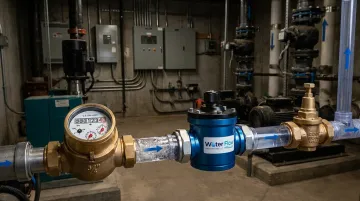
Meter over-reading is one of the most overlooked examples. Water meters are mechanical or electronic devices calibrated to measure liquid water only. When air bubbles or turbulent flow enter the measurement stream (a common occurrence in pressurized commercial and industrial systems), the meter registers more volume than was actually delivered. Facilities end up paying for water they never received.
This is precisely the problem Water Flow Innovation's Flow Conditioning Device (FCD) is built to solve. Installed immediately after the meter, it removes entrained air and stabilizes flow at the point of measurement, so the meter reads only actual water. Documented results across food and beverage plants, hotels, hospitals, manufacturers, and municipal facilities show 5-30% reductions in combined water and sewer bills, with 46% the highest documented single result. Savings appear on the very next billing cycle, with no disruption to operations.
A few other structural factors worth checking:
- Pipe sizing, system pressure, and layout: oversized pipes and excessive line pressure both contribute to turbulence and wasted volume
- Greywater recycling and rainwater harvesting where local regulations permit, particularly valuable for facilities with laundry, cooling, or irrigation loads
- Utility rebate programs: EPA's WaterSense Rebate Finder is a good starting point for fixture and irrigation retrofit incentives
Conclusion
Cutting a water bill is rarely a one-fix job. It requires figuring out where the cost actually originates (consumption, metering, billing, or system condition), then applying the strategy that matches that specific source of waste or overcharge.
It's also not a one-time project. Usage patterns shift, equipment ages, and rate structures change. Facilities that review bills regularly, audit systems, and address meter and infrastructure issues before they compound tend to keep their savings rather than lose them back to drift.
For the metering piece specifically, Water Flow Innovation's Flow Conditioning Devices correct overcharges directly, with savings appearing on the very next billing cycle.
Frequently Asked Questions
What runs up your water bill the most?
Indoor water use, especially toilets, showers, and appliances, accounts for the majority of most water bills. Leaks and meter inaccuracies, though, can silently inflate charges well beyond what's actually being consumed.
How can I save money on my water bill?
Focus on three areas: efficient fixtures and habits to cut consumption, fast leak repairs, and a bill review for metering errors or rate misclassification. Most facilities find savings in more than one area.
Do water meters ever over-read actual usage?
Yes. Air entrainment and turbulent flow can disrupt measurement accuracy in pressurized commercial and industrial systems, causing facilities to pay for water never actually delivered. A Flow Conditioning Device corrects this exact type of error.
What percentage of a water bill is sewer fees?
Sewer or wastewater discharge fees often equal or exceed the water supply portion of a bill, commonly falling between 80% and 120% of the water charge. Any strategy that reduces metered consumption therefore reduces sewer charges too, doubling the impact of the savings.
How do I find hidden leaks that are raising my water bill?
Use the meter-isolation method: record your meter reading, avoid all water use for one to two hours, then check the reading again. If it changed, a leak exists somewhere in the system.
Can upgrading plumbing fixtures really make a meaningful difference on a large facility's water bill?
At scale, yes. EPA modeled a 10-story, 1,000-occupant office building and found WaterSense-certified toilets alone saved nearly 1.2 million gallons per year compared to standard fixtures.
What does a bill review look at to find a metering error?
Your water and sewer bills, meter size, pipe size, line pressure, and PRV configuration, which together establish whether the connection is prone to over-reading and what correction it needs. The review is free, remote, and carries no commitment.
Why would a meter record water that was never delivered?
Because most meters register total volume passing through them and cannot distinguish entrained air and gas from water. Every pump start, valve closure, and demand cycle pushes air through, and the meter counts it as consumption.