
Introduction
Running a dealership means washing cars, prepping used inventory, rinsing down service bays, and keeping restrooms and irrigation running all day, every day. Water and sewer charges add up fast when flow demand swings constantly between a full detail bay and a quiet lobby restroom.
A 2025 survey of self-service car-wash operators found water expenses equal 6.1% of monthly revenue, with sewer at 3.7%. Those numbers describe car washes, not dealerships, but they show how quickly these costs climb in any water-intensive business.
Sometimes the real problem is not consumption. Meter over-registration happens when air entrainment or turbulent flow causes a meter to record more volume than the facility actually received.
This article explains how flow conditioning devices work, where they fit in dealership operations, and how to evaluate savings without disrupting wash bays or service lanes.
Key Takeaways
- Flow conditioning manages air, pressure, reverse flow, and turbulence at the meter—not low-flow fixtures or water quality.
- Review both water and sewer billing structures before estimating any financial benefit.
- Validate projected savings with utility bills, meter data, and post-installation comparisons.
- Confirm installation requirements, certifications, pressure loss, and warranty terms before approving any project.
How Water Flow Conditioning Devices Work
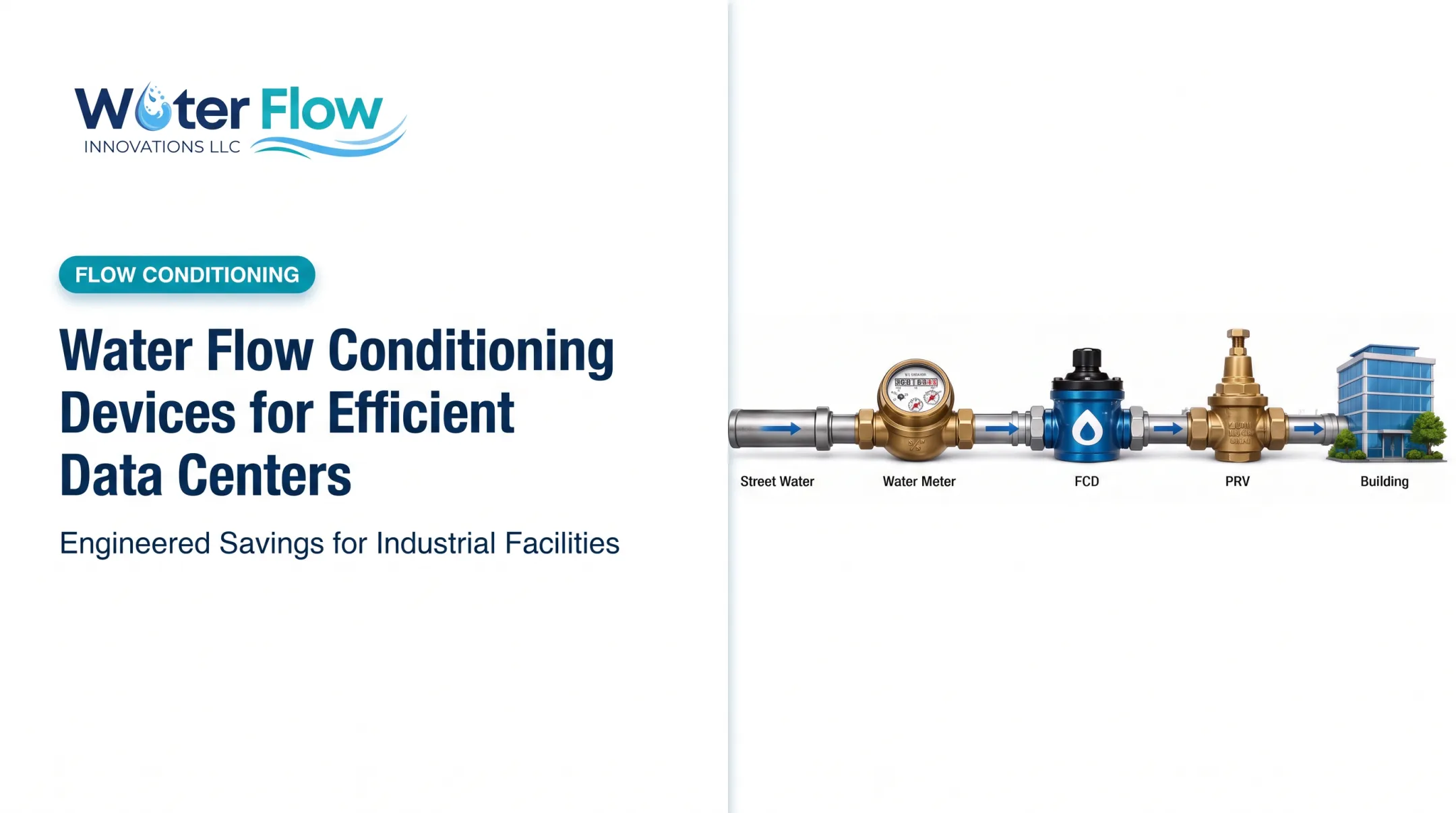
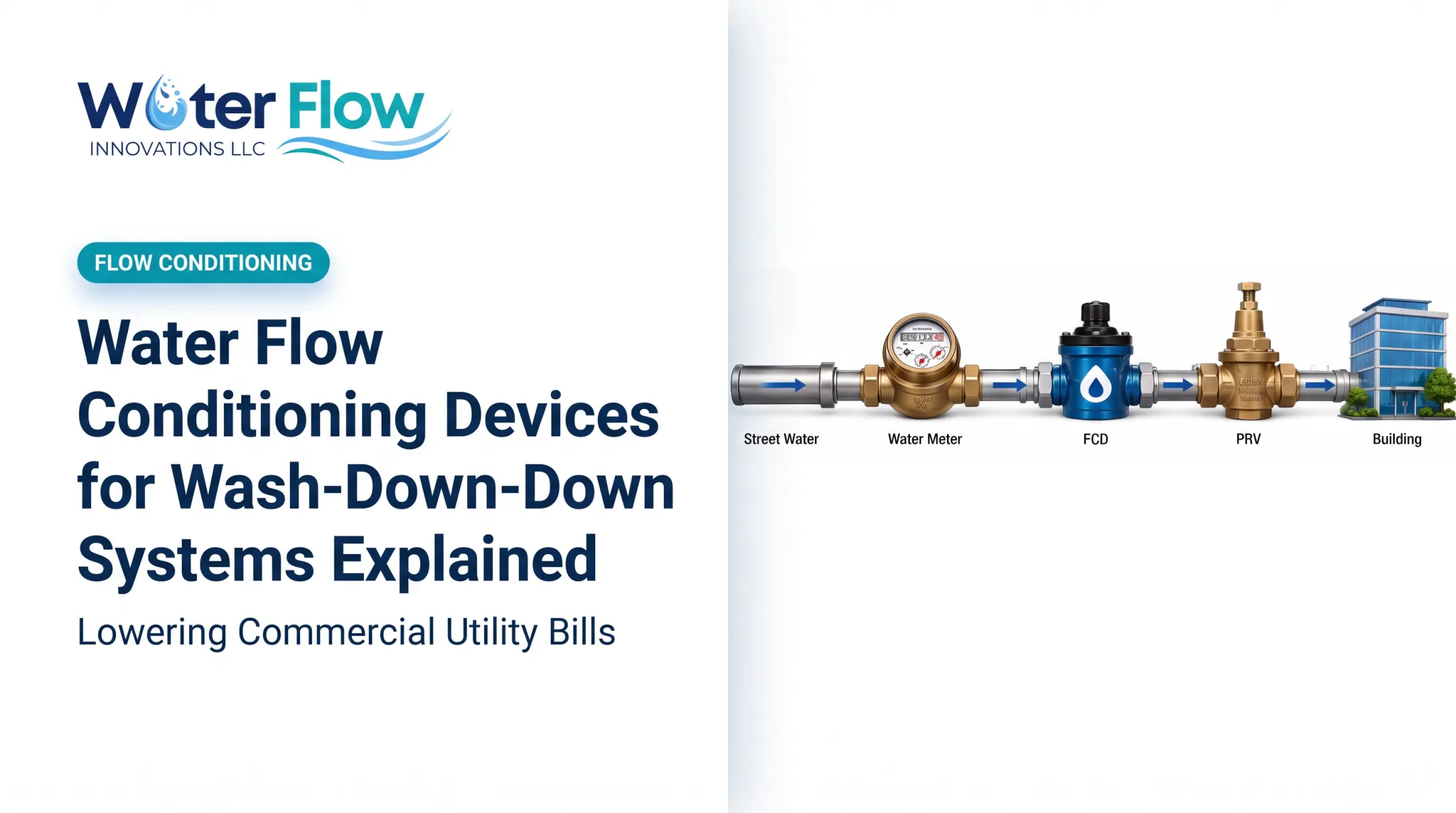
A water flow conditioning device is not a filter, softener, pressure-washing accessory, or leak detector. It doesn't treat water chemistry or reduce consumption. Instead, it's installed near a water meter to address the physical conditions that drive over-registration: entrained air, pressure swings, and turbulence. Those conditions can cause certain meter types to over-register flow.
Air can enter commercial plumbing through several paths: pump cycling, pressure changes, supply-side leaks, or irregular line configuration. An IWA-published laboratory study found that single-jet and multi-jet meters registered flow while an initially empty pipe refilled and expelled air, producing excess registered volume during refill.
Researchers caution against extrapolating lab results to every operating system. A dealership should confirm whether comparable pipe-emptying and refilling actually happens on site.
Meter design matters too. OIML's 2024 test method for water meters addresses swirl and asymmetric upstream flow, but notes that oscillating-piston and nutating-disc volumetric meters are largely insensitive to these installation conditions. Identifying your meter type is step one before considering any conditioning solution.
The Four Functional Elements
Water Flow Innovation's Flow Conditioning Device (FCD) is built around four components:
- Air and gas management: rather than venting air out of the line, the system uses static pressure to keep entrained air and micro-bubbles from reaching the measurement zone.
- Pressure regulation: stabilizes flow entering the meter, reducing surges tied to pump cycling or variable demand.
- Check valve: included on select models to limit reverse flow and water-hammer events.
- Turbulence reduction: slows velocity just enough to prevent the spinning vortex pattern associated with meter over-counting.
What it does: addresses meter-registration conditions so billed volume more closely reflects delivered water.
What it doesn't do: manufacture water savings, fix leaks, or substitute for operational efficiency improvements.
Water Flow Innovation builds the FCD for any pipe size (NPS ½" to 12") and any meter type, with a negligible-pressure-loss design. Rare installations may see a drop of a few psi. Confirm technical specifications for your dealership's meter and piping before you buy or lease.

Why Water Flow Conditioning Devices May Matter for Car Dealerships
Dealerships generate highly uneven flow demand throughout the day:
- Vehicle wash and rinse stations — new-car prep, used-vehicle reconditioning, and detail bays that start and stop constantly.
- Service-department washdown — parts cleaning, maintenance-area rinse-downs, customer and employee restrooms.
- Site-specific uses — landscaping, irrigation, and cooling equipment where applicable.
Wash-cycle starts and stops create pressure surges and turbulence—precisely the conditions flow conditioning is designed to address.
Dealership managers also favor solutions that don't require retraining staff or slowing vehicle prep. System pressure at spray arches, rinse nozzles, and spot-free systems should stay unaffected when the device is properly specified.
Water and Sewer Charges Can Compound
Because sewer charges are often calculated from metered water consumption, a registration issue can hit both line items at once. But sewer billing treatment varies by utility and won't always mirror water charges one-for-one.
A realistic scenario: A dealership notices variable flow during peak wash periods and an unexpected jump in utility charges. The facility manager rules out leaks through a standard leak check, then investigates whether air or turbulence near the meter could be influencing the reading.
Flow Conditioning vs. Other Water-Cost Measures
| Measure | What it addresses |
|---|---|
| Leak detection and repair | Water physically escaping the system |
| Low-flow fixtures or process changes | Actual consumption reduction |
| Reclaimed-water systems | Source or reuse cycle |
| Flow conditioning | Conditions surrounding meter registration |
Before deciding anything, document:
- Billing history and meter readings
- Operating schedules and wash volume
- Pressure complaints
- Known plumbing changes
- Any unexplained utility adjustments
Business and Sustainability Benefits to Investigate
For dealerships, the financial upside is more accurate billing, not a guaranteed drop in water use. Wash bays, detail shops, and campus-style service lines often drive high combined water and sewer charges—so meter over-reading is worth checking against your bills.
Water Flow Innovation reports an average 5–30% reduction in combined water and sewer bills, with a highest documented reduction of 46%. Treat those figures as a condition-specific range, not a promise. Use them to pressure-test a site proposal, not as a universal benchmark.
Estimating Payback
Compare equipment and installation costs against verified changes in billed charges over matching operating periods (same season, similar volume). Water Flow Innovation reports that 90% of its customers reach full ROI within 12 months, but your payback still hinges on baseline usage, sewer rate design, and meter setup.
Skip any universal ROI claim. Ask for a written, site-specific projection tied to your dealership’s recent bills.

Operational Continuity
Bill impact only helps if install doesn’t stall service lanes. The company states installation typically takes about an hour, with minimal disruption to normal operations.
Site conditions still matter: meter location, pipe material, and service-line access can extend the timeline. Confirm the plan against your dealership’s operating hours before you schedule.
Sustainability Reporting
Documented before-and-after utility data can support ESG water-stewardship reporting or internal sustainability tracking—useful if your group already reports utility KPIs.
If you're pursuing LEED documentation, USGBC's metering prerequisite still requires permanent meters that track total potable use and multi-year data sharing. A flow conditioning install alone does not automatically satisfy a credit. Confirm eligibility with your LEED consultant before claiming points.
Certifications
Water Flow Innovation lists IAPMO, NSF International, ANSI, CAN 61, KIWA, GMP, and SQF certifications. Those marks typically cover material health-effects and manufacturing-site standards—not meter-accuracy or billing performance by themselves.
Ask which certification applies to the specific device and use case before treating any mark as proof of bill impact.
Get It in Writing
Request a written proposal covering:
- Expected outcomes and how savings will be measured
- Warranty terms (Water Flow Innovation offers a lifetime transferable warranty)
- Maintenance responsibilities
- Installation responsibility and timeline
- Money-back guarantee conditions (the company's 6-month guarantee refunds the device price; installation cost is non-refundable)
- Lease versus purchase terms
How to Evaluate and Implement a Device at a Dealership
Build Your Baseline First
- Pull billing history. Collect several cycles of water and sewer invoices (ideally 12 months) and separate fixed charges from usage-based charges.
- Document the system. Record meter type, pipe size, service-entry layout, pressure readings, and any recent plumbing or equipment changes.
- Rule out other causes. Check for leaks, running fixtures, irrigation faults, wash-equipment losses, and billing errors before attributing cost increases to meter over-registration.
- Ask your utility. Find out how water and sewer charges are calculated, and whether unusual flow conditions affect your specific billing.
Set Up a Verification Plan
Before installation, establish baseline meter readings and identify comparable operating periods — accounting for seasonal shifts, wash volume changes, and occupancy variation. This gives you an honest before-and-after comparison rather than a coincidental one. Note any planned service bay closures, remodeling, or seasonal sales promotions that could shift water use during the comparison window, and keep a written log so results hold up to later scrutiny.
Installation Considerations
Coordinate placement relative to the meter, access to the service line, any shutdown requirements, local plumbing codes, and backflow rules with your facility management team. Note that flow conditioning devices cannot be installed on fire-line systems. Most installations run about an hour, so a short water shutoff window is typically all you need to schedule with your service team.
Questions to Ask a Provider
- Which meter types and pipe sizes are supported?
- What pressure loss should we expect at our dealership's operating flow?
- What certifications apply to this exact model and installation?
- What maintenance, inspection, warranty, lease, and removal terms apply?
- How will savings be measured, and what happens if results fall short?
Water Flow Innovation's FCD is one option to evaluate on these terms: it's custom-fabricated per facility specification (pipe sizes from ½" to 12", available in 316L stainless steel), priced from roughly $799 to $44,999 depending on configuration, with purchase or lease options. Confirm all current terms directly with the provider before committing.

Implementation Checklist
- ✅ Review provider proposal and confirm certifications apply to your specific unit
- ✅ Coordinate installation timing with utility and facility management
- ✅ Document pre-installation meter readings and operating conditions
- ✅ Record post-installation readings across comparable periods
- ✅ Compare invoices cycle-by-cycle, not just a single bill
- ✅ Prepare an internal report for ownership or finance teams
Frequently Asked Questions
What is a water flow conditioning device?
It's a system designed to condition water flow near a meter by addressing entrained air, pressure variation, reverse flow, and turbulence. The goal is more accurate meter registration, not water treatment.
How does a water flow conditioning device work?
Most designs combine air/gas management, pressure regulation, a check valve, and turbulence reduction. Together, these components create a more stable, predictable flow profile through the meter.
Can a flow conditioning device reduce a car dealership's water bill?
It depends on your meter type, billing structure, and actual flow conditions. Any potential savings should be confirmed through verified before-and-after utility data, not assumed in advance.
Does a flow conditioning device reduce actual water usage?
No. It targets meter-registration accuracy, not conservation. Leaks, inefficient fixtures, and wasteful operating practices still need to be addressed separately.
Will installation disrupt dealership operations?
Disruption depends on your service-line layout and installation plan. Many installs take about an hour with little or no operational impact, but confirm timing against your site conditions.
How can a dealership determine whether it is a good candidate?
Use a short pre-decision checklist:
- Review utility bills and rule out leaks
- Gather meter and pipe details
- Note flow variability across wash and service bays
- Confirm sewer billing rules
- Set a documented before-and-after measurement plan