
That confusion has a cost. Install the wrong device, and you either keep paying inflated water bills or keep hearing pipes bang at 2 a.m. — sometimes both, because neither fixes the other's problem.
This guide breaks down what each device actually does, where each one belongs in your system, and how to figure out which one (or both) your facility needs.
Key Takeaways
- Flow conditioners correct turbulent flow at the meter, improving accuracy and cutting water/sewer bills
- Water hammer arrestors absorb shockwaves from quick-closing valves, stopping banging pipes and fitting damage
- One protects your budget; the other protects your infrastructure — they're not interchangeable
- Rising bills point to a flow conditioner; banging pipes point to an arrestor — many facilities need both
Flow Conditioner vs Water Hammer Arrestor: Quick Comparison
| Dimension | Flow Conditioner | Water Hammer Arrestor |
|---|---|---|
| Primary Function | Stabilizes the disturbed flow profile at the meter | Absorbs pressure surges from abrupt valve closure |
| Root Problem Solved | Meter over-registration from turbulence and disrupted flow | Pipe-damaging shockwaves and banging noise |
| Installation Location | Immediately after the main water meter, on the consumer side | Near the quick-closing valve or appliance (washing machine, solenoid, flush valve) |
| Financial Impact | Directly lowers water/sewer billing without changing usage | Avoids repair costs from burst pipes, failed joints, and appliance damage |
| Ideal Facility Type | High water-use, process-intensive facilities (manufacturing, hospitality, healthcare) | Facilities with frequent valve cycling (multifamily, hotels, laundromats, hospitals) |
What Is a Flow Conditioner?
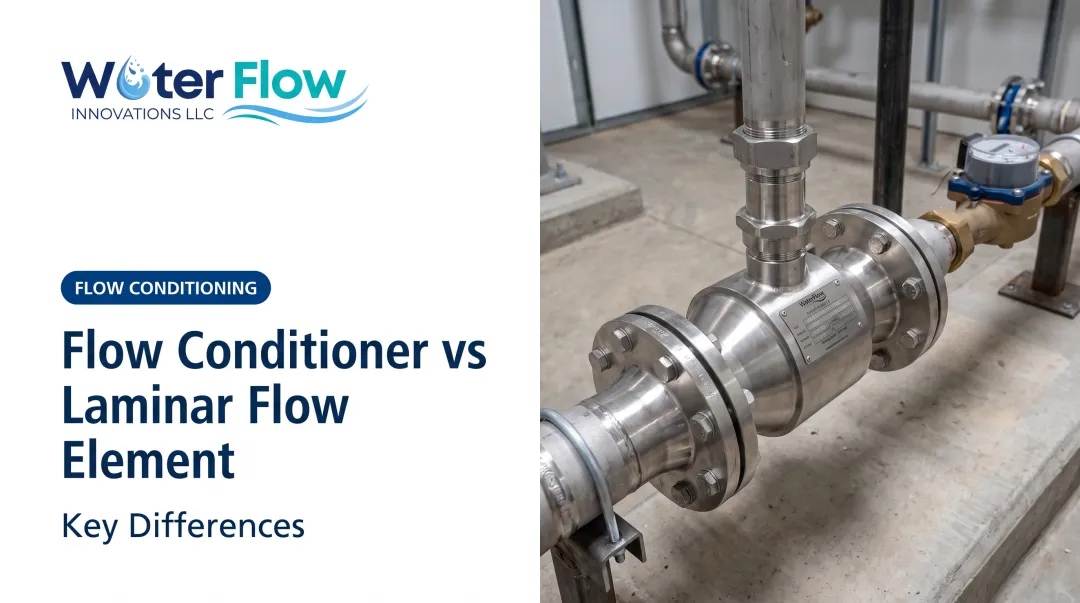
A flow conditioner is a device installed on the incoming water line that stabilizes turbulent flow at the meter. Disturbances from elbows, tees, valves, and variable-speed pumps distort the water's velocity profile. That swirl and turbulence hit right where accuracy matters most: the meter.
Water Flow Innovation's Flow Conditioning Device (FCD) tackles this through a four-component mechanism:
- Air & gas separation: creates static back-pressure to promote laminar flow so the meter sees a homogeneous water column
- Pressure regulation: reduces surges from on-off cycling and stabilizes the meter environment
- Check valve (optional): limits reverse flow and pressure spikes that could reintroduce air into the line
- Turbulence elimination: slows velocity enough to prevent vortex flow during high-volume events like CIP cycles or tank filling

More accurate metering means lower billed water and sewer costs, without any change in actual consumption or system performance.
Certifications Worth Checking
For commercial buyers, certifications matter because they signal code compliance and reduce qualification risk with engineering or facilities teams. Look for:
- IAPMO: plumbing code compliance
- NSF: potable water safety
- ANSI: national consensus standards
- KIWA: European water performance certification
Water Flow Innovation's FCD carries all of these, plus CAN 61, GMP, and SQF certifications relevant to food and pharmaceutical facilities.
Use Cases of Flow Conditioners
Flow conditioners are typically installed right after the main water meter, before the pressure-reducing valve if one is present, so they condition incoming flow before it's distributed internally.
Industries where meter accuracy issues are common and costly:
- Manufacturing and industrial plants (chemical, automotive, pulp and paper)
- Food and beverage processing, including bottled water and dairy
- Healthcare facilities and hospitals
- Hospitality (hotels, resorts)
- Multifamily and high-rise residential buildings
- Data centers and semiconductor manufacturing
These operations share common drivers: entrained air, pressure cycling, batch surges, cooling-tower makeup water, and CIP wash cycles. All of these disturb flow at the meter.
Documented results from Water Flow Innovation show average water and sewer bill reductions of 5-30%, with a highest documented single result of 46%.

Roughly 90% of customers reach full ROI in under 12 months. Because savings appear on the next billing cycle, some facilities recover their investment in as little as a month.
What Is a Water Hammer Arrestor?
A water hammer arrestor is a shock-absorbing device built around a permanently sealed, gas-charged chamber. When a valve slams shut, a moving column of water stops abruptly, sending a pressure wave back through the pipe at roughly 4,000 to 4,500 feet per second, according to the PDI WH-201:2017 standard.
The arrestor's gas cushion compresses to absorb that energy before it reaches your fittings. Repeated shock loosens joints, stresses valves, and shortens the working life of equipment on the system. A properly sized arrestor protects piping infrastructure and cuts maintenance and repair costs over time.

Common Variations
- Mini-rigid units — compact form factor for tight installation spaces
- Bellows-type — mechanical bellows separate air from water; common in certified models such as MIFAB's stainless steel bellows arrestor
- Pipe-mounted or in-wall models — chosen based on fixture access and whether the unit must stay concealed
Note: plain capped-pipe air chambers are not the same thing. PDI documentation warns that their air can dissolve into the water over time, leaving them "waterlogged" and ineffective — which is exactly why certified, sealed-gas arrestors exist.
Use Cases of Water Hammer Arrestors
Arrestors belong at the point of use, as close as possible to the fixture or valve causing the shock. Typical locations include:
- Washing machines and dishwashers
- Solenoid valves
- Flush valves on toilets and urinals
- Quick-closing equipment in commercial kitchens
Water hammer is most disruptive in multifamily buildings, hotels, laundromats, and hospitals with frequent valve cycling—anywhere quick-closing fixtures operate constantly throughout the day.
Sizing and placement aren't arbitrary. The PDI WH-201 standard classifies arrestors by fixture-unit load (classes AA through F) and sets placement rules:
- On branches serving multiple fixtures up to 20 feet long, install between the final two fixtures
- On longer branches, an additional arrestor is required
- For a single remote appliance, place the arrestor as close to that valve as possible, not at the top of a riser
Skipping these rules is a common reason arrestors underperform. An undersized unit on a high-fixture-count branch simply won't absorb the surge it's facing.

Flow Conditioner vs Water Hammer Arrestor: Which One Do You Need?
Start with the symptom, not the product.
Ask yourself:
- Hearing banging or knocking in the pipes? → Water hammer arrestor
- Water and sewer bills climbing despite stable usage? → Flow conditioner
- Both? → You likely need both devices, installed independently
These devices solve unrelated problems. A flow conditioner won't quiet banging pipes, and an arrestor won't touch your metering accuracy. Many well-run facilities run both as part of a complete water management approach. There's no conflict between them.
Not sure which issue you're dealing with? Water Flow Innovation offers a free water bill review and savings analysis that shows whether meter over-reading is driving up costs. You can also use the 30-second online savings calculator for a quick estimate.
Real-World Example: Solving High Water Bills with Flow Conditioning
Consider a mid-size multifamily property paying $18,000 a month in combined water and sewer charges. Usage patterns hadn't changed year over year, yet bills kept climbing: a classic sign of meter over-registration rather than an actual increase in consumption.
Once the facility manager traced the climb to meter accuracy, the property installed a Water Flow Innovation FCD immediately after the main meter. Installation took about an hour, with no disruption to residents or building operations.
At a 20% reduction (within the documented 5-30% average range), that property saved roughly $3,600 per month, or $43,200 annually. At a 4.5% cap rate, that operating-cost reduction translated into an estimated $960,000 in added property value.

Takeaway: If your facility is dealing with unexplained bill increases and stable usage, investigate meter accuracy before assuming consumption is the culprit.
If your numbers look similar, Water Flow Innovation offers a free bill review to check whether flow conditioning could apply to your property.
Conclusion
Flow conditioners and water hammer arrestors solve different problems. One protects your budget by correcting how your meter reads water already passing through your pipes. The other protects physical infrastructure from the repeated shock of valves slamming shut.
Confusing the two, or assuming one can substitute for the other, wastes money and time. Rising utility costs point to a flow conditioner. Banging pipes and premature fitting failures call for a water hammer arrestor.
Many facilities eventually install both. Matching each device to the real problem delivers lower utility bills, longer-lasting plumbing, and fewer maintenance calls.
Frequently Asked Questions
How long does a water hammer arrestor last?
PDI describes sealed-gas arrestors as controlling shock for "many years" under normal conditions. Older air chambers can become waterlogged and lose effectiveness sooner—a sign they need replacing.
Do I need a water hammer arrestor?
Any facility with quick-closing valves (washing machines, dishwashers, flush valves) benefits from one, especially if you're already hearing banging pipes. Code (IPC 604.9) requires an ASSE 1010-listed arrestor wherever quick-closing valves are used.
Where should a water hammer arrestor be installed?
As close as possible to the quick-closing valve or appliance causing the shock, not at the top of a riser. For branches serving multiple fixtures, PDI standards place it between the final two fixtures.
Can a flow conditioner reduce my water bill without changing how much water I use?
Yes. Flow conditioners correct meter over-reading caused by turbulence and disturbed flow, so your billed usage drops even though actual consumption stays the same.
Can I install both a flow conditioner and a water hammer arrestor in the same system?
Yes. They address different points and functions in the plumbing system, so there's no conflict installing both.
How do I know if my water meter is over-reading due to turbulence?
Watch for unexplained bill spikes despite stable water usage. A professional flow assessment or free bill review can confirm whether turbulence is the cause.
How much of a reduction has that correction produced?
An average 5–30% across combined water and sewer charges, with a highest documented single result of 46%, landing on the very next billing cycle after the device goes in.
Does fitting one require taking the building offline?
No. A licensed plumber or mechanical contractor installs it at the supply connection in about an hour, with a brief water shutoff at the meter connection, and existing arrestors stay in place at their fixtures.