This scenario is more common than most facility managers realize — and the answer isn't always a hidden leak. Water meters can malfunction outright, or they can appear fully functional while systematically over-reporting consumption due to air entrainment, turbulent flow, or internal wear. Knowing which problem you're dealing with changes everything about how you respond.
This guide walks through the observable warning signs, three field-tested diagnostic methods, how to interpret what the results actually mean, and what to do once you have a confirmed fault.
Key Takeaways
- Faulty meters fail in two ways: mechanical breakdown or calibration drift that causes over-reading
- Three reliable field tests — shut-off, volume accuracy, and sequential reading — can confirm a problem
- Passing a utility tolerance check doesn't mean a meter is billing you accurately under real conditions
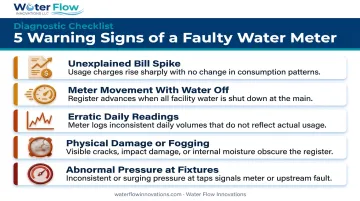
- Key warning signs: unexplained bill spikes, movement with all water off, erratic readings, visible damage, abnormal pressure
- Document your findings before contacting the utility; never tamper with the meter yourself
Warning Signs Your Water Meter May Be Faulty
Most meter problems give you advance warning before you need to run a formal diagnostic. These observable signals are your first checkpoint — assess them before investing time in structured testing.
Unexplained Spike in Water Bills
A sudden increase in billed consumption with no corresponding change in operations — no new equipment, no additional occupants, no irrigation expansion — is the most common early indicator of a meter problem.
The critical distinction: this spike could mean either a hidden leak (the meter is correctly recording real water loss) or meter over-reading (the meter is recording consumption that never occurred). You can't distinguish between the two by looking at the bill alone. That's exactly what the tests in the next section are designed to determine.
State regulators in Washington and Kentucky have established that a measured meter error exceeding 2% to the customer's detriment triggers mandatory utility action. That threshold matters: billing disputes backed by documented meter error carry real regulatory weight.
Meter Movement With All Water Shut Off
Check the low-flow indicator (typically a small triangle or spinning dial) using these steps:
- Confirm all taps, toilets, appliances, and irrigation are off
- Watch the indicator for 5–10 minutes without disturbing the system
- Any movement indicates either a hidden leak in the supply system or the meter registering phantom flow with no water actually moving
Inconsistent or Erratic Readings
Record the meter at the same time each day for 3–5 days. Compare the daily consumption delta against your known usage patterns. Large, unexplained swings between days — especially on days with comparable operations — point to erratic meter behavior. Both mechanical meters with worn impellers and digital meters experiencing sensor drift are known to produce inconsistent reads.
Physical Damage, Fogging, or Leaks
Walk up to the meter and look carefully for:
- Cracks in the meter body or lens
- Corrosion or rust at pipe fittings
- Condensation or fogging behind the dial glass (indicating moisture intrusion)
- Pooling water around the meter housing
Any of these warrants immediate follow-up, regardless of whether the meter appears to be reading correctly.
Abnormal Water Pressure at Fixtures
A partially blocked meter can restrict flow and drop pressure at downstream fixtures. If multiple fixtures throughout the facility are showing lower pressure than normal, with no known supply-side cause, an internal meter blockage is a plausible cause.
Normal pressure does not clear the meter of suspicion. Over-reading caused by air entrainment or turbulent flow can occur even with only a slight water pressure loss (0-3 psi).
How to Test Your Water Meter for Faults
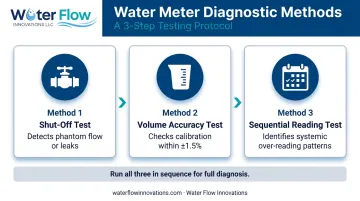
Run all three methods in sequence. Together, they can distinguish between a hidden leak, a mechanically failed meter, and a meter that's over-counting due to flow conditions. No single test tells the full story.
Method 1: The Shut-Off Test
This test detects flow registration when no water is actively being used — identifying both leaks and phantom registration. You'll need access to the meter, a flashlight if visibility is limited, and a smartphone or watch for timing.
Steps:
- Confirm every water-using fixture, appliance, toilet, and irrigation zone is fully off. Close toilet fill valves manually if you're uncertain — a slow-running fill valve is enough to skew this test.
- Observe the low-flow indicator (small triangle or needle) for a minimum of 5–10 minutes without disturbing the supply line.
- If the indicator moves, note the direction and rate. Photograph the meter display before and after the observation window to document any reading change.
Keep in mind: movement alone doesn't confirm meter malfunction versus an active leak. Run Method 2 to isolate the cause.
Method 2: The Volume Accuracy Test
This test checks calibration accuracy — whether the meter records the correct volume for a precisely known amount of water. Gather a calibrated container (a measured 5-gallon bucket works well) and a way to log readings.
Steps:
- Stop all other water use in the facility. Photograph the exact meter reading to establish your starting point.
- Fill the calibrated container a set number of times using a single controlled tap — for example, three fills of a 5-gallon bucket equals exactly 15 gallons. No other flow should be running.
- Record the new meter reading and calculate the difference. Compare it to the known volume, accounting for your meter's unit of measurement. Conversion note: 1 gallon ≈ 0.134 cubic feet — confirm the unit printed on your meter face before calculating.
Interpreting the result: AWWA-derived accuracy standards use a ±1.5% registration band at intermediate and high flow rates for most commercial meter types. A discrepancy exceeding 2% has direct regulatory support as an action threshold in states including Washington and Kentucky. If your result falls outside that range, it warrants escalation.
This method works best at a single dedicated fixture. In complex commercial facilities with multiple simultaneous draws, isolate the environment as tightly as possible before testing.
Method 3: The Sequential Reading Test
One disrupted day can skew results. If occupancy or operations vary significantly on a given day, note it in your log — don't exclude it, but account for it when interpreting the pattern.
How to Interpret Your Water Meter Test Results
Normal / No Fault Detected
A clean result looks like this: the shut-off test shows zero movement, the volume test matches within ±1.5% at normal flow rates, and sequential readings track proportionally with logged usage. If all three are clean, the meter is likely functioning correctly — look upstream at billing process errors or check for a supply-side issue with your utility.
Meter Moving With All Water Off — Likely a Leak
Movement during the shut-off test almost always indicates a hidden leak in the supply system rather than a faulty meter. To narrow down the location, check toilet fill valves and flush mechanisms first (they're the most common culprit), then irrigation zone valves, then underground supply lines. Engage a licensed plumber for confirmation — the meter is likely doing its job correctly by recording real water loss.
Volume Test Mismatch — Meter Over- or Under-Reading
A discrepancy beyond ±1.5% at normal flow indicates calibration failure or internal wear. However, there's a second explanation that gets overlooked: air entrainment and turbulent flow.
When air pockets pass through a meter's measurement zone, the meter counts them as water volume. Turbulent vortex flow can also artificially accelerate the meter's internal mechanism, producing inflated readings. In both cases, the meter isn't mechanically broken: it measures accurately under controlled test conditions but systematically over-reports under real operating conditions.
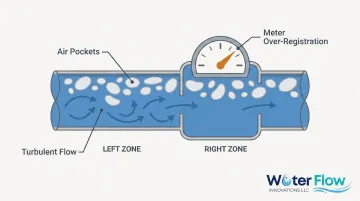
PNNL's federal metering guidance identifies turbine and compound meters as installation-sensitive and calls for flow conditioning or adequate straight pipe as the correction.
That root cause is what Water Flow Innovation's Flow Conditioning Device (FCD) addresses. Its four-component system — air/gas separation, pressure regulation, check valve, and turbulence elimination — creates laminar, bubble-free flow in the measurement zone, so the meter registers only actual water. Water Flow Innovation has documented bill reductions of 5–30%, with a highest single-site result of 46%.
Sequential Pattern Points to Systemic Over-Reading
The pattern to recognize: the meter consistently records more than usage logs can account for, the shut-off test is clean (ruling out a leak), and the volume test shows a repeatable surplus. This combination warrants two actions: request a formal meter test from your utility provider, and evaluate whether flow conditioning at the meter addresses the root cause without requiring replacement.
Common Mistakes When Checking Your Water Meter
Certain testing mistakes routinely lead facility managers to the wrong conclusion: either missing a real problem or triggering an unnecessary meter replacement.
Not shutting off every water source before testing. A running toilet fill valve or a slow drip from an outdoor hose bib creates movement during the shut-off test, producing a false leak reading. Physically verify each fixture — don't assume.
Measuring volume with an imprecise container. A jug labeled "approximately 5 gallons" introduces enough error to make a borderline meter look fine or faulty. Use a precisely measured vessel or a known-volume appliance cycle instead.
Misreading the meter's unit of measurement. Meters display in cubic feet, gallons, or cubic meters. Confirm which unit is printed on your meter face before calculating — applying the wrong conversion produces completely misleading results.
What to Do When Your Water Meter Is Faulty
Once you've identified a likely fault, follow this sequence:
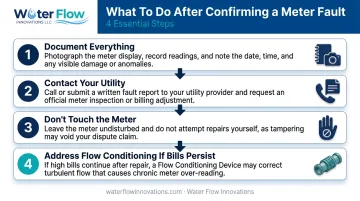
Document everything. Photograph meter readings before and after each test. Write down dates, times, calculated discrepancies, and the conditions during each test. This documentation is essential for any billing dispute.
Contact your utility provider. Request a formal meter test or inspection. In most U.S. jurisdictions, the utility owns the meter and is responsible for accuracy. In Washington State, for example, utilities must test within 10 days of an accuracy complaint and replace the meter at no cost if error exceeds 2% to the customer's detriment. Oregon requires testing within 7 calendar days. Policies vary: check your local utility's tariff or commission rules.
Don't touch the meter yourself. Meters are utility property. Tampering can void any billing dispute claim and may create legal or code compliance issues. Involve a licensed plumber for any physical work on the supply side.
If bills remain elevated after the utility confirms the meter is within tolerance, the issue may be systemic over-reading from air entrainment or flow turbulence. Standard utility tests don't replicate real operating conditions, so a meter can pass inspection while still over-recording. A flow conditioning device installed after the meter corrects the turbulence and air entrainment causing the over-read. Water Flow Innovation's IAPMO, NSF, ANSI, CAN 61, KIWA, GMP, and SQF-certified FCD installation is usually about an hour (+/-) with a brief water shutoff, and corrected billing shows up on the next cycle.
Frequently Asked Questions
What are common symptoms of a faulty water meter?
The main signs are unexplained bill increases, the flow indicator moving when all fixtures are confirmed off, inconsistent daily readings, visible physical damage or fogging behind the dial, and abnormal downstream pressure. Whether the cause is mechanical failure or calibration drift, the billing impact is the same.
How common are faulty water meters?
Outright mechanical failures are uncommon, but research confirms that meter accuracy degrades over time while meters continue to operate — meaning a meter can reach the end of its useful accuracy life without failing completely. Calibration drift and over-reading become more likely as meters age and accumulate throughput.
What is the average lifespan of a water meter?
AWWA guidance recommends evaluating meter life by cumulative consumption, not calendar age — a high-flow commercial facility can exhaust a meter's accuracy range far sooner than a low-flow one. Accuracy typically degrades before the meter fails outright, so periodic testing matters regardless of how old the meter is.
Do I have to pay for a replacement water meter?
In most U.S. jurisdictions, the utility owns the meter and covers replacement costs if testing confirms inaccuracy. Policies vary — some utilities charge an upfront test fee, and property owners may be responsible for related internal plumbing. Check your local utility's tariff before assuming coverage.
Can a water meter over-read without being mechanically broken?
Yes. Meters can systematically over-report consumption due to air entrainment or turbulent flow — conditions that standard bench testing doesn't replicate. The meter's internal mechanism counts air pockets as water volume, producing inflated readings even when the meter passes a formal accuracy check.
What should I do if my utility says the meter is accurate but my bills are still high?
Air entrainment or pipe turbulence may be causing over-reading under actual operating conditions that a bench test won't catch. A certified Flow Conditioning Device corrects the root cause without meter replacement. Water Flow Innovation offers a free bill review to quantify potential savings before any commitment.
What does the free bill review actually examine?
Recent water and sewer billing cycles, meter size, pipe size, line pressure, and PRV configuration, plus your facility's water-use profile. It returns a projected savings range, device sizing recommendation, ROI estimate, and installation plan, and is completed remotely from uploaded bills.
What certifications should a corrective device hold?
Look for approvals that cover potable supply lines. The FCD is certified by IAPMO, NSF International, and KIWA, and complies with the EPA WaterSense program. It is built from 316L stainless steel, made in the USA.