
For high-volume tunnels and in-bay automatics (IBAs), this shows up as shrinking margin per car. Chemicals and labor get scrutinized every month. Water rarely does.
Here's the uncomfortable truth: a large chunk of what operators call "water cost" isn't actually washing cars. It's leaks, inefficiency, and meters that can't tell the difference between water and air. This article breaks down how those costs build, what drives them, and what you can do about it — without touching wash quality.
Key Takeaways
- Water and sewer bills are among the top operating costs at most car washes, per Professional Carwashing & Detailing
- Costs build gradually (aging equipment) or spike suddenly (leaks, reclaim outages)
- Wash format, equipment age, undetected leaks, and meter accuracy drive most of the bill
- Cut costs at three levels: smarter purchases, active monitoring, and structural corrections
- Flow conditioning at the meter can deliver 5-30% average bill reductions starting next cycle
How Costs Around Car Wash Water Bills Typically Build Up
Water costs aren't one big number: they're hundreds of small ones, multiplied. A wash running 300 cars a day compounds even a 2-gallon-per-vehicle inefficiency into thousands of extra gallons monthly.
Some of this creep is gradual. Other spikes hit overnight. Common drivers include:
- Aging valves and a reclaim pump losing efficiency
- A controller slowly drifting out of calibration
- A solenoid valve failing overnight
- A reclaim system offline for a weekend while the wash runs full fresh water unnoticed
The core problem: most operators never formally audit water the way they audit labor or chemical spend. One Auto Laundry News example found a leak costing nearly $4,900 in a single quarter before it was caught, money that simply vanished into a bill nobody line-item reviewed.
Key Cost Drivers for Car Wash Water Bills
Not every wash bleeds money the same way. The drivers depend heavily on format, equipment age, and local rate structure.
Consumption Baseline by Wash Type
Fresh-water use varies significantly by format. An International Carwash Association (ICA)-sponsored study of reclaim-equipped sites found:
- Conveyor/tunnel washes: averaged 30 fresh gallons per vehicle
- In-bay automatic (IBA) formats: averaged 44.8 fresh gallons per vehicle

These numbers set your cost floor before anything else comes into play.
Equipment and Structural Drivers
- Build-out choices (blowers, pumps, reclaim systems, tunnel controllers) lock in utility exposure for years
- Undetected leaks in solenoid valves, restrooms, or reclaim tanks erase savings from other upgrades
- Municipal rate structures often bill sewer as 80–100% of metered water, so a water problem becomes a sewer problem too
- Meter accuracy gaps leave most operators blind: standard meters can't tell air from water in the line
High-pressure wash systems cycle on and off dozens or hundreds of times daily. Each start-stop event introduces air and turbulence into the line — exactly the conditions meters struggle with most.
Cost-Reduction Strategies for Car Wash Water Bills
Strategies fall into three buckets: what you decide to buy, how you manage daily operations, and what you fix around the meter itself.
Purchase and Equipment Decisions
- Invest in a water reclaim system. Reclaim percentages vary by system; evaluate ROI against your volume and rates rather than a generic payback figure
- Choose tunnel controllers with to-the-inch accuracy and vehicle profiling to avoid wasting water on unoccupied tunnel space
- Select VFDs (variable frequency drives) for blowers and pumps. Professional Carwashing documented a pressure-transducer setup that avoided bypassing 20% of pump water
- Reuse RO reject water in rinse cycles rather than treating it as waste

Daily Water Management
- Log meter readings daily. Catching a spike within 48 hours beats discovering it on next month's bill
- Run leak surveys during closed hours. If the meter shows any flow when nothing's running, you have a leak
- Use stagger-starting and look-back logic on tunnel controllers to cut peak-demand charges and unnecessary drying cycles
- Track reclaim system uptime. Even a few hours offline forces full reliance on costlier fresh water
Meter Accuracy and Billing Context
Here's the piece most operators never think to check: what happens between the meter and the pipe.
Every time a high-pressure system cycles, it introduces air, turbulence, and micro-bubbles into the water line. Standard meters often can't distinguish that air from actual water, and they bill it anyway. Wash operations are particularly exposed because pressure cycling happens constantly throughout the day.
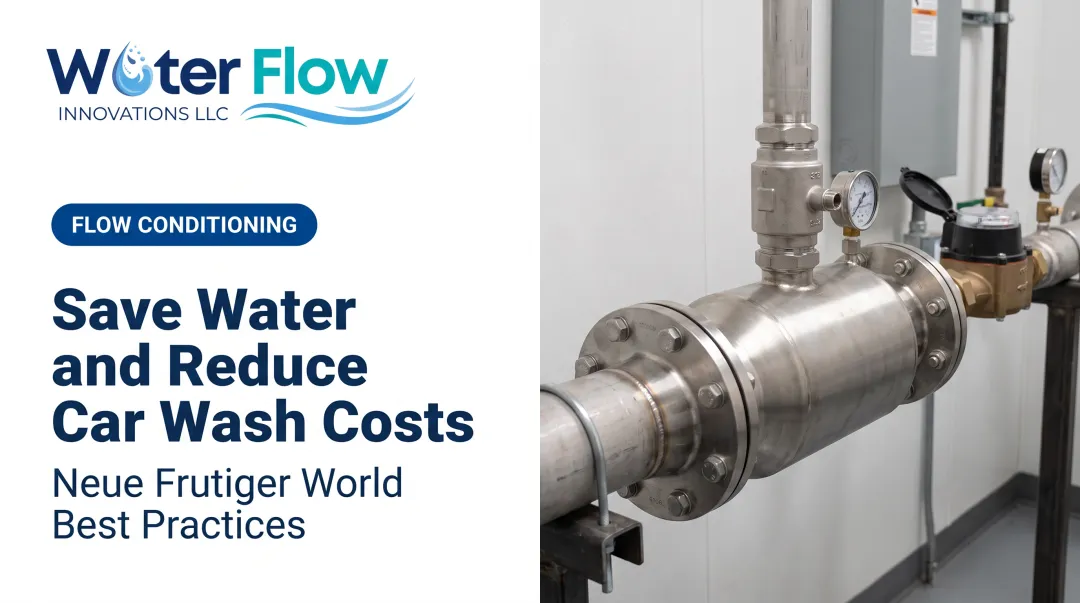
Water Flow Innovation's Flow Conditioning Device (FCD) targets that over-read. It installs directly after the water meter and:
- Removes entrained air and gas from the line
- Regulates pressure and reduces turbulence
- Requires no changes to wash equipment, pressure, or process

Installation typically takes about an hour, with zero disruption to wash operations. It doesn't touch anything inside the tunnel or bay.
Documented results run 5-30% average reductions on both water and sewer charges, with the highest single result at 46%. Because sewer is usually billed as a percentage of metered water, correcting the meter reading cuts both charges at once. Savings typically show up on the very next billing cycle.
For reclaim-equipped washes, the FCD sits before the reclaim system and doesn't change how reclaim operates — it corrects the fresh-water billing that feeds into it.
Other structural levers worth checking:
- San Antonio Water System offers a 10% sewer discount for qualifying WaterSaver Car Wash participants; Tampa reimburses up to 75% of commercial efficiency project cost
- If your utility bills sewer at a high percentage of water use, a water-side fix delivers outsized sewer savings too
Conclusion
Reducing car wash water bills starts with diagnosing where costs actually originate: usage, leaks, equipment inefficiency, or meter-level over-reading.
The most durable savings stack three layers:
- Smart purchasing decisions (reclaim systems, VFDs)
- Active daily management (leak monitoring, uptime tracking)
- Structural meter-side fixes, including flow conditioning to correct over-reading
Hit all three and you cut bills without cutting wash volume.
Frequently Asked Questions
How much is charged for a car wash?
Customer pricing varies by service tier, but the underlying water and sewer cost per vehicle depends on wash type and local rates. That cost directly eats into margin per ticket, even when the retail price stays the same.
Why is car wash so expensive?
Rising water and sewer rates, equipment energy demands, chemicals, and labor make washing vehicles costlier than most people assume. Leaks and meter inefficiency often add still more before operators notice.
How much water does a typical car wash use per vehicle?
Fresh-water studies show conveyor and tunnel washes averaging around 30 gallons per vehicle, and in-bay automatic (IBA) formats around 44.8 gallons per vehicle, though this varies by equipment and reclaim use.
What is the ROI timeline for a water reclaim system?
Payback depends heavily on reclaim percentage and local rebates, so there's no single universal timeline. Get a facility-specific analysis rather than relying on a generic figure.
Can a car wash reduce its water bill without changing its equipment?
Yes. Usage monitoring and meter-side flow conditioning can cut water and sewer bills without changing wash equipment or process. Documented reductions average 5–30%, with a highest documented result of 46%.
How quickly can water bill savings appear after making changes?
Flow conditioning devices typically show results on the very next billing cycle. Reclaim system upgrades take longer to reflect fully due to installation and calibration time.
Why is the sewer charge on a car wash bill so high?
Most utilities calculate sewer as a percentage of metered water intake, typically 80–120% of the water charge. Every phantom gallon is therefore billed twice, once as water and once as sewer, even though it never entered a drain. Car and truck washes are already high-discharge sites, and many also pay surcharges calculated from metered intake, so an over-reading meter is billed against twice. Truck stops and railway and freight locomotive washing operations share the same exposure.
Does flow conditioning interfere with a water reclaim system?
No. It corrects the accuracy of the incoming municipal meter and does not treat, filter, or alter water, nor connect to reclaim equipment. It does give a truer fresh-water makeup baseline, which makes reclaim performance easier to evaluate.