
The pain points stack up fast. Pressure surges stress your equipment. Water hammer damages valves and joints over time. Inconsistent flow disrupts operations. And meter over-reading from turbulent flow quietly inflates your water and sewer bills month after month.
This guide covers what causes pressure instability, the core techniques to stabilize it, and how flow conditioning fills the gap that pressure regulation alone can't close.
Key Takeaways
- Unstable pressure causes water hammer, equipment stress, and meter inaccuracy
- Flow conditioning removes turbulence and air that cause meters to over-register usage
- Pressure regulation plus flow conditioning delivers reliability and cost savings
- Routine pressure monitoring catches problems before they become expensive repairs
What Causes Pipeline Pressure Instability?
Pressure instability rarely comes from one source. It's usually a combination of mechanical and hydraulic factors working against your system at once.
Common triggers include:
- Sudden valve closures or openings
- Pump cycling (rapid on/off starts)
- Elevation changes along the pipeline route
- Abrupt pipe diameter transitions
- Demand fluctuations from variable facility usage
Water Hammer: The Pressure Spike You Can Hear
Water hammer happens when moving water stops or changes direction suddenly, typically from rapid valve operation or pump starts/stops. The resulting pressure wave can spike well beyond your system's maximum operating pressure, stressing components and, in severe cases, causing cavitation, valve damage, or pipe bursts.
Turbulence and Air Entrainment Near Meters
Fittings, bends, and valves positioned too close to a meter introduce turbulence that reduces measurement accuracy for most meter types. Turbine and compound meters are particularly sensitive here. Many require 5 to 10 pipe diameters of straight, undisturbed run upstream to read correctly.
Calculating Pressure Drop: The Basics
For steady-state friction loss (not transient surges), engineers commonly reach for two formulas: Hazen-Williams and Darcy-Weisbach. Both relate head loss to flow rate, pipe diameter, length, and a roughness or friction factor.
The EPA's EPANET manual notes Hazen-Williams is the most widely used formula for water distribution systems, while Darcy-Weisbach applies more broadly across fluid types. Neither formula calculates water hammer. That requires separate transient analysis.
Left unmanaged, instability leads to:
- Accelerated equipment wear and leaks
- Higher energy costs from avoidable pressure losses
- Inflated utility bills from meter inaccuracy

Core Techniques to Stabilize Pipeline Pressure
Stabilizing pressure means matching the right tool to the right problem. Here's what actually works.
Pressure-Reducing Valves and Regulators
A pressure-reducing valve balances a spring and diaphragm against downstream pressure, automatically throttling flow to maintain a target output pressure. It's your first line of defense against oversupply from the main line, but it doesn't absorb sudden transients on its own.
Surge Protection and Backflow Prevention
- Surge tanks/accumulators/air chambers: Absorb sudden pressure rises and release stored volume when pressure drops.
- Check valves: Stop reverse flow that drives secondary spikes; pair with controlled-closure designs so the valve itself doesn't slam.
In one modeled pipeline study, a properly sized surge tank cut peak pressure from over ~165 psi (116 m of head) to roughly ~102 psi (72 m). Results are site-specific, but the drop shows how much surge hardware can matter (MDPI study).
Pipe Sizing and Gradual Transitions
Abrupt diameter changes create turbulence at the exact point where you least want it. Gradual transitions and correctly sized meters (avoiding oversizing, which hurts low-flow accuracy) reduce instability before it starts.
Variable Frequency Drives on Pumps
Instead of pumps slamming on and off, VFDs ramp speed up and down smoothly to match demand. This eliminates the abrupt starts that trigger water hammer in the first place.
To keep pressure genuinely constant, combine:
- A correctly sized pressure regulator at the service entrance, plus surge or check protection where transients are likely
- Monitoring sensors at key points in the system
- Scheduled maintenance and valve exercising (utility SOPs often call for annual checks on critical valves)
Stable pressure is what lets the rest of flow conditioning hold: less swing means less turbulence at meters and fittings, and a steadier profile for downstream equipment.

Flow Conditioning: The Missing Link for Optimal Stability
Here's the piece most facilities overlook. Pressure regulation controls how much pressure reaches your system. Flow conditioning controls how stable that flow is by the time it hits your meter.
Flow conditioning straightens and stabilizes turbulent, swirling flow at the meter or piece of critical equipment. Without it, air and gas entrainment combined with turbulence can cause your meter to register more flow than actually passed through — meaning you're billed for water you never used.
How Water Flow Innovation's FCD Addresses This
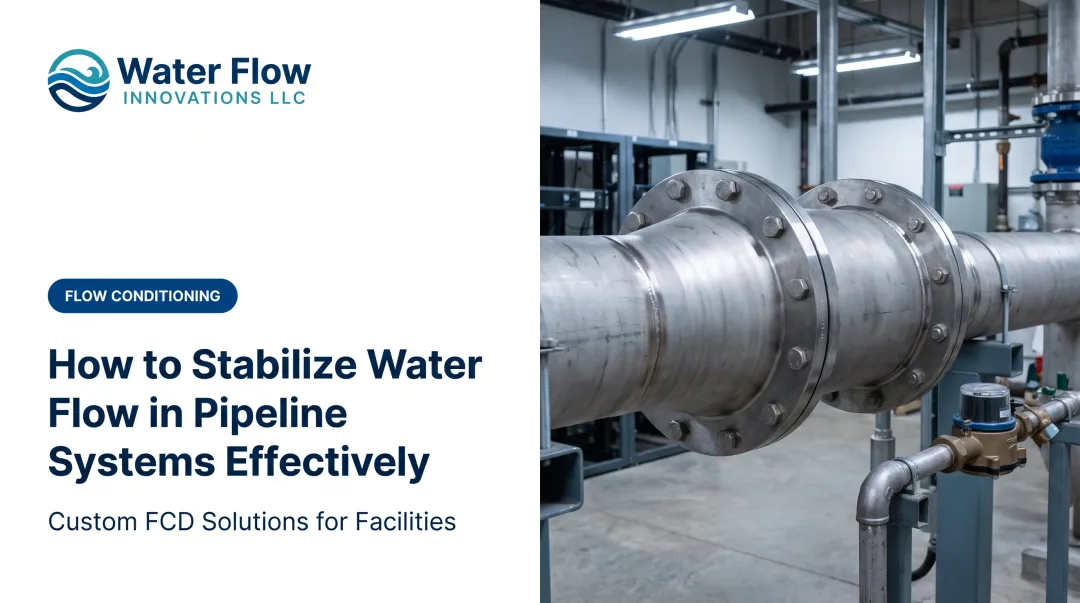
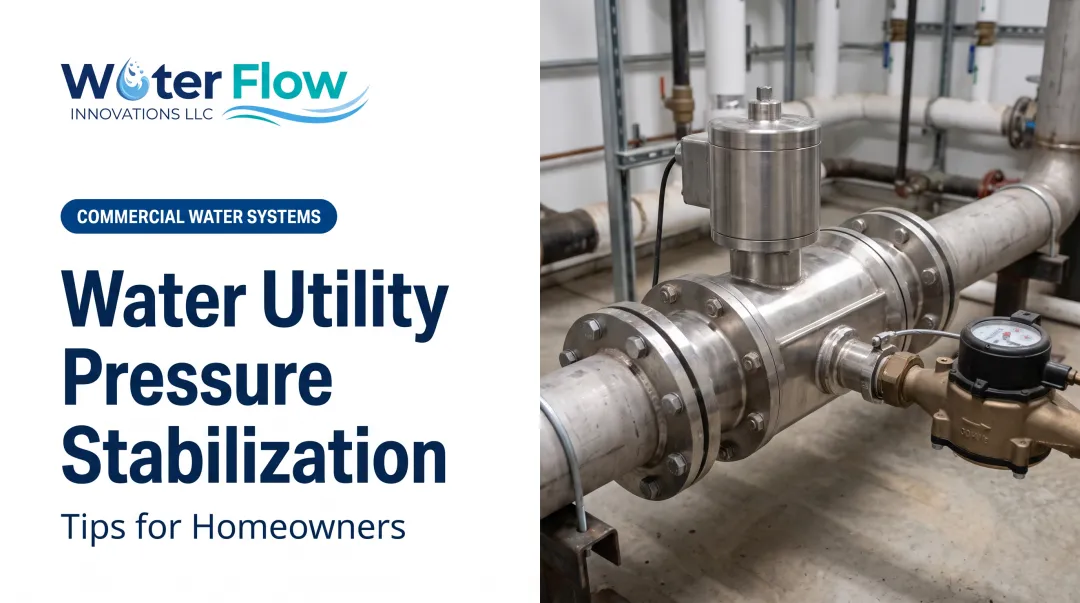
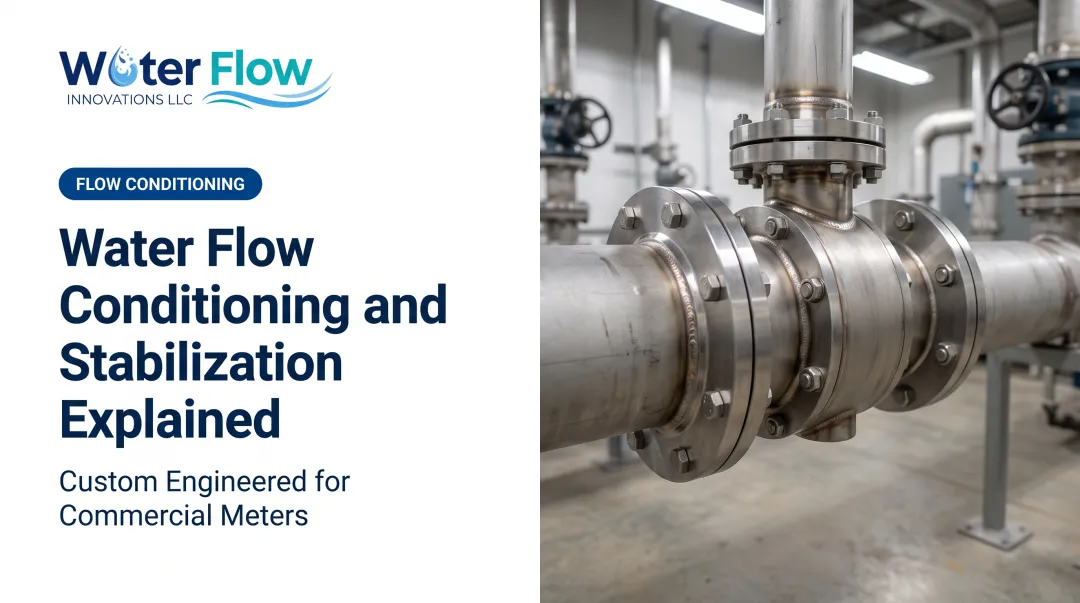
Our Flow Conditioning Device (FCD) combines four functions in a single unit installed just after the water meter:
- Air/gas separation — creates static back-pressure and laminar flow that reduces entrained-air distortion of meter readings
- Pressure regulation — smooths pressure surges from cycling and variable demand
- Check valve function — limits reverse flow and related water hammer (on select models)
- Turbulence elimination — slows velocity enough to prevent vortex flow, even during CIP cycles or tank fills
The FCD is custom-fabricated in 316L stainless steel for pipe sizes from NPS ½" to 12" (DN20 to DN500). It works with any meter type, installs in about an hour, and adds negligible pressure loss with no operational disruption.
It's certified under IAPMO, NSF, ANSI, CAN 61, and KIWA standards for potable water safety, plus GMP and SQF for food and pharmaceutical environments.

Documented results include an average 5-30% reduction in water and sewer bills, with a top result of 46%. Most customers reach full ROI within 12 months.
Monitoring and Maintaining Stable Pressure Long-Term
Stabilizing pressure once isn't enough. Systems drift, components wear, and demand patterns shift.
- Install pressure gauges or sensors at pump discharge, regulator inlet/outlet, and near critical equipment
- Run routine inspections on valve function, regulator calibration, and pipe condition
- Log pressure data consistently so patterns emerge before they escalate into surges, leaks, or bill spikes
A single spot-check reading won't reveal a transient spike. Continuous or periodic logging catches drift early—before it becomes a surge, leak, or cost spike.
Signs Your Facility Needs Better Flow Conditioning
Some warning signs are obvious. Others hide in your utility bill.
Watch for:
- Unexplained water or sewer bill increases with no corresponding usage change
- Audible turbulence or banging noise in pipes
- Fluctuating or unstable pressure at gauges
- Inconsistent flow at fixtures or equipment
- Frequent valve or meter service calls

Facilities across manufacturing, hospitality, healthcare, and multifamily housing commonly see meter over-reading from turbulent flow and air entrainment.
If any of these signs sound familiar, a facility assessment can determine whether you need pressure regulation, flow conditioning, or both. Water Flow Innovation offers a free bill review to start that conversation.
Frequently Asked Questions
What is the general rule of thumb for calculating pipeline pressure drop?
Engineers typically use the Hazen-Williams or Darcy-Weisbach formulas, which relate head loss to flow rate, pipe diameter, pipe length, and a roughness factor. These estimate steady friction loss, not transient pressure spikes like water hammer.
How do I keep water pressure constant?
Combine a correctly sized pressure-reducing valve with monitoring sensors at key points and scheduled maintenance, including valve exercising. Flow conditioning devices add another layer by stabilizing turbulent flow at the meter.
Can unstable pipeline pressure affect my water bill?
Yes. Turbulence and air entrainment caused by pressure instability can cause meters to over-register actual usage. That over-registration shows up as higher water and sewer charges on your bill.
How long does it take to install a flow conditioning device?
Typical flow conditioning device (FCD) installation takes about an hour, with a brief water shutoff at the meter connection, sometimes longer for more complex industrial setups. Installation happens without disrupting facility operations.
Does flow conditioning reduce actual water usage?
No. Flow conditioning corrects meter over-reading rather than changing how much water you actually use. The result is more accurate billing, not reduced consumption.
What industries benefit most from pipeline pressure stabilization?
Manufacturing, hospitality, healthcare, and multifamily facilities with high water throughput see the most benefit. Food and beverage processing, data centers, and pharmaceutical facilities also commonly experience meter over-reading from turbulent flow.
What savings figure should a stabilization business case use?
Documented installations average a 5–30% reduction in combined water and sewer charges, with a highest documented single result of 46%. Basing the case on the range rather than the ceiling keeps the projection defensible.
What happens if the projection isn't met in practice?
A 6-month money-back guarantee covers the device purchase price, with installation cost non-refundable, so it can be returned if metered consumption does not measurably fall. A lifetime transferable warranty against manufacturing defects also applies.