Introduction
Most facility managers assume "water flow optimization" means one thing: use less water. That's only half the story.
Flow inefficiencies like turbulence, air entrainment, and pressure imbalances can inflate your water and sewer bills even when your actual consumption hasn't budged. Your meter can register water you never touched. Facilities often overpay by 5–30% as a result.
This problem hits manufacturing plants, hotels, hospitals, and multifamily properties alike. Different industries, same silent drain on the budget.
This guide covers why flow optimization matters, the most common flow problems, how to diagnose them, and proven correction strategies. You'll also see how certified flow-conditioning technology delivers savings you can verify on your next utility bill.
Key Takeaways
- Flow irregularities inflate metered use and sewer charges — two separate bill-reduction opportunities
- Turbulence, air entrainment, and pressure drops can cause meters to over-register usage
- Start with a flow audit to uncover hidden overcharges
- Certified flow conditioning corrects meter over-reading, with savings visible on the next billing cycle
Why Water Flow Optimization Matters for Businesses
Here's something most facility teams never question: water and sewer bills are calculated from meter readings, not actual consumption. If your meter reads high, you pay high — regardless of what actually flowed through your pipes.
That distinction matters more than people realize. Pumps alone account for 27% of the electricity used by industrial manufacturing systems, according to DOE and Hydraulic Institute research. Add inefficient flow conditions on top of that energy draw, and the financial stakes climb fast.
The Over-Registration Problem Nobody Audits
When water passes through a meter in a turbulent, chaotic pattern instead of a smooth column, mechanical meters can misread the volume. Most facilities never check. They treat water bills like property tax: fixed, non-negotiable, not worth investigating.
That assumption is expensive. Common patterns include:
- Multifamily properties with a single master meter absorb entrained air and turbulent vortex flow for years, tying rising water and sewer charges to "usage" instead of a correctable meter condition
- Hotels watch bills climb without an occupancy increase; audits confirm "elevated consumption" but never find the missing water, because it was air and turbulence counted as volume
The Sustainability Connection
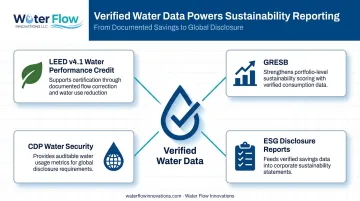
Documented water reductions aren't just a finance story. They feed directly into ESG and green building reporting. LEED v4.1's Water Performance credit requires 12 months of potable water use data entered into Arc to calculate a project's score, according to USGBC's official LEED documentation. Verified consumption reductions strengthen that score and support GRESB, CDP Water Security, and other disclosure frameworks institutional owners increasingly report against.
Common Water Flow Problems That Quietly Drain Your Budget
Common Water Flow Problems That Drain Your Budget
Flow problems rarely announce themselves. They show up as a slightly higher utility bill, a slightly harder-working pump, a slightly more frequent maintenance ticket. None of it looks urgent — until you add it up.
Turbulence and air entrainment are the biggest culprits at the meter itself. Fittings and valves positioned too close to a meter introduce turbulence, and most compound and turbine meters need at least five pipe diameters of straight run upstream and downstream to read accurately, per PNNL's Water Metering Best Practices.
Air bubbles in the water column make the problem worse, degrading accuracy in ways that are hard to detect without dedicated testing.
Beyond the meter, three other issues chip away at performance:
- Pressure drops from throttled control valves force pumps to work harder and raise energy consumption
- Scaling and corrosion in aging piping increase friction, straining pump systems over time
- Inconsistent flow rates from worn valves or fluctuating demand make it nearly impossible to maintain stable operating costs
Smaller pipe diameters make this worse. They increase liquid velocity, which accelerates erosion and wear while raising friction head, so your pump works harder for the same output. None of these issues reduce your actual water usage. They just make delivering that water more expensive.
How to Measure and Diagnose Flow Inefficiencies
You can't fix what you haven't measured. A proper flow audit starts by comparing actual measured flow against design specifications and your utility billing history. Eyeballing the bill and assuming it's accurate won't cut it.
Choosing the Right Measurement Technology
Different diagnostic tools suit different situations:
| Meter Type | Best For | Watch Out For |
|---|---|---|
| Mechanical (positive displacement) | Low, variable flows | Moving parts require sizing that matches the flow profile |
| Mechanical (turbine/velocity) | Higher, steady flows | Poor accuracy at low flow rates |
| Electromagnetic | Conductive water, no moving parts | Air bubbles and installation orientation affect readings |
| Ultrasonic (clamp-on) | Non-invasive, temporary diagnostics | Needs adequate straight pipe run and homogeneous liquid |
Spotting Over-Reading vs. Real Waste
Once you have flow data, compare it against known usage patterns:
- Fixture counts and rated capacities
- Production volume or batch output
- Occupancy levels and operating hours
If metered charges consistently run higher than what your operations should generate, you're likely looking at a meter accuracy problem, not a consumption problem.
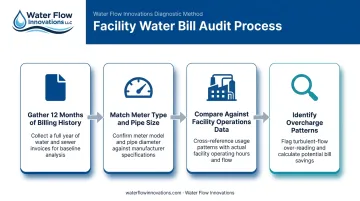
A free water bill review is built to catch this gap. Matching 12 months of billing history to meter type, pipe size, and facility operations (CIP cycles, cooling tower makeup, irrigation zones) surfaces patterns a single bill never shows.
Proven Strategies to Optimize Water Flow in Industrial and Commercial Facilities
Once you've diagnosed the problem, several proven approaches address it: some targeting consumption, others targeting billing accuracy.
Balancing and Right-Sizing Water Circuits
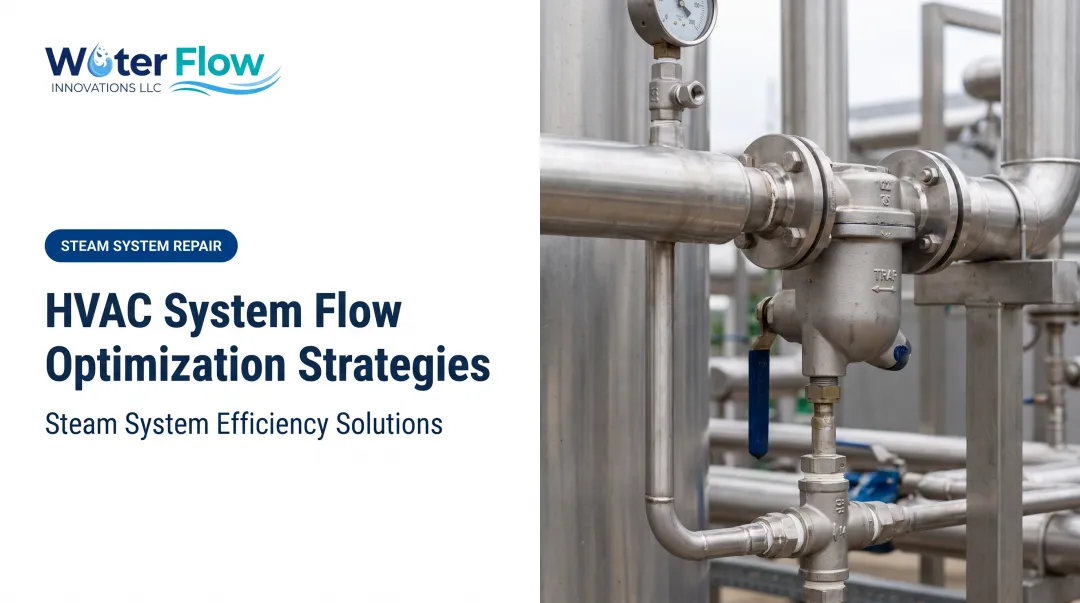
Balancing valves, variable frequency drives (VFDs), and properly sized piping match flow output to actual demand. Speed control is more efficient than throttling because less energy gets imparted to the fluid in the first place. One caution: in high-static-head systems, small speed reductions can sharply cut flow and efficiency, so this isn't a universal fix. It requires system-specific calculation.
Reducing Turbulence and Correcting Meter Accuracy
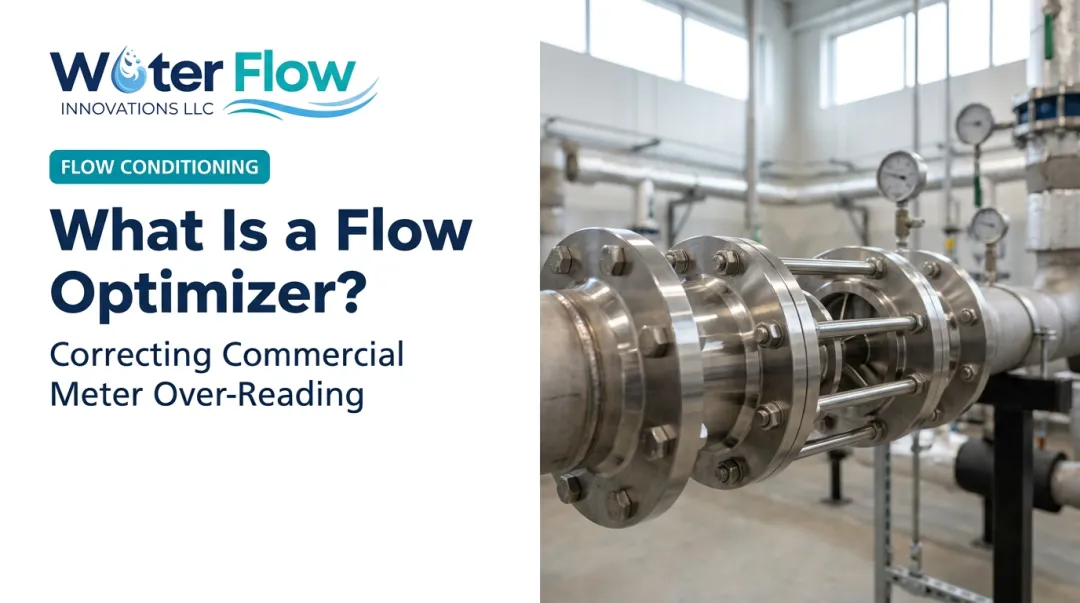
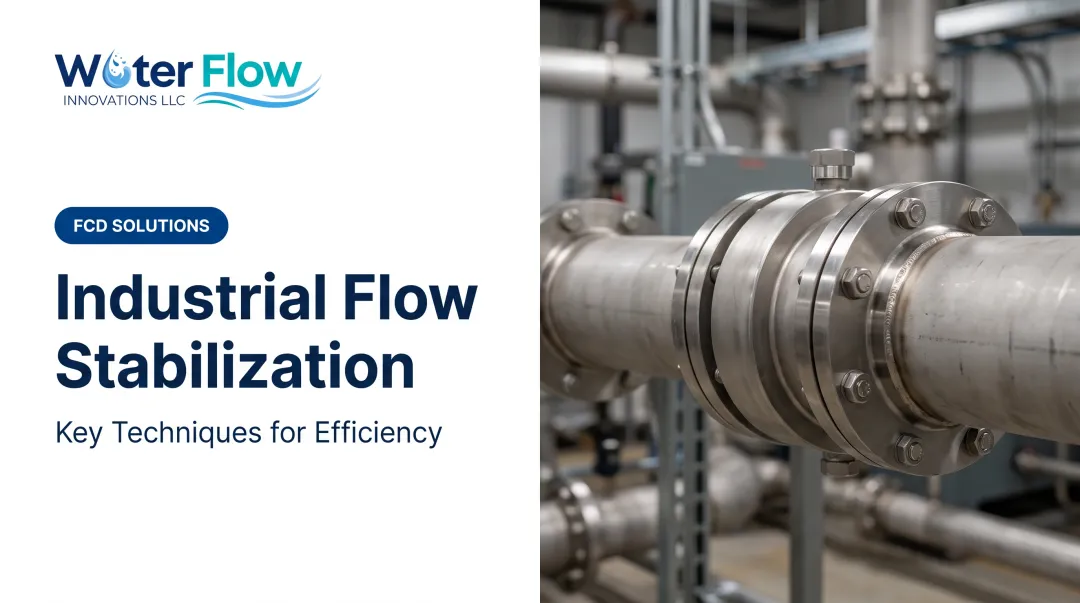
This is where billing accuracy gets addressed directly. Removing air and gas from the flow stream, regulating pressure, and reducing turbulence at the meter stabilizes the reading itself. Flow conditioning devices (FCDs) perform these functions in a single inline unit, so the meter records actual volume instead of inflated readings from turbulent flow. This strategy targets the bill you receive, not just the water you use.
Water Recovery and Reuse
Food, beverage, and industrial processing facilities commonly use:
- Recovery tanks for process water capture
- Closed-loop rinse water reuse systems
- CIP (cleaning-in-place) recovery for sanitation cycles
Cascading reuse (using water first for a final rinse, then repurposing it for an earlier operation) works well when water quality stays adequate for its intended use at each stage.
Preventive Maintenance and Monitoring
Scale removal, valve repair, meter calibration, and monitoring software catch developing issues before they become expensive failures. Operating pumps near their best efficiency point reduces both energy cost and long-term maintenance demand.
How Water Flow Innovation Helps You Optimize Flow and Cut Utility Bills
Everything above points to one conclusion: meter accuracy is the piece most facilities never check. That's the exact gap the Flow Conditioning Device (FCD) was built to close.
A Four-Component Correction System
The FCD installs immediately after your municipal meter and combines four elements:
- Air/gas removal — creates static back-pressure that produces laminar flow, preventing air bubbles from forming at the meter
- Pressure regulation — smooths pressure surges from equipment cycling, reducing the water-hammer events that force air into the line
- Check valve — prevents reverse flow and pressure spikes that can reintroduce air after the system's been conditioned
- Turbulence elimination — slows velocity at the meter just enough to prevent vortex flow, without noticeable pressure loss
It works with any pipe size from ½ inch to 12 inches and any meter type, fabricated in 316L stainless steel with titanium and specialty alloys available on special order.
Documented Results, Fast
The numbers here come from Water Flow Innovation's own installation data:
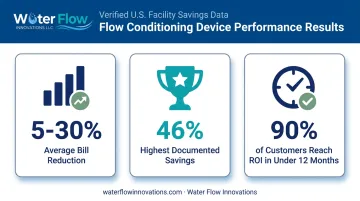
- 5-30% average water and sewer bill reduction, with the highest documented case of 46%
- Savings appear on the very next billing cycle, with no ramp-up period
- 90% of customers reach ROI in under 12 months
Because sewer charges are often calculated as a percentage of metered water intake, correcting the meter reading typically reduces both bills simultaneously.
Installation Without the Headache
Installation takes about an hour, with the only disruption being a brief, schedulable water shutoff. There's no impact on downstream pressure, no changes to production lines, and no tenant access required. Facilities can request a free savings analysis before committing to anything.
Beyond the install itself:
- Flexible buy-or-lease options, with volume pricing for multi-site portfolios
- 6-month money-back guarantee on the device (installation cost excluded)
- Lifetime transferable warranty that stays with the property through any ownership change
- Multi-standard certified — IAPMO, NSF, ANSI, CAN 61, KIWA, GMP, and SQF
The before-and-after utility bill documentation also plugs directly into ESG disclosures, LEED submissions, and sustainability reporting. No additional sub-metering or monitoring infrastructure is required.
Frequently Asked Questions
How do I optimize water flow in manufacturing?
Start with a flow audit comparing actual usage against billing history and design specs. Install balancing valves or VFDs to match demand, reduce turbulence at the meter, and maintain a preventive maintenance schedule.
How do I reduce water usage in manufacturing?
Focus on recovery and reuse systems, closed-loop rinse water, and CIP (clean-in-place) recovery cycles. Tracking water use at the process level also helps identify where consumption can be trimmed.
What is process optimization in manufacturing?
Process optimization means improving efficiency across an operation's inputs, outputs, and workflows. Water flow optimization is one specific piece of that broader effort, focused on how water moves through and is billed within your systems.
What is water meter over-reading and how does it affect my bill?
Turbulent or unconditioned flow can cause a meter to register more volume than actually passed through the line. Since utilities bill based on meter readings, this inflates both your water and sewer charges without any increase in real usage.
How quickly can facilities see savings from water flow optimization?
Flow-correction solutions like the FCD typically show savings on the very next billing cycle after installation. Broader efficiency upgrades, such as pipe resizing or VFD installation, usually take longer to reach full ROI.
Does correcting water flow affect water pressure or daily operations?
No. Certified flow conditioning devices are engineered for negligible pressure loss and install upstream of your internal distribution system, so daily operations and downstream pressure remain unchanged.
Which manufacturing sectors see the largest correction?
Those with the most frequent demand cycling: semiconductor and electronics, automotive, aerospace, metal finishing, glass, concrete and cement manufacturing, textile mills, paper mills, rubber and plastics, and lithium-ion battery giga-factories.
Does swapping or recalibrating the meter solve the problem?
Usually not. The instrument is faithfully counting everything reaching it, air included, so a replacement or recalibration reproduces the same result. Correcting the flow conditions the meter sees is what removes the phantom volume.