
This happens more often than most facility managers expect. Water bills combine fixed fees, tiered pricing, and sewer charges that all move independently. For commercial and industrial sites, the math gets even messier because meter size, high-volume tiers, and equipment cycles all stack on top of each other.
This article breaks down exactly how water bills are calculated, unit by unit and charge by charge, so you can spot when something's off.
Key Takeaways
- Bills combine a fixed availability charge with a variable usage charge based on metered consumption
- Rate structures (uniform, tiered, or budget-based) determine how much each gallon actually costs you
- Meter over-reading from turbulent flow can inflate bills even when real usage hasn't changed
- Understanding the formula helps you spot meter errors and cut avoidable charges
Understanding Your Water Meter and Usage Units
Utilities measure water in a few standard units, and mixing them up is one of the easiest ways to misread a bill.
Common units:
- Gallons — the everyday unit most facility managers recognize
- CCF (or HCF) — hundred cubic feet; both labels mean the same billing unit
Conversion: 1 CCF equals 748 gallons, according to EPA WaterSense.
So 40,000 gallons works out to roughly 53.48 CCF. If your bill lists CCF but you're mentally tracking gallons, that mismatch alone can make usage look wrong.
How Usage Gets Calculated
Utilities simply subtract:
Current meter reading − Previous meter reading = Total usage for the period
That's it. No adjustments, no estimates, unless your utility flags an unusual reading.
For context, the EPA's Lean and Water Toolkit estimates 20–35 gallons per employee per day for domestic demand in commercial and industrial settings, not counting kitchens or process water.
That's a screening benchmark, not a hard rule—but it's useful for sanity-checking whether your facility's usage looks reasonable.
The Two Core Components of Every Water Bill
Every water bill, regardless of location, is built from two pieces.
Fixed (Availability) Charge
This covers infrastructure costs—pipes, treatment plants, and maintenance—regardless of how much water you use. It's typically scaled to your meter size. Bigger meter, bigger fixed charge, because a bigger meter means more potential capacity draw on the system.
Variable (Commodity) Charge
This is based purely on metered consumption. Sewer charges usually piggyback on this same water-usage data, since most utilities assume all metered water eventually goes down the drain.
Other line items you might see:
- Infrastructure investment fees
- Account maintenance fees
- Environmental or regulatory surcharges
- Uplift or assistance fees
Commercial and industrial accounts often add submeters or electronic meters for irrigation or non-sewer water use. That water never enters the sanitary system, so it shouldn't be billed for sewer treatment.
Real-world example: San Antonio Water System's 2026 General Class rate stacks five components into one total:
- Monthly fixed water charge by meter size ($24.04 for a 1-inch meter)
- Tiered variable water charge
- Fixed sewer charge ($21.66 for the same meter)
- Flat sewer volume rate of $4.3680 per 1,000 gallons
- Small uplift fees
Water Rate Structures Explained
Not all utilities price water the same way. The structure your utility uses directly shapes how your bill is calculated.
| Structure | How it works | Common use case |
|---|---|---|
| Uniform | Flat price per unit, no matter the volume | Smaller utilities, simpler billing |
| Increasing block (tiered) | Price rises as usage climbs past set thresholds | Encouraging conservation in residential/commercial areas |
| Declining block | Price drops as usage increases | Heavy industrial users, rural systems |
| Seasonal | Rates shift by time of year, often higher in summer | Peak-demand management |
| Drought-based | Rates adjust to local drought severity | Water-stressed regions |
For high-volume commercial users, knowing which structure applies directly affects total cost. Under an increasing block structure, your marginal gallon might cost nearly 75% more than your first gallon of the month. Budgeting off an average rate instead of the actual tier structure is a common and costly mistake.

How to Calculate Your Water Bill: Step-by-Step
Let's walk through a real example using San Antonio Water System's published 2026 rates for a 1-inch meter, assuming a facility uses 40,000 gallons in a month with an assigned base of 20,000 gallons.
Step 1: Determine total usage
Current reading − Previous reading = 40,000 gallons
Step 2: Apply tiered rates to each usage band
| Usage band | Rate | Charge |
|---|---|---|
| First 20,000 gal (base) | $1.958/1,000 gal | $39.16 |
| 20,001–25,000 gal | $2.252/1,000 gal | $11.26 |
| 25,001–35,000 gal | $2.937/1,000 gal | $29.37 |
| 35,001–40,000 gal | $3.427/1,000 gal | $17.14 |
Step 3: Add fixed and sewer charges
- Water volume subtotal: $96.93
- Water fixed charge (1-inch meter): $24.04
- Water uplift fee (40 × $0.102 per 1,000 gal): $4.08
- Sewer volume (40 × $4.3680 per 1,000 gal): $174.72
- Sewer fixed charge: $21.66
- Sewer uplift fee (40 × $0.106 per 1,000 gal): $4.24
Total bill: approximately $325.67

Notice how sewer charges ($200.62 combined) outweigh the water charges ($125.05). That split is typical—and why meter accuracy matters as much on the sewer side as on the water side.
Facilities with high water use, such as manufacturing plants, hotels, and multifamily buildings, should recalculate their bills periodically. Rate schedules change annually, and errors compound quickly at volume.
Why Your Water Bill May Be Higher Than It Should Be
Before assuming your meter is wrong, rule out the obvious causes:
- Leaks — running toilets, dripping fixtures, underground pipe leaks
- Seasonal irrigation — landscaping demand spikes in summer months
- Aging fixtures — older equipment often uses more water than rated
- Billing errors — wrong meter size on file, misapplied tiers, estimated readings
The Hidden Factor: Meter Over-Reading
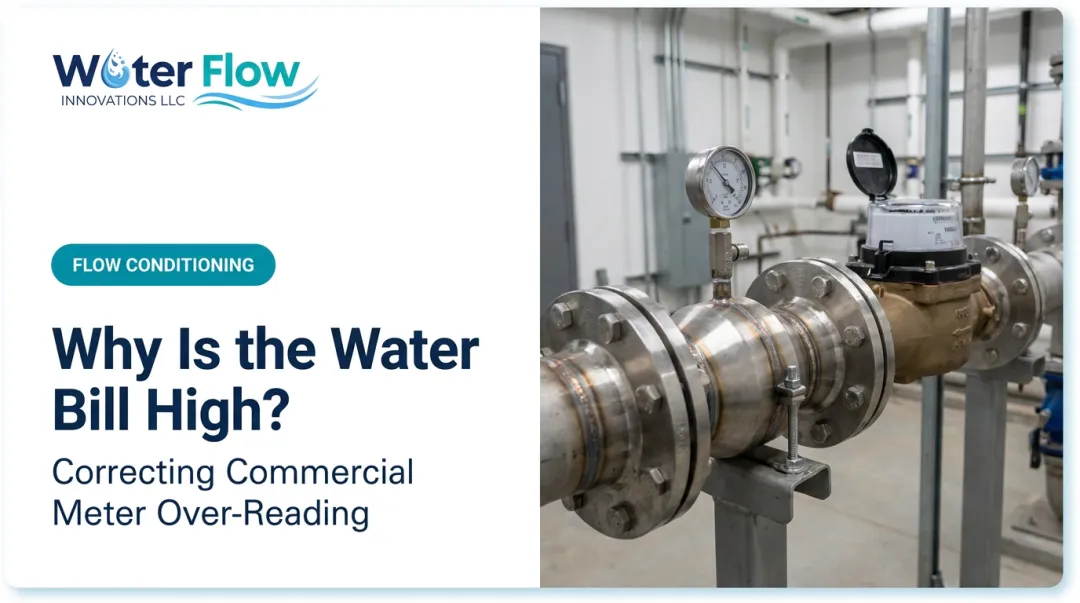
Here's what most facility managers don't know. Turbulent flow and entrained air inside pipes can cause water meters to over-register consumption that never actually happened. Air bubbles and turbulence near the measurement zone get counted as water volume, inflating the reading even though real usage hasn't changed.
This is especially common in commercial and industrial systems with variable demand, pumps cycling on and off, CIP processes, irrigation systems, or cooling towers.
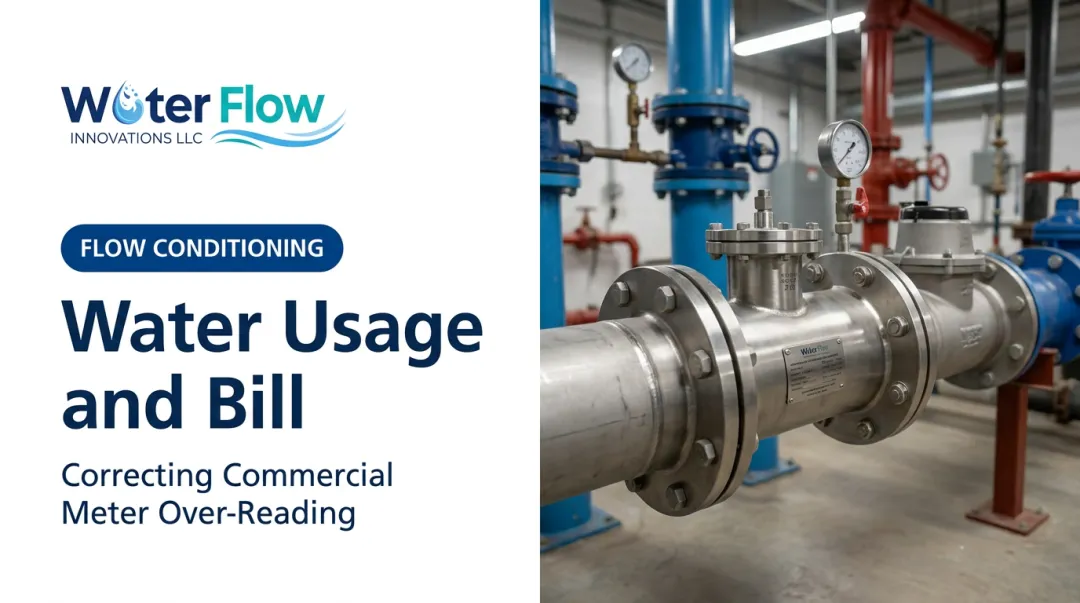
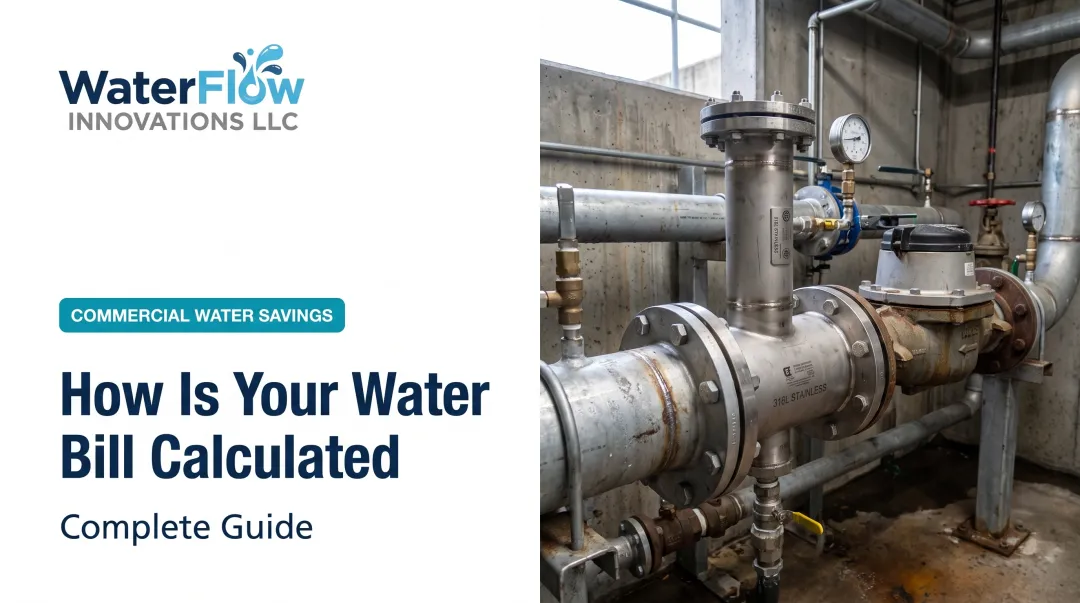
That's the problem Water Flow Innovation's Flow Conditioning Device (FCD) was built to solve. installed immediately after the water meter, the FCD uses a four-part process: air and gas separation, pressure regulation, a check valve, and turbulence elimination. The result is a smooth, stable water column at the meter, so the meter reads more accurately.
What this looks like in practice:
- 5–30% average water and sewer bill reduction (46% highest documented)
- 90% of customers reach full ROI in under 12 months
- Next-cycle savings — results typically appear on the following bill
- Minimal disruption — install takes about 1–2 hours with negligible pressure loss
- Certified under IAPMO, NSF/ANSI, CAN 61, KIWA, GMP, and SQF standards

If your facility's water bill seems disproportionate to actual usage—and you've already ruled out leaks and rate changes—a free water bill review is a practical next step.
Frequently Asked Questions
How much is 40,000 gallons of water?
There's no universal price. It depends on your utility, meter size, and rate tier. Using San Antonio's 2026 tiered rates as an example, 40,000 gallons with water, sewer, fixed, and uplift charges combined totals roughly $325.67.
How much water does a 2-minute shower use?
A standard showerhead flows at 2.5 gallons per minute, per EPA WaterSense, so a 2-minute shower uses about 5.0 gallons. WaterSense-labeled showerheads, capped at 2.0 gpm, use no more than 4.0 gallons in that same time.
What is the difference between a water bill and a sewer bill?
Sewer charges are usually calculated from your metered water usage, not measured separately, since utilities assume all water entering your facility eventually reaches the sewer. An approved auxiliary meter can exclude water that never reaches the sewer, such as irrigation.
Why is my water bill so high even though I haven't used more water?
Common culprits include hidden leaks, rate increases, or meter inaccuracies caused by turbulent flow and air entrainment. The last one is often overlooked, but it can silently inflate readings without any change in actual consumption.
How can businesses reduce water and sewer costs without changing operations?
Flow conditioning technology corrects meter over-reading at the source, so the meter measures real usage instead of turbulence and air bubbles. It requires no process changes and no disruption to daily operations.
What is a water meter size and why does it matter for billing?
Your fixed charge scales with meter size, regardless of how much water you actually use. A 12-inch meter can carry a fixed charge over 80 times higher than a 5/8-inch meter, based on published SAWS rates, so confirming your billed meter size matters.
What proportion of the bill does the sewer calculation add?
Commonly between 80% and 120% of the water charge, depending on the utility. Because that figure is derived from metered intake rather than measured discharge, an inflated reading raises both lines of the bill at once.
Where does a correction sit in relation to the billing meter?
At the municipal supply connection, immediately after the meter and upstream of every downstream system, with each unit custom-built for the facility. Nothing about the utility's meter, the tariff, or the plumbing has to change.