Large commercial buildings use an average of 22,000 gallons of water per day, according to EIA's Commercial Buildings Energy Consumption Survey. At that volume, even a small measurement error compounds into real money over a year.
Flow conditioning is the process of normalizing how water moves through a pipe at the meter. Get it wrong, and the meter reads more water than actually passed through. This article breaks down what flow conditioning is, what causes disturbed flow, how it inflates your bill, and what actually fixes it.
Key Takeaways
- Disturbed flow makes meters over-register consumption that was never delivered.
- Turbulence, swirl, and entrained air drive this over-reading, not meter defects.
- Sewer charges are tied to metered water, so over-reading inflates both bills.
- A properly installed FCD cuts combined bills by 5-30%, visible on your next statement.
What Is Flow Conditioning?
Flow conditioning is the practice of reorganizing how fluid moves inside a pipe so it arrives at a measurement point in a stable, predictable, uniform state. That means no swirl, no turbulence, and no entrained air or gas mixed into the stream.
The Flow Profile Problem in Water Systems
In a perfect world, water moves through a pipe in a symmetrical velocity pattern, fastest at the center and gradually slower near the pipe walls. Engineers call this a fully developed flow profile, and meters are calibrated assuming this exact pattern.
Real commercial plumbing almost never delivers it. Between elbows, valves, pumps, and tees, the water reaching most meters is anything but uniform.
Most technical literature on flow conditioning focuses on gas pipelines, but the same underlying physics applies to water systems, and the stakes look different here. In gas systems, disturbed flow mostly affects accuracy in both directions. In commercial water metering, disturbed flow tends to push readings higher than actual consumption, meaning customers end up paying for water they never received.
Fixing that overbilling starts with how the flow gets conditioned in the first place.
Passive vs. Active Conditioning
There are two ways to condition flow:
- Passive conditioning: Relying on long, straight sections of pipe upstream of the meter to let turbulence naturally settle out.
- Active conditioning: Installing a device that conditions the flow within a short footprint.
Most existing commercial buildings can't accommodate passive conditioning. There simply isn't enough straight pipe run available, especially in retrofitted mechanical rooms or tight utility closets. That's why active devices matter so much in real-world facilities.
This applies broadly: apartment buildings, hotels, hospitals, food and beverage plants, universities, and data centers all have high water usage funneled through metered connections where flow conditioning issues inflate bills unnoticed.
What Causes Flow Disturbances in Water Pipes?
Water piping is designed around space and operational needs, not meter accuracy. Every fitting, valve, and pump the water passes through before the meter adds some distortion to the flow.
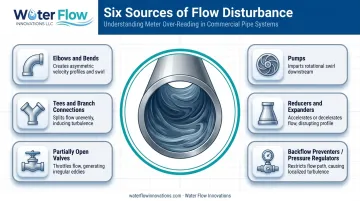
Common Sources of Disturbed Flow
- Elbows and bends — redirect flow and generate swirl
- Tees and branch connections — split or merge streams unevenly
- Partially open valves — create turbulence immediately downstream
- Pumps — introduce pulsations into the flow stream
- Reducers and expanders — accelerate or decelerate velocity abruptly
- Backflow preventers and pressure regulators — create pressure drops that distort readings
The Air Entrainment Problem
Air and dissolved gases work their way into water lines constantly, through pressure changes, water hammer events, temperature swings, and system restarts after maintenance shutoffs. Once that air is in the line, it travels along with the water, all the way to the meter.
This issue gets far less attention than turbulence, but it matters just as much for billing accuracy.
Disturbances Don't Cancel Out Quickly
A common misconception is that disturbances "settle down" a short distance downstream. They don't.
A Utah State University study on electromagnetic meters found measurable reading deviations several pipe diameters downstream, even under fully-open valve conditions. Researchers concluded that 20 pipe diameters of straight run were needed before some meters read within their rated accuracy.
Most commercial mechanical rooms don't have anywhere close to that much straight pipe before the meter.
How Disturbed Flow Causes Water Meters to Over-Read
Most commercial meters, whether turbine, displacement, or electromagnetic, are calibrated to measure clean, single-phase water. They can't tell the difference between water and everything else moving with it.
The Air Entrainment Effect
Air bubbles and gas pockets mixed into the water stream pass straight through the meter, which counts that volume as water because that's all it's built to register. Since utilities bill for every unit the meter shows, customers pay for a share of water they never actually received.
The Turbulence Effect
Swirling or asymmetric velocity profiles can cause rotating sensing elements, like turbine rotors, to spin faster than the true average flow velocity warrants. That produces an artificially elevated reading.
This is a well-documented physics response to the flow condition entering the device, not a defective meter or manufacturing flaw.
The Sewer Charge Multiplier
Here's where the math gets painful. Most utilities calculate sewer charges as a percentage of metered water use. New York City, for example, sets sewer charges at 159% of the water charge, and other cities use different but similarly linked formulas.
That means an over-reading meter doesn't just inflate one bill. It inflates two, simultaneously.
A simplified illustrative example: Say a facility actually uses 3 million gallons annually, but the meter over-reads by 15% due to turbulence and air entrainment. That's 450,000 gallons of phantom consumption billed on both the water rate and the sewer rate.
At a combined rate near $13.86 per hundred cubic feet (roughly NYC's current combined schedule), that phantom volume alone adds over $8,300 a year in charges for water that was never delivered. Every facility's numbers will differ, but the compounding effect is the same everywhere sewer charges track metered water.
How a Flow Conditioning Device Addresses the Problem
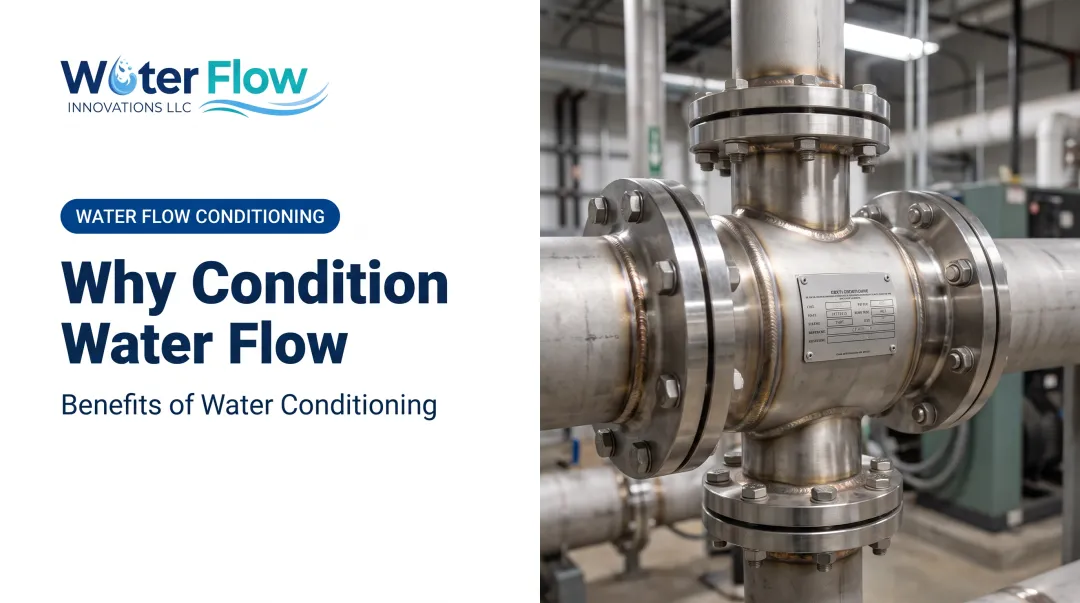
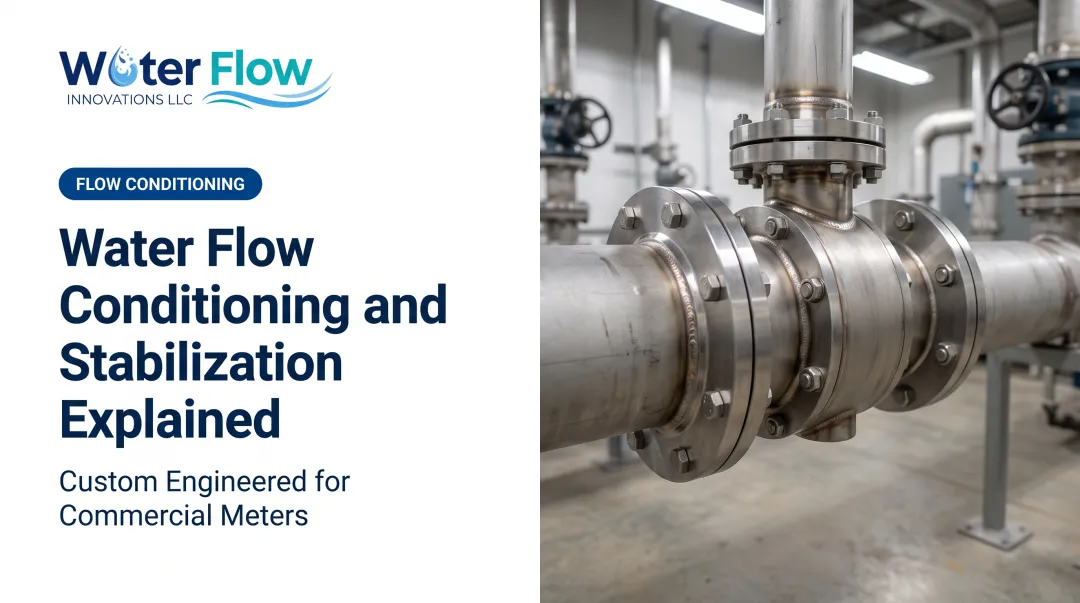
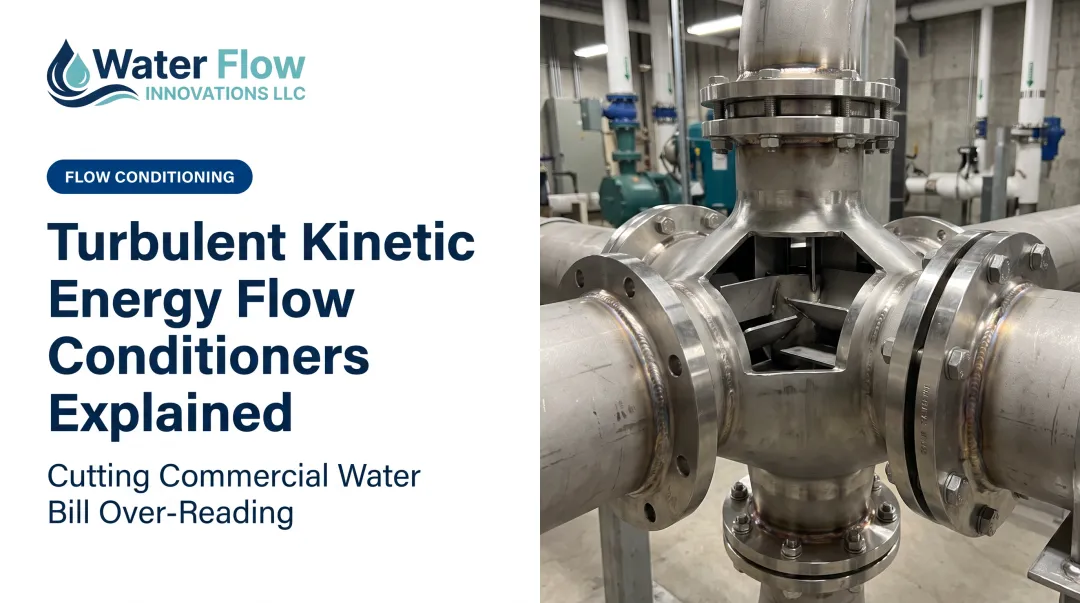
A Flow Conditioning Device (FCD) installs directly in the water line, addressing the root causes of over-reading at the measurement point. Unlike passive solutions that need long straight pipe runs, an FCD conditions flow within a compact footprint, which matters in facilities without room to spare.
Water Flow Innovation's Four-Component System
Water Flow Innovation offers a proprietary FCD built around four components working together in a single unit:
- Air and gas separation: creates static back-pressure that produces laminar flow back through the meter, preventing air bubbles from forming in the first place
- Pressure regulation: stabilizes flow and reduces the pressure surges and water hammer that trigger turbulence
- Check valve: prevents reverse flow through the meter, protecting the clean flow condition already established upstream
- Turbulence elimination: slows velocity just enough at the meter to prevent vortex flow, reorganizing the stream into a uniform profile
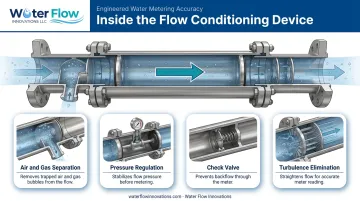
Together, these components correct the mechanical and air-related causes of over-reading in one installation.
Negligible Pressure Loss, By Design
The FCD conditions flow without restricting it. System pressure at downstream connections sees only a slight loss (typically 0–3 psi) before and after installation, so day-to-day operations stay effectively unchanged for guests, patients, tenants, or production equipment. This matters in pressure-sensitive environments like hospital patient care systems or semiconductor fabs, where the change stays well within acceptable tolerances.
Installation Snapshot
- Compatible with any pipe size (NPS ½" to 12", DN20 to DN500, custom sizes available) and any meter type
- Installation is usually about an hour (+/-), on the consumer side of the meter
- Backed by IAPMO, NSF, ANSI, CAN 61, KIWA, GMP, and SQF certifications
- Built from 316L stainless steel, with titanium and specialty alloys available for aggressive water chemistry
Benefits of Flow Conditioning for Commercial Water Users
Once flow is conditioned and the meter reads accurately, metered consumption drops. Because actual water use hasn't changed, that reduction is a recovery of overcharges, not a behavior change.
What the Numbers Typically Look Like
- 5-30% average combined reduction in water and sewer bills
- 46% highest documented single-facility result
- 90% of customers reach full ROI in under 12 months
- Savings often begin showing up on the very next billing cycle
Facilities with high baseline water use, older metering infrastructure, or heavy cycling operations (think CIP systems, cooling towers, or irrigation zones) tend to see results toward the higher end of that range.
Beyond the Utility Bill
Documented, auditable savings from utility bills carry weight beyond finance. Because the reduction shows up directly on municipal billing records rather than an internal estimate, it's the kind of third-party-verifiable evidence that sustainability programs actually want. That makes it useful for:
- ESG water intensity reporting and CDP water security disclosures
- LEED water efficiency credits, where documented metered reduction is required
- Corporate or municipal sustainability commitments tracking water use per square foot or unit of production
Flow Conditioner vs. Flow Straightener: What's the Difference?
These two terms get used interchangeably, but they're not the same thing.
A flow straightener, sometimes called a honeycomb or tube bundle, primarily reduces swirl, the rotational component of flow. That's useful, but limited. It doesn't correct asymmetric velocity profiles on its own, and it does nothing about entrained air.
A flow conditioner built specifically for water metering applications addresses a wider set of problems:
| Disturbance Type | Flow Straightener | Purpose-Built Flow Conditioner |
|---|---|---|
| Swirl | Addresses | Addresses |
| Velocity profile asymmetry | Limited | Addresses |
| Entrained air/gas | Not addressed | Addresses |
| Pressure surges/water hammer | Not addressed | Addresses (on FCD models with pressure regulation) |
For facilities trying to correct meter over-reading, this distinction isn't academic. Since air entrainment is one of the primary drivers of inflated readings, a straightener alone will not solve the billing problem. A hotel with frequent pressure spikes, for instance, may see swirl corrected yet still get billed for phantom volume.
Frequently Asked Questions
What is flow conditioning?
Flow conditioning stabilizes water movement inside a pipe at the meter, so the meter receives a clean, uniform stream rather than turbulent, air-mixed flow. Most meters cannot distinguish water from air and count both as billable volume.
What is the difference between a flow conditioner and a flow straightener?
A flow straightener primarily reduces swirl, or rotational flow. A flow conditioner addresses a wider range of issues, including turbulence, velocity distortion, and entrained air and gas — the leading cause of water meter over-registration. Correcting swirl alone leaves the billing problem in place.
How does air get into water pipes and affect meter readings?
Air enters through pressure fluctuations, system startups and shutdowns, water hammer, and temperature changes. Once entrained, those bubbles pass through the meter alongside the water, and the meter counts them as billable consumption — phantom gallons that never reached your operation.
Will flow conditioning affect my facility's water pressure or operations?
A properly engineered device with a negligible-pressure-loss design introduces only a slight water pressure loss (typically 0–3 psi) and doesn't meaningfully change flow rate or any operational process. Water delivery and daily operations continue essentially as before.
What types of facilities benefit most from flow conditioning?
Any commercial or industrial facility with significant metered water use can benefit, including hotels, hospitals, multifamily buildings, food and beverage manufacturers, universities, and data centers. The largest gains appear where demand cycles frequently, since every start and stop introduces fresh air and turbulence.
How much can flow conditioning reduce a water bill?
Documented installations average a 5–30% reduction in combined water and sewer bills, with the highest documented single result reaching 46%. Savings appear on the very next billing cycle, since the correction applies from the moment the device is installed.
Does correcting the meter also lower sewer charges?
Yes. Most utilities calculate sewer as a percentage of metered water intake, typically 80–120% of the water charge. Every phantom gallon is therefore billed twice, despite never entering a drain, so correcting the reading reduces both lines together.