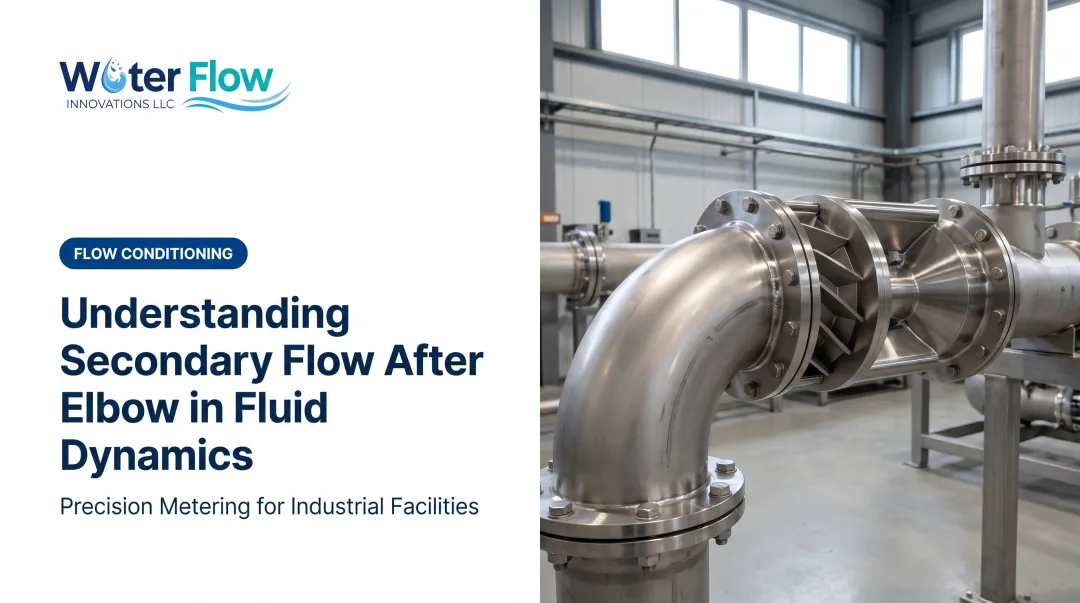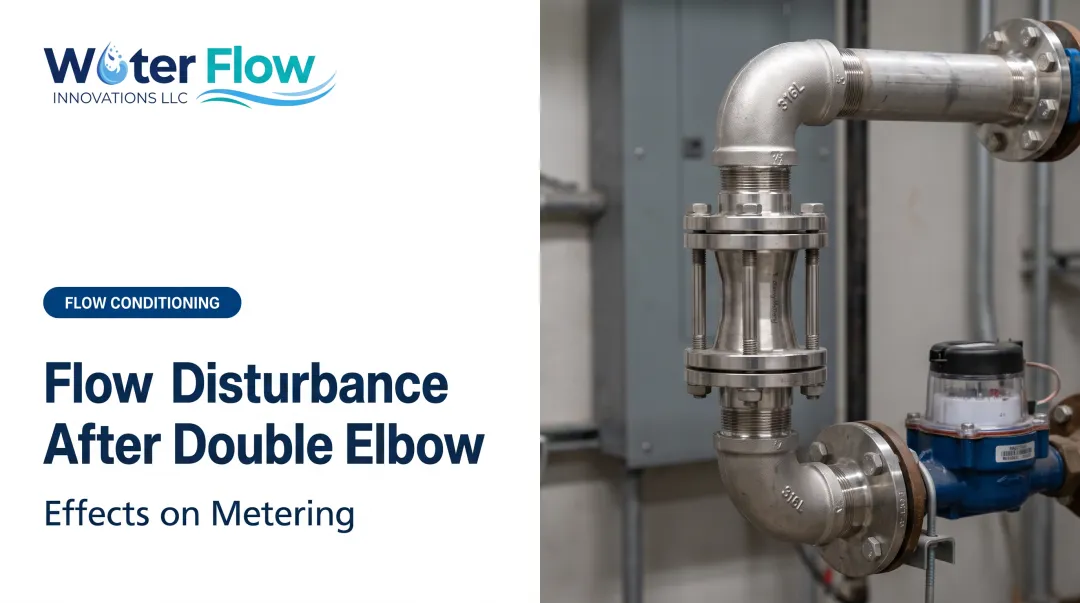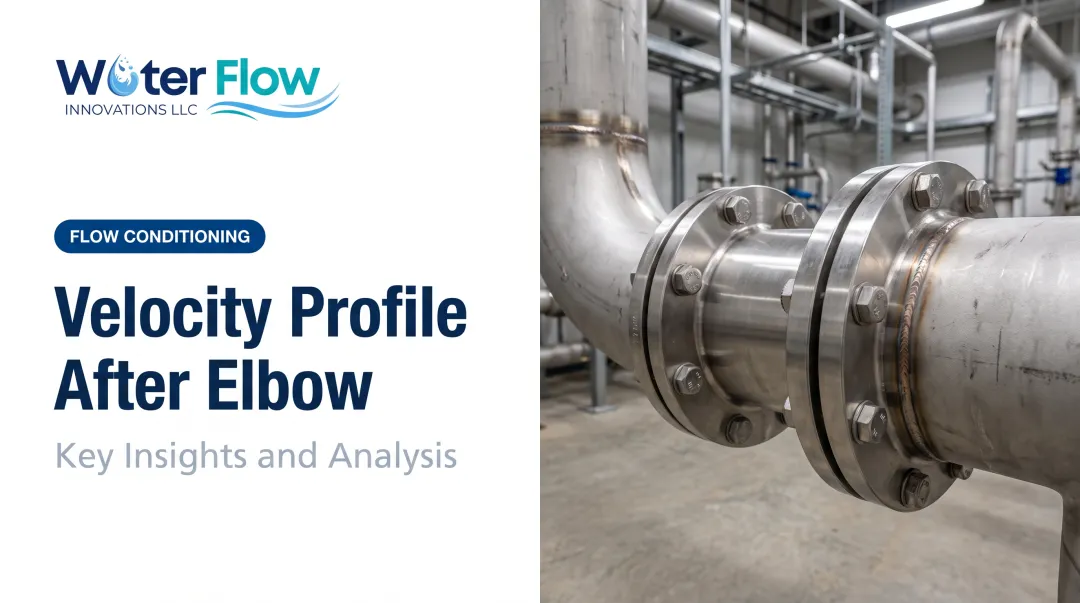

This isn't a niche fluid dynamics concern. It's a real operational problem. Flow disturbance after elbows affects pump performance, wears out equipment, and, critically for facility managers, skews the water meter readings that determine your utility bill.
This article breaks down the causes, consequences, and fixes for flow disturbance after 90-degree elbows, using peer-reviewed research and industry standards.
Key Takeaways
- Swirl and velocity deviations after a 90° elbow often need 3 to 16+ pipe diameters to settle, and full uniformity can remain unresolved past 50D
- Unresolved turbulence drives pressure loss, pump strain, and inaccurate water meter readings
- Long-radius elbows and straight-pipe runs reduce turbulence throughout the system, protecting pumps and equipment; a certified flow conditioner is a separate, targeted fix that corrects the meter reading itself, at the meter
- Meter errors from turbulent flow are a fixable, often overlooked cost on water and sewer bills
Common Causes of Flow Disturbance After a 90° Elbow
Flow disturbance refers to the swirl, asymmetric velocity profile, and secondary flow patterns generated when water is forced to change direction abruptly.
A 2020 pump-intake study published in Applied Water Science found swirl angles exceeding 5 degrees and velocity deviations above 10% persisting for 3 to 16 pipe diameters downstream. In some configurations, velocity profiles stayed non-uniform even at 50 diameters.
Sharp/Short-Radius Elbow Geometry
A tight internal corner forces water to separate from the pipe wall. This creates a low-velocity zone on the inner radius and shifts peak velocity toward the outer wall.
Short-radius elbows, with Rc/D below 1.5, are common in space-constrained installs: utility rooms, mechanical closets, and retrofit runs with no room for a sweeping bend.
Multiple Elbows in Close Proximity
Sequential elbows, especially in different planes, compound swirl instead of letting it decay. Instead of one disturbance pattern, you get a composite of overlapping vortices. This is typical in tight mechanical rooms where piping has to turn several times to route around tanks, beams, or other equipment.
High Flow Velocity or Reynolds Number
Higher velocities increase turbulence intensity and extend the distance needed for swirl to decay. A 2024 study in Applied Sciences found Dean vortices persisting to 25 diameters downstream, with full recovery lengths running 10D to 40D depending on flow velocity. This shows up most in high-demand facilities:
- Car washes and truck washes
- Laundromats and coin laundry operations
- Industrial process lines with continuous high-volume discharge

Insufficient Straight Pipe Run Downstream
Meters, pumps, and valves often end up too close to an elbow because layout leaves no other option. Standards like ANSI/HI 9.8 set straight-pipe benchmarks, but research shows those minimums frequently fail to fully normalise flow.
Effects of Flow Disturbance on Water Systems and Billing
Flow disturbance after a 90-degree elbow wears equipment faster. It also drives up operating costs and throws off the readings your bills depend on.
Meter accuracy issues. Most water meters are calibrated for smooth, fully developed flow. Swirling, turbulent flow breaks that assumption.
Independent testing has found deviations in both directions by meter type and setup. One study found a Woltmann meter under-registering by as much as 12%. Another found close-coupled magnetic meters off by −3.31% to +0.76%, per research from Utah State University. When a meter over-registers, you pay for water, and often sewer, you never used.
Pump performance degradation. Non-uniform velocity at the pump inlet drags efficiency down. In one controlled test with an elbow-disturbed inlet, head fell from 18.2 metres to 16.0 metres and efficiency dropped from 61.4% to 53.2%. Required cavitation allowance rose from 2.52 metres to 3.32 metres.
Other cost and compliance hits stack on quickly:
- Pressure loss — turbulence raises loss through higher K-values or equivalent pipe length, so pumps work harder and energy spend climbs
- Drainage buildup — sharp corners and eddies trap solids, causing blockages and more maintenance calls
- ESG reporting risk — skewed meter data undermines LEED, utility benchmarking, and sustainability totals
Pump wear, drainage buildup, and general pressure loss are system-wide effects of the turbulence itself. They need to be addressed at the source through elbow geometry, pipe routing, and straight-run distance, not at the meter. The metering error is the one piece of this problem a flow conditioning device is built to fix.
Warning Signs You May Have a Flow Disturbance Problem
These symptoms often show up when turbulence from a 90-degree elbow reaches meters, pumps, or gauges:
- High water or sewer bills versus fixture counts or known usage
- Pump vibration, noise, or early bearing wear near elbow-adjacent installs
- Fluctuating pressure readings just downstream of direction changes
When several appear together, disturbed flow after an elbow is a likely cause, especially if a meter sits close to the bend.
How to Prevent and Minimize Flow Disturbance After a 90° Elbow
Prevention combines layout design, fitting selection, and, where retrofitting isn't practical, flow conditioning technology at the meter. The first three approaches below reduce turbulence throughout the piping system, protecting pumps, valves, and fittings, not just the meter. The fourth is a targeted fix for the meter reading specifically.
Use Long-Radius Elbows Instead of Sharp Bends
Long-radius elbows, with Rc/D greater than 1.5, reduce peak swirl angle and shorten the distance flow needs to normalise. In the pump-intake study cited earlier, configurations with larger radius elbows reached acceptable swirl levels within 5D, compared with 16D for short-radius fittings. Best implemented at the design or new-installation stage.
Maximize Straight Pipe Length Before Critical Components
More straight pipe upstream of pumps, meters, or valves gives turbulence more distance to dissipate before it affects equipment. This should be planned during facility design or major retrofit projects, not as an afterthought.
Consider Two 45° Elbows Instead of One 90°
Splitting a turn into two gentler bends can reduce abruptness, though the research here is mixed. ASHRAE's fixed-K method suggests a modest pressure-loss benefit, while DOE's equivalent-length tables suggest a slight penalty. It is configuration-dependent rather than a guaranteed fix, but worth considering when pipe routing has some flexibility.
Install a Certified Flow Conditioning Device at the Meter
When space constraints make elbow or layout changes impractical, a flow conditioning device corrects the turbulence and air entrainment reaching the meter itself. It does not extend upstream to fix pump wear or drainage buildup elsewhere in the system, which still depend on the layout fixes above.
Water Flow Innovation offers a Flow Conditioning Device (FCD) built for meter-side turbulence and air entrainment. It installs immediately after the water meter, on the consumer side of the connection, and where a pressure-reducing valve is present the preferred order is Water Meter → FCD → PRV → Building. Installing after the PRV is a fallback only, and runs roughly 20–40% less effective. It is a four-component system:
- Air and gas separation — creates static back pressure and laminar conditions so the meter reads a homogeneous water column
- Pressure regulation — reduces surges and water hammer from on-off cycling
- Check valve, on select units — prevents reverse flow and re-entrained air
- Turbulence elimination — slows velocity enough to eliminate vortex and spinning flow at the measurement point

The FCD installs in about an hour, with a brief water shutoff at the meter connection and no access to internal facility systems, process equipment, or operational areas required. It is custom-fabricated in the USA from 316L stainless steel for NPS ½″ through 12″ as standard, with larger custom sizes available up to 32″, works with the meter types used in commercial and industrial facilities, and carries negligible pressure loss. It is certified to IAPMO, NSF, ANSI, CAN 61, KIWA, GMP, and SQF standards.
Facilities using this approach commonly see verifiable water and sewer bill reductions of 5–30%, with a documented high of 46%. Savings typically show up on the next billing cycle, without changing actual water usage.
Tips for Long-Term Flow Management
A few ongoing habits keep flow stable and catch meter or bill issues early, whether or not a conditioning device is in place:
- Schedule periodic pressure and flow checks near elbow-heavy runs and compare results with your baseline
- Train staff to spot turbulence wear and unexplained gaps between metered use and water or sewer bills
- Document pipe layouts and fitting types for future retrofits or troubleshooting
- Track monthly water and sewer bills against metered usage trends to catch anomalies early
Conclusion
Flow disturbance after a 90-degree elbow has well-documented, measurable causes rooted in fluid dynamics. Layout choices and fitting selection address the turbulence itself, protecting pumps and equipment throughout the system. Flow conditioning technology at the meter is a separate, targeted fix for the billing impact, correcting the reading without touching the pipe layout.
Proactive correction typically pays for itself quickly. About 90% of Water Flow Innovation customers reach full ROI in under 12 months, backed by a 6-month money-back guarantee on the purchase price, with installation cost non-refundable, and a lifetime transferable warranty.
Frequently Asked Questions
How much pressure is lost in a 90-degree elbow?
Pressure loss depends on the elbow's K-value and flow velocity, calculated via hL = K(v²/2g). Documented K-values for 90-degree elbows range from 0.16 to 1.1, depending on radius and construction. Sharp elbows can equal several feet of straight pipe.
Do 90-degree elbows affect water flow?
Yes. They create turbulence, swirl, and measurable pressure drop. Severity depends on elbow radius, flow velocity, and how many bends are involved.
What are the pros and cons of a 90-degree elbow?
Pros: a compact layout that fits tight mechanical spaces. Cons: more turbulence, higher pressure loss, and greater meter or equipment risk than long-radius elbows.
How far downstream of a 90-degree elbow should a water meter be installed?
Industry guidance calls for several pipe diameters of straight run, but swirl often lasts well past those minimums. Flow conditioning is a practical safeguard when space limits straight pipe.
Can flow disturbance cause my water bill to be higher than expected?
Yes, in many cases. Turbulent flow at the meter can cause over-registration, which inflates water and sewer charges even when actual use has not changed.
Does adding more elbows increase pressure loss?
Yes. Losses compound with each bend, especially when elbows sit close together, and may require larger pumps or more energy to compensate.
Is re-piping the only way to get enough straight run?
No, and it is rarely practical. A conditioning device is custom-built and fitted at the meter connection in about an hour, with a brief water shutoff at the meter connection and no access to internal facility systems, process equipment, or operational areas required, so the existing elbow layout stays exactly as it is.
What does correcting elbow-driven over-registration recover?
Documented installations average a 5–30% reduction in combined water and sewer charges, with a highest documented single result of 46%, appearing on the very next billing cycle.