"Wrong water meter" isn't a single problem. It can mean a utility installed the wrong meter for your connection, a meter is physically damaged, or — most commonly in commercial facilities — a perfectly functional meter that over-reads because of air entrainment and turbulent flow. Each scenario requires a different diagnostic approach.
This guide walks through the warning signs, the tools you need, three practical checking methods, and how to interpret what you find — including the scenario where no leak exists but your meter is still registering more water than you actually use.
Key Takeaways
- A bill spike with no change in operations is the most reliable first indicator of a meter problem
- Three methods — zero-flow test, bill comparison, and measured volume test — each catch different issues
- Passing all three tests doesn't rule out over-reading — air entrainment can inflate readings on an intact meter
- Photograph and date-stamp meter readings before contacting your utility
- If over-reading is confirmed with no leak present, a Flow Conditioning Device corrects the root cause
Warning Signs That Your Water Meter May Be Wrong
Unexplained Bill Increases
The clearest signal is a significant increase in your water bill with no corresponding change in facility activity. EPA WaterSense at Work guidance advises commercial and institutional facilities to compare utility bills against historical use and investigate any unexpected changes. There is no universal percentage trigger established by EPA or AWWA, but a useful internal benchmark is flagging any billing period that exceeds your rolling 12-month average by 20% or more — particularly when no operational expansion occurred.
Cross-reference the spike against your operational calendar. If consumption jumped during a documented production increase, that's expected. If it jumped during a slow period or a scheduled shutdown, that's a flag worth pursuing.
That billing pattern is often the first sign something is off. The next step is walking the meter itself.
Physical Meter Warning Signs
Inspect the meter itself for:
- Cracked or damaged casing
- Fogged or clouded dial face (moisture inside the housing)
- Corrosion around fittings or the meter connection points
- Water pooling near the meter box
- A spinning low-flow indicator with all water completely shut off
A moving indicator during confirmed zero-flow is the most actionable physical sign. It suggests either a hidden downstream leak or a meter registering phantom movement.
The Less Obvious Pattern: Consistent Monthly Over-Reading
This is the warning sign most facility managers miss. A meter that looks perfectly normal but reads consistently higher month after month — without any single dramatic spike — often points to air entrainment or turbulent flow, not physical damage.
This pattern is common in facilities with:
- Long pipe runs
- Variable-demand or high on/off cycling systems
- Cooling towers
- Frequent pressure fluctuations
The meter isn't malfunctioning. It's registering everything passing through it, including air it can't distinguish from water.
What You Need to Check for a Wrong Water Meter
Checking your meter doesn't require specialized equipment, but preparation determines whether your results are reliable or misleading.
Tools and Records Required
Gather these before starting any test:
- Access to the meter box or panel (and a flashlight if it's in a low-light location)
- Pen and notepad or phone for timestamped reading logs
- At least 12 months of water bills showing consumption in gallons or CCF per billing cycle
- Operational records showing periods of higher or lower facility activity
- A calibrated container of known volume — a 5-gallon bucket with clear measurement markings is sufficient for the volume test
Preconditions and Setup
Before any test begins, every water-using fixture, appliance, and system in the facility must be confirmed off. In commercial settings, this requires coordination with operations staff. The draw points most often missed:
- Ice machines and refrigeration make-up water
- Boiler auto-fill systems
- Cooling tower make-up valves
- HVAC humidifiers
- Toilet tank fill valves
If the dial face is fogged, the display is blank, or the meter box is flooded, clear those issues before proceeding and notify your utility of any physical obstruction. A reading you can't clearly see is not a reading you can use.
Methods to Check for a Wrong Water Meter
Use more than one method where possible. A single test under imperfect conditions can produce a misleading result. These three methods are complementary: each catches what the others can miss.
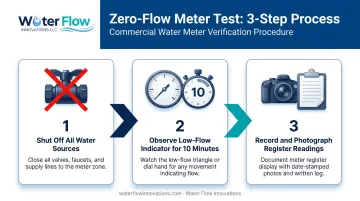
Method 1: The Zero-Flow Test
Purpose: Determines whether the meter records movement when no water is being used — the most direct way to detect phantom consumption or a hidden leak.
Steps:
- Shut off every faucet, valve, irrigation zone, and water-using piece of equipment. Confirm with facility staff that no automated systems will activate during the test window.
- Locate the low-flow indicator on the meter face — typically a small triangle, star, or rotating wheel. Observe it for at least 10 minutes without disturbing the system. Photograph or video the dial at start and end.
- Record whether the main register reading changed. Even fractional movement during a confirmed zero-flow window warrants further investigation.
Limitations: Achieving true zero-flow in large commercial facilities is harder than it sounds. A single toilet fill valve, HVAC humidifier, boiler auto-fill, or ice machine will produce movement that looks like a meter fault. Any undetected slow draw creates a false positive.
Method 2: The Bill Comparison Method
Purpose: Uses billing history to identify systematic over-reading that a one-time snapshot test might miss entirely.
Steps:
- Pull all available billing statements and log consumption by billing cycle in a spreadsheet. Calculate a 12-month rolling average and flag any period exceeding that average by a meaningful margin.
- Cross-reference high-consumption periods against operational records. Did the spike align with expanded production, new equipment, or seasonal changes — or did it occur during normal or reduced activity?
- For any suspicious billing cycle, request that your utility confirm whether those reads were actual meter reads or estimated. Most states require utilities to issue actual reads at defined intervals — Wisconsin limits consecutive estimated bills to three, and Texas requires physical reads at least every three months.
Limitations: Requires accurate historical records and cannot identify the cause of over-reading on its own. Best used to build a documented case before contacting the utility.
Method 3: The Measured Volume Test
Purpose: Cross-checks the meter register against a physically known volume of water — a hands-on accuracy comparison that requires no specialized equipment.
Steps:
- Record the exact current reading on the meter register, noting all digits including the smallest measurable increment. Confirm all other water sources are off.
- Fill your calibrated container completely using a single isolated outlet downstream of the meter. Use enough volume that the meter's resolution can detect it — at least 10 gallons.
- Record the new meter reading and calculate the difference. Compare that difference to the known volume dispensed.
Interpreting the result: Per NIST Handbook 44 Section 3.36, Class 1.5 meters carry a tolerance of 1.5% over- or under-registration in the upper flow zone. If your meter registered more than the dispensed volume beyond the published tolerance for your meter type, that's a measurable discrepancy worth escalating.
Limitations: This test only reflects accuracy at the specific flow rate you used. Meters can perform differently at high versus low flow rates. Test at the flow rate that best represents your facility's normal operating conditions.
How to Interpret Your Results
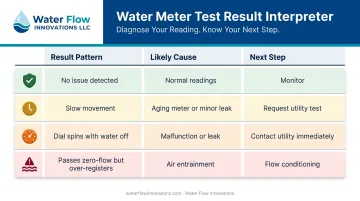
The action you take depends entirely on what the tests show. Misreading the results in either direction carries real financial consequences — accepting an inflated bill as legitimate, or disputing one that reflects an actual leak.
| Result Pattern | Likely Cause | Next Step |
|---|---|---|
| No dial movement; bills consistent with operations; volume variance within tolerance | No issue detected | Document and monitor periodically |
| Very slow dial movement; modest upward billing trend; 5–10% volume variance | Aging meter or slow leak | Request utility's certified meter accuracy test |
| Dial spins with all water off; 20%+ billing spike; significant volume discrepancy | Meter malfunction or leak | Contact utility immediately, preserve all self-test documentation |
| Zero-flow test passes, but volume test and bills both show over-registration | Air entrainment or turbulent flow | See below |
The Over-Reading Without a Leak Scenario
Most facility managers — and many utilities — don't immediately recognize this pattern. The meter passes the zero-flow test, confirming no leak exists. Yet the volume test and bill comparison both show the meter consistently registering more than the actual water delivered.
The culprit is air entrainment and turbulent vortex flow. Displacement and turbine meters cannot distinguish between water and the air, micro-bubbles, and turbulence present in real commercial plumbing. Common triggers include:
- Valve closures and rapid pressure changes
- Variable demand across shifts or time-of-day peaks
- Equipment on/off cycling during production
- System startup and shutdown sequences
Each event forces air into the supply line. The meter counts it as billable volume.
When this is the diagnosis, correcting flow conditions — not replacing the meter — is what resolves the over-registration. Water Flow Innovation's Flow Conditioning Device (FCD) installs immediately after the meter on the consumer side, creating laminar, bubble-free flow through the measurement zone so the meter reads only actual water. It works with any meter type, any pipe size from ½" to 12" NPS, and requires no meter replacement. Customers see an average water and sewer bill reduction of 5–30% (46% is the highest documented single result), with savings appearing on the first billing cycle after installation.
Common Mistakes When Checking for a Wrong Water Meter
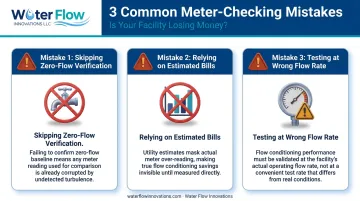
Even a careful inspection can produce misleading results if the process has gaps. These three mistakes are the most common — and the most likely to send you in the wrong direction.
Skipping true zero-flow verification. Automated systems — toilet fill valves, cooling tower make-up lines, HVAC humidifiers — create slow, intermittent draws that can mimic a meter fault. Confirm with facility management that every draw point is genuinely inactive before starting the observation window. In large commercial buildings, this is harder than it sounds.
Relying on estimated bills for baseline comparison. Utilities issue estimated reads when meters are inaccessible or transmitters fail. Those estimates are calculated from past averages, not actual meter reads, which can significantly distort your baseline. Before drawing conclusions from bill history, confirm which billing periods used actual reads versus estimates.
Testing at the wrong flow rate. A meter may read accurately at moderate flow but over-read substantially at high flow due to turbulence. Test at the flow rate that mirrors your facility's typical operating conditions — not whatever's convenient at the moment.
Frequently Asked Questions
How do I know if my water meter reading is wrong?
The most reliable indicators are a bill spike with no change in usage, a spinning low-flow indicator during a zero-flow test, and a meter register that shows more volume than a measured fill confirms. Using all three checks together gives a clearer picture than any single test alone.
What happens if my meter reading is wrong?
You receive an inflated bill that, in commercial settings, can compound across multiple billing cycles before detection. Customers are entitled to a formal certified meter accuracy test, and if utility error is confirmed, a billing adjustment or credit for the overbilled period. Adjustment limits vary by state.
Can a water meter over-read without being physically broken?
Yes. Air entrainment and turbulent flow conditions cause mechanically sound meters to register more water than actually flows through them. This is not a malfunction — displacement and turbine meters measure total volume passing through them, including air. The over-reading is a measurement environment problem, not a meter defect.
How do I dispute a water meter reading with my utility?
Submit a written dispute with documented evidence (dated meter photographs, self-test records, and billing history) and request a certified meter accuracy test. Keep your account in good standing while the dispute is under review. Most state utility commissions have defined timelines for utilities to respond.
How often should I check my water meter for accuracy?
Commercial and industrial facilities should follow this schedule: compare meter readings against operational data monthly, perform a zero-flow test quarterly, and run a full bill comparison audit annually. Conduct an immediate audit after any unexplained consumption spike.
What causes a water meter to over-read?
The four main causes are: a wrong meter installed by the utility, physical meter damage or malfunction, meter reader error or transmitter failure, and air entrainment or turbulent flow conditions that inflate readings even when the meter is mechanically intact. The last cause is the most common in commercial and industrial facilities and the least frequently identified.
Does a wrong reading inflate the sewer charge as well?
Yes, and that is often the larger half. Most utilities never meter discharge — sewer is calculated as a percentage of metered intake, typically 80–120% of the water charge. Every phantom gallon is therefore billed twice despite never entering a drain.
If the utility confirms the meter is accurate, what recourse remains?
Correcting the flow conditions rather than the instrument. A flow conditioning device carries a 6-month money-back guarantee on the purchase price plus a lifetime transferable warranty, so the correction can be tested against real bills without committing to a disputed replacement.