
Turbulence doesn't just waste energy. It shows up as noisy pipes, premature equipment wear, and, most annoyingly, water meters that register more flow than actually passed through. Your utility bill climbs. Your equipment ages faster. Your system loses accuracy. None of it shows up as a single dramatic failure—it just quietly costs you money every month.
This article breaks down why turbulence builds up in water pipelines, what causes it, and the practical strategies facilities use to reduce it.
Key Takeaways
- Turbulence increases pressure loss, wastes pumping energy, and causes meters to over-register
- Common causes: high velocity, elbows, valves, diameter changes, and poor installation
- Solutions include pipe redesign, flow conditioning devices, and ongoing maintenance
- Water Flow Innovation's FCD corrects meter over-reading for 5–30% average bill reductions (up to 46%)
How Turbulence Builds Up in a Water Pipeline
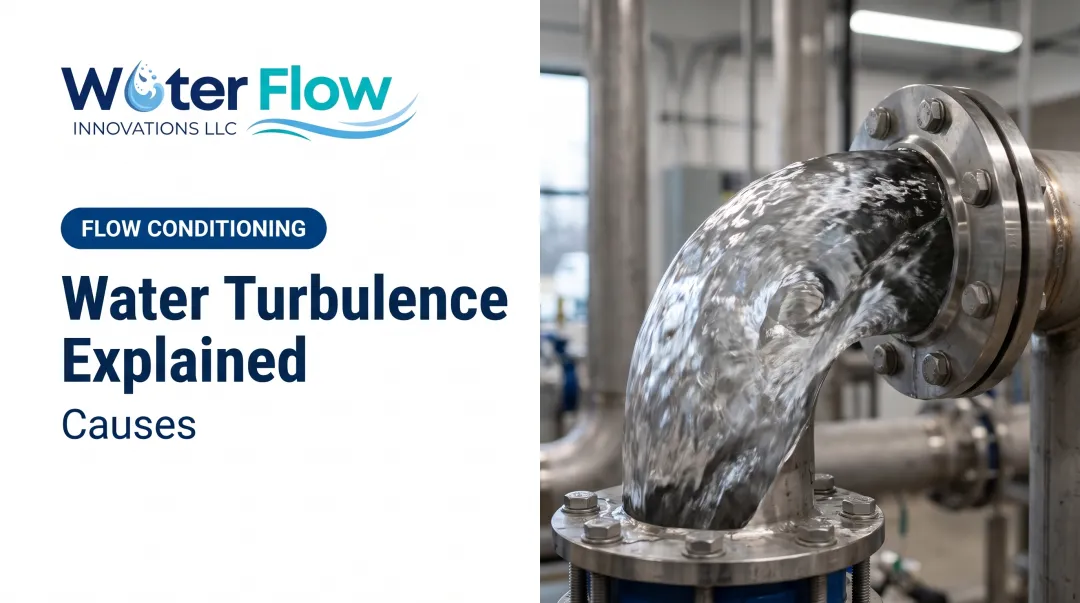
Turbulence rarely comes from one dramatic event. It accumulates gradually as water moves past elbows, valves, junctions, and meters—each disturbance adding a little more chaos to the flow profile.
Two factors drive intensity: flow velocity and Reynolds number. As either rises, turbulence gets worse and travels further downstream before settling out.
A 2024 pipe-bend study found asymmetric flow persisting **beyond 100 diameters downstream** at lower Reynolds numbers, and still 10-40 diameters at higher ones, depending on what you're measuring (mean velocity, wall shear, or vorticity).

Here's the frustrating part: turbulence stays invisible until it hits your budget.
- Water bills climb without any change in actual usage
- Pipes develop unusual noise or vibration
- Meter readings become inconsistent between billing periods
By the time facility managers notice, the disturbance has usually been building for months or years.
Key Causes of Turbulent Flow in Water Pipelines
Turbulence results from three interacting factors: pipe geometry, fluid velocity, and internal obstructions.
Primary contributors include:
- Sharp bends and elbows that force abrupt directional changes
- Sudden diameter changes that accelerate or decelerate flow unevenly
- Partially closed valves that create asymmetric flow paths
- Rough interior surfaces from corrosion, scaling, or tuberculation
- Air entrainment at pump intakes or during pipe filling
These factors compound each other. High velocity through a 90-degree elbow generates far more turbulence than low velocity through that same elbow. According to research on flow disturbances and meter accuracy, valves and nearby fittings are among the leading causes of meter inaccuracy industry-wide.

Aging municipal systems face a different challenge than newer industrial plants. Older pipes accumulate internal roughness from corrosion and mineral scaling, according to AWWA hydraulic capacity research. Turbulence in a 40-year-old municipal line often comes from deterioration, not original design.
Effective Strategies to Reduce Turbulence in Water Pipelines
Reducing turbulence effectively means matching the fix to the actual cause: design, flow conditioning, or ongoing system management.
Pipe Design and Layout
Good design prevents turbulence before it starts:
- Use long-radius elbows instead of sharp 90-degree bends to smooth directional changes
- Maintain straight pipe runs—typically 5-10 pipe diameters before and after fittings, valves, or meters (exact requirements vary by meter type)
- Size pipe diameter appropriately to avoid unnecessary velocity spikes
- Minimize fittings in series—every tee, valve, and elbow adds disturbance
Straight-run requirements aren't universal. PNNL guidance recommends 5D upstream/5D downstream for compound and turbine meters, while ultrasonic meters often need closer to 10D upstream. Always check your specific meter manufacturer's requirements.
Flow Conditioning
When space constraints make long straight runs impossible, flow conditioning devices smooth the velocity profile at sensitive measurement points.
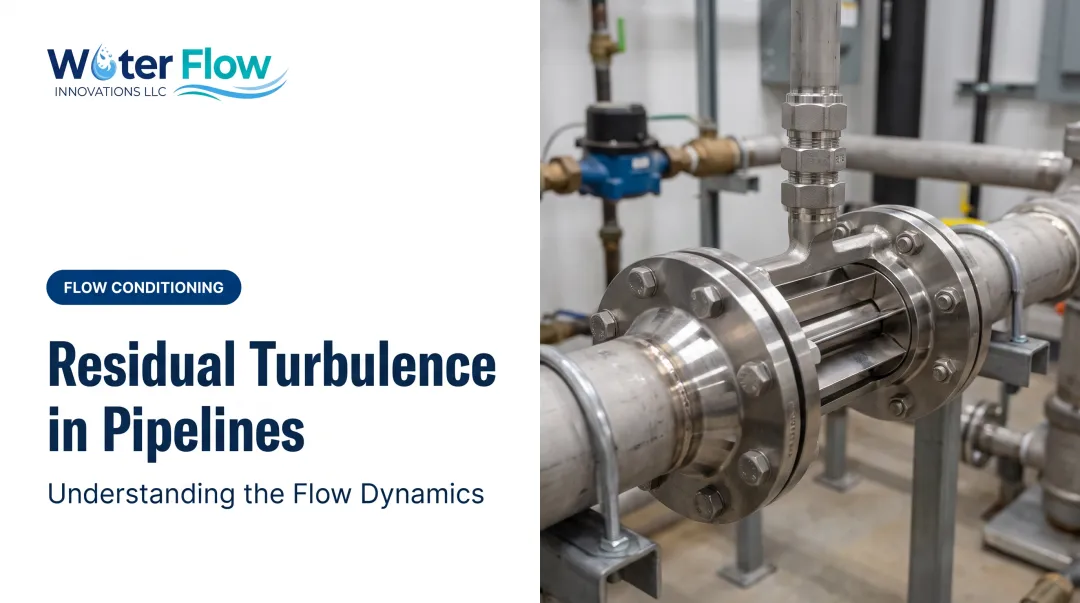
Standard flow straighteners can restore a reasonable velocity profile within roughly 2 diameters downstream, though they introduce their own pressure penalty. That's the trade-off with basic conditioning: you fix the flow profile but pay for it in head loss.
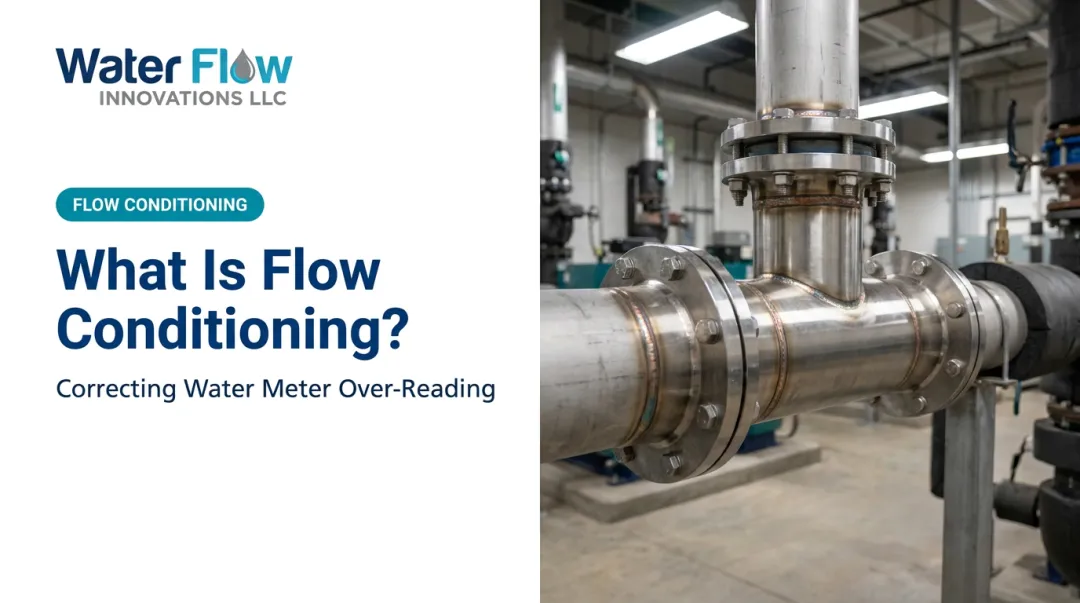
Multi-function conditioners go further than profile correction alone. Water Flow Innovation's Flow Conditioning Device (FCD), for example, combines four functions in one certified unit:
- Air and gas removal — creates static back pressure that pushes entrained air and micro-bubbles out of the water column the meter sees
- Pressure regulation — smooths surges and reduces water-hammer risk from on-off cycling
- Check valve function (on select models) — minimizes reverse flow that can let air re-enter the line
- Turbulence elimination — slows velocity at the meter enough to prevent vortex flow
The FCD installs immediately after the municipal meter, on the consumer side, fitting into existing piping via flange connection—no pipe replacement required. Installation typically takes about an hour, and the device is engineered for negligible pressure loss, so downstream performance stays unchanged.

Air entrainment and turbulence at the meter also drive billing errors. Over-registration means the meter counts air bubbles and chaotic flow as water that never actually passed through. Correcting that at the meter point directly fixes billing accuracy without changing how much water your facility actually uses. Documented results across installations range 5-30% average bill reduction, with a highest recorded single-facility result of 46%.
The unit is IAPMO, NSF, ANSI, CAN 61, KIWA, GMP, and SQF certified, built in 316L stainless steel for ½ inch to 12 inch lines (larger custom sizes on request).
System Management and Maintenance
Design gets you started. Ongoing management keeps turbulence from creeping back in.
- Inspect and clean pipe interiors regularly to prevent scale buildup and corrosion-driven roughness
- Monitor flow velocity against recommended limits for your pipe material—copper commonly tops out around 8 ft/s for cold water, while PVC manufacturers often cap steady-state flow near 5 ft/s
- Address air entrainment at pump intakes, air release valves, and elevation changes in the pipeline route
- Track differential pressure and pump power trends at repeatable operating points to catch developing roughness early

Here's the reality most facility managers miss: your original pipe design might be fine. The turbulence problem could be entirely from 15 years of scale buildup or a valve that's been left half-closed since the last renovation. Diagnosing before fixing matters.
Signs Your Pipeline May Have a Turbulence Problem
Watch for these physical and operational red flags:
Physical indicators:
- Unusual pipe noise, humming, or vibration
- Water hammer after sudden valve changes (a related pressure symptom, not the same as steady turbulence)
Operational indicators:
- Unexplained pressure drops across the system
- Inconsistent flow readings between similar operating periods
- Water or sewer bills that climb without any corresponding increase in actual usage
Rising bills with no change in operations deserve a closer look. If usage, occupancy, and equipment have stayed the same, turbulence-driven meter over-reading is worth investigating.
A professional flow assessment can confirm whether turbulence is the root cause before you spend money on fixes that miss the real issue.
Conclusion
Reducing turbulence effectively starts with identifying whether the cause is design-related, mechanical, or simply the result of years of wear and scaling. A generic fix applied to the wrong cause wastes time and money.
Correcting turbulence-related meter over-reading delivers savings on your very next billing cycle, with no ramp-up period and no operational disruption. For facilities facing inflated water and sewer bills that don't match actual usage, that immediate payoff makes diagnosis and correction worth prioritizing now.
Frequently Asked Questions
What are two main causes of turbulent flow?
High fluid velocity relative to pipe diameter (a high Reynolds number) and physical disturbances such as bends, valves, and rough interiors. The two compound each other: high velocity through a disturbance creates far more turbulence than low velocity at the same point.
How can I reduce the noise from my water pipes?
Secure loose pipe supports, add adequate straight runs before fittings, and consider flow conditioning devices that smooth velocity profiles. Rule out cavitation and water hammer first so you know turbulence is the real cause.
Does turbulence affect water meter accuracy?
Yes. Turbulence and air entrainment can make meters over-register flow, inflating bills with no real change in consumption—especially in facilities with variable demand such as tank fills or irrigation.
How much energy does turbulence waste in pipelines?
No single figure isolates turbulence alone. Pumping systems use about 25% of US industrial electric-motor energy, and optimization that includes turbulence reduction can cut 20–40% or more of that load.
Can turbulence in pipes be eliminated completely?
In the lab, turbulent flow can revert to laminar under tightly controlled conditions. In real pipelines, you can only reduce it significantly through design and conditioning—not eliminate it entirely.
Is a flow conditioning device the same as a flow straightener?
Not quite. Flow straighteners mainly fix velocity profile and swirl. Devices like Water Flow Innovation's FCD also remove air/gas and regulate pressure, which matters when air entrainment (not only turbulence) drives meter inaccuracy.
What symptoms suggest turbulence is reaching the billing meter?
A bill that no longer moves with production or occupancy, a sewer charge out of step with actual discharge, several demand sources cycling on one connection, and no change after the utility swapped the meter.
How much of the bill does conditioning that flow recover?
Documented installations average a 5–30% reduction in combined water and sewer charges, with a highest documented single result of 46%, showing on the very next billing cycle after installation.