Introduction
Steel manufacturing ranks among the most water-intensive industrial processes. A single integrated mill can withdraw tens of millions of gallons a day for cooling, descaling, and process needs.
Rising water scarcity, climbing utility rates, and ESG scrutiny are forcing plants to rethink every gallon.
Most operators focus on the obvious pain point: sheer withdrawal volume. But there's a second, quieter cost. High-volume industrial pipes generate turbulent flow that can cause water meters to over-register usage. Plants often pay for water they never actually received.
This guide covers how much water steel mills really use, where it goes inside the plant, proven reduction and reuse methods, and an often-overlooked lever for immediate savings: correcting meter accuracy.
Key Takeaways
- Steel plants recover and reuse up to 90% of drawn water through recirculating cooling and treatment systems
- Cooling, process, and boiler-feed streams each need their own reduction playbook—not one plant-wide fix
- Pair water-saving equipment with accurate flow measurement to close the gap between water used and water billed
- Build every plan around source-water quality, energy trade-offs, and discharge compliance
How Much Water Does a Steel Mill Actually Use?
Water figures in steel production vary widely depending on production route, plant age, and cooling system design.
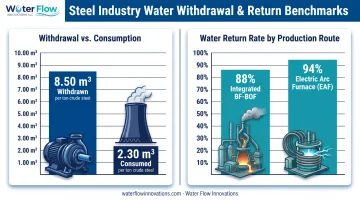
According to worldsteel's 2025 Sustainability Indicators Report, the industry-wide average is 8.50 m³ of freshwater withdrawal per ton of crude steel (about 2,245 gallons), with 2.30 m³ actually consumed (about 608 gallons). The rest is returned to the source after treatment.
That gap between withdrawal and consumption matters. Withdrawal is everything a plant pulls from a river, well, or municipal supply. Consumption is what's lost for good, mostly through evaporation during cooling. Older route-specific surveys found integrated (BF-BOF) plants returning about 88% of withdrawn water, while electric arc furnace (EAF) plants returned closer to 94%.
Once-Through vs. Recirculating Cooling
The single biggest driver of a plant's total water footprint is its cooling system design:
- Once-through systems pull fresh water, cool equipment once, then discharge it: high withdrawal, minimal reuse
- Recirculating systems cycle the same water through cooling towers repeatedly, replenishing only what's lost to evaporation and blowdown
A JRC-documented integrated steelworks example achieved 97.2% recirculation, with freshwater makeup covering just 2.8% of total system volume. That's the difference between a plant that withdraws tens of millions of gallons daily and one that operates on a fraction of that.
At the scale steel mills operate, precision matters. Facilities running high-volume lines through turbulent piping systems often lose measurement accuracy at the meter, a hidden cost on top of real process use.
Where Water Is Used Across the Steel Manufacturing Process
Not all water use inside a mill is equal. Understanding where it goes is the first step toward targeting reduction efforts effectively.
Cooling Water
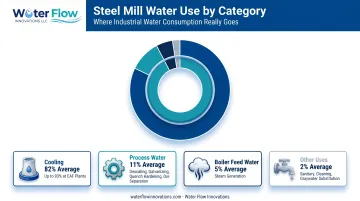
Cooling dominates steel plant water demand by a wide margin. A worldsteel survey of member facilities found cooling accounted for roughly 82% of total withdrawal on average. That share is 80% at integrated BF-BOF plants and as much as 93% at EAF plants, where cooling is nearly the entire water story.
Cooling applications include:
- Contact cooling during hot and cold rolling
- Off-gas cooling and gas cleaning circuits
- Furnace shell, hearth, and tuyere belt cooling
- Continuous casting mold and secondary spray cooling
Plants running once-through cooling on any of these systems are leaving the largest reduction opportunity on the table.
Process Water
Process water covers a range of applications with very different contamination profiles:
- Descaling: high-pressure water removes oxide scale between rolling passes
- Galvanizing and coating: baths and rinses that introduce metals and salts
- Quench hardening: rapid cooling that can introduce oils and residues
- Ore separation and preparation: upstream water used in raw material handling
Reuse potential here depends entirely on what the next process can tolerate. Acids, solvents, and emulsions from pickling or coating lines typically require targeted membrane or chemical treatment before that water can be recycled anywhere downstream.
Boiler Feed Water and Other Uses
Boiler feed water generates the steam used across coking, blast furnace operations, vacuum treatment, and mechanical drive systems. It carries strict quality requirements. Dissolved solids and hardness that would be tolerable in cooling water can foul boiler tubes and cut equipment life.
Beyond the major systems, plants also use water for:
- Sanitary systems and employee facilities
- General cleaning and dust suppression
- Drinking water supply
A growing number of facilities substitute treated graywater for these lower-quality-tolerant uses, freeing up higher-quality freshwater for boiler and process applications.
Proven Methods and Technologies for Reducing Water Consumption in Steel Plants
Water Recirculation and Closed-Loop Cooling Systems
Converting once-through cooling to recirculating loops is the highest-impact change most plants can make. Tata Steel's Jamshedpur facility built a 15,140 cubic meter/day Central Effluent Treatment Plant combining clarification, filtration, and UF/RO treatment, reusing water through six to eight cycles before discharge. The result: a 25% reduction in freshwater intake over four years (Tata Steel, 2018).
Membrane Filtration: Ultrafiltration and Reverse Osmosis
UF and RO systems treat blowdown and contaminated streams to produce reusable permeate. A documented Italian integrated steelworks case applied UF followed by RO to hot-strip-mill water, achieving:
- 89.5% UF recovery and 75% RO recovery
- 94.5% salt rejection, rising to nearly 96% with concentrate recirculation
- A 20% cut in pickling-plant freshwater makeup when pipe-coating blowdown was reused as feedwater
Water Network Integration and Digital Monitoring
Mapping the full plant water network, instead of optimizing units in isolation, surfaces reuse paths that single-system projects miss. The EU-funded WHAM project tested this at TenarisDalmine, Ferriere Nord, and an ArcelorMittal Spanish finishing line with online monitoring, network simulation, and diagnostics.
A separate modeled study at an integrated Italian works found that reusing continuous-casting blowdown in gas-washing circuits could cut freshwater use by up to 33%.
Zero Liquid Discharge (ZLD) and Advanced Treatment
For facilities facing the strictest effluent regulations, ZLD eliminates wastewater discharge entirely. Tata Steel's Kalinganagar plant runs a CETP with membrane treatment, crystallizers, and evaporators to reach zero discharge. The trade-off is real: thermal brine concentration runs 20-25 kWh per cubic meter, and crystallization can reach 52-66 kWh per cubic meter — meaning ZLD solves a discharge problem at a meaningful energy cost.
Correcting Water Meter Over-Reading for Billing Accuracy
Every method above cuts real water use. A separate issue still inflates cost: the meter reading itself.
High-volume lines to cooling towers, descaling, and gas-washing create turbulent flow, air entrainment, and vortices that push commercial meters to over-register.
Displacement and turbine meters cannot tell water from entrained air, so every air bubble gets billed as water.
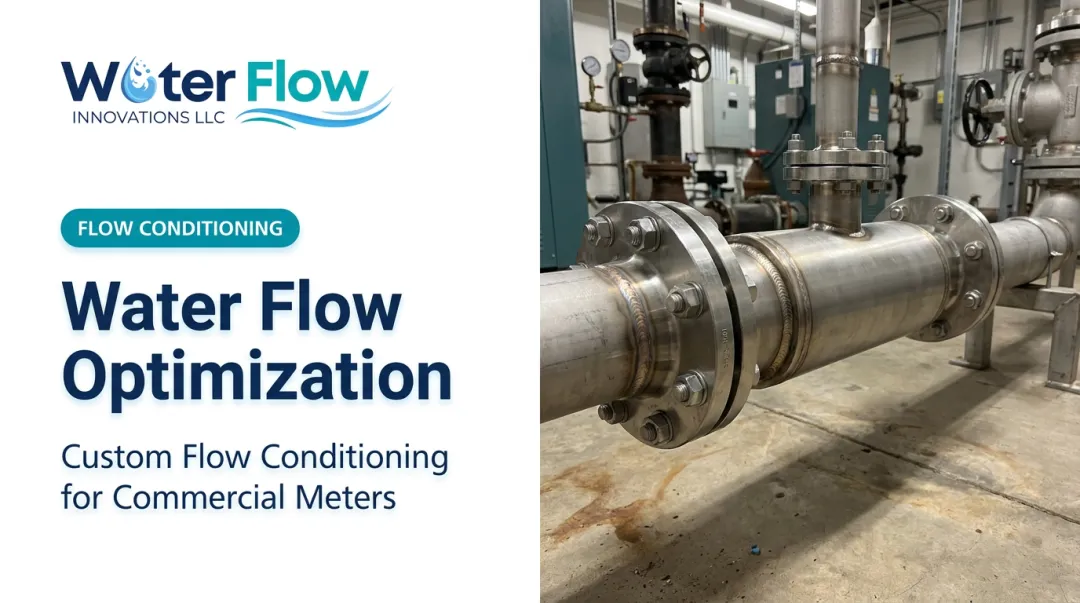
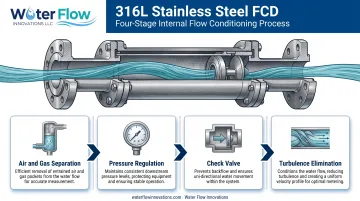
Water Flow Innovation's Flow Conditioning Device (FCD) addresses that measurement error alongside treatment upgrades, not instead of them. The custom-fabricated 316L stainless unit installs directly after the meter and corrects over-registration with four components:
- Air and gas separation — builds static back-pressure so the meter sees a homogeneous water column
- Pressure regulation — smooths spikes from cooling-tower makeup, CIP cycles, and variable demand
- Check valve — blocks reverse flow that would pull air back in after purging
- Turbulence elimination — slows velocity enough to stop vortex flow at the measurement zone
Install usually takes about an hour on pipe sizes NPS 1/2"–12" (DN20–DN500) and any meter type, without changing actual usage or system pressure. That range covers the large-diameter cooling and process lines common in steel mills. IAPMO, NSF, ANSI, CAN 61, KIWA, GMP, and SQF certifications give procurement and QA a clear vendor-qualification trail.
Documented results average a 5–30% drop in water and sewer bills, with a high of 46%. Savings typically appear on the next billing cycle, with no change to usage or production.
Real-World Water Savings in Steel and Heavy Manufacturing
Two documented cases show what's achievable when process improvements and reuse technology are combined:
Tata Steel, Jamshedpur: Its CETP and UF/RO recycling program cut freshwater intake 25% over four years. The plant recycled 17.69 million cubic meters of water in 2017 alone through multi-cycle reuse before any discharge.
Toyota, automotive manufacturing: Secondary RO treatment of previously discharged concentrate recovered 50% of that stream. Broader rollouts across US, Canadian, and Mexican plants saved 73 million gallons per year (Water Tech Online, 2016).
Facilities that pair consumption-reduction technology with accurate metering see compounded gains. Reducing actual withdrawal lowers the volume billed. Correcting meter over-reading ensures the plant only pays for what that lower volume actually costs.
At mill-scale intake, even a modest correction percentage compounds into a meaningful annual figure on both the water and sewer side of the bill.
Key Factors to Balance When Building a Water Management Strategy
A sound strategy weighs more than raw usage numbers.
Source water quality and availability
Geographic location and seasonal supply swings dictate treatment cost and feasibility. A mill drawing from a mineral-heavy river needs different pretreatment than one on a municipal supply. Drought-prone regions face tighter withdrawal permits no matter which technology is in place.
Energy efficiency trade-offs
Treatment isn't free. RO, UF, and especially ZLD systems consume real energy. Thermal ZLD alone can run 20-66 kWh per cubic meter depending on the stage. Plants need to weigh net environmental impact, not just water saved in isolation.
Regulatory and discharge compliance
EPA's Iron and Steel Manufacturing Effluent Guidelines (40 CFR Part 420) apply to roughly 254 facilities nationwide across 13 subcategories, covering everything from cokemaking to pickling and coating discharge. Any reduction strategy has to satisfy withdrawal and discharge permits while keeping production capacity intact. That constraint often shapes which technology gets deployed first.
Frequently Asked Questions
How much water does a steel mill use per day?
Mills withdraw about 8.5 cubic meters per ton of crude steel produced, and large integrated plants can pull tens of millions of gallons daily. Most of that volume is recovered and returned, not permanently consumed.
Which methods are most effective for reducing water consumption in steel plants?
Recirculating cooling systems, UF/RO membrane treatment, plant-wide water network integration, and accurate flow metering deliver the biggest reductions. Pairing those measures with correct billing measurement produces the largest overall savings.
What percentage of water can steel plants realistically reuse or recycle?
Many facilities recover up to 90% of drawn water through combined recirculation and treatment strategies, with some integrated works reaching over 97% recirculation in specific circuits.
Does reducing water use impact steel production quality or output?
No. Well-designed recirculation and treatment systems maintain the water quality standards required for cooling, descaling, and boiler feed without affecting production output or product integrity.
How can a steel plant tell if it's being overcharged for water it never used?
Turbulent flow and air entrainment in high-volume pipes can cause meters to over-register usage. A free savings analysis from Water Flow Innovation can show whether that is happening at your facility.
What is the first step a steel plant should take to start reducing water costs?
Start with a water audit covering total usage volume, recirculation potential, and metering accuracy. A free bill review can flag over-registration issues before any larger capital investment in treatment infrastructure.
Does fitting a correction require pausing the mill?
No. A licensed plumber or mechanical contractor installs the custom-built device at the municipal supply connection in about an hour, with a brief water shutoff at the meter connection, so descaling, cooling, and boiler circuits keep running otherwise untouched.
Which other heavy industries show the same metering pattern?
Metal finishing, concrete and cement manufacturing, glass, mining and mineral processing, lead-acid battery manufacturing, and lithium-ion battery giga-factories — all combining high-volume cooling with abrupt demand changes on one connection.