Flow meter accuracy measures how close a meter's reading is to the actual flow passing through the pipe. No meter hits that number exactly. Every measurement device carries some margin of error, whether ±0.5% or ±5%.
That margin matters more than most people realize. A commercial building running continuous water service can rack up thousands of gallons in billed "phantom" volume over a year if a meter systematically reads high.
This article breaks down what flow meter accuracy actually means, how it differs from repeatability and resolution, how manufacturers express it in specs, what conditions degrade it in the field, and what error ranges are considered acceptable for water metering applications.
Key Takeaways
- Flow meter accuracy measures how close a reading is to the true flow value, expressed as a ± percentage.
- Repeatability, resolution, and accuracy are related but distinct: a meter can be repeatable yet still inaccurate.
- Stated as % of Full Scale vs. % of Reading, accuracy shifts drastically at low flow rates.
- Turbulence, air entrainment, poor installation, and calibration drift are the leading causes of reduced accuracy.
- Meters operating "within spec" can still systematically over-read, inflating water bills for years.
What Is Flow Meter Accuracy?
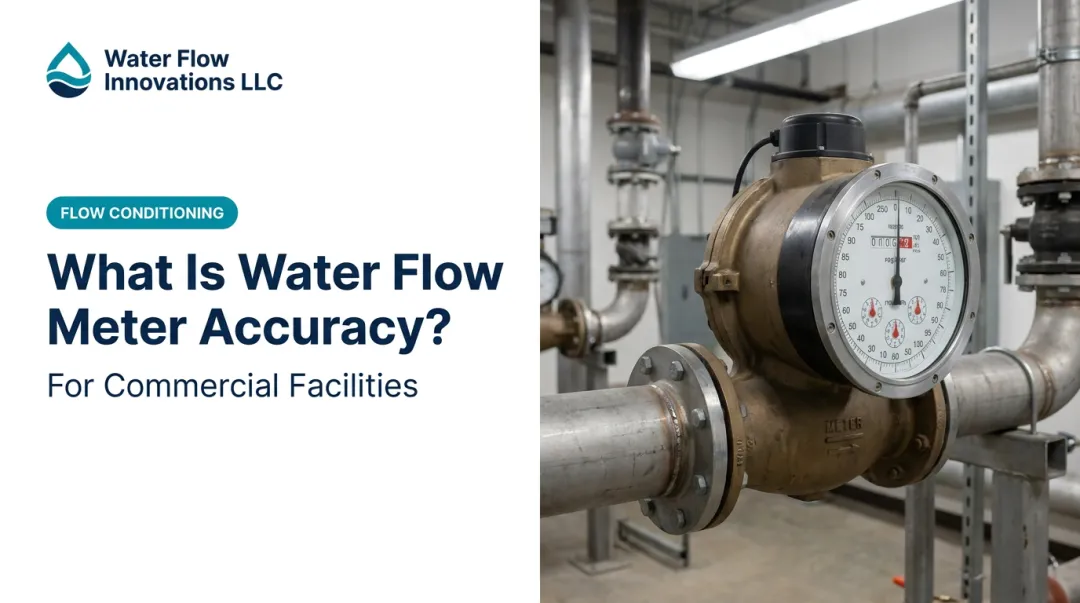
Flow meter accuracy is the degree to which a meter's output matches the actual flow rate moving through the pipe at a given moment. It's typically expressed as a plus-or-minus percentage, such as ±1% or ±2%, attached to either the reading or the meter's maximum capacity.
No flow meter is perfectly accurate. Every measurement device, from a budget residential meter to a high-end industrial mass flow meter, carries some inherent margin of error.
Since a zero-error meter doesn't exist, the real job for an engineer or facility manager is to identify how much error is present, understand its source, and minimize it for the application at hand.
A practical example:
Say a meter reads 100 GPM with a stated accuracy of ±2%. The true flow could be anywhere from 98 to 102 GPM. That 4 GPM window sounds small in isolation.
Now stretch it across a commercial building running that flow continuously, day and night, for a full billing cycle. A consistent 2% overstatement compounds into thousands of billed gallons that were never actually consumed.
Specification Accuracy vs. Real-World Accuracy
Manufacturers publish accuracy numbers tested under controlled, ideal conditions: straight pipe runs, stable temperature, clean fluid, properly calibrated equipment. Real-world accuracy is often worse.
Badger Meter's own documentation illustrates this gap directly. One electromagnetic meter model is rated at ±0.2% with proper straight-pipe run, but only ±1% with zero straight run, representing a fivefold difference driven entirely by installation conditions.
That means the number printed on a spec sheet is a best-case ceiling, not a guarantee.
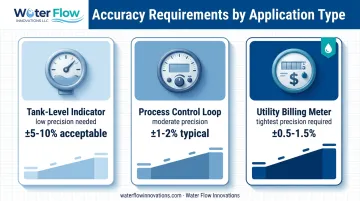
Match accuracy to the application. Higher-accuracy meters cost more, and that premium isn't always necessary:
- A tank-level on/off indicator doesn't need ±0.1% precision.
- Process control loops benefit from tighter accuracy but can tolerate some drift.
- Utility billing meters need the tightest accuracy the application can justify — every gallon carries a dollar value, and error compounds directly into cost.
Accuracy vs. Repeatability vs. Resolution: Key Differences
These three terms get used interchangeably in sales conversations and spec sheets, but they answer completely different questions. Confusing them leads to bad purchasing decisions and leaves facility managers trusting numbers that don't mean what they assume.
Accuracy
Accuracy asks: is this reading correct? It measures how close a single measurement comes to the true flow value passing through the pipe. A highly accurate meter produces readings that track closely with actual flow, regardless of how many times you check it.
Repeatability
Repeatability asks a different question: is this reading consistent? A repeatable meter produces the same output every time it measures the same actual flow under the same conditions.
Here's the catch: a meter can be highly repeatable and still wrong. If a meter consistently reads 5% high every single time, often the result of turbulence near the meter, it's perfectly repeatable but not accurate. The good news is that kind of consistent bias can usually be corrected through calibration.
A meter that isn't repeatable is a bigger problem. If readings bounce around unpredictably under identical conditions, there's no way to calibrate it into reliable accuracy. You can't fix noise with a correction factor.
The relationship that matters: you cannot have reliable accuracy without repeatability, but you can have repeatability without accuracy. For billing and process control, check both specs, not just one.
Resolution
Resolution is the smallest increment of flow change a meter can detect and display. A meter with 0.1 GPM resolution can't distinguish between 10.0 and 10.05 GPM. It will round or hold steady until the change exceeds its detection threshold.
If an application needs to know flow to a finer degree than the meter's resolution allows, that meter will introduce effective inaccuracy, even while operating perfectly within its stated accuracy spec.
How Flow Meter Accuracy Is Expressed
Manufacturers don't all express accuracy the same way, and that inconsistency creates real risk during equipment selection. Two meters both claiming "±1% accuracy" can perform very differently depending on which basis that percentage uses.
Percent of Full Scale (%FS)
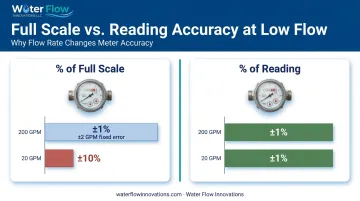
With %FS accuracy, the error is a fixed amount based on the meter's maximum rated capacity, not the actual flow being measured. That fixed error doesn't shrink just because flow drops.
Example: a meter rated at 200 GPM with ±1% FS accuracy always carries a ±2 GPM error, whether the actual flow is 200 GPM or 20 GPM. At 20 GPM, that same ±2 GPM error now represents ±10% of the actual reading: ten times worse than the headline number suggests.
The Instrumentation, Systems, and Automation Society makes this concrete. A meter rated at ±0.5% of a 50 ft/s full-scale range carries an absolute error of 0.25 ft/s. At an actual flow velocity of 6 ft/s, that fixed error equals 4.17% of the reading, more than eight times higher than the printed ±0.5% spec suggests.
Percent of Reading (%R or %RD)
With %Reading accuracy, the error scales proportionally with whatever flow is actually being measured at that moment. A meter with ±1% of reading accuracy stays close to ±1% error whether it's measuring 200 GPM or 20 GPM.
This makes %Reading a far more meaningful spec for facilities where flow varies significantly, which describes almost every commercial water system. Flow peaks during business hours and drops to a trickle overnight.
Watch for split accuracy statements. Some meters apply one spec at higher flow rates and switch to a second (often %FS) spec at low flow rates. Read the full specification table, not just the headline number, to understand real performance across your actual operating range.
What Factors Affect Flow Meter Accuracy?
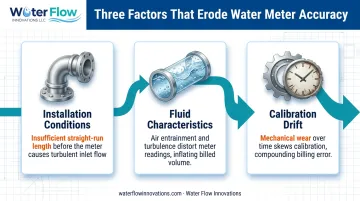
Three categories of real-world conditions push meters away from their factory-rated accuracy: installation, fluid characteristics, and calibration drift.
Installation Conditions
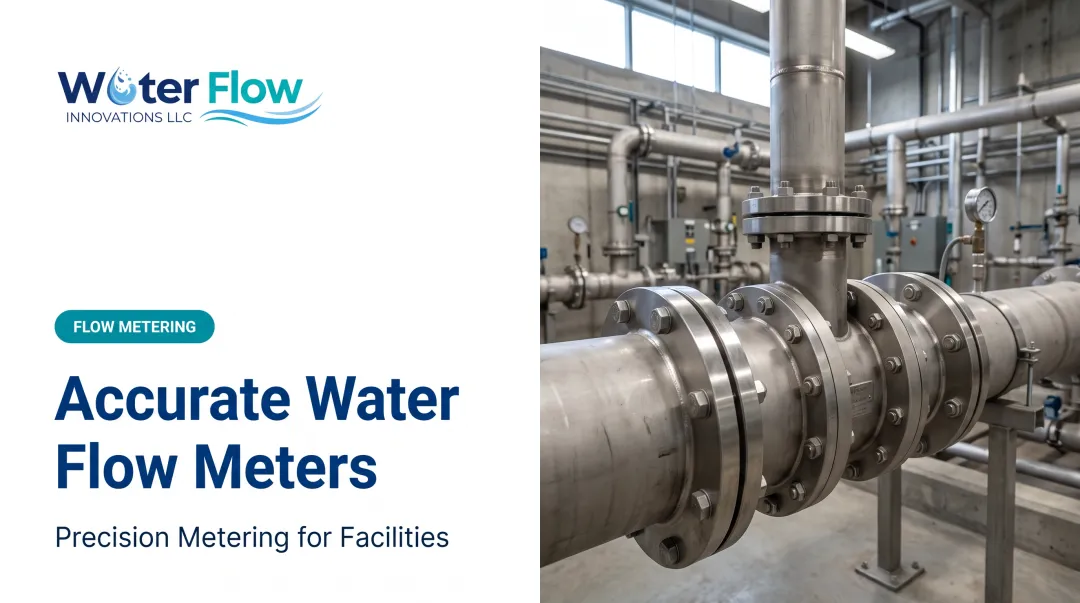
Most flow meters need a minimum length of straight, undisturbed pipe both upstream and downstream to develop a uniform, non-turbulent flow profile at the measurement point. Elbows, valves, pumps, and tees placed too close to the meter distort that profile and skew readings.
Straight-run requirements vary by meter technology; there's no universal number:
- Electromagnetic meters are relatively tolerant. Siemens cites 5D upstream as ideal for some magnetic meter configurations.
- Clamp-on ultrasonic meters often need considerably more. Endress+Hauser recommends 15 pipe diameters or more upstream depending on the disturbance.
- Turbine meters are highly geometry-sensitive; published research has recorded errors approaching -15% behind a double elbow with zero straight-run distance.
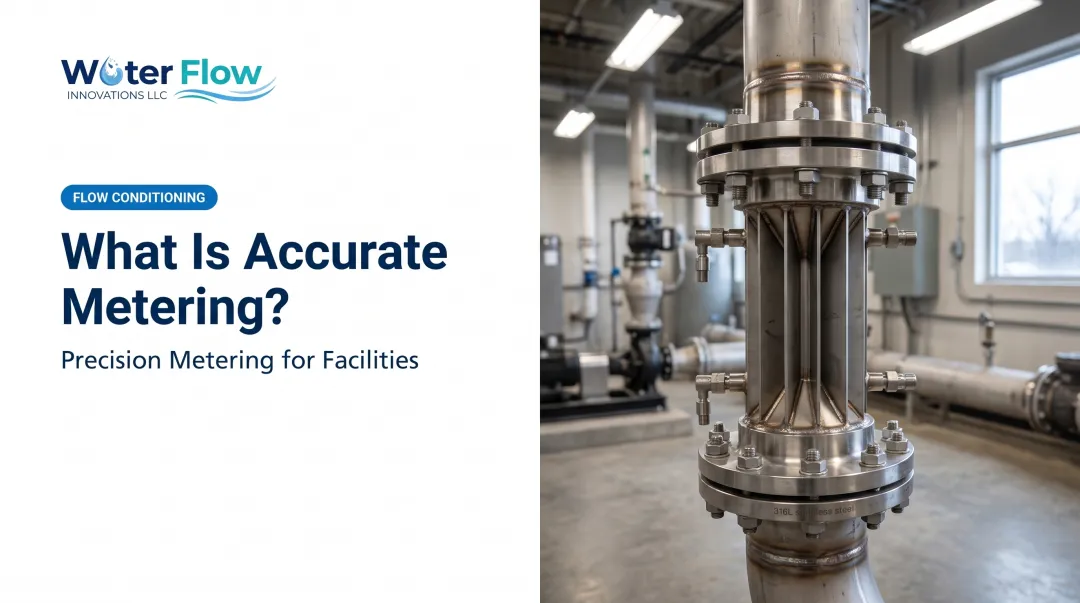
There's no universal rule of thumb here; installation geometry has to match the specific meter's certified requirements. This dynamic is exactly why flow conditioning devices exist: they restore a uniform flow profile downstream of pipe fittings, correcting the over-reading that turbulent installations cause.
Fluid Characteristics
Air bubbles, entrained gas, suspended solids, viscosity shifts, and temperature swings all change how a meter measures flow. Air and gas entrainment is especially disruptive in water systems: when air passes through a meter's measurement zone, many designs register it as water volume, producing systematic over-reading.
This is particularly common around pressure cycling events, such as pump starts and stops, valve cycling, and tank refills after a service interruption. Air can enter the line during these events and pass through the meter before pressure stabilizes.
Calibration Drift
Over time, mechanical wear, fouling, mineral coating, or electronic component aging cause meters to drift away from their factory-calibrated accuracy. Calibration intervals vary by meter type and application, but a meter operating well past its recommended interval may be reading inaccurately with no visible warning sign. No error light, no alarm, just a number that's quietly wrong.
Regular calibration checks, at whatever frequency the manufacturer and application demand, are the only reliable way to catch this drift before it accumulates into a billing problem.
What Is the Acceptable Error for a Flow Meter, and What Happens When Meters Over-Read?
Acceptable error depends heavily on the application. Custody transfer and utility billing meters, where money changes hands based on the reading, are held to tighter standards than a process monitoring gauge that just needs a general sense of flow.
For commercial water meters, Neptune's technical summary of AWWA standards puts new-meter accuracy at 98.5% to 101.5% of true flow at normal operating rates, widening to a looser band at low flow. Field-tested turbine meters carry a separate AWWA M6 recommendation of roughly 96% to 102%.
These figures come from the family of ANSI/AWWA standards: C700 for displacement meters, C701 for turbine meters, C715 for electromagnetic and ultrasonic designs.
Being "within spec" doesn't mean a meter is reading perfectly. A meter sitting at the edge of its acceptable error range can still consistently over-read every billing cycle.
When that error is systematic (always high, rather than randomly scattered), it accumulates into real, ongoing overbilling over months and years. A meter that's 1.5% high every month adds a permanent, recurring cost to every bill.
The Role of Air Entrainment and Turbulence
Air and gas entrainment causes a structural accuracy problem unrelated to meter manufacturing quality. It's common around pump cycling, valve operation, CIP cycles, irrigation zone switching, and pressure surges in commercial plumbing.
When air enters the water line, many meter designs can't distinguish it from water. The meter counts the air volume as billable flow, registering more than what was actually delivered.
This happens independent of whether the meter itself is operating within its rated accuracy specification. A meter can be performing exactly as designed and still over-read; the entrained air passing through it, rather than any meter defect, causes the excess reading.
Correcting the Root Cause
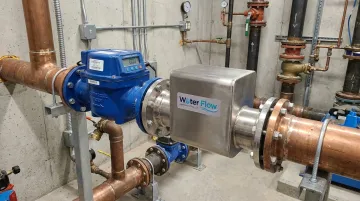
This is the specific problem Water Flow Innovation's Flow Conditioning Device (FCD) is built to solve. Rather than replacing or recalibrating the meter, the FCD installs immediately downstream of it and conditions the water at the point of measurement.
Its proprietary four-component system:
- Removes entrained air and gas to create a homogeneous water column
- Regulates pressure to eliminate surges and water hammer
- Includes a check valve to prevent reverse flow and re-entrained air
- Eliminates turbulence and vortex flow at the point of measurement
By correcting these conditions rather than the meter's calibration, the FCD helps the meter register closer to true flow. Facilities typically see 5–30% reductions in water and sewer bills, with the highest documented result at 46%.
Roughly 90% of customers reach ROI in under 12 months, and the device is IAPMO, NSF, ANSI, CAN 61, KIWA, GMP, and SQF-certified. Installation is usually about an hour (+/-).
Frequently Asked Questions
How accurate are flow meters?
Accuracy varies by technology: typical commercial water meters are specified within ±1.5–2%, while high-precision Coriolis meters can reach ±0.1%. Real-world accuracy is often worse once installation and calibration drift are factored in.
What is the acceptable error for a flow meter?
Acceptable error depends on the application: utility billing and custody transfer meters are typically held to tighter AWWA/ANSI standards, often within ±1.5–2%, while process monitoring tolerates wider margins. Even a meter "within spec" can still over- or under-read meaningfully over time.
What is the difference between flow meter accuracy and repeatability?
Accuracy measures how close a reading is to the true flow value, while repeatability measures how consistently the meter repeats that reading. A meter can be highly repeatable yet still inaccurate if it's consistently off, so both specs matter.
What does % of full scale vs. % of reading mean for flow meter accuracy?
%FS error is a fixed amount based on the meter's maximum capacity, so it becomes a larger percentage of actual flow at low rates. %Reading error stays proportional to actual flow, making it the more meaningful spec when flow varies widely.
What causes a water meter to read inaccurately?
The most common causes are air and gas entrainment, turbulent flow profiles from nearby fittings, calibration drift over time, and operating outside the meter's rated flow range. Several of these can cause systematic over-reading that inflates utility bills.
How can I tell if my water meter is reading too high?
Watch for unexplained bill increases without a matching change in usage, bills disproportionate to actual consumption, or discrepancies between the utility meter and internal sub-meters. A flow conditioning assessment can help confirm whether air entrainment or turbulence is the cause.
What does a flow conditioning assessment involve?
A remote review of recent water and sewer bills, meter size, pipe size, line pressure, and PRV configuration, plus your operating profile. It returns a projected savings range, device sizing, ROI estimate, and installation plan at no cost and with no commitment.
Which facilities most often operate outside the meter's ideal conditions?
Those with rapid, repeated demand changes: car and truck washes, laundromats, food and beverage and dairy processing, breweries and distilleries, hotels, hospitals, data centers, and irrigation-heavy sites such as golf courses and agricultural operations.