For facilities and finance teams, that's not a rounding error. It's an operating expense that eats into margins and makes budgeting harder than it needs to be.
Annual water and sewer costs for mid-to-large commercial or industrial facilities vary widely based on employee count, square footage, and how water-intensive the operation is. But here's the thing: high water bills are rarely inevitable. Most of the time, they come from poor visibility, aging infrastructure, and a lack of oversight — not from actual necessity.
This guide breaks down how water costs build up, what really drives them, and the strategies that cut them down.
Key Takeaways
- Water bills build from usage, tariff structure, and hidden losses like leaks and meter error
- Biggest cost levers: billing classification, aging fixtures, and meter over-reading from air and turbulence
- Reduction strategies fall into three buckets: smarter decisions, active management, and system-level fixes
- Correcting meter over-reading often cuts costs with zero change to water use or operations
- Combining all three approaches delivers the largest, most durable savings
How Costs Around Business Water Bills Typically Build Up
Water costs rarely show up as one obvious line item. Instead, they build across billing cycles: extra gallons from aging fixtures, inflated meter readings, and tariff classifications that no longer match how the facility actually uses water.
Most of this build-up is gradual. Aging fixtures lose efficiency slowly. Rate hikes creep in incrementally. But it can also be sudden. A single undetected leak or a faulty, over-reading meter can spike a bill overnight, with no warning until the invoice arrives.
The real problem is visibility. Water simply doesn't get audited with the same rigor as energy:
- Operations scale up without anyone revisiting water infrastructure
- Billing errors go unnoticed for years because nobody is checking tariff classifications
- Meter inaccuracies persist silently because there's no obvious symptom: the water still comes out of the tap
That's why many businesses only find the problem after a billing spike forces a closer look, or an audit shows they've been overpaying for months or years.
Key Cost Drivers for Business Water Bills
Not every water bill problem has the same root cause. Understanding which driver applies to your facility determines which fix will actually cut your bill.
Consumption Volume and Billing Structure
The most obvious driver is actual usage, tied to fixture count, occupancy, irrigation, and water-intensive processes like cooling towers or manufacturing lines. But usage alone doesn't explain the whole bill.
Billing structure matters just as much. Sewer multipliers, stormwater fees, and meter-size charges can inflate costs independent of how much water a facility actually consumes. Misclassification (being billed under the wrong tariff category or meter-size fee tier) is a common, hidden driver that has nothing to do with consumption.
Physical Losses and Aging Equipment
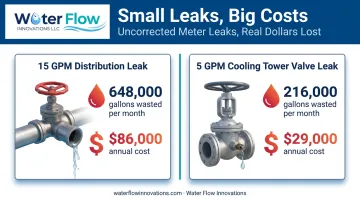
Leaks, dripping fixtures, and inefficient older equipment quietly inflate bills over time, often without any visible operational change. A stuck cooling-tower float valve running at just 5 gallons per minute can waste over 216,000 gallons a month, adding roughly $29,000 a year to the bill.
Water Meter Over-Reading
Here's a driver most facility teams have never heard of: air entrainment and turbulent flow through pipes can cause standard water meters to register more volume than what was actually delivered. In plain terms, businesses end up billed for water they never received.
This happens because meters are calibrated to measure a steady, fully-charged column of water. Introduce air bubbles or turbulence (common during equipment startup, pump cycling, or high-demand events) and the meter can register phantom volume.
Different facility types are driven by different combinations:
| Facility Type | Dominant Cost Driver |
|---|---|
| Irrigation-heavy properties | Outdoor watering, zone cycling |
| Manufacturing plants | Process water, cooling tower makeup |
| Older office buildings | Fixture inefficiency, meter inaccuracy |
| Hotels and multifamily | Combined fixture load, HVAC cycling |
Cost-Reduction Strategies for Business Water Bills
Effective cost reduction depends entirely on where the cost originates. Some savings come from decisions made before water is even used. Others come from how usage is actively managed day to day. And some of the largest savings come from fixing conditions in the system itself, with no change to how water is used at all.
Change Decisions Before Water Flows
These are choices made in procurement, specification, or policy, before a single gallon flows through the meter.
- Right-size water meters and verify tariff classification — a meter that's too large for actual demand, or a facility billed under the wrong rate class, quietly overpays every single cycle
- Specify water-efficient fixtures during renovations or new builds — low-flow toilets, sensor faucets, and efficient aerators cost far less to install upfront than to retrofit later
- Evaluate rate renegotiation where local markets allow it — options vary significantly by state and utility, so check what's actually available in your service area
- Establish sub-metering by department or tenant where usage disputes or inefficiency are likely, so accountability doesn't get lost in a shared bill
Manage How Water Is Used Day to Day
Once water is flowing, visibility and consistency become the priority.
- Implement real-time leak detection monitoring that flags abnormal usage before a billing cycle reveals a costly problem
- Schedule proactive fixture and irrigation maintenance rather than reactive repairs triggered by a bill spike
- Use smart irrigation controllers with weather and soil-moisture data to prevent overwatering and cut outdoor water waste
- Build a facility-wide conservation culture through simple employee or tenant awareness — usage reminders in high-traffic restrooms and break rooms cost nothing and add up over time
Fix Conditions in the Water System
This is where the highest-ROI fixes usually sit. In many cases, the surrounding infrastructure, not actual consumption, is the real cost driver.
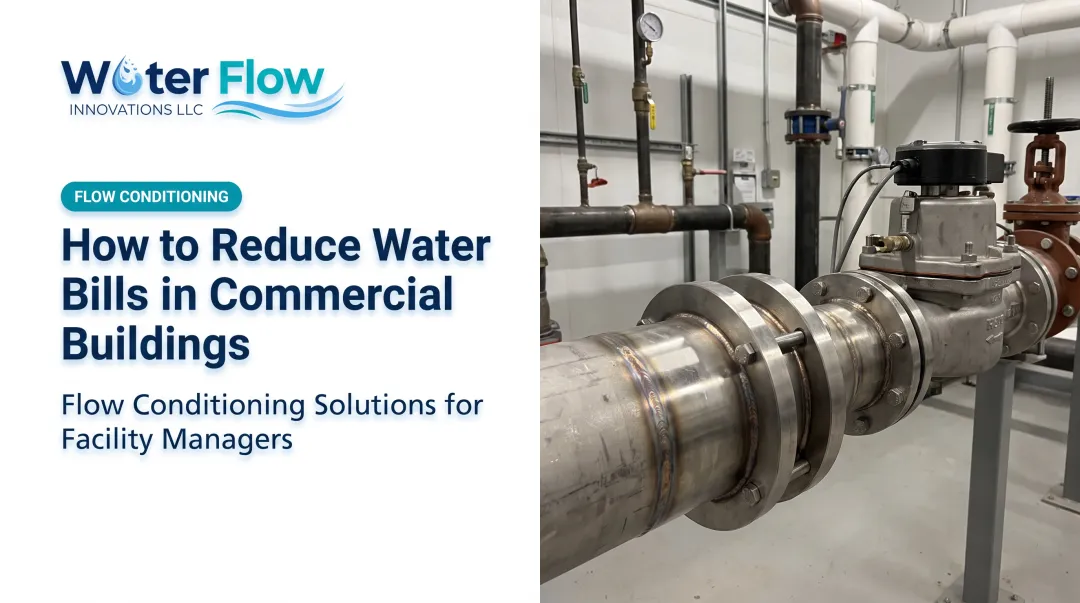
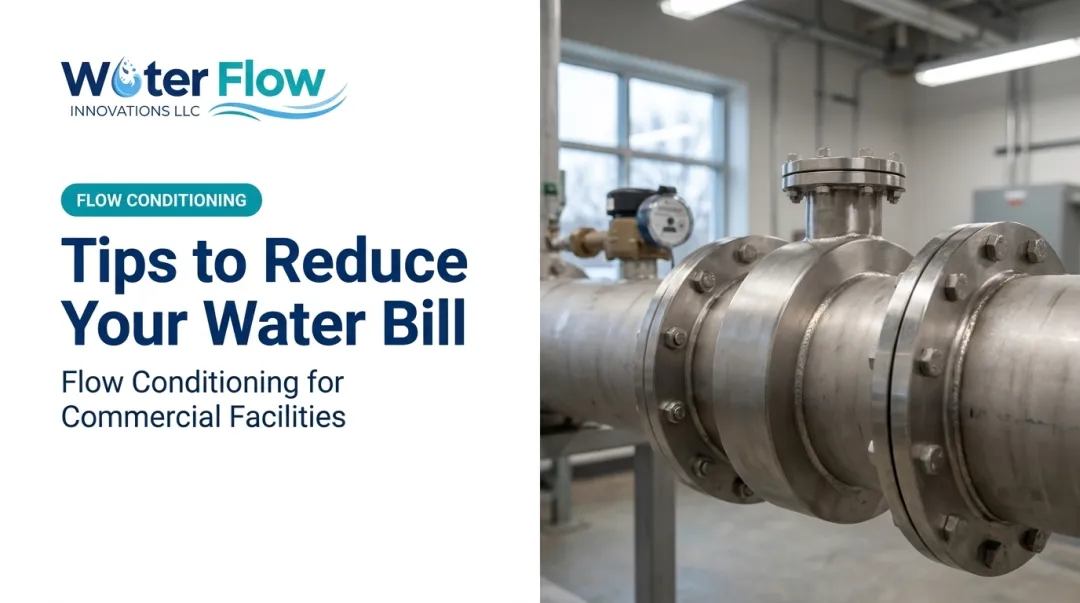
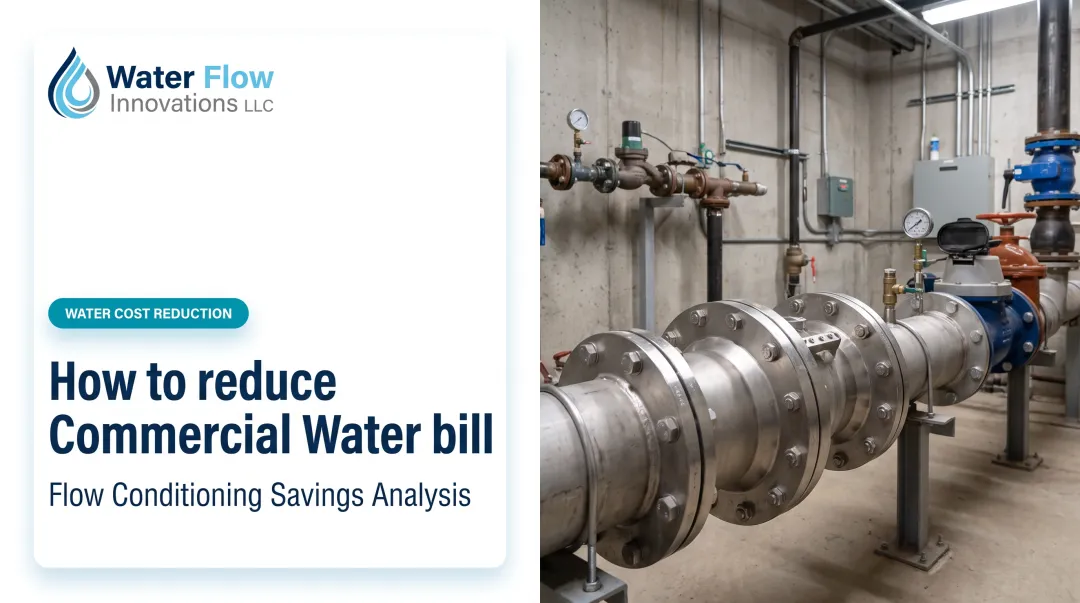
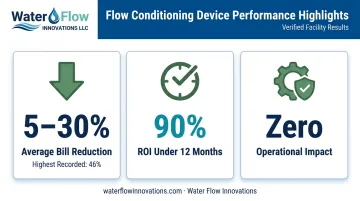
Correcting meter over-reading is the clearest example. Water Flow Innovation offers a Flow Conditioning Device (FCD) that removes entrained air and stabilizes turbulent flow at the meter, so the facility is billed only for water it actually received. Documented results show:
- 5–30% average bill reduction, with the highest single documented result at 46%
- 90% of customers reach ROI in under 12 months
- No operational impact on system performance, pressure, or daily operations
Because the FCD installs immediately after the municipal meter, not inside the facility's internal distribution system, installation typically takes about an hour of water shutoff time, with savings appearing on the very next billing cycle.
Beyond meter correction, a few other system-level fixes are worth pursuing:
- Pursue sewer credit adjustments for non-sewered water use such as irrigation and cooling tower evaporation. Utilities often overlook these unless usage is documented
- Optimize cooling tower cycles of concentration — moving from 3 cycles to 5–6 can cut makeup water demand by roughly 20–25% with no performance impact
- Commission a full utility bill audit to catch tariff misclassifications, billing errors, and missed efficiency credits across multiple billing cycles
Conclusion
Reducing business water costs starts with identifying exactly where those costs originate. Usage, billing structure, physical loss, and meter inaccuracy each requires a different fix. Generic cuts won't get you there.
The most durable savings come from combining three levers: smarter upfront decisions, active day-to-day management, and system-level corrections like flow conditioning. Savings hold when you treat this as ongoing work, not a one-time project.
If you're unsure where to act first, start with a line-item review of your water and sewer bills. That step usually shows which lever will pay off fastest.
Frequently Asked Questions
How can I reduce my commercial water bill?
Combine three approaches: smarter upfront decisions (fixture specification, tariff review), active management (leak detection, maintenance), and system-level fixes like correcting meter over-reading. Using all three together delivers the largest combined savings.
What uses the most water in commercial buildings?
Restrooms typically account for the largest share of office building water use, followed by heating and cooling systems, landscaping, and kitchen or process water. The exact split shifts depending on facility type, according to EPA's commercial water use research.
What is water meter over-reading and how does it inflate bills?
Air entrainment and turbulent flow in pipes can cause a meter to register more volume than was actually delivered. That means businesses get billed for water that never reached their facility, and because sewer is calculated from the same reading, the charge lands twice.
How quickly can businesses see savings after implementing water-saving measures?
Administrative fixes like audits and sewer credits, plus technology corrections like flow conditioning, often show measurable savings on the very next billing cycle. Fixture upgrades typically take longer to reach full ROI.
Are there rebates or incentives available for water efficiency upgrades?
Many utilities offer rebates for water-efficient fixtures and equipment. Check with your local provider for current programs. Documented savings from measures like flow correction can also support ESG, LEED, or sustainability reporting requirements.
Does reducing water costs disrupt daily business operations?
Most effective strategies, including audits, sewer credits, and flow conditioning technology, work in the background. There's no flow restriction, downtime, or impact on facility operations.
Can one programme cover an entire commercial estate?
Yes. Each property with its own metered municipal connection is a separate installation opportunity, so savings compound across the estate and sites can be prioritized by consumption volume. Before-and-after billing evidence aggregates for corporate benchmarking and capital planning.
What commercial and institutional property types benefit most?
Commercial office buildings, shopping malls, supermarkets, hotels and hospitality, healthcare facilities, schools and universities, municipal buildings, data centers, and stadiums and arenas — anywhere many demand sources share one metered connection.