
That raises a fair question: is your hospital paying for water that entered the meter but was never actually delivered as usable water downstream? A water flow conditioning device (FCD) is not a filter, a softener, a disinfection system, or a water-saving fixture. It's something different, and this article explains what that difference actually means.
We'll define flow conditioning, walk through air entrainment and turbulence, map likely veterinary applications, and give you a practical framework for evaluating safety, compatibility, savings, and installation.
Key Takeaways
- Flow conditioning targets how a meter measures flow, not water use or clinical procedures
- Review meter behavior, plumbing layout, billing history, and infection-control needs before selecting a device
- Check savings projections against baseline bills adjusted for occupancy, weather, leaks, and seasonal demand
- Confirm certifications, warranties, and performance claims in current manufacturer documentation before signing off
What Are Water Flow Conditioning Devices?
A water flow conditioning device stabilizes flow conditions at the point where a meter measures water, rather than changing the water's chemical makeup. It's not treatment. Filtration, softening, and disinfection systems alter what's in the water. Flow conditioning addresses how the water moves past the measuring instrument.
Why Flow Disturbance Matters to a Meter
Here's a simple way to picture it: a meter is calibrated to register accurately when water moves through it in a steady, fully developed stream. Bends, valves, pumps, and sudden demand changes upstream can disturb that stream, creating turbulence or allowing air to mix into the flow.
International metrology standards acknowledge this directly. OIML R 49-1:2024 requires meters to be completely filled under normal operating conditions. It also flags upstream bends, valves, and pumps as disturbance sources that call for sufficient straight pipe, with or without a flow straightener, to keep accuracy within specified error limits.
That's a meaningful detail. Disturbed flow is a recognized accuracy variable in metrology, not a marketing invention.
It does not mean every veterinary hospital is losing money this way, or that a device fixes it by a fixed percentage. The actual effect depends on plumbing layout, meter type, and demand pattern at each site.
Where This Might Be Worth Investigating
Facilities worth a closer look typically share certain traits:
- Large or multi-service veterinary hospitals with varied water demand
- Specialty and emergency facilities running equipment around the clock
- Boarding operations with heavy, intermittent cleaning cycles
- Teaching hospitals with complex, branching plumbing systems
- Any site with aging pipes, multiple risers, or frequent valve cycling
What Flow Conditioning Is Not
Related devices do different jobs:
- A backflow preventer protects potable supply from contamination flowing backward
- A pressure regulator reduces incoming pressure to a safe operating range
- An air separator vents entrained air out of a closed hydronic loop
- A strainer removes solids
- A water meter indicates passing volume
- A leak-detection system flags abnormal use
None of these do what a flow conditioner does, and a flow conditioner doesn't replace any of them.
Just as importantly, a flow conditioning device isn't a cure for leaks, a broken meter, inadequate pressure, contamination, poor plumbing design, or inefficient fixtures running longer than necessary. Those are separate problems requiring separate fixes.
How Do Water Flow Conditioning Devices Work?
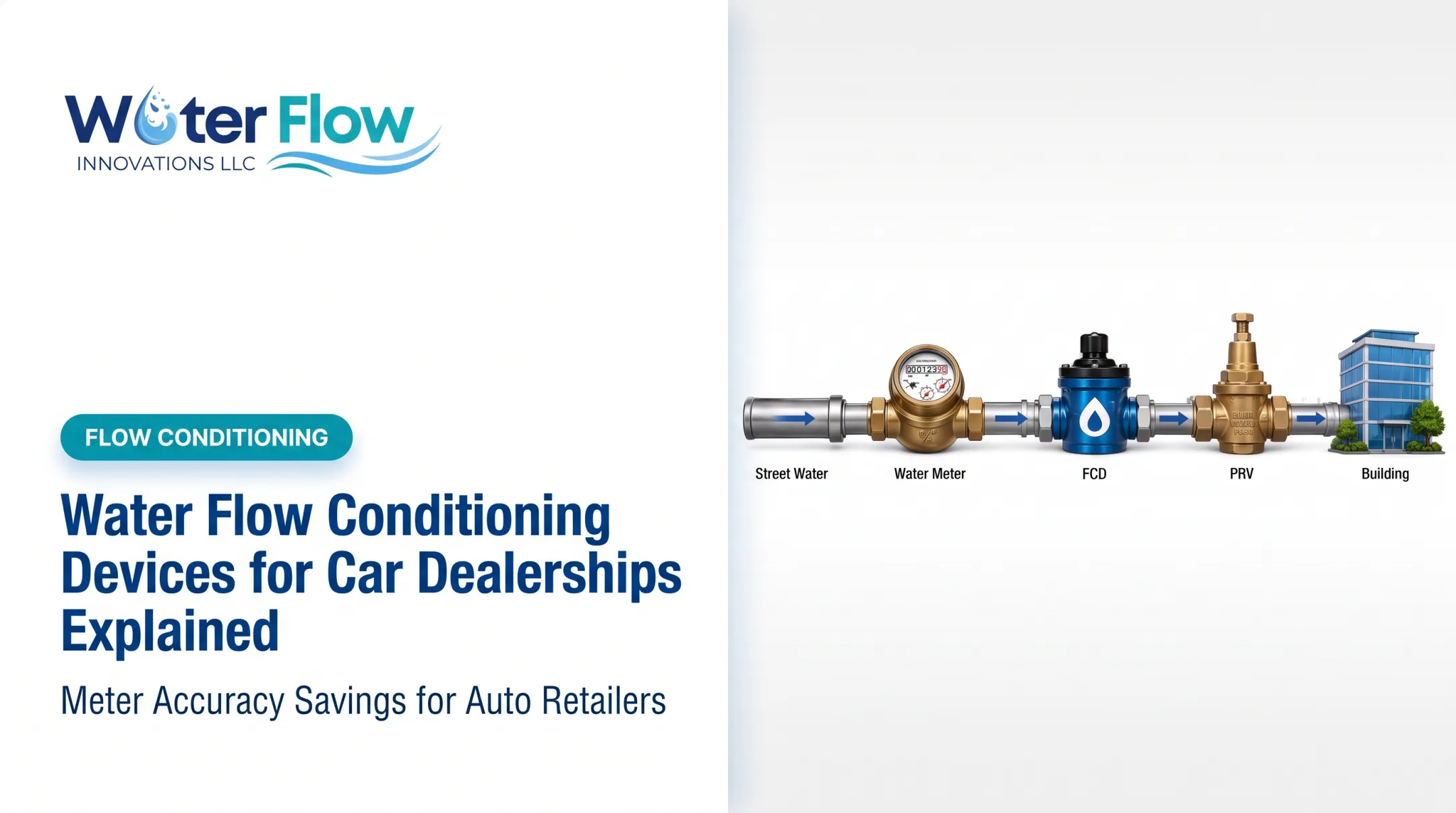
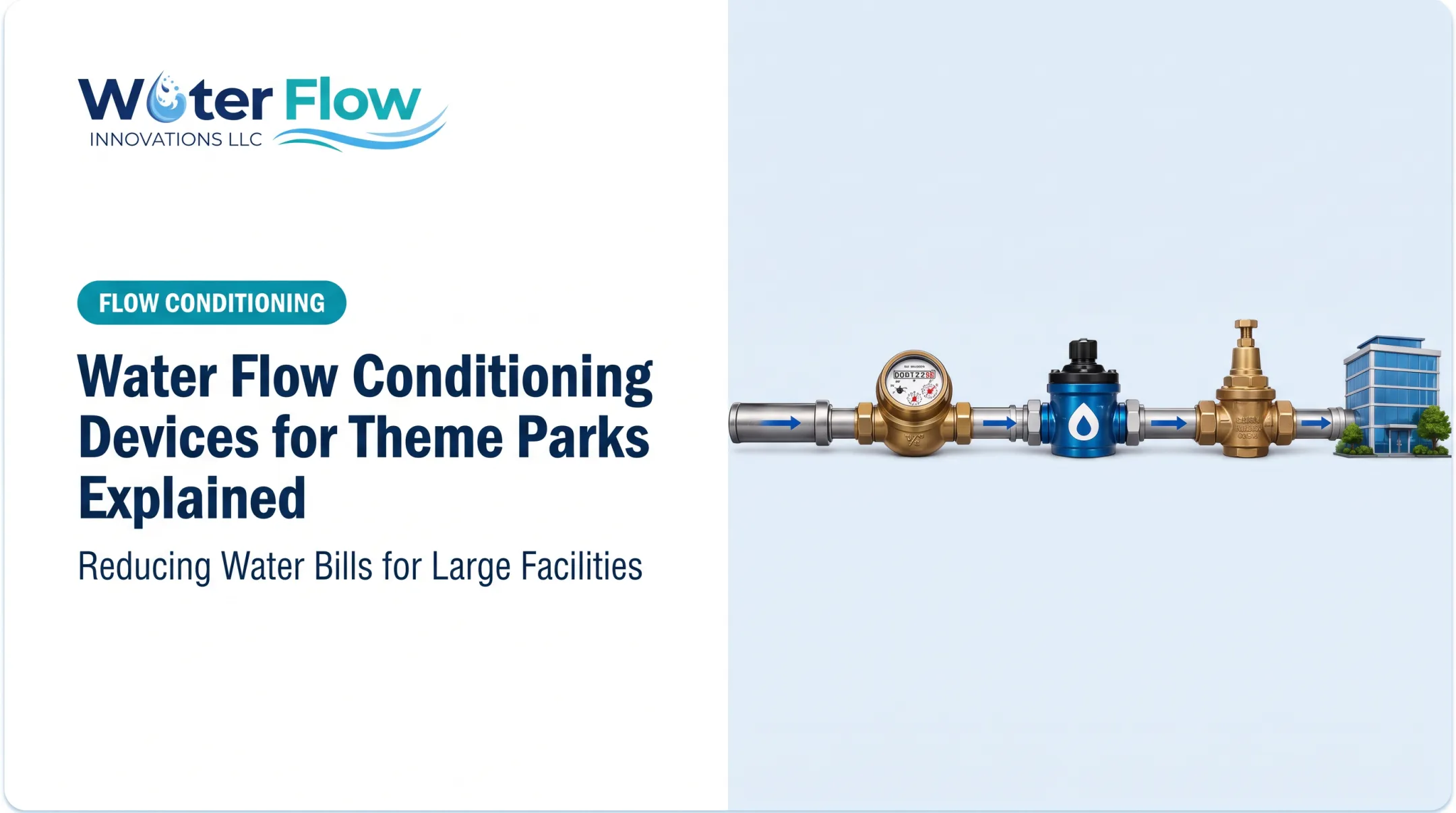
Picture the flow path: water enters the building supply line, passes through the utility meter, then continues to downstream plumbing serving kennels, surgery, laundry, and labs. Air and turbulence can enter at several points along that path, including valve closures, pump cycling, and rapid demand spikes when, say, three cage-washing stations start simultaneously.

A commercial flow conditioning system is typically designed to combine several functions in one unit:
- Air or gas separation to remove entrained air and micro-bubbles before they reach the measuring zone
- Pressure regulation to dampen surges and water hammer from on-off cycling
- Check-valve control (on some models) to prevent reverse flow through the meter
- Turbulence reduction to slow and straighten the water column ahead of the meter
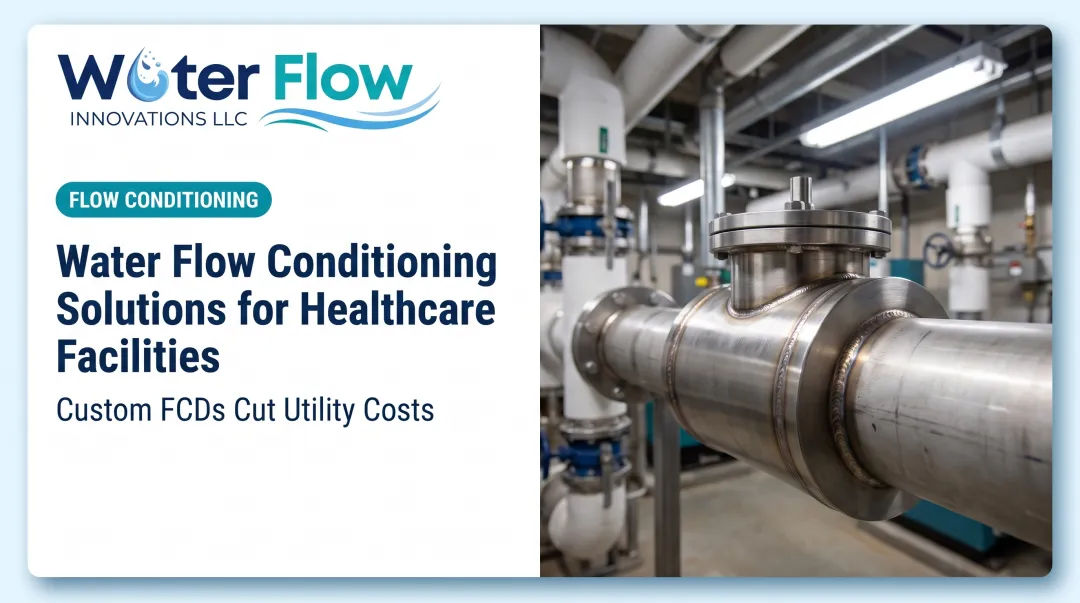
Water Flow Innovation's FCD uses that four-component approach—air and gas removal, pressure regulation, a check valve, and turbulence reduction—and installs immediately after the water meter on the consumer side.
Each unit is custom-fabricated to the facility's pipe size:
- Material: 316L stainless steel (titanium and specialty alloys on special order)
- Size range: 1/2-inch through 12-inch NPS (DN20 through DN500)
- Fit: Built to the facility's pipe size, flange type, and meter setup
Verify current technical specifications with the manufacturer before finalizing any installation.
Pressure Loss Is the Question to Ask First
Veterinary hospitals can't afford reduced pressure at cage washing stations, surgical scrub areas, laundry, or grooming tubs. Before installing anything, confirm the product's published pressure-loss data for your actual flow range.
A 2019 AWWA Water Science study by Beck, Barfuss, and Johnson tested five electromagnetic flowmeters with a flow conditioner at varying upstream distances and found that accuracy deviations were not proportional to measured turbulence changes. Conditioning doesn't behave the same way in every installation—site-specific data matters more than general assumptions.
Compatibility Questions Before You Commit
- Meter manufacturer and type
- Pipe material and diameter
- Installation orientation and available straight-run length
- Upstream and downstream equipment, including backflow assemblies
- Pressure and temperature range
- Local plumbing code requirements
- Access for future inspection and service
A flow conditioner should never change water quality or clinical protocols. Bring in facilities staff, plumbers, infection-prevention personnel, and the authority having jurisdiction before anything gets installed.
Where Could a Flow Conditioning Device Help in a Veterinary Hospital?
Water demand in a veterinary hospital isn't uniform. It spikes and drops depending on the hour and the caseload. Likely high-demand areas include:
- Animal bathing and grooming stations
- Kennel and isolation-area cleaning
- Treatment rooms and surgical support
- Laundry (towels, bedding, surgical linens)
- Laboratory and imaging support
- Food preparation and staff facilities
Facilities with frequent intermittent demand—like a boarding wing that runs hose-down cycles several times a day, or a surgical suite that cycles scrub stations unpredictably—deserve a closer look at flow stability.
High water use alone doesn't mean a meter is over-registering. The only way to know is to investigate the actual plumbing and billing data.
A Practical Scenario
Consider a multi-service hospital with kennels, surgery, laundry, and boarding under one roof. Before choosing any intervention, the facilities team should:
- Pull twelve months of water and sewer bills
- Check meter readings against known occupancy patterns
- Map where pressure cycling and valve activity are heaviest
That groundwork, not a product brochure, should drive the decision.
Billing matters here too. Many hospitals pay both a water-supply charge and a separate sewer-discharge charge, and both may or may not be based on metered volume depending on the local utility's tariff structure. Verify how your specific utility calculates each charge before projecting any savings.
Where Extra Caution Applies
Some systems call for separate engineering review rather than a standard installation:
- Fire-suppression piping (flow conditioners generally should not be installed on fire lines)
- Specialized laboratory systems
- Treated or purified water loops, including RO, EDI, or WFI systems
- Medical equipment connections
- Backflow assemblies
- Any plumbing serving regulated clinical processes
A flow conditioner installed on the municipal supply, after the utility meter and before pretreatment or purification equipment, shouldn't change feed pressure or purified water quality. But that claim needs verification for your specific configuration, not assumption.
How to Evaluate, Install, and Verify a Device
Start with a measured baseline before you sit through any product demo.
Build Your Baseline First
Before evaluating any device, gather:
- 12-24 months of water and sewer bills
- Meter readings and operating hours
- Patient or boarding volumes and laundry activity
- Weather patterns, known leaks, and maintenance events
- Any major changes in services or occupancy
Site Assessment Checklist
A proper site visit should confirm the installation point is technically sound. Cover at least:
- Meter location, type, and pipe dimensions
- Pressure readings and typical flow patterns
- Known air-entry points and valve positions
- Backflow equipment and service access
- Local code requirements
If those checks fail, the proposed point is not viable—stop before you price a device.
Selecting a Device
Score vendors on proof you can verify, not brochure claims:
- Independently verifiable certifications
- Documented materials compatibility
- Published pressure-loss data
- Clear maintenance and service-access needs
- Warranty terms and any performance guarantee
Water Flow Innovation, for example, states its FCD carries IAPMO, NSF, ANSI, CAN 61, KIWA, GMP, and SQF certifications. It also cites install time of about an hour, a lifetime transferable warranty, and a six-month money-back guarantee (installation cost excluded from refunds). Confirm every term with the manufacturer before purchase—terms can change.

Installation and Verification
- Coordinate with clinical leadership to schedule work during a low-risk period
- Protect animals and sterile areas throughout the shutoff window
- Document the original configuration before any work begins
- Confirm pressure and flow return to expected levels at critical endpoints immediately after installation
- Compare normalized bills and meter readings across several billing cycles, not just one, to separate real performance from normal seasonal variability
Financial, Sustainability, and Reporting Considerations
The business case rests on total cost of ownership, not sticker price alone. Build your projection around:
- Equipment, installation, and inspection costs
- Financing or lease terms
- Expected water and sewer savings
- Payback period
- The cost of waiting another billing cycle to act
What a Realistic Projection Looks Like
US commercial water rates matter here. EPA's WaterSense program estimates 2024 commercial averages at $6.13 per 1,000 gallons for water and $7.23 per 1,000 gallons for wastewater, a combined $13.36. Those are national planning figures, not a guarantee for any specific facility's tariff.
Water Flow Innovation reports healthcare customers seeing a 5-30% average reduction in water and sewer bills, with a 46% highest documented result and 90% of customers reaching ROI within 12 months. Treat these as company-reported figures tied to specific installations, not a promised outcome. Request a site-specific projection using your own bills before budgeting around any number.

Documentation for Sustainability Reporting
Documented reductions in billed water and sewer volume can support LEED, GRI, or internal ESG tracking, but transparent baseline and post-installation records are what make that documentation credible. A lower invoice by itself doesn't prove reduced physical water use unless the underlying measurement data backs it up.
One Part of a Bigger Program
Flow conditioning works best alongside, not instead of, other water-management measures:
- Leak detection and repair
- Low-flow fixtures where clinically appropriate
- Laundry and linen-use controls
- Staff training on water-conscious habits
- Regular utility-bill audits
A Practical Decision Sequence
- Audit 12+ months of water and sewer bills
- Inspect the plumbing and meter configuration on site
- Consult qualified plumbers and facilities engineers
- Verify current product documentation and certifications
- Request a site-specific savings projection
- Install during a scheduled, low-disruption window
- Measure results across multiple billing cycles
FAQ
Does a flow conditioning device replace water filtration or softening?
No. Flow conditioning stabilizes how water moves past the meter. It doesn't remove contaminants, minerals, or alter water chemistry, so existing filtration and treatment systems remain necessary.
Will installation disrupt hospital operations?
Water Flow Innovation reports installation usually takes about an hour with a brief water shutoff. Schedule during a low-activity window so surgical and boarding areas stay uninterrupted.
Can a flow conditioner be installed on fire-suppression lines?
No. Fire-suppression lines need separate engineering review and local authority approval, and flow conditioning devices are not installed on fire lines.
How quickly would savings show up on the utility bill?
Most facilities see the effect on the next billing cycle. Still confirm several cycles of data before drawing conclusions, since weather and occupancy also shift bills.
Does this affect infection-control protocols?
A properly installed flow conditioner on the supply side shouldn't touch clinical water quality or sterile processing. Still, involve infection-prevention staff before any installation to confirm your specific setup.