That assumption can be expensive. One utility's targeted review of just 45 flagged meters found 22 were under-performing, representing more than $200,000 in lost revenue over eight years — and that's only the visible side of meter error, reported by the City of Bend. The less visible side, over-reading, hits your bottom line directly.
This article breaks down why meters drift from accurate, including the over-reading problem most billing conversations skip entirely. You'll get three practical ways to test your own meter, how to read the results, and what to do if the numbers point to a problem.
Key Takeaways
- Meters are factory-calibrated within 98.5%–101.5%, but field conditions often push readings outside that range.
- Aging meters under-register, while air entrainment and turbulent flow inflate your bill instead.
- Bucket tests, zero-flow tests, and bench tests each catch different problems — none catches all of them.
- A meter can pass a bench test and still over-read in the field from trapped air.
- Flow conditioning fixes over-reading at the source, rather than replacing a meter likely to repeat it.
What Causes Water Meters to Read Inaccurately
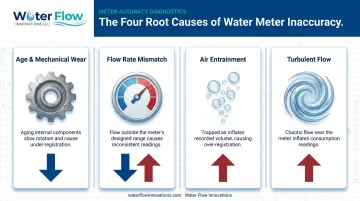
Water meters are precision instruments, but two very different forces knock them off target: physical wear inside the meter and hydraulic conditions in the pipe around it. Knowing which one you're dealing with matters, because the fix for a worn-out meter looks nothing like the fix for turbulent flow.
Age and Mechanical Wear
Mechanical meters (positive displacement and multi-jet types) rely on internal moving parts. As gears, discs, and pistons wear down, they register less water than actually passes through. This is under-registration, and it worsens gradually rather than all at once.
Testing frequency depends on meter size. Federal facility best practices from the Department of Energy's FEMP program recommend:
- 5/8"–1" meters: test every 10 years
- 1"–4" meters: test every 5 years
- Meters above 4": test annually
These intervals come from PNNL's water metering best practices guidance, not a single blanket AWWA rule; actual requirements vary by local utility policy and meter technology.
Flow Rate Mismatch
A meter sized for high flow struggles at low flow. Overnight drips, slow tank fills, and light-use periods can all register below actual volume. The EPA notes that compound meters exist specifically because large commercial and institutional facilities need accurate measurement across a wide flow range; a single-range meter simply can't do both jobs well.
The inverse problem exists too. Meters pushed near or past their maximum rated flow (think a burst of simultaneous demand) can also distort readings, though usually in less predictable ways than the low-flow case.
Air Entrainment: The Hidden Over-Reading Cause
Here's the one most billing conversations skip: when air or gas gets trapped in the supply line, the meter counts it as water. It has no way to tell the difference. Facilities with variable pressure, pump-driven systems, or lines that drain and refill periodically are especially prone to this.
This is different from age-related wear. Under-registration is the utility's revenue problem. Over-reading from air entrainment is your financial problem: you're being billed for volume you never received.
Turbulent Flow
Elbows, valves, pumps, and pressure fluctuations near the meter distort the flow profile the meter was designed to read. The result is measurement error that often skews upward.
The tricky part: turbulent flow over-reading is invisible. The meter shows no fault code, no alarm, nothing. The read gets taken normally. The bill just arrives higher, with no obvious explanation attached.
How to Test Your Water Meter's Accuracy
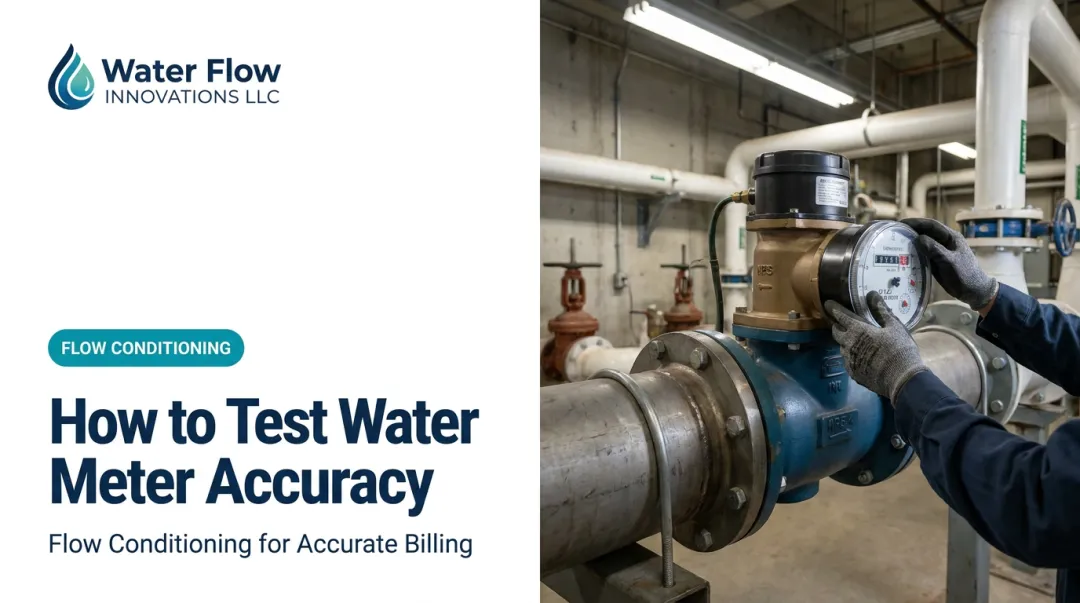
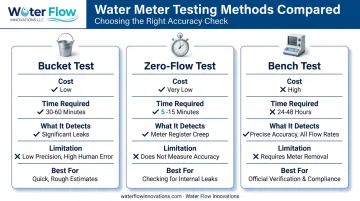
Three practical methods exist, and each suits a different situation. Some you can run yourself this afternoon. Others require your utility's involvement. Using more than one builds confidence in whatever you find.
Method 1: The Measured Volume (Bucket) Test
This DIY test compares a known volume of water against what the meter registers. It's best for smaller meters and lower flow rates.
Tools needed: a container of known volume (a 5-gallon bucket works fine), access to the meter's dial or digital display, and a helper to control flow.
Steps:
- Record the exact meter reading. Confirm every other water-using fixture or system is off first.
- Fill the container completely, then immediately record the new meter reading and calculate the difference.
- Repeat 3–5 times at different flow rates, including a slow fill and a fast fill, then average the results.
Pros and cons: Free, simple, no utility involvement. But it's impractical for large commercial meters (1.5" and above) and won't catch intermittent issues like air entrainment.
Method 2: The Zero-Flow (No-Usage) Leak Test
This test checks whether the meter registers movement when nothing in the facility is using water. It primarily catches internal leaks but can also reveal meter sensitivity issues.
Tools needed: access to the meter display, knowledge of which zones or fixtures exist, and at least 30 minutes (ideally overnight for larger facilities).
Steps:
- Shut off every water-using fixture, system, and piece of equipment. Record the exact reading.
- Wait a minimum of 30 minutes without any water use.
- Return and read the meter again. Any movement means either an internal leak or a meter sensitivity problem.
Pros and cons: Costs nothing and catches phantom usage, but it can't distinguish meter error from a genuine leak, and it won't reveal over-reading caused by air in the line.
Method 3: Formal Utility Meter Test (Third-Party Bench Test)
A calibrated bench test, performed by your utility or a certified lab, compares your meter against a known-accurate reference at multiple flow rates. It's the most authoritative option available.
Steps:
- Contact your utility's metering department and formally request an accuracy test. Ask about fees; many utilities waive them if the meter is found out of spec.
- The utility tests the meter at low, medium, and high flow, documenting accuracy as a percentage at each point.
- You receive written results. A pass means the meter falls within AWWA tolerance at each tested flow rate.
Pros and cons: Legally defensible and well-documented, making it useful for billing disputes. The catch: it doesn't replicate your actual pipe conditions, so it can't catch over-reading caused by air or turbulence specific to your installation.
How to Interpret the Results
Test results fall into three categories, and the direction of the error matters just as much as the size of it.
Normal / Acceptable (98.5%–101.5%): The meter registers within standard tolerance at every tested flow rate, so billing is presumed accurate. Retest on a regular schedule based on meter size.
Minor Deviation / Under-Registration (95%–98.4%): You're likely being under-billed slightly, which sounds favorable but actually signals aging internal components. Flag the meter for replacement before wear accelerates and produces unreliable billing data.
Out of Spec / Over-Reading (above 101.5%): You're being billed for water you didn't use, and that calls for immediate action:
- Open a billing dispute with documentation in hand
- Request meter replacement
- Investigate whether air entrainment or turbulent flow upstream is the actual root cause
That last point matters most: a replacement meter in the same piping will likely over-read again unless the turbulence gets corrected. Water Flow Innovation's Flow Conditioning Devices fix that exact problem, stabilizing flow so accurate readings hold long-term.
Common Mistakes When Checking Meter Accuracy
Testing sounds simple, but a few errors routinely skew results:
- No true zero-flow baseline: Even one slow-running fixture or HVAC system invalidates the test, so walk the entire facility and confirm shutoff at every point first.
- Testing at a single flow rate: Meters that perform well at moderate flow can still fail at the extremes; request a multi-rate bench test.
- Confusing meter error with internal leaks: Movement during a zero-flow test usually signals a dripping fixture or running toilet, not a faulty meter.
- Assuming a passed bench test proves billing is correct: Bench tests don't replicate air in the line, meaning a meter can pass in the lab yet over-read in the field.
What to Do When Your Meter Is Over-Reading
Most conversations about meter accuracy focus on under-registration, since that's the utility's revenue concern. Over-reading gets far less attention, but it's your financial problem, and it may never show up in a standard test result.
Here's the part that trips up most facilities: over-reading caused by air entrainment or turbulent flow is a hydraulic problem, not a meter problem. Swap in a brand-new meter and install it in the same piping conditions, and it will likely start over-reading too.
The air entering the line and the turbulence distorting the flow profile both exist upstream of the meter. Fixing the meter without fixing the plumbing conditions just delays the same bill inflation.
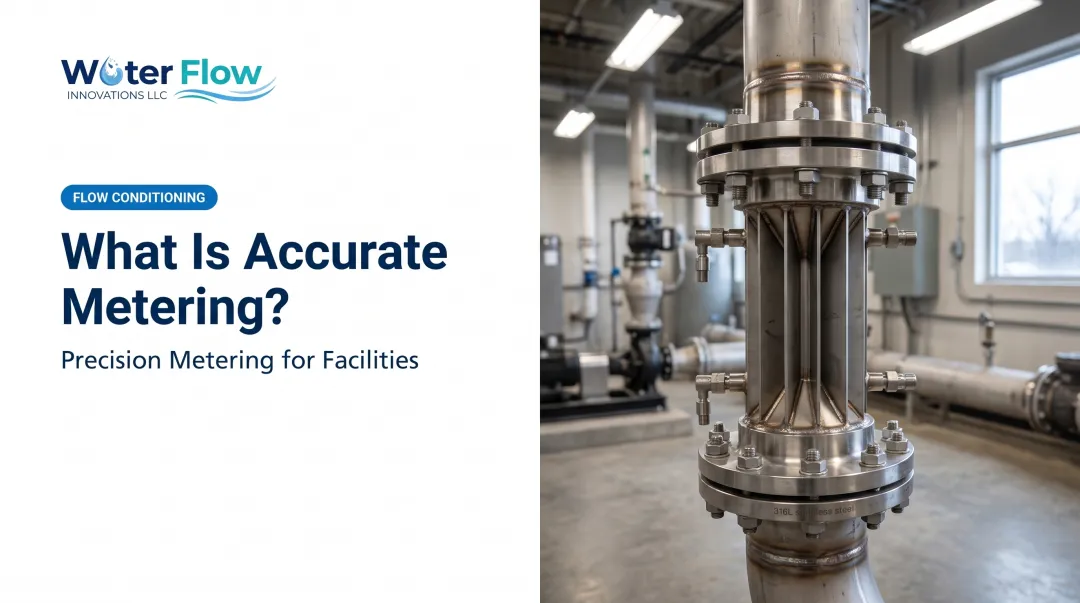
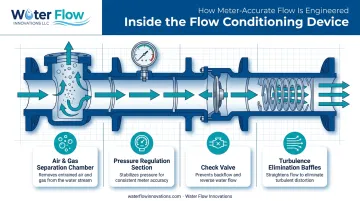
That's the specific gap Water Flow Innovation's Flow Conditioning Device (FCD) is built to close. Installed immediately after the meter, the FCD works through four components:
- Air and gas separation — creates laminar flow and prevents air bubbles from forming, so the meter reads a homogeneous water column
- Pressure regulation — smooths out water hammer and pressure surges from on-off cycling
- Check valve — blocks reverse flow, which is one of the main ways air re-enters a line after purging
- Turbulence elimination — slows velocity just enough to prevent the vortex flow that causes over-counting
The FCD is IAPMO, NSF, ANSI, CAN 61, KIWA, GMP, and SQF-certified, custom-fabricated to your exact pipe size and flange configuration, and installation is usually about an hour (+/-).
Because it corrects the meter reading rather than reducing actual water use, savings show up on the very next billing cycle. Customers see an average 5–30% reduction in combined water and sewer bills, with a documented high of 46%, backed by a 6-month money-back guarantee and a lifetime transferable warranty.
If you suspect your facility is affected, a free savings analysis reviews your bills, meter type, and pipe configuration before you commit to anything.
Conclusion
Meter accuracy isn't a yes-or-no question. A meter can sit comfortably inside AWWA tolerance and still generate an inflated bill, because air entrainment and turbulent flow operate outside what a standard test measures. That's why testing the conditions around the meter matters as much as testing the meter itself.
The bucket test, zero-flow test, and bench test each reveal a different piece of the picture. Run more than one, then match the fix to what you find:
- Meter out of tolerance: replace it
- Registration with no flow: repair the leak
- Meter tests fine, bill still high: add flow conditioning
Accurate metering underpins cost control, ESG reporting, and every sustainability target your facility is working toward. Facilities that check their meter conditions proactively avoid years of quiet overbilling that nobody ever thinks to question.
Frequently Asked Questions
How do I know if my water meter is accurate?
Request a formal bench test through your utility, or run a quick DIY bucket test comparing known versus registered volume. Even meters that pass a bench test can still over-read in the field due to air entrainment.
Are old water meters accurate?
Meters older than 10–15 years typically under-register rather than over-read, as worn mechanical parts register less flow over time. Age alone isn't fully reliable, though — testing by flow rate gives a clearer diagnosis.
What is the AWWA accuracy standard for water meters?
New meters must register between 98.5% and 101.5% of actual flow to meet AWWA standards. A meter falling outside that range at any tested flow rate is considered out of specification.
Can a water meter read higher than actual usage?
Yes. Air or gas trapped in the water line gets counted as billable volume, and turbulent flow near the meter can also distort readings upward. Unlike under-registration, this means you're paying for water you never received.
How often should commercial water meters be tested?
Federal facility guidance recommends testing 5/8"–1" meters every 10 years, 1"–4" meters every 5 years, and meters above 4" annually. Larger meters and higher usage volumes generally warrant more frequent checks.
What causes a water meter to over-read?
The main culprits are air entrainment (trapped air counted as water), turbulent flow from nearby valves, pumps, or pipe elbows, and pressure fluctuations. This is distinct from age-related under-registration, which works in the opposite direction.
Is a flow conditioning device the same as a water treatment or filtration system?
No. Filtration, softening, and treatment change what is in the water. Flow conditioning changes only how the water moves, removing entrained air and turbulence so the meter measures accurately. It alters no water chemistry and is not a restrictor or pressure reducing valve.
What reduction is typical once over-reading is corrected?
Documented installations average a 5–30% cut in combined water and sewer bills, with a highest documented single result of 46%, appearing on the very next billing cycle with no ramp-up period.