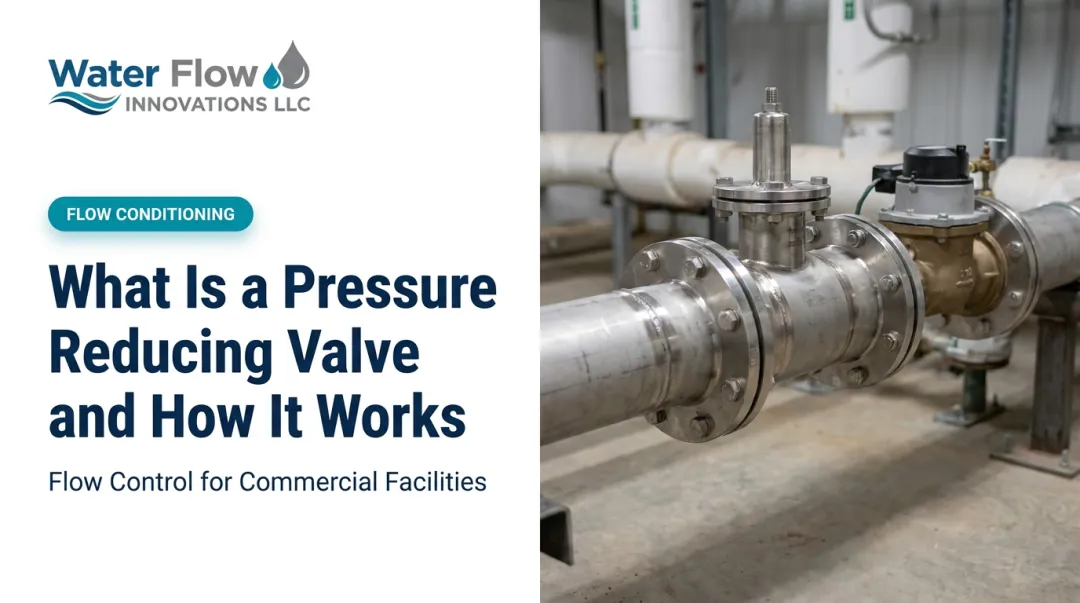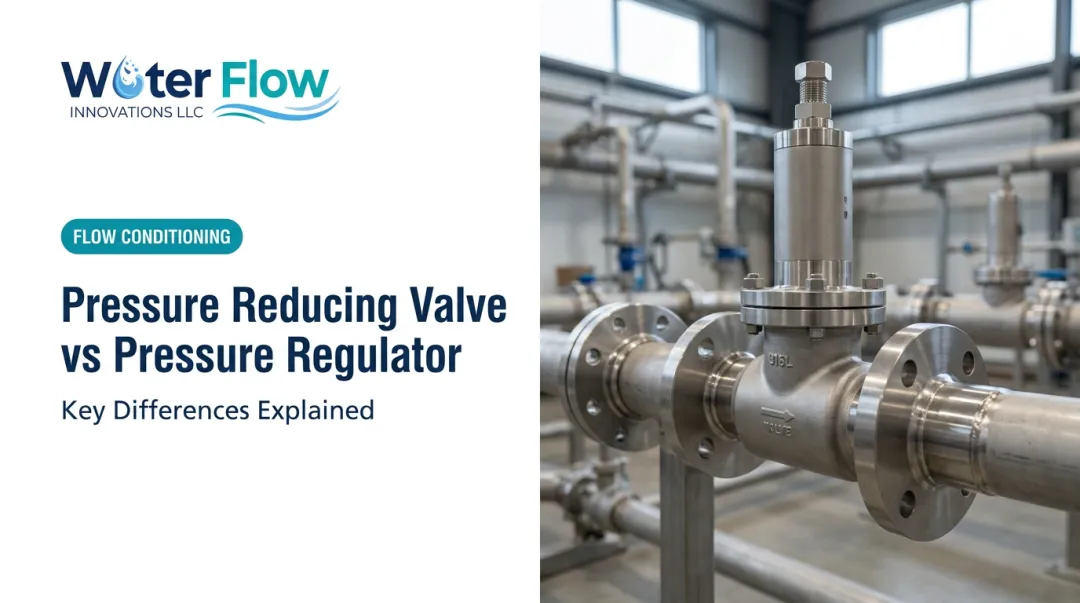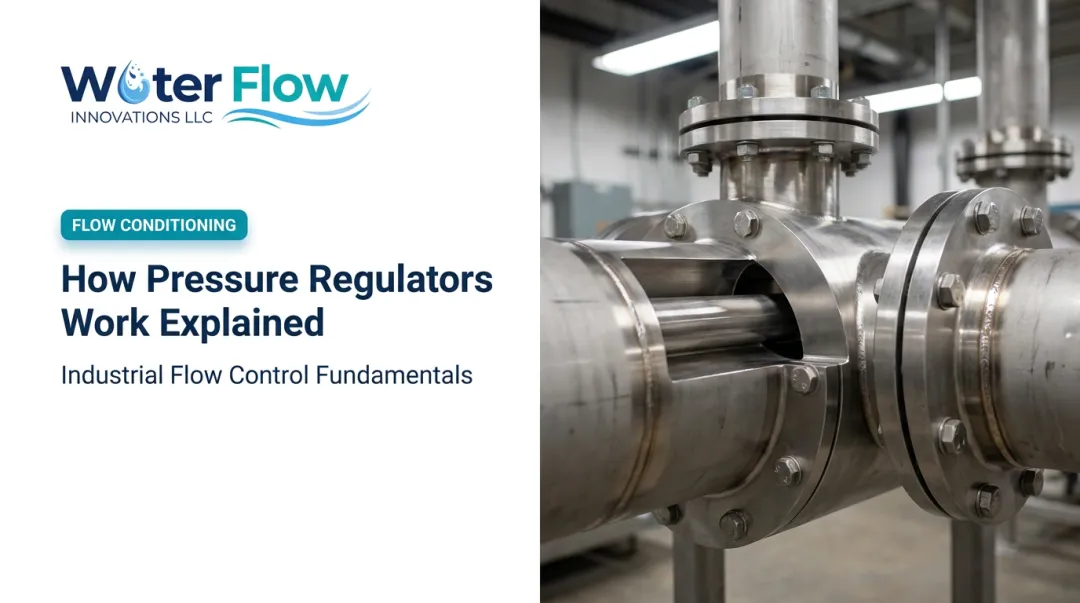
Introduction
Pressure reducing valves protect the pipes, fixtures, and equipment behind nearly every commercial building, multifamily property, and industrial plant in the country. Without one, a spike in municipal supply pressure can blow out a water heater, split a pipe joint, or trigger constant water hammer.
The 2024 International Plumbing Code requires a PRV whenever building static pressure exceeds 80 psi, reducing it back down to 80 psi or less as specified in IPC Section 604.8. That single code requirement explains why so many buildings have one installed, whether the owner realizes it or not.
Here's the problem: most facility managers know a PRV is there, but not how it works. That gap leads to wrong sizing, delayed maintenance, and missed warning signs before failure. This guide breaks down exactly what happens inside the valve, stage by stage.
Key Takeaways
- A PRV lowers high, fluctuating upstream pressure and holds a steady, safe downstream level automatically
- A spring-loaded diaphragm and poppet valve self-adjust from downstream feedback, with no power or electronics required
- PRVs prevent water hammer, seal leaks, and premature wear on pipes and appliances
- They're used in homes, high-rises, industrial plants, and municipal zones where incoming pressure runs too high
- Pressure regulation is also one function in flow-conditioning systems that stabilize flow and protect downstream equipment
What Is a Pressure Reducing Valve?
A pressure reducing valve (PRV) is a self-operating valve that automatically drops higher, often unstable, upstream pressure down to a lower, steady, preset outlet pressure. It needs no electricity, sensors, or software to do this — it's a purely mechanical response to physics.
Municipal water lines and steam supply mains often arrive at pressures far above what facility distribution systems, water heaters, or process equipment were built to handle. Left unchecked, that excess pressure shows up as leaks, water hammer, premature equipment failure, and higher maintenance costs.
What a PRV Is Not
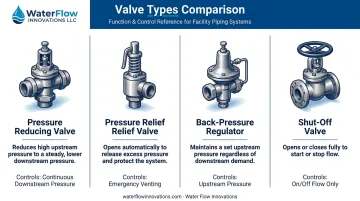
It's easy to confuse a PRV with other valve types that look similar but do very different jobs:
- Pressure relief valve — opens only during an overpressure emergency to vent excess fluid; it doesn't continuously regulate anything
- Back-pressure regulator — controls upstream (inlet) pressure rather than downstream (outlet) pressure
- Shut-off valve — simply opens or closes flow; it has no ability to modulate pressure at all
Direct-Acting vs. Pilot-Operated
Not every PRV is built the same way. The two dominant architectures split by scale and precision needs:
| Feature | Direct-Acting PRV | Pilot-Operated PRV |
|---|---|---|
| Typical use | Light commercial and smaller branch lines | Large-volume industrial and commercial systems |
| Control mechanism | Single diaphragm and spring act directly on the poppet | A separate pilot circuit modulates a hydraulically operated main valve |
| Size range | Roughly 1/2" to 4" | Roughly 1-1/4" up to 24" |
| Accuracy at high flow | Good for standard demand swings | Tighter control loop for large or variable flow volumes |
Watts documentation on pilot-operated valves notes the pilot circuit includes its own strainer and supply restriction, giving it finer control across changing flow rates than a direct-acting design can achieve alone.
Despite the rise of smart building automation, PRVs remain essential because they are passive: no firmware to update and no network connection to maintain. For facility teams, that mechanical fail-safe is still hard to replace.
How Does a Pressure Reducing Valve Work?
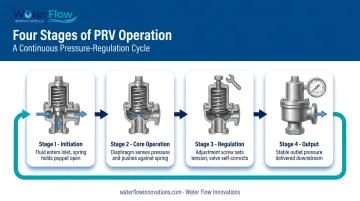
A PRV runs on a continuous feedback loop with four functional stages: initiation, core operation, regulation, and output. None of these stages require a human to trigger them. The valve reacts to pressure changes in real time, every second water or steam moves through it.
Initiation
The process starts the instant pressurized fluid hits the valve's inlet port. There's no button, switch, or manual step involved.
By default, a PRV is "normally open." The internal spring holds the poppet open so flow begins immediately, then the valve narrows the opening as downstream pressure builds toward its set point.
This is also where problems start to show. If inlet pressure fluctuates (common with municipal supply during peak demand hours), the valve has to constantly reinitiate this balancing act. Undersized or worn valves often can't keep up, causing a phenomenon called pressure "hunting," where the outlet pressure oscillates instead of holding steady.
Core Operation
A diaphragm senses downstream pressure and pushes against a calibrated spring, and the poppet moves in direct response to that balance of forces.
Here's what physically happens:
- Downstream pressure rises as demand drops
- The diaphragm flexes upward against the spring
- That movement gradually closes the poppet
- Flow restricts just enough to cap outlet pressure at the set point
The surface area of the diaphragm and poppet determines how responsive the valve is. Larger surface area means finer control under shifting demand, but the valve still needs correct sizing for the pipe. An oversized or undersized diaphragm assembly leads to sluggish response or instability.
Regulation
An adjustment screw on top of the valve lets a technician raise or lower spring tension, which directly changes the target outlet pressure. Turn it one way, pressure goes up. Turn it the other, it drops.
Once set, the valve self-corrects continuously. Any deviation from the target pressure, such as a demand spike or supply-side surge, gets countered instantly by diaphragm movement. No electronics, no external power source.
Without accurate regulation:
- Water hammer becomes frequent, stressing pipe joints and valve seats
- Seals degrade faster under constant pressure cycling
- Leaks develop at weak points in the system
- Downstream fixtures and appliances wear out ahead of schedule
Output
You get a stable, code-compliant outlet pressure delivered continuously downstream, commonly in the 40–70 psi range for commercial and industrial systems. The exact setting depends on the valve model and facility requirements.
That steady output feeds everything connected downstream. Boilers, process lines, irrigation, domestic water risers, and fixtures all receive predictable pressure regardless of supply-side swings. The measurable payoff includes:
- Fewer leaks and burst pipe incidents
- Reduced water waste from pressure-driven inefficiencies
- Longer service life for appliances and fittings
- Fewer emergency repair calls overall
Where Is a Pressure Reducing Valve Used?
PRVs typically sit at a handful of critical points in a water or steam distribution system:
- Main service entrance — right after the meter, before water enters the building's internal plumbing
- Ahead of water heaters and boilers — protecting equipment rated for lower pressure than the incoming supply
- Before irrigation systems and process equipment — anywhere sensitive components can't tolerate pressure spikes
They matter most under these conditions:
- High-rise buildings — elevation creates large pressure swings between floors
- Municipal zones with fluctuating psi — especially during peak morning and evening demand
- Industrial steam lines — requiring tight downstream pressure control for process consistency
Water pressure changes by roughly 0.433 psi per vertical foot. A 10-story building can see differences exceeding 40 psi from ground floor to top—which is why high-rises often need staged PRVs on multiple floors.
Pressure regulation is also one piece of a larger water-efficiency picture. At Water Flow Innovation, pressure stabilization is built into our certified Flow Conditioning Device (FCD) as one of four integrated components, alongside air and gas removal, check-valve protection, and turbulence elimination.
That combination matters because pressure surges and water hammer reintroduce air into lines after it's been purged. By stabilizing pressure right at the meter entry point, the FCD's pressure regulation function prevents the very disturbances that cause water meters to over-read — a problem that inflates utility bills without any actual increase in water use.
The FCD installs after the meter and before an existing PRV, conditioning water at full incoming pressure before the building's own PRV reduces it downstream. Facilities running this setup typically see 5–30% reductions in water and sewer costs, with the highest documented case reaching 46%.
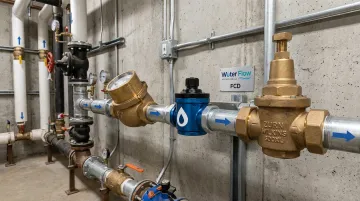
The pressure regulation component adds negligible pressure loss, so the building's existing PRV keeps doing its job exactly as before.
Conclusion
A pressure reducing valve works through a straightforward mechanical loop: sense pressure, balance it against a calibrated spring, and self-correct through poppet movement. There's no software involved, which is why it remains a dependable, low-maintenance safeguard for pressurized systems of any size.
Understanding that mechanism changes how you approach maintenance and sizing decisions. A correctly sized, well-maintained PRV reduces water waste and protects equipment for years. Facilities that also need bill-side results can pair that pressure stability with a certified flow-conditioning system like Water Flow Innovation's FCD. It adds documented, verifiable water bill savings on top of the protection you already have, and most customers reach full ROI in under 12 months.
Frequently Asked Questions
What is pressure reduction?
Pressure reduction is the process of lowering high incoming fluid pressure to a safe, stable, usable level for downstream equipment. A PRV does this automatically once it's installed and set.
At what psi do you need a pressure reducing valve?
Most plumbing codes, including the 2024 International Plumbing Code, require a PRV once static building pressure exceeds 80 psi. Municipal supply pressure can spike well above that depending on elevation, time of day, and demand.
How do you adjust a pressure reducing valve?
Adjustment happens at the top screw: turning it clockwise increases outlet pressure, counterclockwise decreases it. After each adjustment, draw some flow and check the new setting with a pressure gauge before locking it in.
Where is the water pressure reducing valve typically located?
It's usually installed at the main water line entry point, right near the meter, in a basement, utility closet, or mechanical room.
What's the difference between a pressure reducing valve and a pressure relief valve?
A PRV continuously regulates and holds a set downstream pressure during normal operation. A relief valve stays closed until an overpressure emergency, opening briefly to vent excess pressure and protect the system.
How long does a pressure reducing valve typically last?
Service life varies with water quality, usage, and valve type. Periodic pressure checks are the best way to catch early signs of diaphragm or spring wear before a failure occurs.
Does lowering pressure also lower the volume the meter records?
Not the phantom portion. A PRV changes the pressure delivered downstream but does not remove entrained air from the supply, and the meter keeps counting that air as water. The two problems need different devices.
How long does adding a flow conditioning device alongside a PRV take?
About an hour, with a brief water shutoff at the meter connection, fitted by a licensed plumber or mechanical contractor at the supply connection. The PRV stays in place and its setting is unaffected.