The frustrating reality is that most flow meter problems are predictable, follow recognizable patterns, and are fixable. The catch: chasing symptoms without identifying the root cause leads to repeated failures and unnecessary equipment costs. This guide walks through the most common flow meter problems, their causes, and the correct fix for each.
Key Takeaways
- Flow meters most commonly fail due to air entrainment, calibration drift, sensor fouling, installation errors, and electrical interference
- Most failures cause over-reading, meaning facilities pay for water they never actually received
- Most issues resolve through recalibration, cleaning, or correcting upstream conditions
- Persistent over-reading from air or turbulent flow is an upstream conditions problem, not a meter replacement problem
What Is a Flow Meter?
A flow meter measures the volume of water passing through a supply line in a fully charged, closed conduit. Utilities use that reading to calculate water and sewer charges for commercial and industrial facilities.
OIML R 49 defines a water meter as an instrument that "continuously measures, memorizes, and displays" water volume at metering conditions. Type testing under this standard requires water free of air bubbles and sufficient outlet pressure to prevent cavitation — conditions that most commercial systems don't meet.
Real commercial systems don't deliver those ideal conditions. In practice, meters encounter:
- Air and dissolved gas in the supply line
- Turbulent or distorted flow profiles from upstream fittings
- Pressure swings from cycling equipment
- Sediment and mineral accumulation
These are normal operating conditions, not equipment failures — but they cause meters to misread, typically registering more flow than actually passed through the line.
Common Flow Meter Problems and Their Root Causes
Most flow meter failures follow recognizable patterns. Identifying which pattern you're dealing with is the first step toward an effective fix.
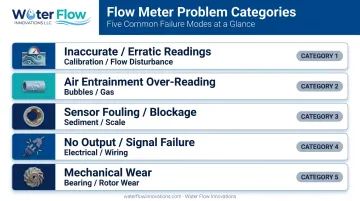
Problem 1: Inaccurate or Erratic Readings
Symptoms: Readings fluctuate unexpectedly, spike during low-use periods, or drift away from consumption baselines without any change in actual usage.
Likely causes:
- Calibration drift from sensor aging or mechanical wear
- Fluid property changes — temperature or viscosity shifts that alter how the meter interprets flow
- Disturbed flow profiles from elbows, valves, or pumps installed too close upstream
One large-meter study found that flow disturbances caused errors ranging from negative values to +2.34% depending on meter type and geometry — illustrating why disturbed flow is an unpredictable variable, not a simple bias in one direction.
Problem 2: Air Entrainment and Over-Reading
Symptoms: Meter registers higher-than-expected flow, particularly during pump startup, after pressure drops, or in systems with dissolved gas. Water and sewer bills run consistently above consumption expectations.
Likely causes: Air or gas bubbles entrained in the supply line pass through the measurement zone and register as water volume. Displacement and turbine meters cannot distinguish between water and air by design — they count everything that moves through them.
The financial impact compounds quickly: every cubic foot of air counted as water appears directly on your utility bill. NIST requires an effective air/vapor eliminator for water-batching systems specifically because entrained air affects electronic meter accuracy.
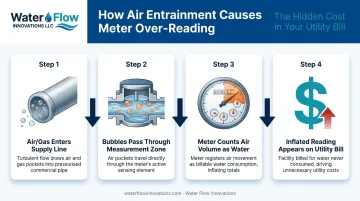
Water Flow Innovation's Flow Conditioning Device (FCD) addresses this directly: its four-component system creates stable, bubble-free flow conditions in the measurement zone, eliminating air-driven over-reading without meter replacement.
Problem 3: Sensor Fouling or Blockage
Symptoms: Sudden reading drops, near-zero output despite active flow, or steadily declining accuracy over time.
Likely causes: Sediment, mineral scale, or debris accumulating on or around the sensing element. Particularly common in older pipes, hard water areas, or systems without upstream filtration. DOE/PNNL reports that suspended particles can abrade measurement components and enlarge orifice openings over time, worsening accuracy.
Problem 4: No Output Signal or Communication Failure
Symptoms: Meter display shows no reading, SCADA or controller receives no data, or output values are fixed and unresponsive to actual flow.
Likely causes:
- Power supply failure
- Damaged wiring or loose terminal connections
- Incorrect output configuration set at commissioning
- Electromagnetic interference affecting signal integrity
Problem 5: Mechanical Wear and Vibration Damage
Symptoms: Unusual noise from the meter body, visible component wear, or readings that degrade progressively under operating load.
Likely causes: Turbine-type meters with moving parts experience bearing and rotor wear over time. External pipe vibration from pumps or adjacent equipment accelerates sensor fatigue. DOE/PNNL confirms that moving components wear over time, reducing both accuracy and reliability. Turbine and positive-displacement designs carry meaningfully higher maintenance demands than solid-state meters with no moving measurement elements.
How to Troubleshoot Flow Meter Problems: Step-by-Step
Attempting to fix a flow meter without isolating the root cause leads to wasted parts, repeat failures, and continued billing errors. Follow this sequence.
Step 1: Identify the Exact Problem
Document everything before touching the meter:
- Unusual readings, error codes, or bill anomalies
- Whether the problem occurs at startup, peak load, low-use periods, or continuously
- All outputs — display, control panel alarms, remote monitoring data
Pattern matters. A spike at pump startup points toward air entrainment. Continuous drift suggests calibration or fouling. No output at all points toward electrical failure.
Step 2: Confirm the Root Cause Category
Classify the failure before applying any fix:
| Category | Indicators |
|---|---|
| Mechanical | Noise, visible wear, progressive degradation under load |
| Electrical | No output, fixed readings, wiring damage |
| Configuration | Incorrect scaling, wrong output type, commissioning errors |
| Environmental/Operational | Air in line, turbulent flow, temperature extremes, incompatible fluid |
Rule out external factors before opening or adjusting the meter. Many meters are replaced unnecessarily because an upstream condition — air, turbulence, pressure swings — was never addressed.
Step 3: Apply the Correct Fix
Fouled or blocked sensor:
- Shut down flow to the meter
- Inspect and clean the sensing element per manufacturer procedure
- Install an upstream strainer or filter if one isn't already present
Calibration drift: Verify the meter is operating within its rated flow range, temperature, and fluid type. DOE/PNNL testing frequency guidelines recommend:
| Meter Type | Recommended Test Interval |
|---|---|
| Nutating-disk positive displacement | 10–15 years |
| Oscillating-piston, multi-jet, single-jet | 5–10 years |
| Electromagnetic, ultrasonic, compound, propeller, vortex | 1–5 years |
| Turbine Class II, venturi, orifice, fire-service | Annually |
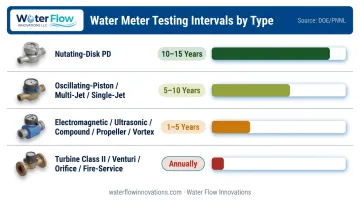
A failed test may require recalibration against a known standard, repair, or replacement. Treat the interval as a testing trigger, not a guaranteed recalibration schedule.
Air entrainment or turbulent flow causing over-reading:
- Identify upstream sources of air ingestion — pressure drops, pump cavitation, partially open valves
- Install a flow conditioner to correct velocity-profile distortion, or an air eliminator to remove entrained gas before it registers as volume — the right device depends on the specific root cause
- Flow conditioning devices (FCDs) are specifically engineered to address both turbulence and air entrainment simultaneously, which is why they're commonly used when over-reading is the primary billing problem
Electrical or signal failure:
- Inspect all wiring, terminal connections, and cable routing
- Verify power supply voltage is within specification
- Check output configuration against the receiving system's expected signal type
- Re-ground the meter if electromagnetic interference is suspected
Step 4: Test and Validate the Fix
Restore normal operating conditions and monitor through a complete billing cycle. Compare readings against:
- Known consumption benchmarks
- Parallel measurement points
- Historical billing data
Confirm no recurrence under both peak and low-load conditions. If the symptom returns, revisit Step 2 — the root cause category may need reassessment before any further adjustments are made.
Fix vs. Replace: How to Decide
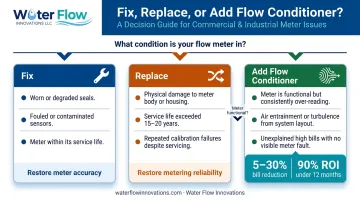
The fix-or-replace decision comes down to three factors: repair cost relative to replacement cost, remaining service life, and whether the problem is isolated or systemic.
Fix when:
- The issue is a worn seal, fouled sensor, or loose wiring correctable with standard maintenance
- The meter is within its service life with no history of repeated failures
Replace when:
- The meter body or internal components are physically damaged beyond repair
- The meter has exceeded its expected service life — WSSC data indicates a 15–20 year typical life for large mechanical meters on commercial properties
- Recalibration costs repeatedly approach replacement cost
- The meter type is fundamentally incompatible with the current application
Consider a complementary solution when: The meter is functioning correctly but consistently over-reads due to systemic air entrainment or turbulent flow. Replacing the meter in this scenario doesn't solve the problem — a new meter placed in the same flow conditions will over-read identically.
That's exactly what Water Flow Innovation addresses. Their FCD installs immediately after the water meter and conditions the flow in the measurement zone, giving a correctly functioning meter the laminar, bubble-free conditions it needs to register accurately.
Documented results across installations show 5–30% average water and sewer bill reduction, with a highest single result of 46%. Ninety percent of customers reach full ROI in under 12 months.
Preventive Maintenance and Common Mistakes to Avoid
Establishing a Maintenance Program
- Test on schedule using the DOE/PNNL intervals above as a baseline — test results determine whether calibration, repair, or replacement follows
- Inspect sensors regularly for fouling, scale, and mechanical wear
- Audit upstream filters and replace media before blockage affects flow conditions at the meter
- Check wiring and connections annually — terminal corrosion and loosened connections are common causes of signal failure
- Document all findings to track degradation trends over time; gradual drift is invisible without a record to compare against
Maintaining Correct Installation Conditions
- Verify adequate straight pipe lengths upstream and downstream remain unobstructed — elbows and valves installed too close to the meter distort flow profiles
- Confirm meter orientation matches manufacturer requirements
- Check that pipe supports prevent vibration transmission to the meter body
Common Mistakes That Cause Repeat Failures
- Treating symptoms without diagnosing the root cause — erratic readings from air entrainment will return after any fix that doesn't address the air source
- Skipping post-repair verification against known flow benchmarks, then assuming the fix worked
- Using non-OEM replacement parts that alter internal dimensions or tolerances
- Overlooking gradual accuracy loss because it doesn't trigger a hard alarm; slow drift toward over-reading is the most financially damaging failure mode in water metering, and it stays invisible until utility bills are compared side by side
These mistakes share a common thread: problems that could have been caught early get ignored until the damage is done. Train facility staff on what normal meter behavior looks like, how to read alarms and error codes, and when to escalate. Many expensive failures begin as minor anomalies that went unrecognized for months.
Frequently Asked Questions
What is the acceptable error for a flow meter?
Acceptable error varies by meter type and application. Under NIST Handbook 44, utility-type meters must stay within ±1.5% at normal flow. OIML Class 2 allows up to ±5% at lower flow rates. Many meters in the field operate outside these tolerances due to age, fouling, or improper installation.
Can a flow meter be calibrated?
Yes. Most flow meters can be recalibrated in-place using reference flow sources or sent to a certified calibration lab. Recalibration restores accuracy to within the manufacturer's stated tolerance — schedule it per your product manual's recommended intervals or after any significant process change.
What is the life expectancy of a flow meter?
It depends heavily on meter type and operating conditions. WSSC data points to 15–20 years as typical for large mechanical meters on commercial properties. Meters with moving parts, in harsh conditions, or without regular maintenance tend to reach the lower end of that range. No single universal lifespan applies across all technologies.
What causes a water flow meter to over-read?
Over-reading most commonly results from air or gas entrained in the water line registering as additional volume, turbulent flow distorting the meter's sensing mechanism, or calibration drift that creates a positive bias.
How do I know if my flow meter needs to be replaced?
Key indicators: the meter has exceeded its rated service life, repair costs are disproportionate to replacement value, the meter has failed recalibration multiple times, or the meter type is incompatible with current fluid or flow conditions.
What are the most common signs of a faulty flow meter?
Watch for unexplained increases in water or sewer bills, readings that spike or fluctuate without changes in usage, no signal output, visible damage or abnormal noise from the meter body, and readings that consistently deviate from known consumption expectations.
What sizes and materials does a flow conditioning device come in?
Each unit is custom-built for the facility and installed at the municipal supply connection, immediately after the billing meter, so no meter replacement or plumbing redesign is needed. Construction is 316L stainless steel, made in the USA.
How much can correcting upstream flow conditions save?
Documented installations average a 5–30% reduction in combined water and sewer bills, with a highest documented single result of 46%. Savings appear on the very next billing cycle, since the correction applies from the moment the device is installed.
If your facility is experiencing consistent over-reading that persists after recalibration or meter maintenance, the root cause may be upstream flow conditions rather than the meter itself. Water Flow Innovation offers a free water bill review and savings analysis to determine whether a flow conditioning solution applies to your situation — no purchase commitment required.