Rising water and sewer rates squeeze margins, complicate budget forecasting, and strain capital planning across the industry. Many plant managers assume these costs simply track production volume. They don't.
A large share of the spend comes from inefficiencies, aging infrastructure, and billing inaccuracies that go completely unnoticed until someone runs the numbers. This article breaks down how those costs accumulate, what actually drives them, and the strategies — across decisions, management, and context — that plants use to bring bills back under control.
Key Takeaways
- Consumption, treatment, and discharge fees build gradually—leaks and metering errors can spike bills overnight
- Sewer charges track metered water use, so inefficiencies get billed twice
- Meter corrections hit the next bill; other fixes need capital and time
- Match strategy to where cost originates—not a blanket cost-cutting approach
How Costs Around Water Bills Typically Build Up
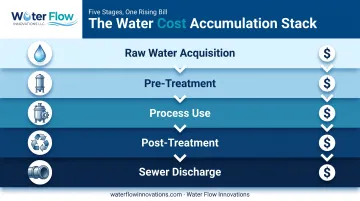
Water costs in a chemical facility don't come from a single source. They stack in layers: raw water acquisition, pre-treatment, process use, post-treatment, and sewer discharge. Each layer adds its own charge to the final bill, whether or not the water was used efficiently.
Most of this build-up is gradual and compounding. Rate hikes happen annually in many municipalities. Production scale-up adds incremental demand. Neither shows up as a dramatic jump — until they combine over several years into a much higher ongoing cost.
Then there are the sudden spikes:
- A cooling tower fouls and blowdown frequency increases without anyone adjusting the makeup water budget
- An unplanned batch change pushes reactor cooling demand well above forecast
- A leak develops in underground distribution piping and runs for weeks before detection
A meaningful share of these costs stays hidden until a formal water audit—or a simple check that billed usage matches what the process should require. Without that comparison, inflated costs get absorbed as "normal" operating expense.
Key Cost Drivers for Water Bills in Chemical Processing
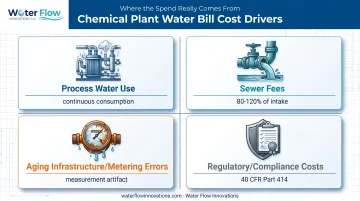
Not every dollar on a chemical plant's water bill comes from the same place. Understanding which driver is doing the damage determines which fix actually works.
Process water use. Cooling, chemical reactions, rinsing, cleaning-in-place, and boiler feedwater are the largest contributors to consumption-based charges. These steps run continuously in most plants, which means even small inefficiencies compound fast across a billing cycle.
Sewer fees. Most utilities calculate discharge charges as a percentage of metered water use, often in the 80% to 120% range depending on the jurisdiction. That structure means any inefficiency in intake gets charged twice: once for the water coming in, once for the assumed discharge going out.
Aging infrastructure and metering errors. These costs have nothing to do with actual water use. Air entrainment and turbulent flow at the meter can cause it to register more volume than was actually delivered (a mechanical measurement artifact, not an operational inefficiency). Undetected leaks in old distribution lines inflate bills from the opposite direction.
Regulatory and compliance costs. Treatment requirements vary by chemical produced and discharge destination. EPA's Organic Chemicals, Plastics and Synthetic Fibers rule (40 CFR Part 414) covers process wastewater from more than 1,000 chemical facilities. Pretreatment standards add further requirements for indirect dischargers sending wastewater to a municipal treatment plant.
The relative weight of these drivers differs by facility type, process design, and site age. A newer plant with closed-loop cooling faces a very different cost profile than a 1970s-era facility running single-pass systems on original piping.
Cost-Reduction Strategies for Water Bills in Chemical Processing
Reducing water bills means working three separate levers: decisions made before water is used, day-to-day water management, and the surrounding context of billing, infrastructure, and discharge. Treat them as one problem and you often spend capital on the wrong fix.
Strategies That Reduce Costs by Changing Decisions
These approaches cut cost by changing design, procurement, or policy choices before water flows through a new system.
- Run a comprehensive water balance or audit before approving any capital project. This shows where usage and spend concentrate so investment goes to the highest-impact area, not a guess.
- Specify water-efficient technologies during equipment procurement. Single-pass cooling uses roughly 40 times more water than a cooling tower at five cycles of concentration for the same heat load, per the US Department of Energy's Best Management Practice guidance on single-pass cooling. Choosing recirculating systems at procurement avoids costly retrofits.
- Design closed-loop or counter-flow recycling into new process lines from the outset. Retrofitting recycling later is almost always more expensive and disruptive than building it in at design.
- Set facility-wide water reduction targets tied to specific production processes. Major producers like Dow and BASF publish site-level water stewardship goals for this reason: targets create accountability a generic "use less water" policy never does.
Strategies That Reduce Costs by Changing How Water Use Is Managed
These approaches lower cost through better control, visibility, and consistency while systems are running. No redesign required.
- Install submetering across major water-use zones (cooling, boilers, CIP) to isolate which areas drive the highest costs. Without submeters, the facility is guessing.
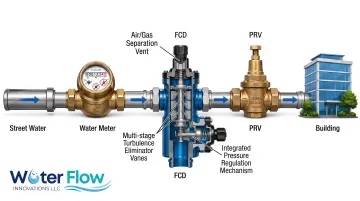
- Correct water meter over-reading caused by air entrainment and turbulent flow. This is one of the most overlooked cost drivers in chemical processing. Commercial meters cannot tell actual water from air, micro-bubbles, and vortex flow created by reactor cycling and pressure swings, so they bill all of it as volume.
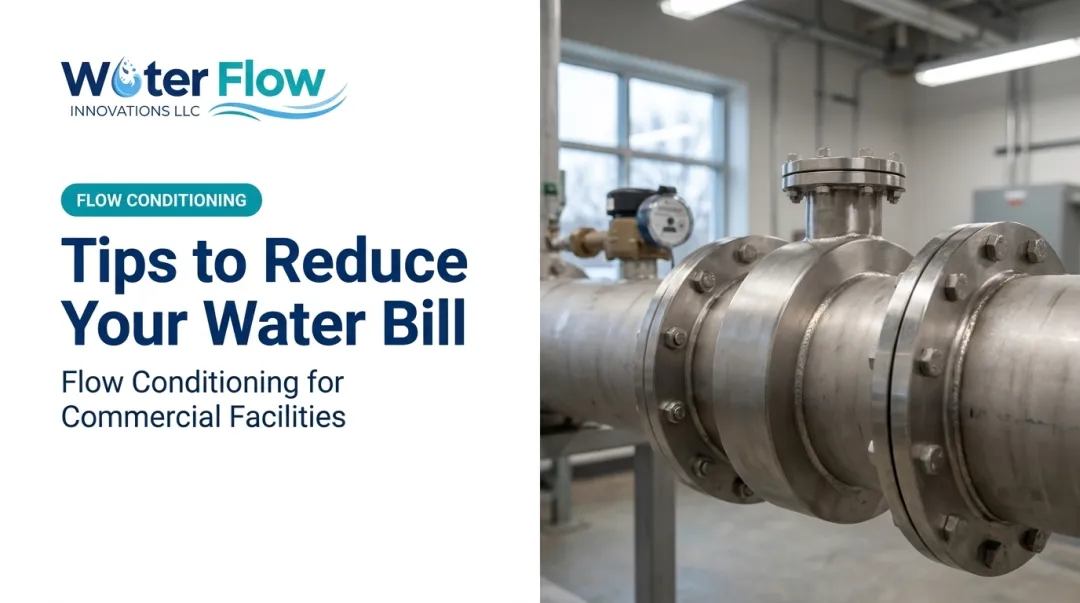
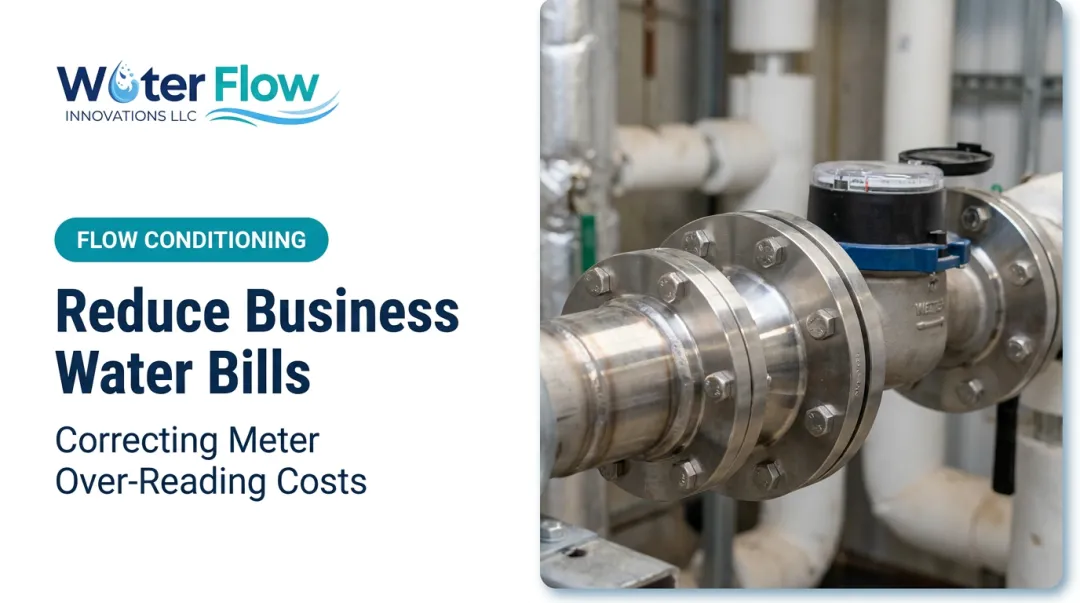
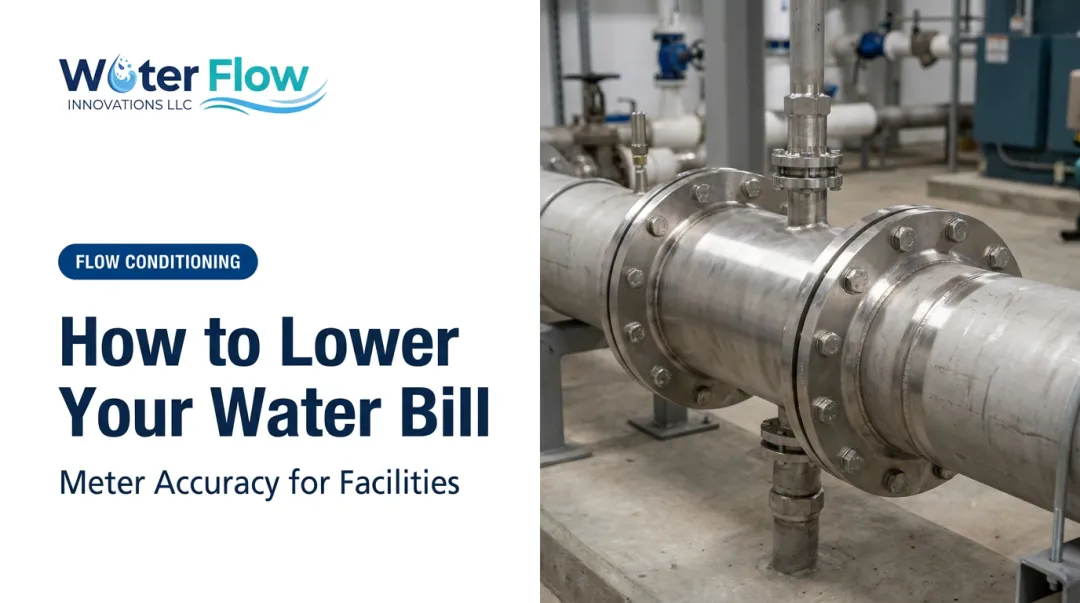
A certified flow conditioner such as Water Flow Innovation's FCD installs immediately after the municipal meter. Its four-component system (air and gas separation, pressure regulation, a check valve, and turbulence elimination) restores a stable, laminar water column through the measurement zone.
Documented installations show a 5% to 30% average reduction in combined water and sewer bills, with a high of 46%. Correction happens at the meter, not in the process, so usage, pressure, and system performance stay unchanged.
- Optimize cooling tower cycles of concentration and blowdown scheduling. Many facilities run at 2 to 4 cycles when 6 or more is achievable. The Department of Energy notes that raising cycles from 3 to 6 cuts makeup water demand by 20% and blowdown by 50%.
- Implement structured leak detection and preventive maintenance. Undetected leaks are a common, costly loss source. One EPA example found a single stuck cooling-tower float valve wasting 216,000 gallons a month.
- Address boiler feedwater losses through steam system repair. Failed steam traps and lost condensate force extra municipal makeup and inflate the site meter. Trap replacement and condensate return optimization fix the source, not the symptom.
Strategies That Reduce Costs by Changing the Context Around Water Use
In many facilities, billing and discharge structure, not the process itself, drives excess cost.
- Segregate contact and non-contact water streams. Non-contact cooling water that never touched process chemicals should not carry the same sewer rate as process-contact wastewater. Agencies such as Connecticut DEEP already separate the two for permitting; apply that distinction to your cost structure.
- Evaluate alternative or reclaimed water sources. Recycled wastewater, rainwater capture, or treated effluent from a nearby facility can cut dependency on high-cost municipal supply. Dow's Terneuzen site, for example, reuses treated municipal wastewater for cooling towers instead of relying only on fresh intake.
- Research utility rebate and incentive programs. Several utilities offer cost-share programs for industrial water conservation, some covering a substantial share of qualifying project costs.
- Benchmark facility water and sewer costs against similar chemical processing peers. If cost per unit of production sits well above comparable sites, something systemic, not only operational, needs attention.
Conclusion
Reducing water bills in chemical processing starts with correctly identifying where the cost actually originates: consumption, discharge fees, or billing inaccuracies. Applying a blanket cost-cutting mandate across all three rarely works, because each has a different fix.
The most effective approach combines quick corrections, like restoring metering accuracy, with longer-term structural and process-level investments. Treat it as ongoing work, not a one-time project: the savings show up on every billing cycle you keep the fixes in place.
Frequently Asked Questions
What are effective ways to cut water-related costs in chemical processing?
Start with process audits and water balances, water-efficient equipment upgrades, closed-loop recycling, and correcting billing or metering inaccuracies. The fastest wins usually come from fixing measurement errors before pursuing capital projects.
How much water do chemical processing plants typically use?
Usage varies widely by process type and facility size. Chemical manufacturing ranks among the top five US manufacturing subsectors for total water consumption, according to Department of Energy and Lawrence Berkeley National Laboratory research.
Can water meter inaccuracies really increase my utility bills?
Yes. Air entrainment and turbulent flow can cause a meter to register more volume than actually passed through it, inflating your bill without any change in real consumption. This is a measurement issue, not a usage issue.
What is the fastest way to see savings on water bills without disrupting plant operations?
Flow conditioning devices correct meter over-reading in about an hour of installation time, with water off for that hour only and no process changes required. Savings typically appear on the very next billing cycle.
How does reducing sewer/discharge fees differ from reducing water consumption?
They're connected. Since most utilities calculate sewer charges as a percentage of metered water use, correcting either actual consumption or metering accuracy reduces both charges at the same time.
Are water-saving investments in chemical plants eligible for ESG or sustainability reporting credit?
Yes. Documented before-and-after water savings can support CDP water security disclosures, LEED certification credits, and corporate sustainability reporting. Most frameworks require verifiable utility bill evidence.
How much can correcting meter over-reading save a chemical plant?
Documented installations average a 5–30% reduction in combined water and sewer bills, with a highest documented single result of 46%. The device carries a 6-month money-back guarantee on the purchase price plus a lifetime transferable warranty.
Which process industries share this over-reading pattern?
Plants with reactor cooling, wash-down, and batch transfer cycling on one meter: chemical manufacturing, paint and coating formulation plants, rubber and plastics, plastic recycling and pelletizing mills, metal finishing, glass, and commercial leather tanneries.