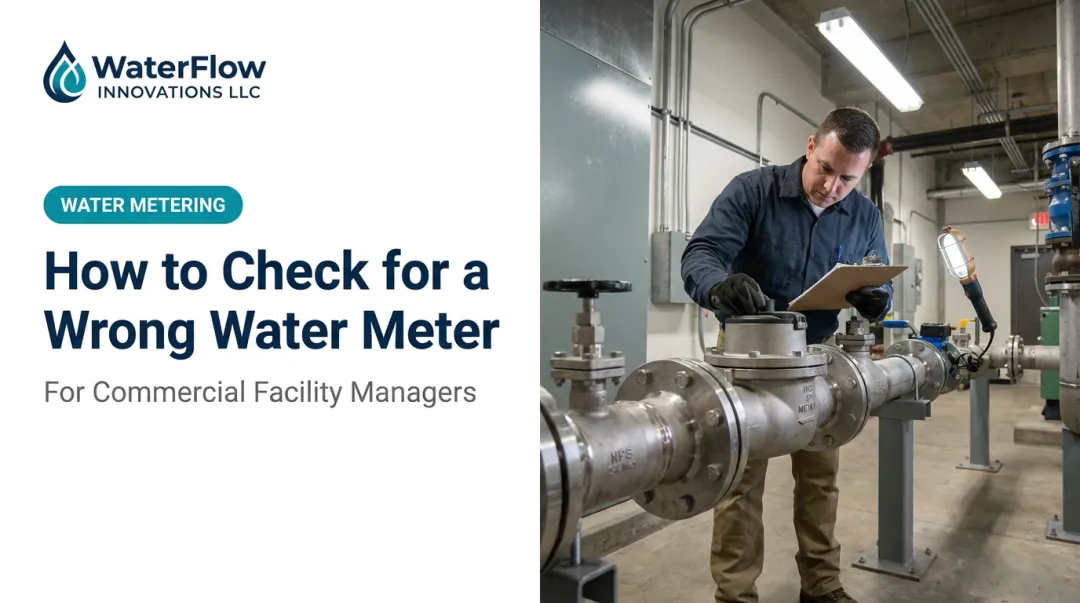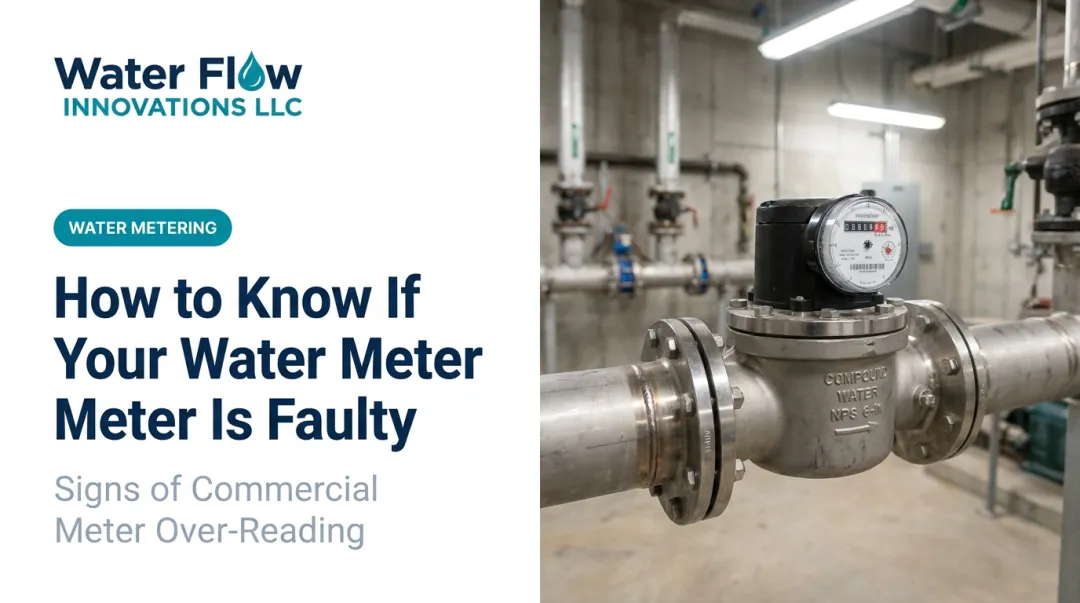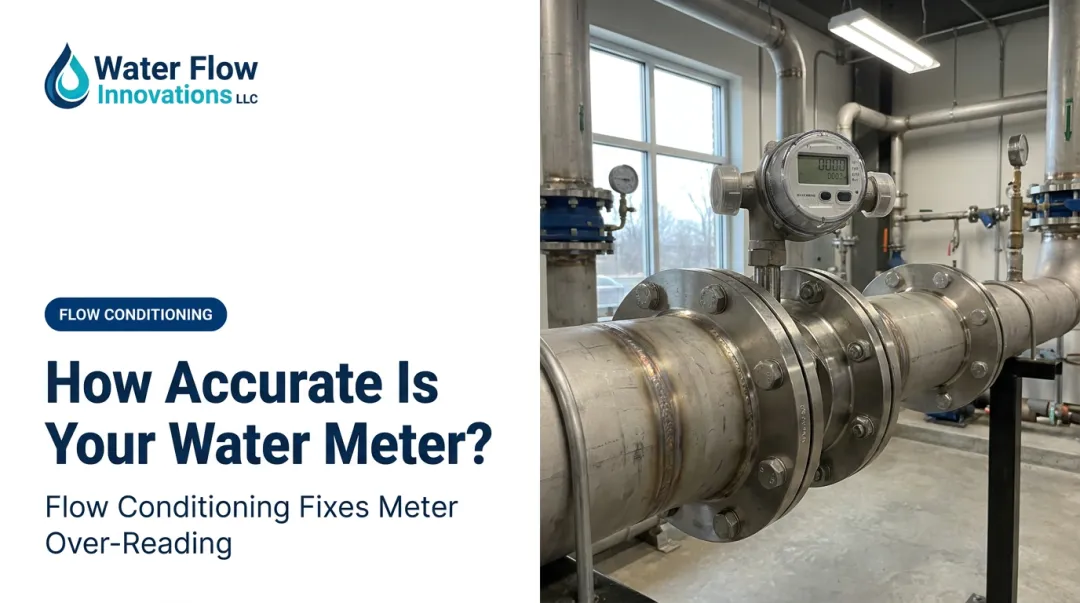
The stakes are real. Because sewer fees are typically calculated from metered water consumption, any metering error compounds across both line items on every bill.
This article walks through three practical methods for testing water meter accuracy, what acceptable results look like under AWWA standards, how to interpret what you find, and what to do when a meter passes testing but bills remain stubbornly high.
Key Takeaways
- AWWA accuracy standards require meters to read between 98.5% and 101.5% of actual volume — anything outside this range warrants action
- Three testing methods cover most situations: the DIY bucket test, zero-flow static test, and professional bench test
- A meter can pass standard testing and still over-read due to air entrainment and turbulent flow conditions not replicated during bench tests
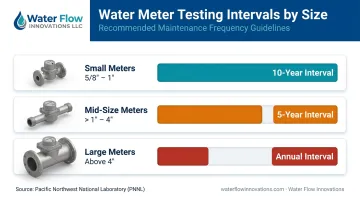
- PNNL best practices recommend testing intervals of 10 years (small meters), 5 years (mid-size), and annually (large meters above 4")
- If a meter passes testing but bills remain high, investigate flow conditions upstream of the meter — not just the meter itself
What You Need to Test Water Meter Accuracy
The tools and setup you need depend on which method you choose. Each approach has different requirements — the sections below cover both equipment and preconditions before you begin.
Tools and Setup by Method
| Method | Tools Required |
|---|---|
| DIY Bucket Test | 5-gallon bucket, measuring cup, bathroom scale (optional), notepad |
| Zero-Flow Static Test | Notepad or phone, flashlight, 10–15 minutes of confirmed zero water use |
| Professional Bench Test | None from the facility — utility or lab supplies all calibrated equipment |
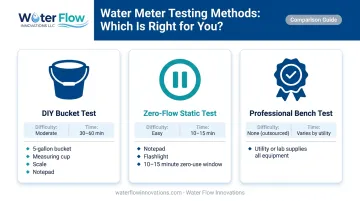
For the bucket test, a standard 5-gallon bucket often holds slightly more than 5 gallons — so measure exactly using 16 cups per gallon, or weigh the filled bucket (5 gallons of water weighs approximately 41.7 lbs, per USGS water density data, plus the empty bucket weight). Eyeballing the fill line introduces enough error to skew your results.
For professional bench testing, when contacting the utility have your meter size (5/8", 1", 2", etc.) and installation address ready — the utility needs both to process the request.
Preconditions Before Testing
- Shut off all water-using equipment, fixtures, and appliances — even a running toilet or ice maker can skew results
- Confirm no irrigation cycles are scheduled or running
- Check that the meter register face is clean, legible, and undamaged
- For digital or AMR meters, confirm the display is functioning and not showing an error code
Methods to Test Water Meter Accuracy
All three methods share the same principle: compare a known volume of water to what the meter registers. Choose based on your available tools, meter size, and whether you need a rough check or a precise measurement.
Method 1: The DIY 5-Gallon Bucket Test
A volumetric test you can run in under five minutes. Run a known quantity of water through the meter and compare the meter's recorded change to what you actually used.
The math: 5 gallons equals 0.6684 cubic feet (per NIST unit conversion standards). On most meter displays, you're looking for a reading change of approximately 0.67 cubic feet or 5 gallons on dial-type registers.
- With all water off, record the current meter reading — note all digits, including decimals and the low-flow indicator position
- Fill the 5-gallon bucket from a bathtub or utility sink; measure precisely using cups or weigh the bucket before and after filling
- Take a second meter reading immediately after filling; subtract the initial reading and compare to the expected 0.67 cubic feet
Pros: Free, fast, requires no utility involvement.
Cons: Only tests accuracy at one flow rate (the bucket fill rate). Won't reveal problems that appear only at high or low flow extremes. Best used as a first-pass check.
Method 2: Zero-Flow Static Test
A no-flow check that determines whether the meter registers movement when all facility water use is confirmed off. Any movement indicates either an active leak or meter over-registration.
- Shut off all water-using equipment and fixtures throughout the facility; close the main shutoff valve briefly to confirm true zero-flow conditions if available
- Record the meter reading and note the position of the low-flow indicator (typically a small triangle or dial)
- Wait 10–15 minutes without using any water, then return to check whether the reading has changed or the indicator has moved
Pros: Excellent for detecting slow leaks or continuous over-registration at very low flow.
Cons: Cannot quantify accuracy in percentage terms. Won't distinguish between a meter fault and an undetected leak without further investigation.
Method 3: Professional Bench Test (Utility or Third-Party)
The gold standard for billing disputes and regulatory challenges. The meter is removed and tested at a certified facility using calibrated flow equipment across at least three flow rates — low, intermediate, and high — per AWWA M6 procedures.
- Contact your utility's billing department and formally request a meter accuracy test in writing; document your reason — bill spikes, unusual meter behavior, or DIY test anomalies
- A technician removes the meter and tests it at a certified facility; PNNL-SA-27804 Water Meter M&V Best Practice recommends testing at an AWWA-certified water-meter testing facility using low, intermediate, and high flow rates
- Request written results showing accuracy percentages at each flow rate; if the meter reads outside 98.5%–101.5%, the utility typically absorbs the testing fee and takes corrective action
What bench tests cost: Fees vary significantly by jurisdiction and meter size. Published schedules show:
- Philadelphia Water Department: $125–$350 (one free test every 20 years)
- City of Fullerton, CA: $248–$303
- San Francisco PUC: $546–$2,142 for commercial sizes
Most utilities waive the fee if the meter tests outside their accuracy limits.
Pros: Produces quantified data across the full flow range; officially recognized by utilities; suitable for billing disputes.
Cons: Requires meter removal and a temporary service disruption; may involve a fee if the meter tests within spec.
How to Interpret Your Water Meter Test Results
How you read the results determines whether you take no action, investigate further, or escalate. Each outcome points to a specific next step.
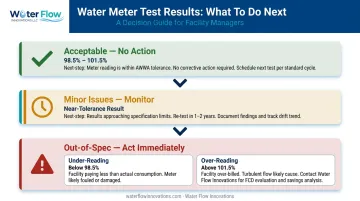
Acceptable Results — No Immediate Action Required
- Bucket test: 0.64–0.70 cubic feet registered for 5 gallons
- Static test: Zero movement with confirmed zero water use
- Bench test: 98.5%–101.5% accuracy across all tested flow rates
Log the test date and schedule your next check per standard frequency — no meter action required.
Minor Issues — Monitor Closely
A bench test result near the outer tolerance limits (98.6% or 101.4%) or a bucket test with slight but consistent deviation may indicate age-related drift. Schedule a re-test within 1–2 years and track billing trends against actual usage.
Out-of-Spec — Act Immediately
- Below 98.5% (under-reading): The utility loses revenue; your facility may be undercharged but risks back-billing when the error is discovered
- Above 101.5% (over-reading): Your facility is being charged for water it never used
Document the results in writing and formally dispute billing discrepancies with the utility. Most utilities will replace or recalibrate an out-of-spec meter at no charge.
Hidden Over-Reading That Standard Tests Won't Catch
Sometimes the bench test comes back within spec, yet water bills remain abnormally high. This happens because bench tests use controlled, clean-flow conditions that don't replicate what actually passes through your meter during normal operations. PNNL-32074 notes that fittings and valves near a meter introduce turbulence that reduces accuracy in most meters. A bench test won't reproduce that turbulence.
Two real-world conditions cause over-reading that bench tests miss:
- Air entrainment: Dissolved air or micro-bubbles released into the water line. Mechanical meters — especially turbine and positive displacement types — count air volume as billable water because they cannot distinguish between air and water
- Turbulent vortex flow: When water spins through the measurement zone, displacement and turbine meters over-count the volume passing through them
For facilities experiencing unexplained bill increases after a clean meter test, Water Flow Innovation's Flow Conditioning Device (FCD) is specifically engineered to address these root causes. The FCD's four-component system works as follows:
| Component | Root Cause Addressed |
|---|---|
| Air & Gas Separation | Creates back-pressure to prevent air bubble formation; ensures 100% homogeneous water column through the meter |
| Pressure Regulation | Eliminates water hammer and pressure surges that reintroduce air into the line |
| Check Valve | Prevents reverse flow and pressure spikes that pull air back into water lines |
| Turbulence Elimination | Converts vortex (spinning) flow to smooth, laminar flow in the measurement zone |
The FCD installs on the consumer side of the meter — installation is usually about an hour (+/-) — and works with any meter type and any pipe size from 1/2" through 12" NPS. Documented results show 5–30% average water and sewer bill reductions across facility types, with the highest single result at 46%. Nine out of ten customers reach full ROI within 12 months.
Common Mistakes When Testing Water Meter Accuracy
Avoid these errors — each one can invalidate your results entirely:
- Confirm true zero-flow before starting — a single toilet fill cycle, irrigation valve, or ice maker introduces enough flow to skew both bucket tests and static tests. Close the main shutoff if needed
- Mark your bucket with measured cups before testing. A standard 5-gallon bucket holds slightly more than 5 gallons; imprecise volume masks real problems or triggers false alarms
- Verify the meter's unit of measurement (cubic feet vs. gallons) before recording your starting reading — then confirm it again at the final reading. Digit count and decimal positions vary by manufacturer
Safety and Testing Frequency
Access and Physical Safety
Water meter vaults can be confined, low-visibility, and slippery. Follow these practices:
- Use a flashlight and confirm stable footing before entering any vault
- Under OSHA 29 CFR 1910.146, an enclosed vault becomes a permit-required confined space if it contains or could contain a hazardous atmosphere — verify ventilation requirements before entry into underground or enclosed spaces
- For large commercial meters in mechanical rooms, confirm no pressure anomalies before loosening any fittings
Testing Frequency by Meter Size
Per PNNL-32074 Water Metering Best Practices:
| Meter Size | Recommended Test Interval |
|---|---|
| 5/8" through 1" | Every 10 years |
| Greater than 1" through 4" | Every 5 years |
| Above 4" | Annually |
A few practical points on applying this table:
- The 4" meter falls in the 5-year category — annual testing applies only to meters larger than 4"
- High-flow or high-turbidity facilities should test more frequently to catch accuracy drift before it compounds across multiple billing cycles
Conclusion
A DIY bucket test takes under 15 minutes and flags obvious problems. A formal utility bench test delivers definitive, documented results suitable for billing disputes. Used together, these two methods give commercial and industrial facilities a clear picture of whether they're paying for actual water consumption.
Passing a bench test doesn't guarantee accurate billing. Air entrainment and turbulent flow conditions — common in food and beverage processing, industrial manufacturing, healthcare, and data center operations — cause systematic over-reading that controlled lab tests don't replicate. Facilities seeing unexplained bill increases after a passing result should investigate flow conditions at the meter, not just the meter itself.
Water Flow Innovation offers a free water bill review and savings analysis to project whether an FCD installation could reduce your water and sewer costs — no purchase commitment required. For an immediate estimate, the Water & Sewer Bill Savings Calculator delivers a projection without requiring any contact information.
Frequently Asked Questions
How do I know if my water meter is accurate?
The simplest check is the DIY bucket test — 5 gallons should register as approximately 0.67 cubic feet on the meter. For a definitive answer, request a formal bench test from your utility, which tests accuracy at low, intermediate, and high flow rates per AWWA M6 procedures.
How much does a meter accuracy test cost?
Costs vary by jurisdiction and meter size, ranging from $125 to over $2,000 for commercial meters. Most utilities waive the fee if the meter tests outside their accuracy limits (98.5%–101.5%). Contact your utility's billing department for the specific fee schedule in your area.
Can a water meter be recalibrated?
Most residential and commercial positive displacement meters cannot be field-calibrated — they are replaced when they fail accuracy standards. Some larger electronic or turbine meters may be recalibrated by the manufacturer or utility, depending on the meter type and condition.
How often should water meters be tested for accuracy?
PNNL guidelines recommend testing small meters (5/8"–1") every 10 years, mid-size meters (greater than 1"–4") every 5 years, and large meters (above 4") annually. Facilities with high flow volumes or high-turbidity water should test more frequently.
What is the AWWA standard for water meter accuracy?
The American Water Works Association (AWWA) requires meters to register between 98.5% and 101.5% of actual water volume at normal flow — no more than a 1.5% error in either direction. Minimum-flow criteria differ by meter type, so verify limits against AWWA M6 for your specific meter.
What should I do if my water meter fails an accuracy test?
Request written documentation of the test results and formally dispute any billing discrepancies in writing, then ask the utility to replace the meter. If the meter passes but bills remain abnormally high, investigate flow conditioning — air entrainment and turbulent flow can cause systematic over-reading that bench tests won't catch. Water Flow Innovation offers a free savings analysis to help identify whether flow conditioning is driving inflated charges.
Why can a meter pass a bench test and still over-read in service?
A bench test runs clean, steady, fully saturated water through the meter. It cannot reproduce the entrained air, turbulence, and rapid on-off demand your facility actually generates, which is where over-registration occurs. The meter is accurate; the measurement environment is not.
How quickly can flow conditioning be installed after a failed investigation?
About one hour, with water off for that hour only, fitted by a licensed plumber or mechanical contractor on the main line after the meter. Savings appear on the very next billing cycle, unlike a utility-scheduled meter replacement.