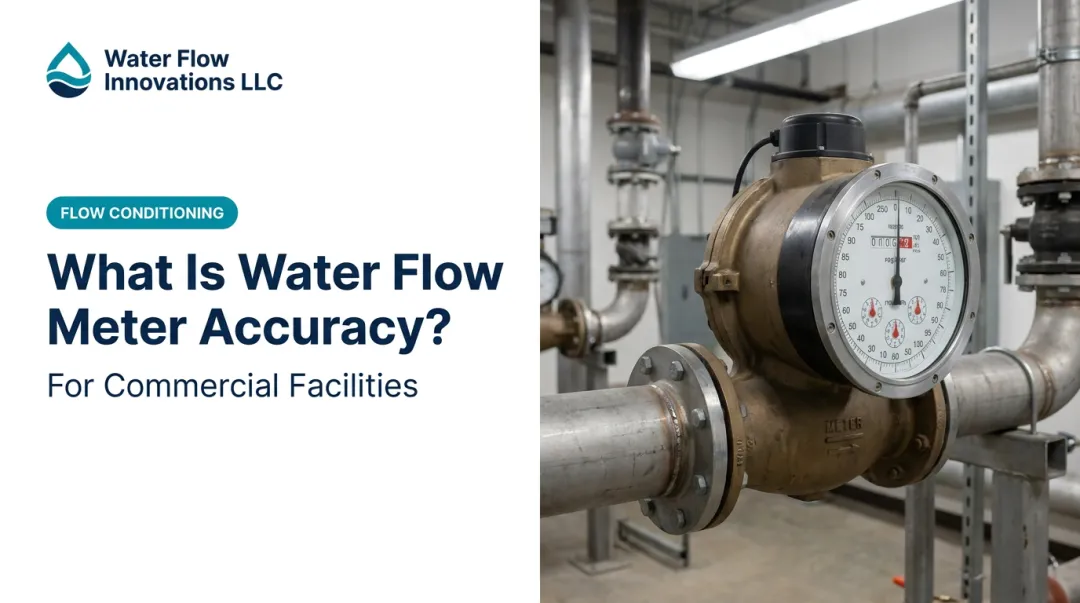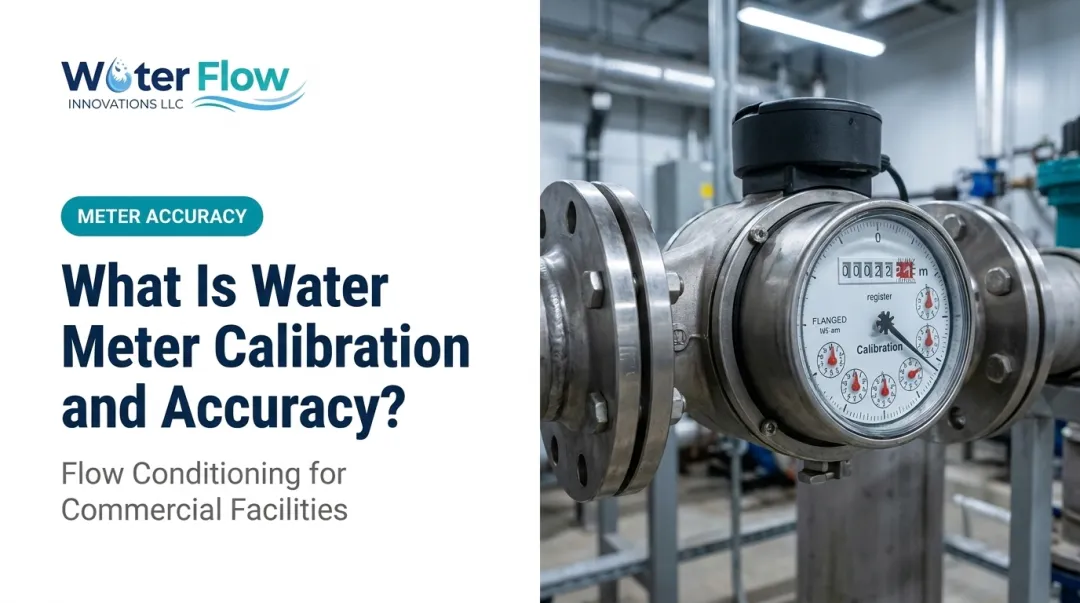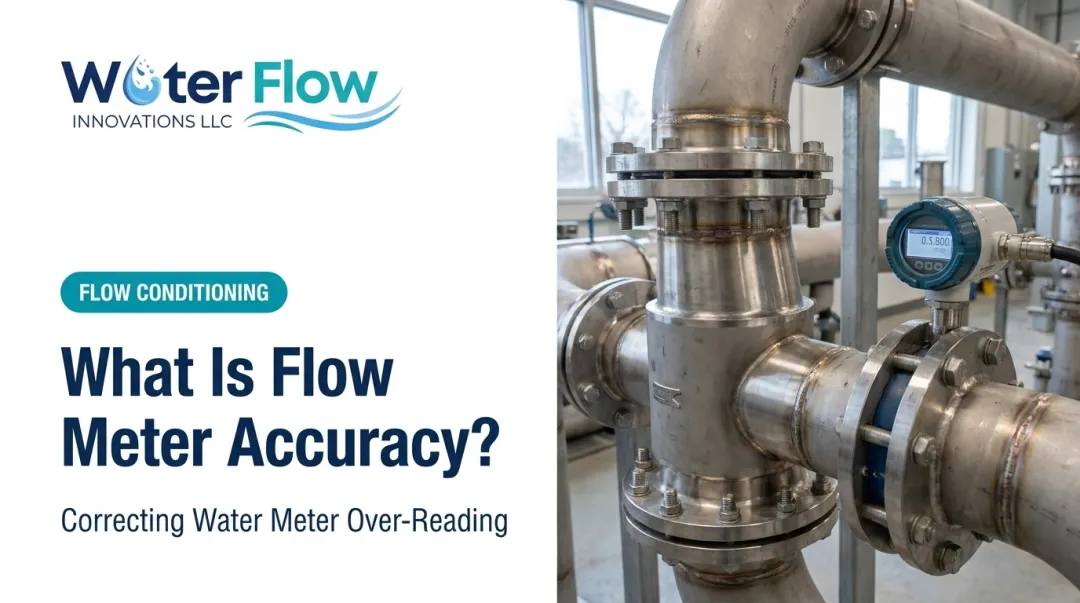

Accurate metering is the standard against which every water meter gets judged: a certified tolerance band, typically +/-1.5% to 2%, within which the meter's reading must match actual flow. Here's the part most people miss: when meters drift, they almost always over-read, not under-read. Physical flow conditions near the meter, not just age or wear, are usually to blame.
This article covers what accurate metering actually means, why meters drift out of tolerance, and how facilities can verify and correct their readings.
Key Takeaways
- Accurate metering means readings fall within a certified tolerance, commonly +/-1.5-2% of actual volume
- Turbulent flow and air entrainment near the meter, not just aging components, drive most over-registration
- AWWA and NIST set the accuracy standards, but field conditions cause meters to drift well within their "accurate" service life
- Fixing upstream flow conditions, rather than replacing the meter, often restores accuracy and lowers bills
What Is Accurate Metering?
Accurate metering describes a water meter's ability to consistently measure the real volume of water passing through it, within a margin of error set by industry standards. It doesn't mean zero error. It means the error stays inside an accepted band.
Two organizations anchor those standards:
- AWWA (American Water Works Association) sets technology-specific standards, including C700 (positive-displacement), C701 (turbine), C702 (compound), and C715 (electromagnetic and ultrasonic)
- NIST provides the traceable calibration chain manufacturers use to verify their test equipment
According to Neptune's summary of AWWA's normal-flow acceptance band, most revenue-grade meters must register between 98.5% and 101.5% of actual flow — commonly expressed as 100% +/-1.5%.
Low-flow tolerances are wider and vary by technology. Accuracy figures should always be tied to a specific meter type, size, and flow rate—not treated as one universal number.
Lab accuracy and field accuracy are not the same:
- Meter accuracy is what the meter achieves under controlled lab conditions, with smooth, uninterrupted flow
- Field accuracy is what happens once that same meter sits downstream of elbows, valves, pumps, and pressure changes
A meter can pass every certification test on the bench and still over-read the moment it's installed in a real pipe run.

Why Accurate Metering Matters
For municipalities, meter inaccuracy directly affects revenue collection. For commercial and industrial ratepayers, it means paying for water that never actually arrived.
The scale can be significant. A PNWS-AWWA case study on the City of Bend found that out of 45 meters investigated, 22 were under-registering. Those meters accounted for over 19.4 million gallons of historical apparent loss and $203,248 in combined water and sewer revenue impact.
That's one utility's experience, not a national average, but it shows how quickly metering errors compound.
Accurate data also underpins:
- Leak detection: distinguishing a real leak from a meter that's simply reading high
- Demand forecasting: planning infrastructure around what's actually being used
- Infrastructure planning: sizing upgrades based on real consumption, not inflated numbers
Why Meters Become Inaccurate (Even When "Certified")
Here's the uncomfortable truth: most water meters are lab-tested and certified accurate the day they're installed. Then real-world piping conditions take over.
Turbulent Flow From Nearby Fittings
Badger Meter's own installation guidance flags nearby fittings as sources of distorted velocity profiles that throw off registration, including:
- Elbows
- Pumps
- Dirt traps
- Valves
Meters are calibrated for a smooth, predictable flow pattern. Anything that disrupts that pattern—especially close to the meter—changes how the internal mechanism registers volume.
Air Entrainment: The Hidden Culprit
Air and gas bubbles moving through a meter get counted as water. This is one of the most under-diagnosed causes of inflated commercial and industrial water bills.
Entrained air causes measurable over-registration even in smaller meters, and the same mechanism shows up in commercial and industrial settings around:
- Cooling tower cycling
- CIP (clean-in-place) operations
- Tank filling
- Irrigation restart after dormancy
Mechanical Wear and Pressure Fluctuations
Debris buildup, worn bearings, and pressure surges add drift over time. Those long-term factors still matter less than flow conditions. A brand-new meter installed downstream of turbulence or air can over-read from day one.
Over-reading dominates for a simple reason: utilities rarely flag a bill that's too high. Under-reading gets caught fast because it costs the utility money. Over-reading costs the customer money, and nobody's watching for that.

How to Check If Your Meter Is Reading Accurately
Request a Formal Accuracy Test
Most water providers will run a field accuracy test on request, comparing registered volume against a calibrated tank or reference meter at low, intermediate, and high flow. This is the most reliable verification method, though it typically requires purging air from the line first.
Try a Known-Volume Self-Check
A rough version of this test compares your meter's registered volume against a measured tank or vessel of known capacity. It won't replace a certified test, but it can flag a gross discrepancy worth investigating further.
Review Your Billing History
Look for red flags such as:
- Consumption rising with no corresponding increase in occupancy, headcount, or production
- Sewer charges climbing faster than water charges
- Usage spikes when irrigation or cooling systems restart
- Bills staying high despite installing low-flow fixtures or conservation measures
These patterns often point to a meter reading problem rather than an actual usage change.
How to Ensure Long-Term Metering Accuracy
Replacing or recalibrating a meter often doesn't solve anything if the turbulence and air entrainment causing the problem are still upstream. You'll get a fresh, certified meter installed in the same disruptive flow conditions that caused the last one to over-read.
Flow Conditioning Addresses the Root Cause
Flow conditioning corrects the water's flow profile and removes trapped air or gas at the meter, rather than swapping out hardware that will eventually drift again.
Water Flow Innovation's Flow Conditioning Device (FCD) is built specifically for this. It's certified through IAPMO, NSF, ANSI, CAN 61, KIWA, GMP, and SQF. It installs on any pipe size from 1/2" through 12" (larger sizes available on request) and works with any meter type.
The FCD uses four coordinated components:
- Air and gas separation: Creates static back pressure that displaces entrained air at the meter
- Pressure regulation: Smooths surges from rapid demand changes
- Check valve: Reduces water hammer and prevents reverse flow (not always required, depending on installation)
- Turbulence elimination: Slows velocity enough to prevent vortex formation at the meter

Documented Savings and ROI
Facilities typically see results without any change in water usage or operations:
- 5-30% average reductions in combined water and sewer bills, with a highest documented result of 46%
- Full ROI in under 12 months for about 90% of customers
- Savings on the very next billing cycle
Installation takes roughly an hour and requires only a brief planned shutdown at the meter connection. No process equipment or production lines get touched.
Savings appear directly on municipal utility bills, which creates a clean before-and-after record. Facilities have used that documentation to support ESG reporting, LEED certification, and other sustainability programs without installing extra measurement infrastructure.

Frequently Asked Questions
How accurate is a meter?
Certified new meters typically measure within +/-1.5% to 2% of actual flow under ideal lab conditions. Field accuracy often degrades due to turbulence, air entrainment, and wear once the meter is installed in a real pipe run.
What is considered an accurate water meter reading?
An accurate reading stays within the meter's certified tolerance—usually ±1.5% to 2%—at normal operating flow rates and conditions.
How often should water meters be tested for accuracy?
There's no single universal interval; it varies by meter size, type, and local water quality. High-volume commercial and industrial meters generally need more frequent testing than smaller residential ones.
Can a water meter be inaccurate even if it's new?
Yes. A brand-new, certified meter can over-read from day one if it's installed downstream of turbulence-causing fittings or in a line with entrained air. This is why a meter swap so often fails to change the bill.
What causes a water meter to over-read?
Turbulent flow, air or gas entrainment, and improper installation are the primary causes. These are distinct from mechanical failure and often affect meters that are otherwise in perfect working condition.
Who is responsible for water meter accuracy, the utility or the property owner?
Utilities generally own and maintain the meter itself. Property owners are typically responsible for the piping conditions feeding into it, which is often where correctable inaccuracy actually originates.
What is the measured value of restoring accuracy?
Documented installations average a 5–30% reduction in combined water and sewer charges, with a highest documented single result of 46%. The gain comes from billing accuracy, not from consuming less.
How long does the customer-side correction take to fit?
About an hour, with a brief water shutoff at the meter connection. A licensed plumber or mechanical contractor fits a custom-built unit at the supply connection, leaving the utility's meter and the downstream plumbing untouched.