
Many facility managers struggle to pinpoint why water costs keep climbing even when usage patterns have not changed. The culprit is often downstream flow instability, not actual consumption.
This post covers the core techniques engineers use to stabilise flow, from straight pipe runs to integrated conditioning devices, and what these fixes mean for accuracy, equipment life, and operating costs. Facilities managing water-intensive operations, whether manufacturing plants, hotels, or municipal buildings, are paying closer attention to this issue for both cost control and sustainability reporting reasons.
Key Takeaways
- Turbulence, swirl, and air entrainment after bends or valves distort meter readings for many pipe diameters downstream
- Straight pipe runs, flow conditioners, and air eliminators are the primary tools for restoring stable, meter-ready flow
- Unstable flow causes meters to over-register, inflating both water and sewer charges
- Properly conditioned flow protects equipment and can deliver savings on the very next billing cycle
What Is Downstream Flow Stabilization?
Downstream flow refers to the flow pattern that forms after a disturbance point, such as an elbow, valve, pump, or reducer, anywhere in a piping system. These disturbances do not just create a brief ripple. They generate turbulent, asymmetric velocity profiles that can persist far longer than most people expect.
There is no single universal rule for how much straight pipe is needed to let that profile normalise. Guidance varies by source and meter type:
- PNNL/FEMP recommends 5D upstream and downstream for compound and turbine meters, or up to 10D upstream without a strainer
- Neptune's HP Turbine meter manual specifies 4D upstream with a strainer, or 8D–10D without one
- API MPMS 5.3 notes that severe out-of-plane elbows can retain swirl past 100 diameters in some liquid-measurement applications

The takeaway: always follow the specific meter manufacturer's guidance and map your actual disturbance geometry, rather than assuming a generic "10-diameter rule" applies everywhere.
Why It Matters for Water Meters Specifically
Two goals often get lumped together. Flow stabilisation for measurement accuracy gives a meter a clean velocity profile so it reads correctly. Flow stabilisation for process stability keeps pressure and flow consistent for equipment performance. They overlap, but they are not the same problem.
Air entrainment is where costs spike. A 2022 study in the IWA journal AQUA found mechanical meters can severely over-register during air-driven conditions, with peak air discharge over 1,400% of rated overload flow. Five of six meters tested failed under high dry-air spin conditions.
Since most utilities calculate sewer charges from metered water usage, this over-registration does not just inflate your water bill. It inflates the sewer line item on the same inflated read.
Core Techniques for Downstream Flow Stabilization
Several proven approaches exist, and most facilities end up combining more than one.
- Straight pipe runs — distance and wall shear rebuild a normal flow profile. The tradeoff is space, since not every mechanical room has 10 extra pipe diameters before the meter.
- Flow straighteners and conditioners — tube bundles, perforated plates, or vane internals break up swirl faster than straight pipe alone. Perforated plates reshape more of the velocity profile but usually cost more in pressure loss.
- Air and gas elimination — removes entrained bubbles from the meter's measurement zone, preventing the false volumetric readings documented in mechanical meter testing.
- Pressure regulation — reduces surges from cycling pumps or variable demand so flow stays consistent at the meter.
- Check valves — maintain unidirectional flow and limit backflow-related pressure spikes and water hammer.
An Integrated Approach
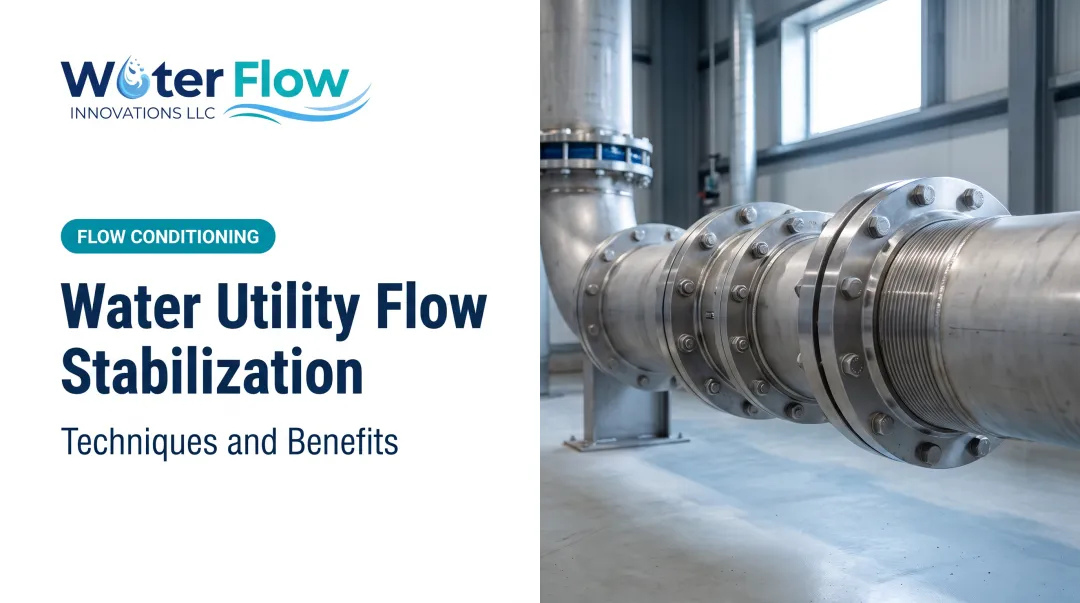
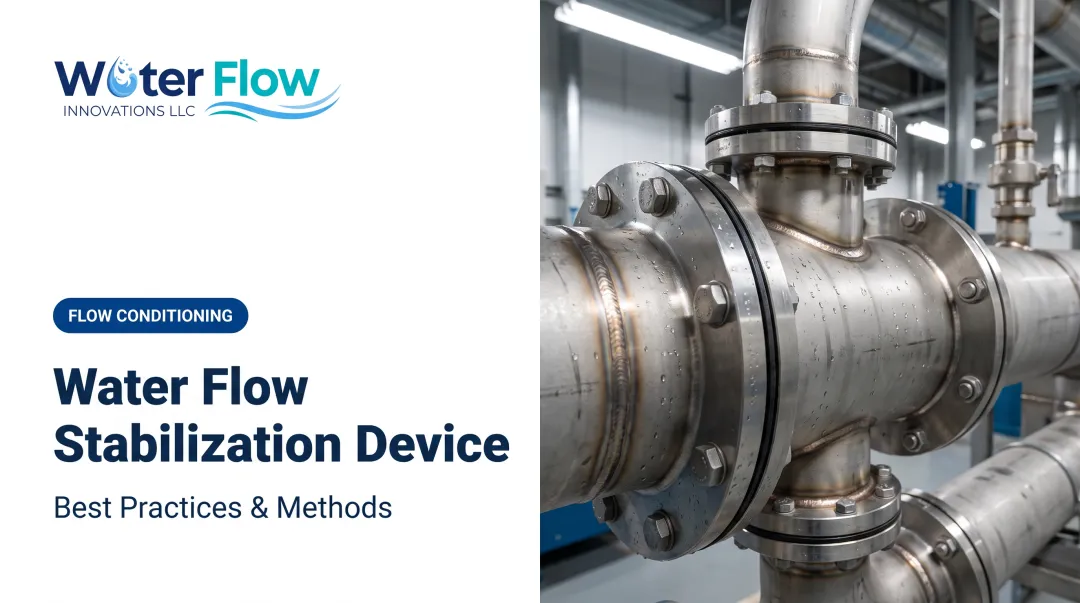
Rather than installing four separate devices, some facilities opt for a single unit that handles multiple functions at once. Water Flow Innovation's Flow Conditioning Device (FCD) is one example: a certified, 316L stainless steel unit installed immediately after the water meter, on the consumer side of the connection, that combines:
- Air and gas separation — creates static back pressure that pushes air back into the system, producing a homogeneous water column
- Pressure regulation — smooths surges from on-off cycling and variable demand
- Check valve protection — limits reverse flow and water hammer, specified when needed
- Turbulence elimination — slows velocity enough to prevent vortex or spinning flow during CIP cycles, tank filling, or irrigation

Where a pressure-reducing valve is present, the preferred configuration is Water Meter → FCD → PRV → Building. Installing after the PRV is a fallback and runs roughly 20–40% less effective.
It is built for negligible pressure loss by design, with most installations showing no detectable drop and rare cases showing 3–5 psi under high-volume open-discharge conditions. Installation takes about one hour with a brief water shutoff at the meter connection.
One boundary worth stating: the FCD corrects the meter reading. It does not resolve general turbulence elsewhere in the piping system, which still needs long-radius elbows, additional straight pipe, or a better layout, and it applies only to the metered municipal supply connection rather than any NPDES-regulated discharge line.
Impacts of Flow Stabilization on Operations and Costs
Stabilising downstream flow affects more than meter readings. It shows up in utility spend, equipment wear, compliance documentation, and how little production time you give up to fix the problem.
Measurement Accuracy
When turbulence and entrained air are removed, meters read what is actually flowing through the pipe, not an inflated version of it. Because the correction happens at the meter itself, accurate readings begin immediately. Savings can show up on the very next billing cycle rather than requiring months of ramp-up.
Utility Cost Reduction
Since sewer charges are often calculated from metered water volume, correcting over-registration reduces both charges simultaneously. Documented results for FCD installations include:
- 5–30% typical water and sewer bill reduction
- 46% highest documented single-site savings
- Full ROI in under 12 months for roughly 90% of customers
Equipment Longevity
Less turbulence means less erosive wear on valves, pump seals, and pipe fittings. No authoritative source pins an exact life-extension percentage on conditioning alone, but stable flow does cut vibration and cavitation stress on those components.
Sustainability Reporting
Verified before-and-after billing data can support LEED metering requirements and GRI 303 water-reporting standards, both of which call for documented methods and measurement status. Keep your calibration records and correction data on file. A billing correction is not the same as reduced water consumption, and reporting frameworks want that distinction made clearly.
Operational Continuity
Modern conditioning units install without disrupting production. An FCD install usually takes about an hour: a brief water shutoff at the meter connection, no access to internal facility systems, process equipment, or operational areas, and no lost production shifts.
Industries and Facilities That Benefit Most
Some facilities feel downstream flow disturbance more than others, and save more when that flow is stabilised.
- Industrial and manufacturing plants — complex piping, bends, and valves near the meter drive turbulence and meter over-reading
- Hospitality, multifamily, and campus sites — hotels, universities, and HOAs with large plumbing networks see frequent disturbances and higher water and sewer charges
- Food and beverage, pharma, and semiconductor plants — CIP cycles, batch runs, and ultrapure water needs make accurate metering critical for cost control and compliance
Best Practices for Implementing Flow Stabilization
A few checks up front help you pick the right stabilisation approach and avoid a poor fit for your meter and piping.
- Conduct a water bill analysis — review at least two years of bills for usage spikes that do not match production or occupancy.
- Verify meter and pipe configuration — confirm meter type, size, orientation, and existing straight-run lengths.
- Choose certified solutions — look for IAPMO, NSF, ANSI, CAN 61, KIWA, GMP, or SQF marks so the device meets local codes and water-quality standards.
- Weigh installation and payment factors — factor in install time of about an hour, pipe size compatibility of ½″ to 12″ as standard with larger custom sizes available, and buy-versus-lease options.
A free bill review is a low-risk first step. Water Flow Innovation offers a no-commitment remote analysis of billing history, meter setup, and operations, then recommends whether an FCD is a fit for your facility.
Frequently Asked Questions
What is meant by downstream impact?
Downstream impact refers to how a disturbance at one point in a pipe system, like an elbow or valve, affects flow behaviour, pressure, and measurement accuracy further along the pipeline.
How long does flow take to stabilize after a pipe fitting or valve?
It depends on the fitting and meter type. Guidelines range from 4–10 diameters for many water meters, though severe swirl-inducing fittings can require much longer runs.
Can turbulent flow really affect my water bill?
Yes. Turbulence and entrained air can cause certain meters to over-register usage, and since sewer charges are often based on metered water, both bills can be inflated simultaneously.
What is the difference between a flow straightener and a flow conditioner?
A basic straightener typically addresses swirl using tubes or vanes. A multi-function conditioner, like an FCD, combines turbulence elimination with air removal, pressure regulation, and check-valve protection in one unit.
How quickly can facilities see results from flow stabilization solutions?
Savings often appear on the very next billing cycle after installation, since the meter begins reading accurately right away.
Does flow stabilization affect water pressure or system performance?
Flow conditioning devices are designed for negligible pressure loss. Most installations show no detectable drop, with only minor changes under high-volume open-discharge conditions.
Can stabilization be standardized across a group of facilities?
Yes. Every facility with its own metered municipal connection is a separate installation opportunity, so sites can be ranked by consumption volume and the resulting evidence pooled for corporate benchmarking and capital planning.
What guarantee backs the stabilization device?
A 6-month money-back guarantee on the purchase price, with installation cost non-refundable, so it can be returned if metered consumption does not measurably fall. A lifetime transferable warranty against defects follows the property on sale.