
That assumption is often wrong. Turbulent flow and trapped air inside commercial plumbing can cause meters to register more water than actually passes through — a mechanical measurement issue, not a usage problem. This article breaks down why conditioning water flow matters in practice, not just in theory, and how it translates into measurable utility savings.
Key Takeaways
- Flow conditioning stabilizes turbulent, aerated water at the meter, correcting meter over-reading
- Facilities typically see 5-30% reductions in combined water/sewer bills, sometimes as high as 46%
- Unlike softening or filtration, it doesn't change water chemistry or usage; it corrects measurement accuracy
- Protects valves, regulators, and downstream equipment from turbulence-related wear
- Most commercial sites hit full ROI in under 12 months with zero operational disruption
What Is Water Flow Conditioning?
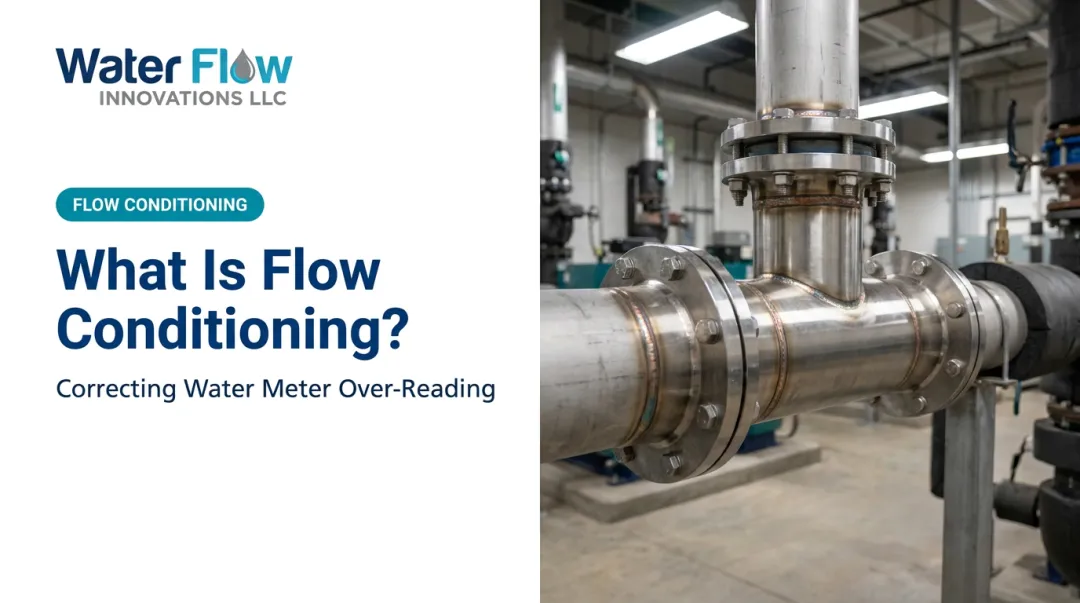
Flow conditioning stabilizes water as it moves through pipes: removing trapped air and gas, smoothing turbulence, and regulating pressure at the meter or point of use. Devices are typically installed at the meter inlet in commercial, industrial, and institutional buildings — manufacturing plants, hotels, hospitals, and multifamily properties.
What flow conditioning is not:
- Not water softening — softening targets hardness minerals (calcium, magnesium)
- Not filtration — filtration targets contaminants and particulates
- Not a chemistry change — it doesn't alter what's in the water at all
The point is accurate billing and protected infrastructure, not another treatment step. A Flow Conditioning Device (FCD), like the ones Water Flow Innovation offers, installs immediately after the municipal meter and works passively — no chemicals, no filters to replace.

Key Advantages of Water Flow Conditioning
The benefits below aren't theoretical. They're measurable outcomes tied to things businesses already track: utility spend, billing accuracy, and sustainability scorecards.
Advantage 1: Corrects Water Meter Over-Reading
Turbulent flow and entrained air bubbles can cause certain meter types to spin faster than the actual water volume passing through, registering what's effectively phantom usage.
Research from the Department of Energy's Pacific Northwest National Laboratory confirms that fittings and valves near a meter introduce turbulence that decreases measurement accuracy. Turbine and compound meters specifically need a uniform, swirl-free flow profile to read correctly.
A properly designed FCD addresses this with four coordinated components:
- Air/gas separation — creates a homogeneous water column so bubbles don't pass through the measurement zone
- Pressure regulation — reduces surges and water hammer from on-off demand cycling
- Check valve (where needed) — prevents reverse flow and re-entrained air
- Turbulence elimination — slows velocity enough to prevent vortex flow at the meter

Why it matters: Billing is based on meter readings, so correcting over-registration reduces both the water consumption charge and the sewer discharge charge. Most sewer fees are calculated from metered water use, which means a two-for-one correction on a single bill.
This matters most for:
- Facilities with older piping or multiple bends/valves upstream of the meter
- High-pressure systems or variable-demand operations (CIP cycles, irrigation, sprinklers)
- Large-volume users — manufacturing, food & beverage, hospitality
Advantage 2: Immediate Savings Without Operational Disruption
Because flow conditioning doesn't reduce actual water usage, there's no behavior change or process adjustment required. Installation typically takes about an hour and integrates into existing plumbing without interrupting production.
That speed matters for the bottom line:
- Savings show up on the very next billing cycle — no testing period, no ramp-up
- Internally tracked data shows 90% of customers reach full ROI in under 12 months, with some payback periods as short as one month
- Properties with higher water usage or larger meters tend to see the fastest payback, often in the 20-30% savings range

For budget approval, this is a low-risk pitch: a device with documented performance, a six-month money-back guarantee, and proof on the next bill, not a capital project with a two-year payback horizon.
Advantage 3: Supports Sustainability Reporting and Compliance
Documented, verifiable reductions in metered water use can be reported as measurable conservation outcomes. That data feeds directly into ESG disclosures, LEED water-efficiency credits, or municipal sustainability initiatives.
A 2025 survey covered by FacilitiesNet found that 32% of organizations are now actively reporting ESG metrics, while 40% still have no plan in place. That gap is closing fast as investors, regulators, and tenants push for measurable environmental performance.
Before-and-after utility bills provide auditable evidence with no separate metering infrastructure required. This is particularly valuable for:
- Organizations pursuing LEED certification (water efficiency is a scored credit category)
- Public sector facilities with sustainability mandates
- Large portfolios — hotels, universities, multifamily — needing standardized reporting across multiple properties
What Happens When Flow Conditioning Is Missing or Ignored
Unconditioned, turbulent flow doesn't self-correct. It keeps inflating meter readings indefinitely, quietly compounding costs year over year on a bill that most finance teams treat as fixed overhead.
There's also a maintenance cost most teams overlook. Trapped air and turbulence accelerate wear on valves, pressure regulators, and downstream equipment, leading to higher repair frequency and shorter equipment lifespans.

Without accurate flow data, facilities can't reliably benchmark true consumption:
- Budget forecasts remain based on inflated baseline numbers
- Sustainability reporting reflects billing data, not actual usage
- Utility disputes become harder to substantiate without a clean before/after reference point
How to Get the Most Value from Flow Conditioning
A few practices separate facilities that see strong, lasting results from those that leave savings on the table:
- Match the device to your system: An FCD sized correctly for your pipe diameter and meter type (from NPS ½" up to 12" and beyond) performs best when installed at the meter inlet.
- Document before-and-after billing data: Pull utility bills for several cycles before installation and compare them against post-installation bills to verify savings for internal reporting or ESG submissions.
- Pair conditioning with routine water audits: Periodic reviews catch new inefficiencies (a failed valve, a new turbulence source) before they compound.
Conclusion
The real value of water flow conditioning is billing accuracy and immediate cost savings, plus longer life for the infrastructure behind the meter. Those gains stack over time: lower bills every month, fewer premature equipment replacements, and documented results you can use in sustainability reporting.
For any facility that wants to cut water and sewer costs without disrupting operations or locking into a multi-year capital project, flow conditioning delivers verifiable savings on the next billing cycle.
Frequently Asked Questions
What factors affect water flow?
Pipe diameter, bends and fittings, pressure fluctuations, trapped air, and turbulence near the meter all influence how water moves and how accurately it's measured. Meters positioned close to elbows or valves are especially prone to inaccurate readings.
What is a water conditioner?
In commercial and industrial settings, a water flow conditioner stabilizes turbulent flow and removes air at the meter to correct over-reading. That differs from residential "water conditioners," which usually treat hard water minerals.
How is water flow conditioning different from a water softener?
Softeners target hardness minerals in the water itself. Flow conditioning devices address the physical behavior of flow and meter accuracy. They have no impact on water chemistry.
How quickly can a business expect to see savings?
Savings typically appear on the very next billing cycle after installation. The device works immediately, with no testing or ramp-up period required.
Does flow conditioning work with any meter or pipe size?
Yes. Certified flow conditioning devices are custom-fabricated for pipe sizes from ½ inch to 12 inches and are compatible across meter types.
Is water flow conditioning certified or regulated?
Reputable devices carry certifications like NSF/ANSI 61 for potable-water safety, IAPMO for plumbing code compliance, and CAN 61 and KIWA for international standards. These validate material safety and manufacturing quality, not a specific savings percentage.
What is examined before conditioning is recommended?
A free review of your water and sewer bills, meter size, pipe size, line pressure, and PRV configuration, which together confirm whether the connection is over-reading and what size device it needs. It is completed remotely with no commitment.
Can conditioning be applied across a group of buildings?
Yes. Every building with its own metered municipal connection is a separate installation opportunity, so savings compound across the group and sites can be ranked by consumption volume before any capital is committed.