
This matters more than most facility teams realize. Pumps account for roughly 27% of energy consumed by motor-driven equipment in US manufacturing facilities, and the DOE's pumping systems sourcebook notes that more than 2.4 million industrial pumps consume over 142 billion kWh per year. A large share of that energy fights friction created by disturbed, turbulent flow.
Operators understand turbulence conceptually. What's poorly understood is how its residual effects — the lingering distortion after the disturbance point — quietly wreck flow measurement accuracy. This guide breaks down how residual turbulence actually behaves, and why it matters operationally, not just theoretically.
Key Takeaways
- Residual turbulence is leftover chaotic flow that persists downstream of valves, elbows, pumps, and meters
- Velocity profiles stay distorted for many pipe diameters after the disturbance passes
- Reynolds numbers above roughly 4,000 signal turbulent conditions in pipe flow
- Meter accuracy, pressure loss, and energy consumption all take a direct hit
- Flow conditioning devices restore accurate readings without changing water usage
What Is Residual Turbulence?
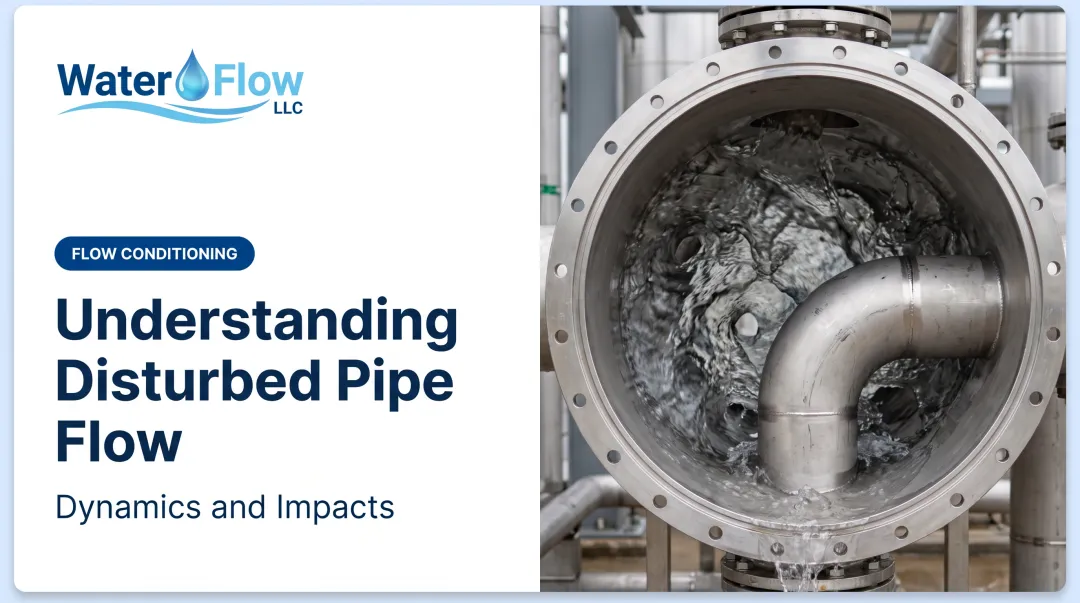
Residual turbulence refers to the chaotic velocity and pressure fluctuations that remain in a fluid stream after it passes a disturbance point, such as a bend, valve, pump, or reducer. The flow can look macroscopically steady on a gauge while the internal velocity profile stays badly distorted.
Fittings and direction changes break up the smooth flow profile, and full recovery back to a uniform state takes many pipe diameters. Research on sharp 90-degree elbows found turbulent recovery ranging from 10-40 pipe diameters at Reynolds 5,600, and in some low-Re cases, flow hadn't recovered even after 100 diameters (Mikuz et al., 2024).
Residual turbulence is not the same as:
- Fully developed turbulent flow: a stable, statistically consistent state
- Transient turbulence (like water hammer): a one-time shock event, not a lingering condition
It typically behaves like transitional flow: a hybrid between orderly wall-bounded turbulence and the free-shear turbulence seen in jets and wakes.
Why This Still Matters in Modern Facilities
Space constraints are the real culprit. ISO 5167-4 specifies straight-pipe requirements of 8D to 22D after bends depending on meter geometry, but most retrofits and tight mechanical rooms simply don't have that room.
NIST testing even found double-elbow effects persisting to 125 pipe diameters, with a measurable shift still present at that distance.

How Does Residual Turbulence Work?
Residual turbulence develops in stages as fluid moves downstream of a disturbance. That sequence is why it's so hard to eliminate without deliberate intervention.
Initiation
Turbulence begins the instant fluid passes an elbow, tee, valve, or pump. This is condition-based, not something that ramps up gradually.
- A sharp 90-degree elbow generates far more turbulence than a gentle, long-radius bend
- Elbows create secondary swirling motion called Dean vortices, plus boundary-layer separation on the inner edge
- Insufficient straight-pipe length before the next fitting or meter is the most common bottleneck preventing recovery
Core Operation
Once initiated, swirling eddies and velocity asymmetries keep mixing fluid layers well past the original disturbance. In elbow studies, these Dean vortices reversed rotation between roughly 8D and 10D downstream and stayed detectable out to 25D.
Physically, high-velocity fluid in the pipe's core and slow-velocity fluid near the wall keep exchanging momentum. That constant exchange keeps the velocity profile distorted instead of settling into the smooth parabolic or flat shape a meter expects to see. This directly affects:
- Measurement accuracy at the meter
- Pressure differential across the pipe run
- Pump load and energy consumption
Regulation and Control
Facilities try to manage residual turbulence through straight-pipe runs, flow straighteners, and conditioning plates. Monitoring approaches include differential pressure sensors and ultrasonic flow profiling to detect irregularities before they cause bigger problems.
Uncorrected residual turbulence is a well-documented cause of water meter over-registration, which leads directly to inflated utility billing.
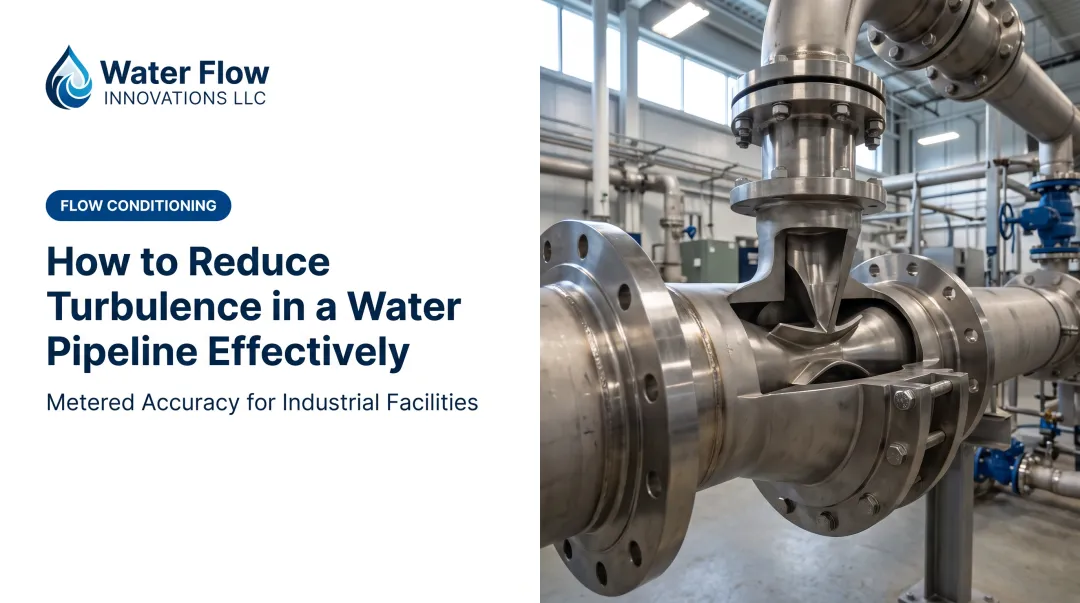
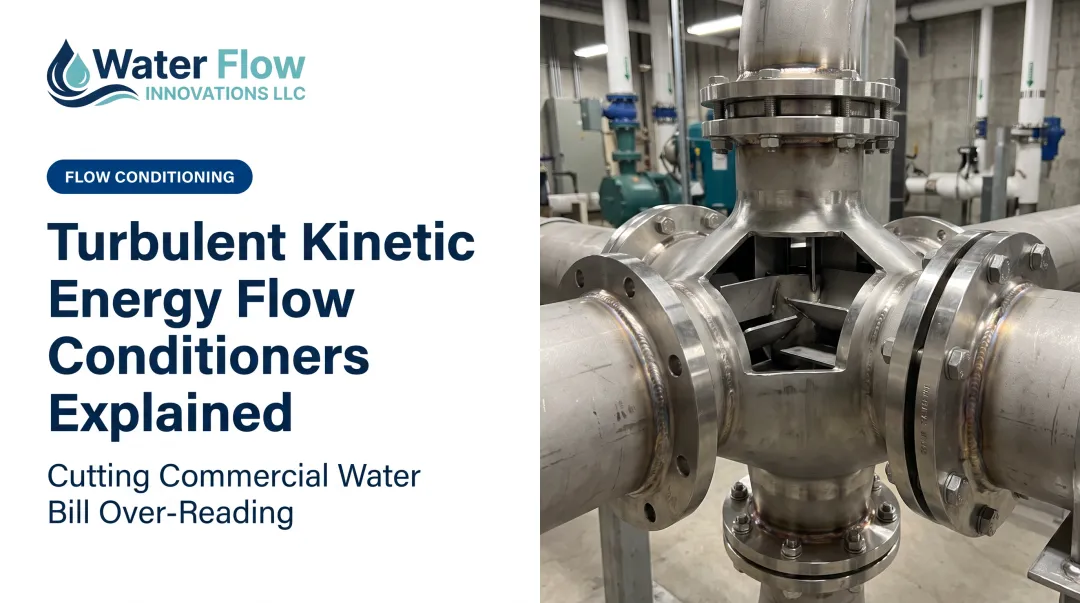
Water Flow Innovation's Flow Conditioning Device (FCD) is built to neutralize residual turbulence and air entrainment at the meter. It corrects false-high readings without changing actual water usage.
The FCD's turbulence-elimination component slows water velocity enough at the meter to prevent vortex flow. That matters most during high-volume events like CIP cycles, tank filling, or sprinkler cycling, when turbulence spikes hardest.

Output and Result
Unmanaged residual turbulence produces a distorted velocity profile feeding straight into meters and instruments. That distorted signal doesn't stay contained: it flows downstream into billing systems, monitoring dashboards, and control logic.
The practical outcome: inaccurate flow totals get treated as real usage data, driving decisions that don't match what's actually moving through the pipe.
Where Residual Turbulence Is Found in Pipeline Systems
Residual turbulence shows up predictably at specific points in a facility's piping layout:
- Immediately downstream of pumps
- After control valves and gate valves
- Following elbows, tees, and reducers
- At water meters, where accuracy matters most
Several conditions make it worse:
- High flow velocities
- Tight retrofits with limited straight-pipe runs
- Aging pipe with rough interior walls
- Air entrainment and micro-bubbles
Independent testing shows how large the error can be. One study found an 80-mm Woltman meter placed right after a 75%-closed gate valve over-registered by 42% to 46%, an extreme case that still illustrates the mechanism (Palau et al., 2019).
Moving that same meter to just 3 diameters downstream dropped the error to under 3%.
This isn't limited to one industry. Municipal water systems, food and beverage processing lines, and industrial manufacturing facilities all face this issue — though severity depends heavily on pipe layout and flow demand at each site.
Reynolds Number and Flow Regimes
The Reynolds number tells you which flow regime you're dealing with. Calculate it as:
Re = (velocity × pipe diameter) / kinematic viscosity
| Reynolds Number | Flow Regime |
|---|---|
| Below ~2,300 | Laminar |
| 2,300 - 4,000 | Transitional |
| Above ~4,000 | Turbulent |
Here's the uncomfortable truth for most facility operators: most real-world pipelines operate well above 4,000. Turbulence and its residual effects are the practical default.
Laminar flow is preferred when you can get it—metering is more accurate and pumping is more energy-efficient. At commercial and industrial scale, though, velocities and pipe diameters usually push Reynolds numbers well past the turbulent threshold.
That is why flow conditioning matters more than trying to force laminar flow through redesign alone.
Why Residual Turbulence Matters for Facility Costs
When residual turbulence disturbs the flow arriving at a water meter, the meter often reports more flow than actually passed through. That error is called over-registration, and it shows up directly on facility water and sewer bills.
Facilities that correct this with certified flow conditioning have documented water and sewer bill reductions in the 5-30% range, with some cases reaching as high as 46% based on Water Flow Innovation's internal customer data. Because sewer charges are frequently calculated from metered water volume, correcting the water reading often reduces both charges simultaneously.

What makes this fix different from conservation programs:
- No change to actual water usage
- No change to system performance or operations
- Savings typically appear on the very next billing cycle
- About 90% of customers reach ROI in under 12 months
The fix is passive. Operations stay the same while you correct a measurement error that has been inflating the bill.
Conclusion
Residual turbulence is a predictable, physics-driven phenomenon in your piping system. It follows clear stages: initiation at a fitting, ongoing momentum exchange between core and wall flow, and a downstream output that hits your meter and your utility bill.
That sequence should shape pipe layout and meter placement decisions. Certified flow conditioning solutions that correct turbulence at the source near the meter fix a problem longer straight-pipe runs alone often can't solve in space-constrained facilities.
Frequently Asked Questions
What are the three types of turbulence in pipelines?
Wall turbulence, free-shear turbulence, and mixed or transitional turbulence are the main types. Residual turbulence usually sits in the transitional category, blending features of the other two.
What Reynolds number indicates turbulent flow in a pipeline?
Turbulent flow is generally indicated above about 4,000. Between 2,300 and 4,000, flow is transitional and may shift between laminar and turbulent behavior.
Which flow is better in pipelines, laminar or turbulent?
Laminar flow is more efficient and accurate for metering purposes. However, it's rarely achievable at typical commercial flow rates and pipe sizes used in real facilities.
What are the two main causes of turbulent flow in pipelines?
High fluid velocity and low viscosity relative to pipe diameter are the two primary drivers—both are captured in the Reynolds number. Fittings and other disturbances compound the effect.
How can facilities reduce residual turbulence at a water meter?
Adding sufficient straight-pipe runs or installing a certified flow conditioning device are the two main practical approaches. The device route is usually far more feasible in retrofits.
Does residual turbulence actually affect utility bills?
Yes. Turbulence-driven meter over-registration is a documented cause of inflated water and sewer charges, and it's correctable without changing actual water usage.
How long does the retrofit route actually take?
About an hour, with a brief water shutoff at the meter connection. A licensed plumber or mechanical contractor fits the custom-built unit at the supply connection, so no pipe is rerouted and no straight run has to be created.
What cover comes with that correction?
A 6-month money-back guarantee on the device purchase price, with installation cost non-refundable, so it can be returned if metered consumption does not measurably fall. A lifetime transferable warranty against manufacturing defects also applies.