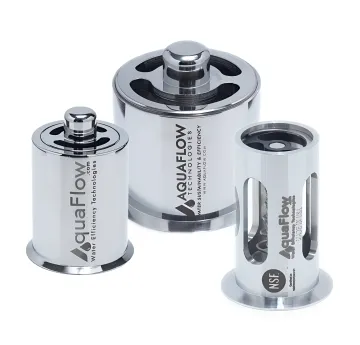
Flow Conditioning Device (FCD)
- Typically up to 30% lower combined water and sewer costs
- Negligible pressure loss, zero equipment impact
- 90% of users reach ROI within 12 months


IAPMO Certified
NSF International & ANSI Certified

CAN 61 & KIWA Certified
This page covers the Flow Conditioning Device (FCD), a certified water flow conditioning device for commercial laundry operations, installed immediately after the utility meter. It corrects water meter over-registration caused by demand surges, when pressure inside the meter drops and gas and vapor form and are counted as water, with typically up to a 30% reduction in combined water and sewer costs (46% is the highest documented, a rare case) and no practical change to wash cycles, water pressure, or equipment performance.
No. High-efficiency washers reduce actual water use, but they do not change what the meter records. A laundry runs wash, rinse, and extract cycles that start and stop continuously across every shift, and each of those demand surges speeds water up through the meter, drops pressure inside it, and lets gas and vapor form that the meter counts as water. Meter over-registration is a separate issue: a Flow Conditioning Device installed immediately after the meter, ahead of the PRV, corrects that reading so the meter records closer to what the facility actually receives.
No. Correcting over-registration is a different problem from water quality. Softeners, filters, and RO systems change what is in the water. The Flow Conditioning Device is not a treatment product and causes no practical change to water quality: it is a certified device that corrects meter over-registration caused by gas and vapor forming inside the meter during demand surges. Documented installations typically show up to a 30% reduction in combined water and sewer costs (46% is the highest documented, a rare case). Many laundries run both, because they solve unrelated problems.
Documented installations typically show up to a 30% reduction in combined water and sewer costs (46% is the highest documented, a rare case). Laundries are common candidates because wash and rinse cycling creates frequent demand surges and several machines draw from one meter at the same time, compounding the over-registration. Actual savings depend on pipe size, line pressure, PRV configuration, and how much over-registration is present at the facility.
Installation takes about an hour, with the water off for about an hour, and is carried out by a licensed plumber or mechanical contractor. The device is fitted immediately after the water meter, ahead of the PRV and all laundry equipment, so no washer, dryer, or water heater needs to be shut down beyond that brief window.
No. Pressure loss across the FCD is under 0.8 psi across all flow conditions, so downstream laundry operations see no practical change. Wash and rinse fill rates, extract cycles, and hot water supply continue as before, because the device corrects how the meter records water rather than changing what any machine receives.
The FCD is certified to IAPMO, NSF, ANSI, CAN 61, and KIWA. The FCD (Flow Conditioning Device) is powered by AquaFlow Technologies, Inc.
Yes. Water Flow Innovations offers both purchase and lease options, so laundries of any size can proceed with limited upfront investment, with savings starting on the next full billing cycle. Multi-location operators can access volume arrangements, and each site with its own utility service meter is a separate installation.
Yes. Because the water is off for only about an hour, most laundries book the work before the first shift, after the last one, or during a planned maintenance window. Before the visit, make sure the meter and service line are accessible and tell shift supervisors when the shutoff will happen so no wash cycle is started mid-window.
The clearest sign is water use on the bill climbing faster than production, especially at peak times: if metered consumption outpaces poundage processed or machine hours, that gap is worth a meter over-registration review. Other indicators include usage that doesn’t match submeters or production records, a clean leak check with the bill still high, and sewer charges rising in step with water. The meter is usually accurate; demand surges in the service line cause it to over-register, so a new meter alone does not fix it. It’s not your meter. It’s your pipes.
Talk to our experts for custom solutions and tailored guidance.
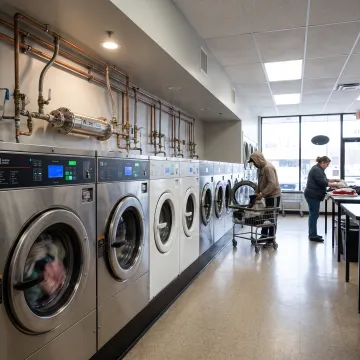
Self-service laundromats correct billed water costs and improve billing accuracy across high-cycle washer banks.
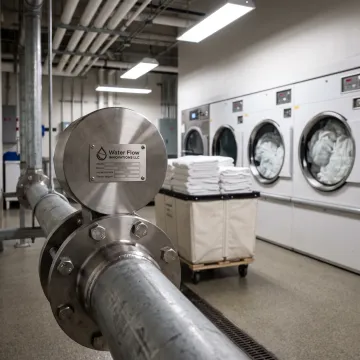
On-site hotel laundry operations correct over-registered linen-washing water charges with no practical change to guest services.
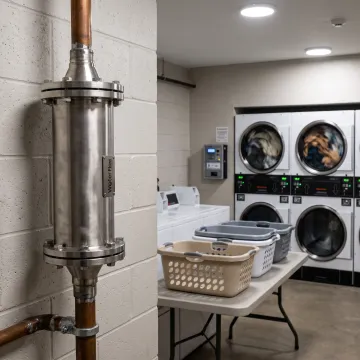
Master-metered apartment buildings with shared laundry rooms correct over-registration at the master meter, with no practical change to water service for residents.
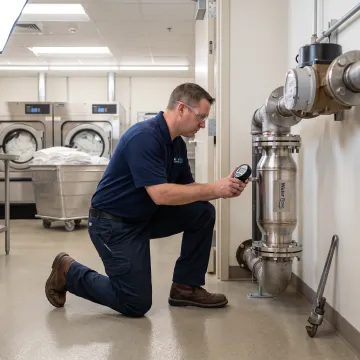
Hospital linen and laundry departments correct billed water costs with no practical change to hygiene or operational uptime.
Talk to our experts for custom solutions and tailored guidance.
Savings start on the next full billing cycle, and 90% of customers reach full ROI in under 12 months.
Under 0.8 psi pressure loss, so wash cycles, extraction, and downstream laundry equipment see no practical change.
Certified to IAPMO, NSF, ANSI, CAN 61, and KIWA.
Share your facility's pipe size and usage details to receive a free water bill review with projected savings estimates.
For immediate assistance, feel free to give us a direct call at 1-844-934-8258. You can also send us a quick email at Info@WaterFlowInnovations.com.
For immediate assistance, feel free to give us a direct call at 1-844-934-8258. You can also send us a quick email at Info@WaterFlowInnovations.com.