Facilities that ignore the warning signs face more than inconvenience. Equipment damage, contamination risks, safety hazards, and inflated utility bills all trace back to unmanaged reverse flow. The EPA has documented dozens of waterborne-disease outbreaks tied to cross-connections and backflow, proof that this isn't a theoretical problem.
This guide breaks down what causes reverse flow, what it costs you if left unchecked, and the specific prevention and monitoring strategies that keep your system running the way it was designed to.
Key Takeaways
- Four main causes: pump trips, water hammer, elevation differences, and turbulent flow
- Unmitigated reverse flow causes cavitation, valve slam, overpressure, and contamination
- Turbulence near meters inflates water and sewer bills with no usage change
- Core toolkit: check valves, power-assisted valves, smart piping, and flow conditioners
- Inspections and real-time monitoring turn one-time fixes into lasting protection
Common Causes of Reverse Flow
Reverse flow occurs when downstream pressure exceeds upstream pressure, pushing fluid backward through a section of piping. That imbalance rarely comes from one isolated failure. Usually, it's a mechanical or hydraulic condition that builds until the system can no longer maintain its intended flow direction.
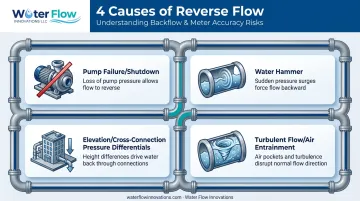
Cause 1: Pump Failure or Shutdown
A sudden pump trip or power outage causes an instant pressure drop on the discharge side. Downstream fluid, still under pressure, has nowhere to go but back through the pump. This is common in:
- Municipal pumping stations during grid outages
- Industrial process lines with unplanned shutdowns
- Cooling water circuits during power interruptions
Cause 2: Water Hammer (Hydraulic Shock)
Abrupt valve closures or rapid changes in flow direction generate pressure waves strong enough to force fluid backward. The Hydraulic Institute notes that rapid pump startup or shutdown, check-valve slam, and air-pocket movement are the main triggers.
Watch for it in:
- Uphill conveyance lines
- Long branch lines
- Fast-moving fluid systems with few elbows to absorb the shock
Cause 3: Pressure Differentials from Elevation or Cross-Connections
Gravity creates its own reverse-flow risk. Elevation differences let downstream head climb above upstream pressure, and improper cross-connections with non-potable sources can drive fluid the wrong way.
Frequent problem areas include:
- Multi-story buildings
- Irrigation systems
- Boiler feedwater lines
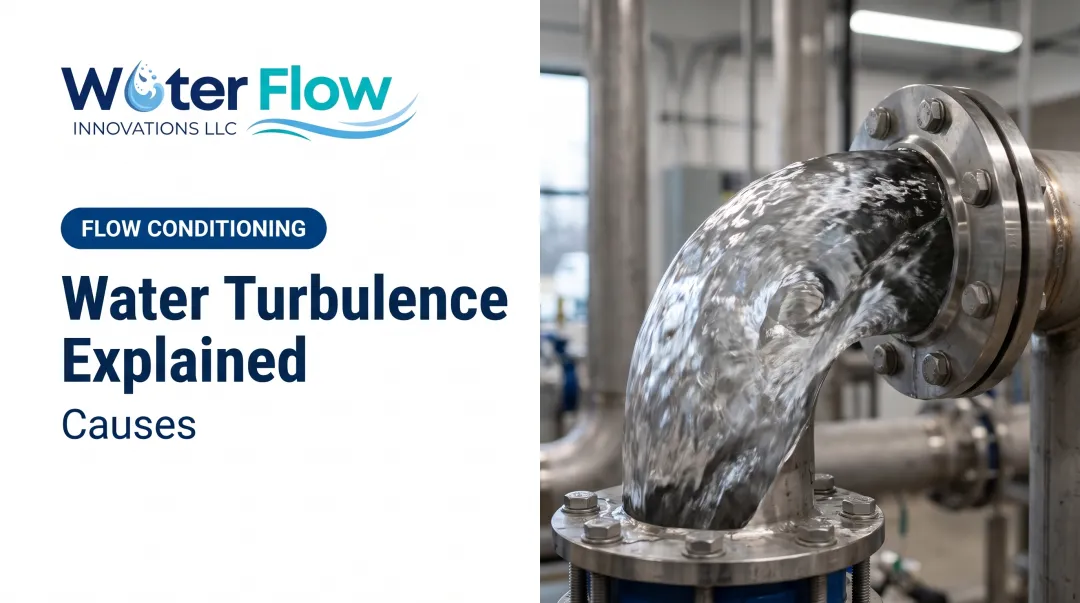
Cause 4: Turbulent Flow and Air/Gas Entrainment
Undersized piping, high-velocity connections, and meters placed too close to elbows or valves all generate turbulence. That turbulence disrupts flow direction and distorts downstream measurement accuracy. We'll return to that measurement problem shortly.
What Happens If Reverse Flow Is Ignored
The consequences compound quickly, and they rarely stay isolated to one part of the system.
Cavitation often appears first. Rapid pressure drops cause fluid to vaporize, then violently implode as pressure recovers. Over time, this pitting destroys valve seats and pipe surfaces from the inside out.
Valve leakage and slamming follow close behind. Shockwaves from reverse flow stress valve seals until they leak, releasing media into the surrounding environment. When reverse flow pulls contaminants across a cross-connection, the public health stakes climb fast. The CDC documented 57 cross-connection-related outbreaks and 9,734 illnesses between 1981 and 1998, and the EPA notes that figure likely understates the real total due to incomplete reporting.
System overpressure is the structural threat. Reversed pressure waves reflect and converge inside piping, sometimes exceeding the pipe's rated pressure. The result: ruptured fittings, cracked brittle components, and permanently deformed ductile ones.
Then there's the cost nobody budgets for. Turbulent, aerated flow near a water meter causes it to register more volume than actually passed through. You're billed for water you never used. The over-read comes from the flow condition itself, not a defective meter. Flow conditioning corrects it.
Warning Signs You're About to Experience Reverse Flow
Catching these warning signs early prevents a maintenance issue from becoming an emergency repair.
- Banging, knocking, or vibration near valves and pipe bends, a classic water hammer signature
- Fluctuating or unexplained pressure drops during pump cycling or shutdown
- Sudden changes in water color, odor, or taste, a red flag for contamination
- Unexplained spikes in water or sewer bills despite consistent usage patterns
A single bang or one odd bill isn't proof of a problem. But when two or more show up together, inspect check valves and related controls before the issue escalates.
How to Prevent Reverse Flow
Prevention isn't a single fix. It takes the right valves, sound piping design, and control of turbulence and air entrainment before problems escalate.
Install the Correct Check Valve
Swing, spring-loaded, silent, and double-check valves each close differently once downstream pressure exceeds upstream pressure. Picking the wrong type can create a new surge problem instead of solving the old one.
| Valve Type | Best Fit | Key Behavior |
|---|---|---|
| Swing check | General waterworks service | Closes under reverse flow, per AWWA C508 |
| Spring/silent check | Pressurized or critical systems | Closes before full reversal, reducing slam |
| Double-check assembly | Cross-connection protection | Holds under intermittent backpressure |
A Hydraulic Institute field test at a municipal pumping station found that a nozzle-style check valve cut surge pressure after pump trip by more than 80% compared to a conventional swing check.
Install or upgrade during initial design, valve replacement cycles, or right after repeated water hammer incidents.
Deploy Power-Assisted Valves for Critical Applications
Electrically, hydraulically, or pneumatically actuated valves respond faster to pump trips than passive check valves alone. They isolate sections of piping for safe repair before damage spreads. These are worth the investment in condenser cooling loops, chemical processing lines, and other continuous-operation systems where downtime carries real cost.
Optimize Piping Design and Pipe Sizing
Undersized pipe accelerates velocity, which drops local pressure and invites cavitation. Working with a design engineer to properly size pipes, fittings, and vacuum breakers reduces turbulence-driven surges before they start. This matters most during new construction, retrofits, or any capacity upgrade.
Address Turbulence and Air Entrainment at the Source
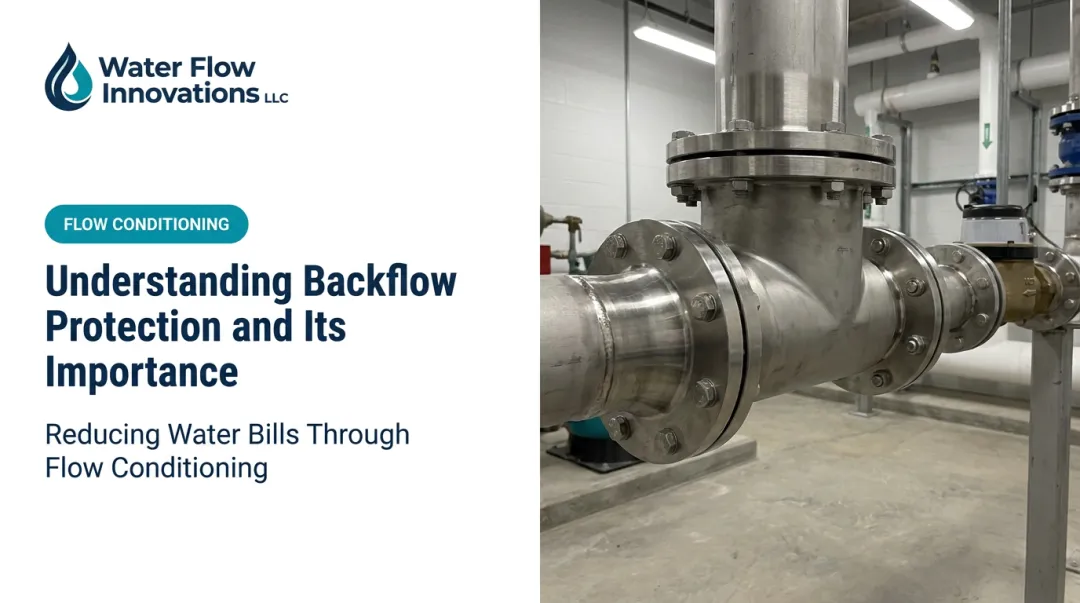
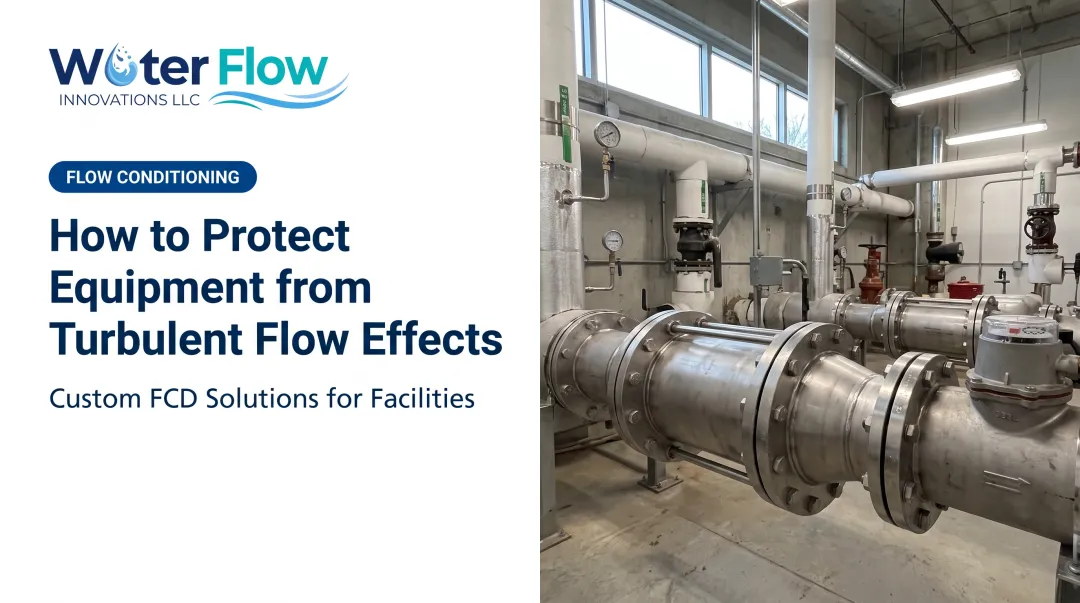
Turbulence and trapped air risk reverse flow and distort meter readings. A certified flow conditioning device fitted immediately after the meter addresses both.
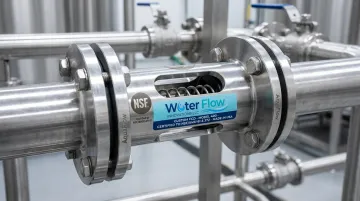
Water Flow Innovation's Flow Conditioning Device (FCD) combines four functions in one custom-fabricated unit:
- Air and gas separation that produces a homogeneous water column back through the meter
- Pressure regulation that smooths surges from on-off demand cycling
- Integrated check valve (specified selectively) that stops reverse flow from reintroducing air after purging
- Turbulence elimination that removes the vortex flow meters misread as extra volume
Each FCD is custom-fabricated in 316L stainless steel for the facility's pipe size (½" to 12", or DN20 to DN500), meter type, and pressure profile, with negligible pressure loss downstream. Units are IAPMO, NSF, ANSI, CAN 61, KIWA, GMP, and SQF-certified, carry a lifetime transferable warranty, and typically install in about an hour without a production shutdown.
Facilities with inconsistent meter readings or inflated bills often see savings on the next billing cycle. About 90% of customers reach full ROI in under 12 months.
Tips for Long-Term Prevention and Control
One-time fixes wear off. Lasting control comes from ongoing habits:
- Schedule routine inspections of valves, pipes, and fittings on a defined maintenance calendar, not an as-needed basis
- Train operators to recognize early warning signs and correctly operate isolation and check valves
- Maintain documentation logs tracking pressure readings, maintenance history, and valve replacement cycles
- Monitor system health with pressure sensors, flow meters, and certified flow conditioning technology for real-time visibility
Codes reinforce this discipline too. The 2021 International Plumbing Code requires annual inspection of backflow-prevention assemblies, a baseline that many facilities treat as a ceiling rather than a floor.
Conclusion
Reverse flow isn't random. It stems from identifiable mechanical and hydraulic causes: pump trips, water hammer, elevation differentials, and turbulence. Each has its own warning signs and fix.
You can prevent it with correct valve selection, sound piping design, and modern flow conditioning technology. Facilities that act on these measures protect equipment and people—and cut the operational and utility costs reverse flow drives.
Frequently Asked Questions
What is reverse flow in a piping system?
Reverse flow is fluid moving opposite its intended direction, usually from a pressure imbalance between upstream and downstream sections. It typically signals a mechanical or hydraulic issue in the system.
What is the difference between reverse flow and backflow?
The terms are often used interchangeably, but backflow specifically means contamination risk from a cross-connection into potable water. Reverse flow is the broader term for any flow moving against its designed direction.
Can reverse flow affect my water meter accuracy or utility bill?
Yes. Turbulence and reverse-flow conditions near a meter can cause it to register more volume than actually passed through, inflating your bill. A certified flow conditioning device corrects this by stabilizing the flow the meter sees.
What type of check valve is best for preventing reverse flow?
Spring-loaded and silent check valves generally offer better shut-off in pressurized or critical systems than standard swing checks, which can slam under sudden reversal. The right choice still depends on your application.
How can I tell if my facility has a reverse flow problem?
Watch for banging or knocking near valves and pressure swings during pump cycling. Also note changes in water color or odor, and unexplained spikes in your water or sewer bill despite steady usage.
Is reverse flow prevention required by plumbing codes?
Most plumbing and industrial codes, including the International Plumbing Code, require backflow prevention devices in specific high-hazard applications to protect potable water supplies.
What does stabilizing the flow the meter sees typically save?
Documented installations average a 5–30% reduction across combined water and sewer charges, with a highest documented single result of 46%, applied from the first billing cycle after installation.
What happens if the stabilization doesn't change the readings?
A 6-month money-back guarantee covers the device purchase price, with installation cost non-refundable, so it can be returned if metered consumption does not measurably fall. A lifetime transferable warranty against manufacturing defects also applies.