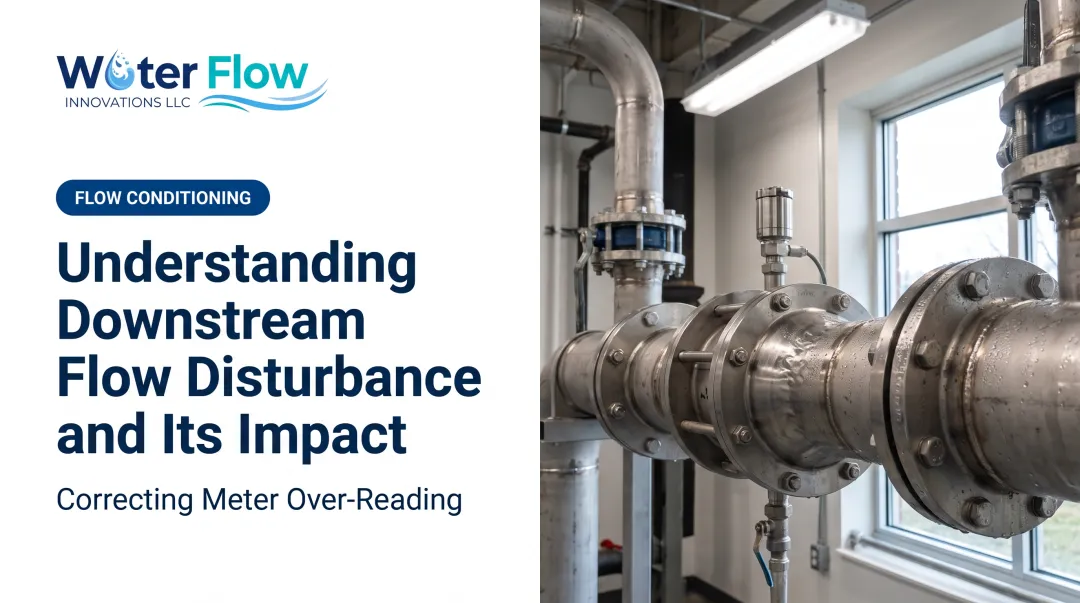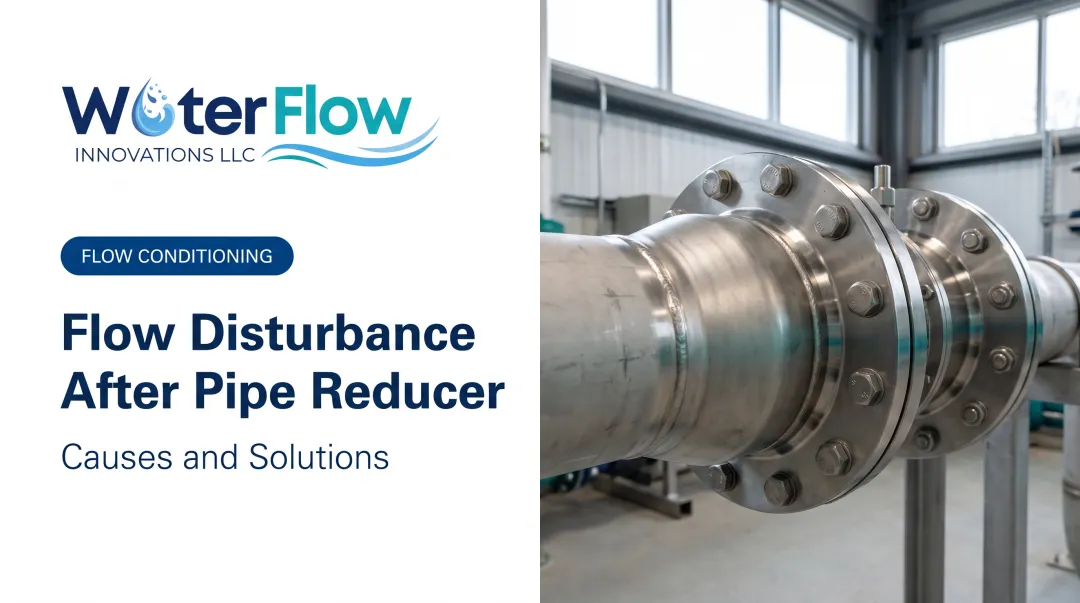

Many facility managers only notice something's wrong when the water bill jumps. Others hear rattling near a fitting and assume it's nothing. In reality, these are often symptoms of the same problem: turbulence, recirculation zones, and even cavitation forming right where a pipe transitions to a larger size.
This article covers what causes flow disturbance after an expansion, the warning signs to watch for, and prevention methods that actually work.
Key Takeaways
- Pipe expansion drops velocity and recovers pressure, creating turbulence, eddies, and air entrainment downstream
- Sudden expansions, high velocity, and oversized ratios drive the strongest flow disturbance
- Unchecked disturbance causes cavitation, noise, vibration, energy loss, and meter error
- Prevent it with proper expansion ratios, flow conditioning, and adequate straight pipe runs
- Flow conditioning corrects turbulence-related metering errors without changing system performance
Common Causes of Flow Disturbance After Pipe Expansion
Flow disturbance refers to turbulence, separation, recirculation, and non-uniform velocity profiles that occur when water moves from a smaller pipe into a larger one. The fluid separates from the wall and forms swirling pockets that take distance—and time—to reattach and settle.
Sudden (Abrupt) Expansion Geometry
When the cross-sectional area changes abruptly, flow can't follow the wall contour. It separates, creating recirculation zones and vortices near the transition point. Research on axisymmetric expansions found that even a moderate area ratio produced a secondary vortex that disrupted the return flow and changed how turbulent energy was distributed downstream of the step.

Typical scenarios:
- Valve outlets that dump into larger downstream piping
- Fitting transitions installed without tapering
- Reducers installed backward or against marked flow direction
High Flow Velocity and Pressure Differential
Higher upstream velocity intensifies turbulence and raises the odds of localized low-pressure zones. Cavitation does not require an expansion on its own. It occurs when local absolute pressure drops below water's vapor pressure, then recovers, and the bubbles collapse.
High velocity through an undersized upstream section, paired with pressure loss at an expansion, creates exactly those conditions.
This shows up most often in:
- Municipal or industrial systems running near peak capacity
- Systems with undersized upstream piping feeding into a larger main
Excessive Expansion Ratio
A very large jump between upstream and downstream pipe area amplifies flow separation and vortex shedding. This is common in retrofit projects, where a much larger pipe segment gets spliced into an existing smaller line to meet new capacity needs, without engineering review of the ratio itself.
Insufficient Straight Pipe Run Downstream
Turbulence needs distance to dissipate. Without enough straight, undisturbed pipe after the expansion, disturbed flow reaches the next meter, valve, or pump before it's had a chance to stabilize. This is especially common in space-constrained mechanical rooms, where fittings get crammed close together out of necessity.
What Happens If Flow Disturbance Is Ignored
Ignoring flow disturbance rarely causes an immediate failure. It causes a slow accumulation of costs and wear:
- Noise and vibration near fittings and valves
- Accelerated erosion at pipe walls, especially where cavity collapse repeatedly strikes the same surface
- Higher energy losses from turbulence that the system has to compensate for
- Meter measurement error: turbulent, non-uniform flow profiles can bias a water meter's reading
That last point needs precision. Disturbed flow does not automatically inflate a bill. Depending on the meter type and where the disturbance sits relative to the sensing element, the bias can run in either direction.
A peer-reviewed study on Woltman meters found errors ranging from +42% to +45% with a partially closed gate valve right at the meter inlet, and a small negative error with a different valve configuration further away. The reliable pattern: disturbed flow creates unreliable, configuration-dependent measurement error. In real-world facility conditions, that error frequently shows up as over-registration.

Warning Signs of Flow Disturbance Issues
Early indicators usually show up before any physical damage does:
- Audible hissing, popping, or rattling near expansion fittings or valves, a recognized indicator of cavitation activity
- Unexplained spikes in water bills without a matching increase in actual usage or occupancy
- Visible pitting, erosion, or vibration at pipe joints downstream of an expansion during routine inspection
How to Prevent Flow Disturbance After Pipe Expansion
Prevention combines smart upfront design with corrective flow-conditioning technology where design changes aren't practical.
Design Gradual Transitions Instead of Abrupt Expansions
Use tapered or conical reducers rather than a sudden step change in diameter. A gradual slope allows pressure to recover more smoothly and reduces the intensity of separation. A 2024 CFD comparison found a gradual expansion (roughly 39 degrees) produced lower head loss than a 90-degree sudden expansion under the tested conditions.
That said, gradual doesn't automatically mean turbulence-free. Angle, inlet profile, and flow rate all matter. Implement this at the design stage or during any repiping project, not as a retrofit afterthought.
Optimize the Expansion Ratio
Size the expansion ratio using hydraulic engineering guidelines, not whatever pipe happens to be in stock. There's no single universal ratio that works for every system. The right number depends on velocity, pressure, and the specific geometry involved. This decision belongs at the specification stage, before pipe gets ordered.
Install Flow Conditioning Devices
A certified flow conditioner installed immediately downstream of the disturbance can remove entrained air, stabilize pressure, and reduce turbulence at the point that matters most: the meter.
Water Flow Innovation's Flow Conditioning Device (FCD) uses a four-part system that addresses air entrainment and turbulence at the meter:
- Air/gas removal: Creates static back pressure that expels bubbles and forms a homogeneous water column so entrained air isn't metered as delivered water
- Pressure regulation: Reduces surges and water-hammer when valves close quickly
- Check valve: Limits reverse flow that can pull air back through the meter (optional by system)
- Turbulence elimination: Slows meter-side velocity to limit vortices during CIP, tank fills, and irrigation cycling
The FCD is custom-fabricated in 316L stainless steel (titanium and specialty alloys available by request) for pipe sizes from NPS 1/2" up to 12". It installs at the existing flange in about an hour without a repipe, typically right after the water meter and before the pressure-reducing valve.

Facilities using it see 5–30% average water and sewer bill reductions, with 46% the highest documented result. About 90% of customers reach ROI in under 12 months.
Implement this after spotting turbulence issues or billing discrepancies, or proactively during new commercial or industrial construction.
Ensure Adequate Straight Pipe Length
Maintain manufacturer-recommended straight-run distances before and after the expansion. ISO 4064 uses declared sensitivity classes rather than one blanket rule, so the correct distance depends on the meter's rated class and the manufacturer's specification. Get this right during layout planning, especially near meters, pumps, or valves.

Tips for Long-Term Prevention and Control
Pipe expansions rarely cause one-time problems. Disturbance can return as joints wear, loads change, or upstream equipment shifts. A simple control routine keeps swirl, separation, and meter error from creeping back in.
Build these habits into normal facility maintenance:
- Inspect expansion joints, expanders, and nearby fittings on a set schedule for erosion, looseness, or vibration
- Train staff to flag noise, chatter, or pressure swings that point to unstable flow after a diameter change
- Log flow totals against billing data so gradual meter over-reading shows up before costs compound
- Place pressure or flow sensors at key transitions to confirm hydraulic stability under real operating loads
After any major piping change, re-baseline meter performance and approach-flow conditions. Steady readings over several billing cycles are the clearest sign that prevention measures are holding.
Conclusion
Flow disturbance after pipe expansion has identifiable, well-documented causes rooted in fluid dynamics, not chance. Prevention through proper design, adequate straight runs, and flow conditioning technology is achievable and, in most facilities, cost-effective within a year.
Addressing these issues proactively protects equipment, cuts energy loss, and can uncover hidden water billing inefficiencies that have been inflating utility costs for years.
Frequently Asked Questions
When does flow become turbulent after a pipe expansion?
Turbulence begins almost immediately at the expansion point as flow separates from the pipe wall. The most intense disturbance occurs within the first several pipe diameters before gradually settling.
What is the difference between sudden and gradual pipe expansion?
Sudden expansion creates an abrupt area change that causes flow separation and strong turbulence. Gradual (tapered) expansion allows smoother pressure recovery, but steep angles or high velocity can still trigger turbulence.
Can pipe expansion turbulence affect water meter accuracy?
Yes. Turbulent, non-uniform flow profiles can bias meter readings, and depending on the meter type and disturbance location, this often shows up as over-registration and inflated bills.
How far downstream should a flow conditioner be installed after an expansion?
Placement depends on pipe diameter and manufacturer specs. Most conditioners go between the expansion and the meter, set to the maker’s straight-run requirements.
Does pipe material affect flow disturbance after expansion?
Material affects thermal expansion and surface roughness, but the primary driver of flow disturbance is geometry and velocity, not the pipe material itself.
Is cavitation always caused by pipe expansion?
No. Expansion alone doesn't cause cavitation. With high velocity and low downstream pressure, though, expansion can create conditions where cavitation is more likely.
What is the billing impact of leaving an expansion uncorrected?
Documented installations that correct this class of disturbance average a 5–30% reduction in combined water and sewer charges, with a highest documented single result of 46%, from measurement accuracy alone.
How is the disturbance confirmed before committing to a fix?
A free review of your water and sewer bills, meter size, pipe size, line pressure, and PRV configuration establishes whether the connection is over-reading and what device size it needs. It is completed remotely and carries no obligation.