For utility managers and plant operators, that gap shows up as strained operating budgets and unpredictable CapEx planning. Desalinated water generally costs $600 to $3,000 per acre-foot for brackish sources, and $1,600 to $3,000 per acre-foot for large seawater projects, depending on the plant, location, and energy market.
Desalination is inherently energy- and capital-intensive. That part won't change. But poor design choices, sloppy operations, and blind spots downstream can push costs well past that baseline. This guide breaks down where those costs actually come from and what you can do about it.
Key Takeaways
- Desalination costs accumulate through energy use, membrane wear, and brine handling, not as a single expense
- Feedwater salinity and energy efficiency drive most of the variability in operating cost
- Savings come from smarter design, tighter operations, and site factors such as energy source, blending, and metering
- Fixing the wrong cost driver wastes budget; precision matters more than blanket cuts
How Costs Around Desalination Typically Build Up
Desalination expenses rarely show up as one clean line item. They build continuously through recurring drivers that run in the background:
- Energy consumption per gallon produced
- Membrane replacement cycles
- Chemical dosing
- Brine disposal fees
Each one adds to the total over time.
Some of it compounds. As membranes foul or scale, pumps need more pressure to push the same volume of water through. That pressure increase means more energy per gallon, month after month. Left unchecked, operating cost drifts upward in a way that's easy to miss on a monthly statement but painful over a year.
Other costs are episodic rather than gradual:
- Major equipment repairs after unexpected failure
- Full membrane bank replacement
- Demand spikes during drought or peak season that force plants to run harder than designed
The tricky part: many of these costs stay hidden during normal operations. They surface at scale, during peak-demand stress, or right after a piece of equipment fails and someone has to explain the invoice.
Key Cost Drivers for Desalination
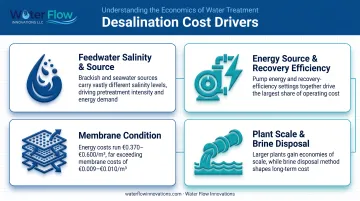
Not every desalination plant has the same cost profile. Four factors typically explain most of the variation.
Feedwater salinity and source. Brackish and inland groundwater require substantially less energy to treat than seawater. California's Department of Water Resources classifies brackish water as 1,000–30,000 mg/L TDS and seawater as 30,000–50,000 mg/L. That difference in salinity translates directly into energy demand and cost per gallon.
Energy source and recovery efficiency. Pumping strategy and energy-recovery devices (like pressure exchangers) often matter more than which membrane technology a plant chose in the first place. A well-designed energy-recovery system can meaningfully change a plant's long-term operating cost, independent of the treatment technology itself.
Membrane condition. Fouling and scaling raise pressure requirements over time. A well-documented cost study of three Canary Islands seawater RO plants found energy costs running €0.370–€0.600 per cubic meter, compared to just €0.009–€0.010 per cubic meter for membranes. Energy dwarfs membrane cost as a recurring expense by a wide margin.
Plant scale and brine disposal. Redundancy design and disposal/regulatory requirements matter more for some facilities than others. A large coastal plant with ocean outfall access faces very different brine economics than an inland plant needing zero-liquid-discharge equipment.
No single driver dominates universally. Blanket cost-cutting rarely works; you have to know which lever applies to your plant.
Cost-Reduction Strategies for Desalination
Effective cost reduction depends on where you're looking: decisions made at the planning stage, day-to-day management, or the broader context surrounding the plant. Each requires a different playbook.
Strategies That Reduce Costs by Changing Decisions
These are choices made before or during procurement that set your long-term cost baseline, and they're much harder to fix after construction than before.
- Brackish or inland sources over seawater wherever the resource exists—lower salinity means substantially less energy per gallon
- Right-size capacity to realistic demand instead of over-building for worst-case droughts that may never hit
- High-efficiency membranes and energy-recovery devices specified upfront, not retrofitted later when downtime and install costs stack on
- Total cost of ownership (lifetime energy and maintenance), not the lowest bid on paper
A membrane that costs 10% more upfront but lasts twice as long, with less energy penalty from fouling, will usually win on a 15-year horizon.
Strategies That Reduce Costs by Changing How Desalination Is Managed
Once a plant is running, cost creep happens through drift, not disaster. Catching it requires visibility.
- Predictive monitoring to flag membrane fouling and pressure drift before efficiency losses get expensive
- Off-peak pumping cycles where rate windows, storage, and operational flexibility allow it
- Disciplined CIP schedules so fouling never hardens into permanent performance loss
- Real-time flow and water-quality data so you neither over-treat water you don't need nor under-use capacity you've already paid for
Manufacturers generally recommend CIP once normalized flow drops around 10%, salt passage rises 5–10%, or differential pressure climbs 10–15%. Waiting longer risks irreversible damage.
None of this needs new capital—only discipline and the monitoring tools already in most modern plants.
Strategies That Reduce Costs by Changing the Context Around Desalination
Sometimes the real cost lever isn't the desalination process at all. It's what surrounds it.
- Renewable energy contracts (solar or wind) to cut exposure to volatile grid pricing; several major plants already offset a large share of energy this way
- Brine valorization partnerships that recover minerals or salts for reuse instead of treating concentrate only as waste
- Blending desalinated output with other sources so less total volume needs the expensive treatment step
There's a downstream piece most facilities overlook. Facilities and municipalities distributing desalinated water still pay from metered readings at every connection point past the plant.
Turbulent flow and air entrainment in pumping systems (common when pressure cycles, valves close, or demand swings) can push commercial and industrial meters to over-register consumption. You end up paying for water you never received, on top of what it cost to produce.
A flow conditioning approach addresses that gap without touching production. Water Flow Innovation's Flow Conditioning Device (FCD) installs on the supply side after the meter and corrects the air entrainment and turbulence that inflate readings, with no change to plant operations or water quality.
- Custom-fabricated in 316L stainless steel for pipe sizes from ½ inch to 12 inches (larger DN sizes available)
- Built to the certification stack municipal and government procurement teams typically require (IAPMO, NSF, ANSI, CAN 61, KIWA, GMP, and SQF)
- Installed in about an hour with a brief shutoff and no disruption to internal distribution
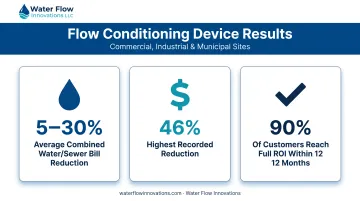
Documented results across commercial, industrial, and municipal sites show 5–30% average reductions in combined water and sewer bills (high of 46%), and 90% of customers reach full ROI within 12 months. Because sewer charges usually track metered water intake, fixing the over-read lowers both bills at once. Those savings stack on top of any production-side efficiency work.
Conclusion
Reducing desalination costs starts with correctly identifying where the expense originates: flawed design decisions, operational drift, or the surrounding context of energy, blending, and billing. Address that specific point rather than cutting broadly and hoping something sticks.
Lasting savings come from treating this as a continuous, contextual effort. That means covering not just how water gets produced, but how accurately it's measured and billed once it leaves the plant.
Frequently Asked Questions
What is the cheapest way to desalinate water?
Brackish or inland desalination via reverse osmosis is typically the most cost-effective method, since lower salinity requires significantly less energy than seawater treatment. Pairing it with renewable energy or energy-recovery devices lowers costs further.
How much does it cost to desalinate 1,000 gallons of water?
Using common acre-foot benchmarks, brackish desalination often lands around $2–$9 per 1,000 gallons, and large seawater projects around $5–$9 per 1,000 gallons. Actual cost depends heavily on local energy prices and plant scale.
Is desalinated water more expensive than imported or municipal water?
Yes, typically. Desalinated water usually costs more than conventional imported or treated municipal supplies because of its energy intensity, though it offers a reliability advantage during drought or supply disruptions.
Can renewable energy make desalination significantly cheaper?
Solar and wind pairing can offset operating costs, and some plants offset a large share of their energy use this way. It rarely covers 100% of demand, though, so it works best alongside other cost strategies rather than replacing them.
What is the single biggest cost factor in running a desalination plant—energy or membranes?
Energy. Recurring energy costs typically dwarf membrane expenses. One plant-level cost study found energy costs roughly 40–60 times higher than membrane costs per cubic meter. Membrane replacement matters, but it is far less frequent.
How can facilities reduce water-related costs beyond the desalination process itself?
Addressing downstream factors like metering accuracy and demand management can deliver savings independent of plant efficiency. Correcting meter over-reading with a flow conditioning device, for example, reduces both water and sewer charges without changing how water is produced.
How large is the billing correction typically worth?
Documented installations average a 5–30% reduction across combined water and sewer charges, with a highest documented single result of 46%, landing on the very next billing cycle rather than accruing gradually.
Where does the device sit relative to treatment equipment?
At the municipal supply connection, upstream of every downstream system, with each unit custom-built for the site. It does not treat, filter, or alter water in any way and connects to no process equipment.