
For households, that means tighter budgets. For commercial and industrial facilities paying per-gallon consumption plus sewer discharge fees, the exposure is far bigger. Some manufacturing plants, hotels, and multifamily properties see water and sewer costs run into the tens of thousands of dollars monthly.
Here's the good news: water itself isn't expensive. It becomes costly because of leaks, inefficient fixtures, poor monitoring, and metering inaccuracies. This guide breaks down how those costs build up and what you can actually do about them, whether you're managing a single-family home or a 200-room hotel.
Key Takeaways
- Bills climb from leaks, aging fixtures, and habits—or spike suddenly from hidden issues
- Fixture age, irrigation, and appliance efficiency drive most home water costs
- Commercial sites also lose money to meter over-reading and poor pressure conditions
- Pair quick fixes and fixture upgrades with flow conditioning for lasting facility savings
How Costs Around Water Bills Typically Build Up
Water costs rarely arrive as one big expense. They accumulate through small inefficiencies: a slow drip, an overlooked restroom fixture, a cooling line that never quite shuts off.
Some of this buildup is compounding — a leak that worsens over months as a fitting degrades. Other costs are episodic, like seasonal irrigation spikes that hit hard in July and disappear by October.
The tricky part: much of this waste stays invisible until something forces the issue.
- A bill spike that seems to come from nowhere
- Pipe damage from excessive water pressure
- A meter reading review that flags unusual consumption
The average household leak wastes more than 9,300 gallons per year, and fixing easily corrected leaks can save about 10% on your bill, according to EPA WaterSense. A faucet dripping once per second alone wastes over 3,000 gallons annually. Multiply that across a commercial property with dozens of fixtures, and small drips become a real line item.

Key Cost Drivers Behind High Water Bills
Not all water costs come from the same source. Understanding which driver applies to your property determines which fix actually works.
Fixture Age and Usage Patterns
Toilets account for nearly 30% of indoor water use, and showers add another 17%. An older toilet using 1.6 gallons per flush (or more, if it predates 1994 standards) uses far more water than a WaterSense-certified model at 1.28 gallons or less.
Outdoor irrigation compounds this. In dry Southwest climates, outdoor use can reach up to 60% of total consumption. Inefficient appliances and day-to-day usage patterns add up fast:
- Long showers and half-loaded laundry cycles
- Manual irrigation schedules that ignore rainfall
- Aging faucets and showerheads without flow restrictions
Meter Accuracy and Pressure (Commercial & Industrial)
Here's where larger facilities face a cost driver that homeowners rarely deal with: meters that overstate actual water delivered.
Displacement and turbine meters can register entrained air, micro-bubbles, and turbulent flow as billable water — even though no extra water was actually delivered. This happens most in facilities with variable-demand operations: cooling towers, CIP systems, process-water cycling, and equipment that switches on and off frequently.
Excessive pressure adds to the problem, forcing air into lines and increasing leak risk. Because sewer charges are often calculated from metered incoming water, facilities can end up paying twice for water they never used — once for the phantom consumption charge, once for the phantom sewer charge.

Usage-side fixes still matter. For commercial and industrial sites, the bigger miss is often the metering system that bills that usage.
Cost-Reduction Strategies for Lowering Your Water Bill
Strategies fall into three categories depending on what you're actually solving: the decisions you make, how you manage ongoing use, or the system surrounding your water use.
Strategies That Reduce Costs by Changing Decisions
These are upfront choices that lower your water cost potential before a single gallon flows.
- Choose WaterSense-certified fixtures — a WaterSense toilet uses 20% less water than the federal standard, saving an average family nearly 13,000 gallons and around $170 a year.
- Upgrade to ENERGY STAR washers and dishwashers; certified clothes washers use about 30% less water than standard models.
- Replace turf with drought-tolerant landscaping, especially in warm climates where outdoor watering dominates the bill.
- Apply for utility rebates before buying — SoCal WaterSmart, for example, offers rebates starting at $35 per rain barrel.
Strategies That Reduce Costs by Changing How Water Use Is Managed
This category is about visibility and consistency, not one-time purchases.
- Run the two-hour meter test: turn off all water use, record the meter, wait two hours, then reread it. Any change likely means a leak.
- Install a weather-based irrigation controller. Replacing a clock-based system can save close to 7,600 gallons a year.
- Watch your monthly statements for usage spikes that don't match your habits.
- Run only full loads in washers and dishwashers, and shorten shower times.
Strategies That Reduce Costs by Changing the Context Around Water Use
Sometimes the real cost driver is the system around usage: pressure, metering, or infrastructure.
Excessive water pressure strains pipes, worsens small leaks, and can force meters to register more than what's actually delivered. The 2021 International Plumbing Code requires a pressure-reducing valve wherever static pressure exceeds 80 psi because of that strain.
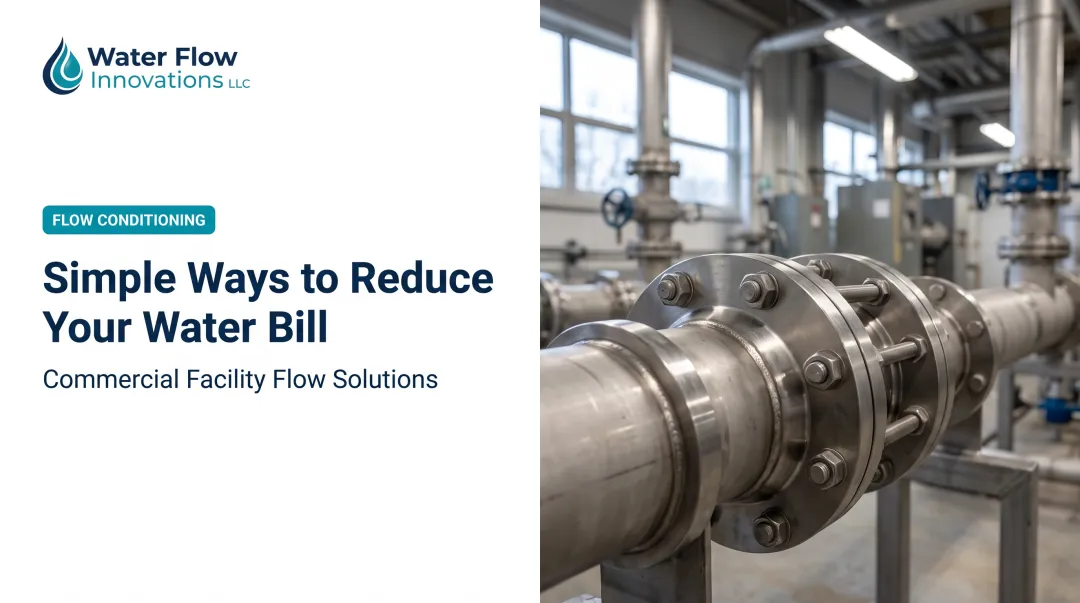
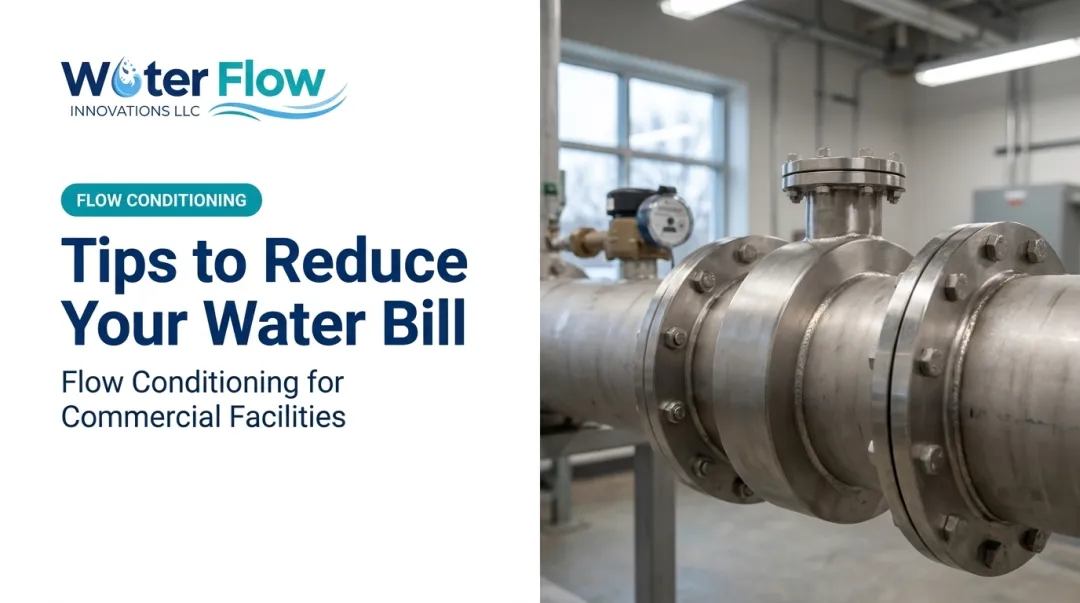
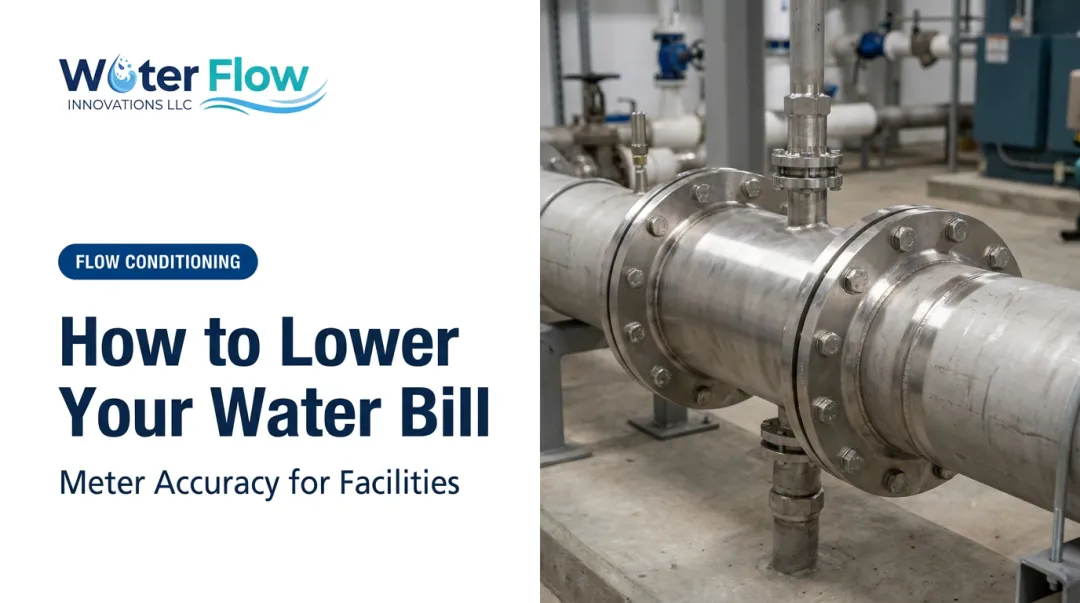
For commercial, industrial, and multifamily facilities, this is where flow conditioning technology comes in. Water Flow Innovation's Flow Conditioning Device (FCD) installs directly after the water meter and corrects over-reading caused by air entrainment and turbulent flow using a four-part system:
- Air and gas separation, creating a homogeneous water column
- Pressure regulation that reduces surges and water hammer
- A check valve preventing reverse flow and air re-entry
- Turbulence elimination that stops vortex flow from inflating meter readings

Facilities see an average 5–30% reduction in water and sewer bills, with a highest recorded result of 46%. Because the device corrects meter readings rather than changing operations, savings appear on the next billing cycle, and 90% of customers reach full ROI in under 12 months.

Installation takes about an hour, with no ongoing disruption to restrooms, cooling systems, or production.
Rainwater harvesting offers a smaller-scale version of the same principle — reducing reliance on the municipal system rather than reducing usage itself. A single rain barrel can save most homeowners about 1,300 gallons during peak summer months.
Conclusion
Lowering your water bill starts with identifying exactly where the cost originates. Sometimes it's a habit. Sometimes it's an aging fixture. For larger facilities, it's often something entirely invisible: a meter over-reading due to turbulence or air in the line.
The most durable savings come from layering approaches: quick behavioral fixes, targeted fixture upgrades, and for commercial or industrial properties, corrections that fix meter over-reading instead of chasing usage that was never really there. If you run a facility, compare recent bills to real operations—or get a free water bill review—to see whether turbulence or air in the line is inflating what you pay.
Frequently Asked Questions
How do I decrease my water bill quickly?
Fix leaks first, especially silent toilet leaks, since fixing common leaks can cut about 10% off your bill. Install aerators, shorten showers, and run only full appliance loads for immediate results.
What causes sudden water bill increases?
Hidden leaks, increased irrigation, malfunctioning appliances, or meter inaccuracies are the most common culprits. Run a two-hour meter test to rule out a leak before assuming a rate increase.
Which home upgrades save the most water?
WaterSense toilets deliver the biggest single-fixture savings, at roughly 13,000 gallons a year for an average family. Low-flow showerheads and ENERGY STAR washers rank next for annual savings.
Are there programs to help lower water bills?
Most utilities offer rebate programs for efficient fixtures, along with income-based assistance, payment plans, and leak adjustment credits. Check with your local provider, since programs vary by ZIP code.
How can commercial or industrial facilities reduce water bills beyond typical fixture upgrades?
Certified flow conditioning devices correct meter over-reading caused by turbulent flow and entrained air. Facilities typically see documented 5–30% water and sewer savings with no change to operations or usage.
Do rain barrels or green infrastructure really reduce water bills?
Yes, though modestly. A single rain barrel saves around 1,300 gallons during peak summer months by offsetting municipal water used for irrigation.