
Flow meters are calibrated in labs with perfectly symmetrical, fully developed flow. Real pipe networks rarely offer that. The result: meters that over-register or under-register, sometimes by several percent, translating directly into billing and process errors.
Vane flow straighteners have been the traditional fix for decades. But flow conditioning technology has moved well past simple vanes. This article covers how vane straighteners work, when they're needed, and how newer conditioning devices stack up.
Key Takeaways
- Vane straighteners reduce swirl but often leave asymmetric velocity profiles uncorrected
- Elbows, valves, and similar disturbances can shift meter readings by several percent in either direction
- ASME MFC-3M applies to orifice meters specifically, not to every meter type
- Conditioning devices like the FCD address air entrainment and turbulence together, not swirl alone
What Is a Vane Flow Straightener?
A vane flow straightener is a mechanical device fitted in the run serving a flow meter. It uses straightening vanes, parallel tubes, or fins to cut swirl and rebuild a usable flow profile at the measurement point.
Design usually follows the application. Gas measurement commonly uses vane-style straighteners, while liquid and steam service more often uses tubular or hex-vane bundle designs.
Industry practice treats vanes as a secondary fix, not a first resort. McCrometer's installation guidance recommends enough straight-run pipe first, and adds vanes only when space makes that impractical. Vanes solve a real problem, but they're a compromise when you can't get the pipe run you'd otherwise want.
Why Flow Measurement Accuracy Matters
Orifice, turbine, ultrasonic, and propeller meters all share one assumption: a symmetrical, fully developed velocity profile matching their lab calibration. Disturbances upstream break that assumption — creating swirl and asymmetric velocity that meters simply aren't designed to interpret correctly.
The standards are more specific than they seem
It's tempting to cite one blanket "minimum straight-run" number for all meters. That's not how the standards work.
| Standard | What it actually covers |
|---|---|
| ASME MFC-3M | Orifice meters — separate tables for unconditioned pipe vs. 19-tube-bundle straighteners |
| ISO 5167-2 | Orifice plates in single-phase, subsonic flow |
| AGA Report No. 3 Part 2 | Natural gas and hydrocarbon orifice metering — not a water standard |
Each meter technology has its own installation math. A propeller meter, for instance, needs 10 diameters of straight pipe upstream without vanes, but only 5 diameters with vanes installed, according to McCrometer's McPropeller installation manual.

The direction of error isn't always the same
A widely cited 2016 CFD-based study published in ScienceDirect modeled disturbed water flow downstream of double elbows. Results: ultrasonic meter errors ranged from -6% to +3%, while electromagnetic meters showed -1.0% to +0.8%. Both over-registration and under-registration occurred, depending on distance and configuration.
For commercial and industrial facilities, over-registration is the expensive scenario. When a meter reads more flow than actually passed, the bill reflects water never delivered.
Many facilities overpay for years when turbulent or aerated flow inflates readings—and few operators think to question the meter itself. That gap is what flow conditioning, including solutions from Water Flow Innovation, is built to close.

How Vane Flow Straighteners Work to Improve Accuracy
Mechanically, vanes are straightforward. They divide the pipe's cross-section into smaller channels, which breaks up swirling motion and pushes the flow toward a straighter, more axial path.
Swirl reduction vs. profile correction
This distinction matters more than most spec sheets admit:
- Swirl reduction: Vanes are effective here. McCrometer describes straighteners as devices that eliminate "most swirls" in the flow the meter sees.
- Velocity profile correction: A separate problem. A profile can be swirl-free but still asymmetric (fast on one side, slow on the other), and basic vanes don't reliably fix that.
Common disturbance sources vanes are meant to counteract:
- Elbows and double elbows (especially out-of-plane)
- Tees and branch connections
- Partially closed valves
- Pumps
- Pipe reducers or expanders
The trade-offs engineers weigh
Vanes don't eliminate the need for straight-run pipe; they reduce it. Positioning and spacing still matter enormously; get it wrong and you can introduce a new disturbance instead of removing the old one.
There's also a pressure cost. Every in-line component creates some resistance. Tube-bundle designs tested in technical literature showed loss coefficients around 0.65 to 1.2, while thicker perforated plates ran higher, around 2 to 5. Engineers have to balance that pressure loss against the accuracy gained.
Types of Vane Straighteners and Where They're Used
Not every vane assembly is built the same way, and the right choice depends heavily on the meter and the installation constraints.
Two common configurations:
- Bolt-in tri-vane assemblies — Install into an existing pipe section without replacing pipe. McCrometer positions these as the cost-efficient option for propeller meters that lack integrated vanes.
- Tube/hex-vane spool designs — Weld directly into a dedicated pipe section. Often specified when a disturbance sits too close to the meter for a bolt-in option to work well.
Meter sensitivity also drives the pairing:
- Propeller meters — typically paired with tri-vane or hex-vane designs per McCrometer specs
- Turbine meters — some models, like Daniel's 1200 series, integrate a conditioning plate directly rather than relying on separate vanes
- Orifice meters — commonly use round or hex tube bundles, per NIST testing protocols
Saddle-style meters and tube-style meters also call for different mounting approaches, so the straightener choice is rarely one-size-fits-all.

Installation Considerations for Optimal Performance
Getting full performance from a vane straightener requires attention to several variables at once:
- Pipe diameter: affects vane sizing and channel dimensions
- Distance from the disturbance: too close, and the vane can't fully process the disturbed flow
- Distance to the meter: NIST testing on orifice meters found 12–14 diameters upstream kept readings within ±0.25% of baseline (lower beta ratios)
- Fluid velocity: affects both conditioning effectiveness and pressure loss
- Material compatibility: corrosion and temperature resistance for the specific fluid
Those install choices only hold if the device stays clear in service. Maintenance is often overlooked. McCrometer specifically warns against intrusive vane designs in surface-water or high-debris service. Long-term risks include:
- Moss and vegetation clogging the channels
- Scaling that narrows flow paths over time
Periodic inspection is required if the vane is to keep performing as installed.
Beyond Vanes: How Modern Flow Conditioning Technology Reduces Water Bills
Vanes address swirl. They don't touch air entrainment, pressure fluctuation, or the combined effect of turbulence from multiple sources at once, and those factors also drive meter over-reading.
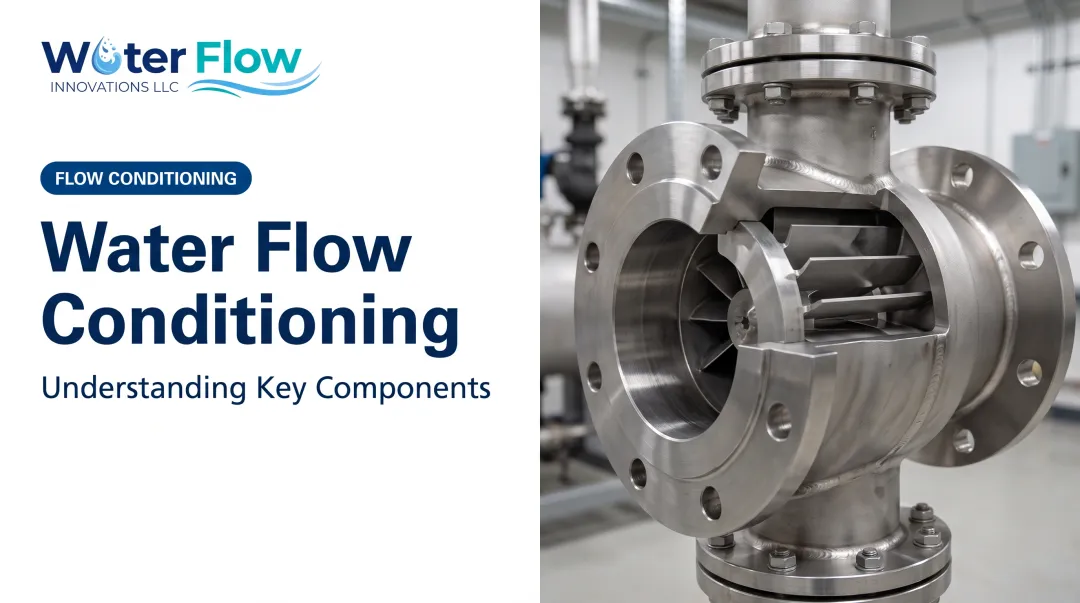
Water Flow Innovation's Flow Conditioning Device (FCD) takes a broader approach. Instead of targeting one disturbance type, it combines four functions in a single unit:
- Air/gas separation — creates static back-pressure and laminar flow so the meter reads a homogeneous water column instead of an air-water mixture
- Pressure regulation — reduces water hammer and surge from on/off cycling
- Check valve function — prevents reverse flow (specified per installation, not universal)
- Turbulence elimination — slows velocity enough at the meter to prevent vortex formation, even during CIP cycles or irrigation surges
The FCD is IAPMO, NSF, ANSI, CAN 61, KIWA, GMP, and SQF certified, built from 316L stainless steel, and fits pipe sizes from ½" to 12" and works with any meter type. Installation usually takes one to two hours, with negligible pressure loss under normal conditions.
Documented outcomes: facilities installing the FCD see 5-30% average reductions in water and sewer bills, with up to 46% savings in top cases. 90% of customers reach ROI within 12 months, with savings appearing on the very next billing cycle.

For facilities already running vanes or relying on long straight-pipe runs, the FCD isn't a replacement for good piping practice. It's an added layer that catches what vanes were never designed to catch.
Water Flow Innovation backs every unit with a 6-month money-back guarantee and a lifetime transferable warranty, making it a low-risk way to find out whether your meter has been over-reading all along.
Frequently Asked Questions
What do straightening vanes do?
Vanes divide flow into smaller channels to reduce swirl, guiding fluid into a more uniform direction at the meter. This improves reading stability, though it doesn't correct every type of flow distortion.
Where are straightening vanes installed?
Vanes go in the run serving the flow meter. Exact spacing follows the manufacturer's specs and the distance from the nearest disturbance (elbow, valve, or pump).
Do all flow meters require straightening vanes?
No. Coriolis meters are insensitive to swirl and velocity-profile distortion and need no straight run. Magnetic meters are often less sensitive too, though requirements still vary by model.
Can straightening vanes replace straight pipe?
Not entirely. Vanes reduce the straight-run requirement, sometimes cutting it in half, but most installations still need some straight pipe on either side.
Do straightening vanes cause pressure loss?
Yes. Any in-line component adds resistance. The exact loss depends on vane design, pipe size, and flow velocity, with tube bundles generally running lower loss than thick perforated plates.
How is a flow conditioner different from a straightening vane?
Conditioners are designed to correct both swirl and asymmetric velocity profiles, while standard vanes primarily target swirl. Some modern conditioners, like a Flow Conditioning Device (FCD), also address air entrainment and pressure surges.
Does a full conditioning device carry the same pressure penalty as vanes?
No. Negligible pressure loss is a fundamental design characteristic of the FCD, so downstream pressure and flow rates are unchanged — a meaningful difference from vane assemblies, where added resistance is inherent to the design.
What billing outcome follows correcting swirl and air together?
Documented installations average a 5–30% reduction in combined water and sewer charges, with a highest documented single result of 46%, since air entrainment is corrected alongside the swirl.