Introduction
Hospitals run on water. Sterilizers, patient bathrooms, laundry rooms, kitchens, and cooling towers all draw from the same strained supply, and the numbers show it. The EPA ENERGY STAR program reports a median hospital water use of 315 gallons per bed per day, with some facilities using far more depending on services offered (EPA ENERGY STAR DataTrends).
That usage collides with two pressures at once. Water and sewer rates keep climbing, and ESG or LEED reporting now demands documented, verifiable savings. Meanwhile, capital budgets for major infrastructure upgrades remain tight.
This guide breaks down department-specific conservation strategies, the technology options worth evaluating, and how to cut water costs without compromising infection control. Facility managers can lower the water bill and protect patient safety when conservation is planned with clinical requirements in mind.
Key Takeaways
- Hospitals use far more water per square foot than typical buildings, so small efficiency gains cut real operating costs
- Patient care, sterilization, laundry, and cooling each offer distinct, measurable savings
- Leak detection and submetering catch losses routine observation misses
- Conservation must be balanced carefully against Legionella risk from stagnant pipes
- A water management team and regular audits support cost control and ESG reporting
Why Water Conservation Matters for Healthcare Facilities
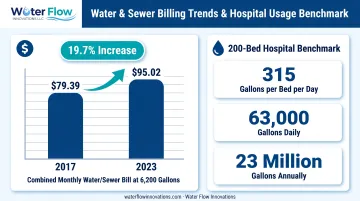
A 315-gallon-per-bed daily benchmark sounds abstract until you run the math. For a 200-bed hospital, that's roughly 63,000 gallons per day, or over 23 million gallons a year. At even modest municipal rates, that volume represents hundreds of thousands of dollars in annual water and sewer charges before a single leak or inefficiency is factored in.
And rates aren't holding steady. A 2024 Journal AWWA study found the combined monthly water and sewer price at 6,200 gallons rose from $79.39 in 2017 to $95.02 in 2023, a 19.7% increase in six years (Journal AWWA, 2024). Hospitals consuming far higher volumes feel that same upward pressure multiplied across their full demand.
The ESG Reporting Shift
Unmanaged consumption used to be a background cost. Now it's a visible risk line, and reporting expectations have caught up:
- LEED Healthcare v4 requires permanent water metering with monthly and annual summary reporting to USGBC
- Practice Greenhealth publishes an annual sustainability benchmark tracking water program performance across health systems
- Investors, regulators, and accreditation bodies increasingly want documented, verifiable savings, not policy statements
Facility managers are responding by moving past "encourage staff to conserve" memos and toward measurable, auditable water programs.
High-Impact Water Conservation Strategies by Hospital Department
Every hospital department uses water differently. A sterilization unit and a cafeteria kitchen have nothing in common operationally, yet both show up on the same utility bill.
Treating water conservation as one uniform policy leaves savings on the table. Start with a department-by-department water audit that shows where volume, waste, and opportunity actually concentrate.
Patient Care Areas & Restrooms
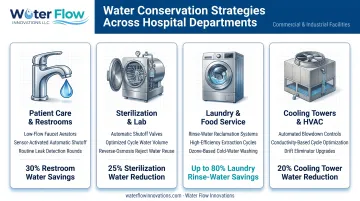
Patient rooms and public restrooms see constant, high-frequency use, making them a natural first target. Providence St. Peter Hospital's reduced-flow faucet initiative saved 1,500 gallons per year with a 4.5-year payback. That work sat inside a broader program that cut over 3.4 million gallons and roughly $140,000 annually (EPA case study).
- Retrofit faucets with WaterSense-certified, sensor-activated fixtures and low-flow aerators at 1.5 gpm or less (from the 2.2 gpm standard)
- Replace older flushometer toilets with 1.28 gpf WaterSense models in high-traffic restrooms (versus 1.6 gpf)
- Add simple signage in visitor restrooms encouraging mindful water use
Sterilization, Lab & Medical Equipment
Sterilization equipment runs constantly, and inefficiency here hides easily behind clinical necessity.
- Run autoclaves, sterilizers, and lab dishwashers only at full load capacity
- Convert once-through cooling for sterilizer condensate to a recirculating loop instead of dumping tempering water to drain
- Install automatic shutoff valves on X-ray film processors and similar lab equipment. A continuously running 0.5 gpm processor can waste up to 260,000 gallons annually (EPA WaterSense at Work)
Laundry & Food Service Operations
Laundry and dietary departments are two of the highest-volume water users outside clinical care.
- Optimize wash cycles by load size and soil level instead of fixed cycles
- Install rinse-water reclamation systems that reuse final-rinse water for the next load's first rinse (simple systems save 10–35%; advanced treatment can exceed 80%) (EPA laundry guidance)
- Add foot-pedal or spray-valve pre-rinse stations in commercial kitchens
- Enforce full-load-only policies for cafeteria dishwashers
Cooling Towers & HVAC Systems
Cooling towers and steam systems quietly consume enormous volumes if left unmonitored.
- Install automatic blowdown controls with conductivity meters to prevent excessive discharge
- Raise cooling tower cycles of concentration from 3 to 6 to cut tower water use by about 20% (EPA mechanical systems guidance)
- Return steam condensate to boilers for reuse instead of discharging it to drain
Advanced Technology Solutions That Maximize Water Savings
Manual audits only catch what's visible. The real hidden losses (leaks, stuck valves, meter inaccuracies) need technology to surface them.
Leak detection and submetering deliver real-time usage data that flags anomalies before they become expensive. A single leaking toilet at 0.5 gpm wastes over 259,000 gallons a year; a sterilizer tempering line stuck open can waste more than 1 million gallons annually. Neither shows up on a walkthrough.
Building automation systems (BAS) integrate water sensors into facility-wide dashboards. A spike in the lab or a pressure drop in the boiler room triggers an alert instead of a surprise bill three months later.
Water reuse systems, such as rainwater harvesting and greywater recycling for irrigation or cooling tower makeup, can deliver savings. They still need careful attention to local health codes and ongoing treatment monitoring before deployment.
A Commonly Overlooked Cause of Inflated Bills
Even with strong monitoring in place, one bill driver still gets missed: the meter itself. Turbulent flow and air entrainment inside a water line can cause a standard meter to over-register actual consumption, inflating bills for water the hospital never used.
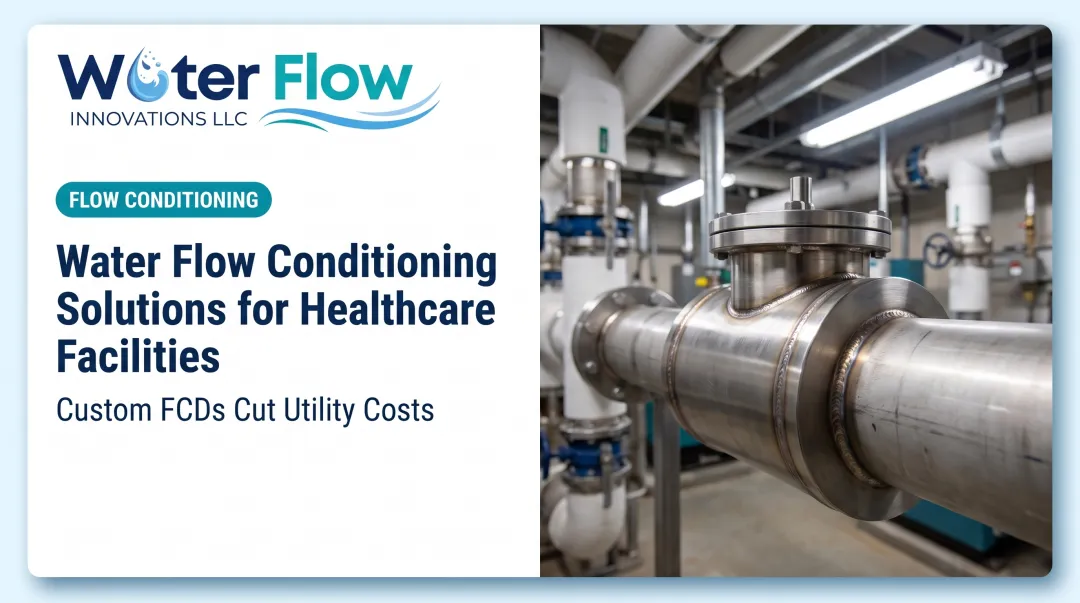
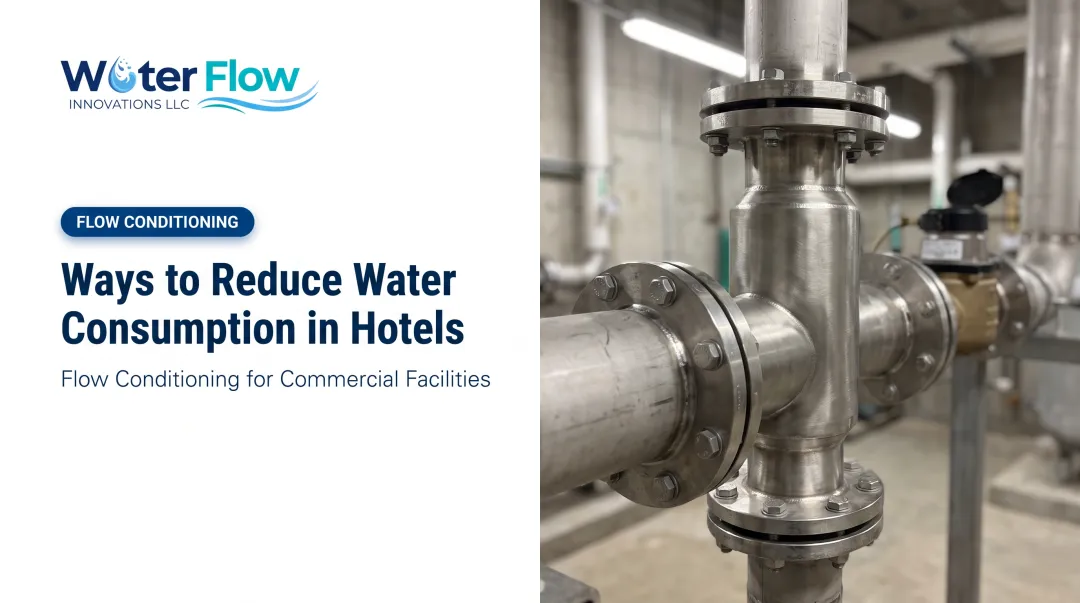
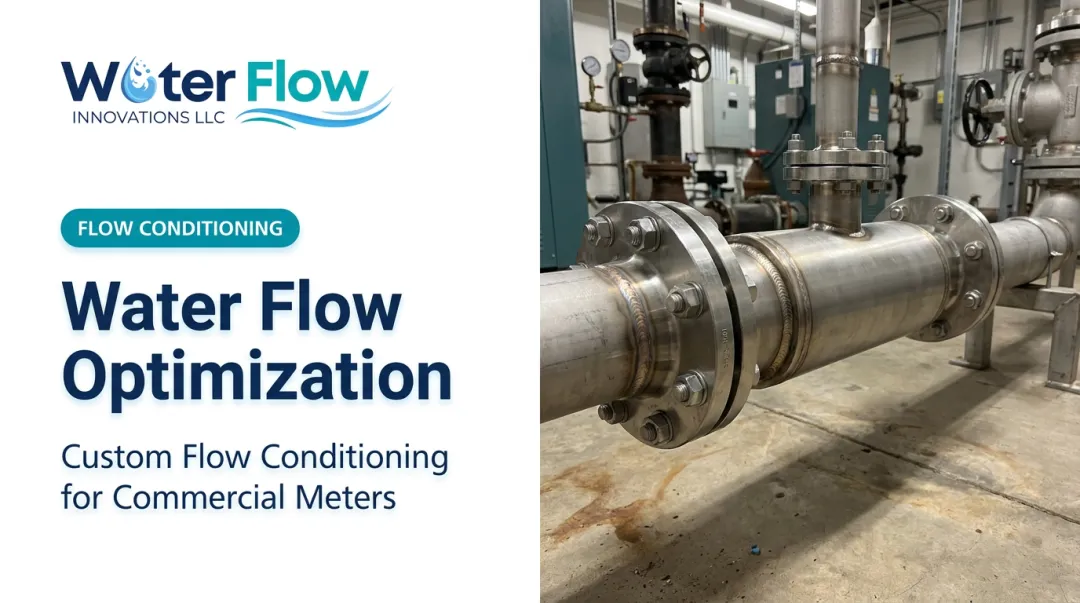
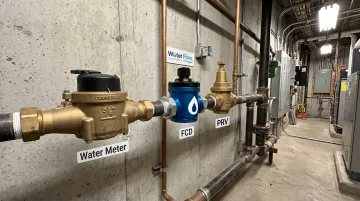
Water Flow Innovation's certified Flow Conditioning Device (FCD) addresses this directly. Installed immediately after the water meter, it stays clear of patient areas, sterilization equipment, and other clinical water connections. The work usually takes about an hour. Facilities typically see:
- 5-30% reductions on combined water and sewer bills, starting the very next billing cycle
- No change to water pressure, flow, or system performance
- 90% of customers reaching full ROI in under 12 months
That model fits hospitals where sanitation and infection control limit how far you can cut actual flow. Savings come from correcting how the meter measures usage, not from reducing the water clinical departments still need.
Flexible financing can ease capital and value analysis committee constraints. Facilities may purchase the device outright or lease it, with lease payments often structured to be offset by savings from the first billing cycle.
Balancing Conservation with Infection Control & Patient Safety
Cutting water use too aggressively can backfire in a hospital setting. When flow slows or stops in a pipe run, water sits still, temperatures drift into the 77-113°F range where Legionella thrives, and disinfectant residual breaks down (CDC guidance).
Conservation still makes sense when you manage the system risks that come with it. A sound water management plan should include:
- Routine flushing of seldom-used outlets and dead-leg piping, at minimum weekly
- Temperature monitoring to keep hot water systems outside the Legionella growth range
- Disinfectant residual testing throughout the distribution system
- Compliance checks whenever a new conservation measure is introduced, aligned with Joint Commission and CMS expectations
That's why meter-side technology like the FCD is worth considering first. It lowers water and sewer bills without altering flow rates, pressure, or distribution anywhere inside the building, so infection control protocols stay exactly as they were before installation.
Building a Sustainable Water Management Program
Individual fixes matter, but they work best inside a structured program.
Estimate baseline demand. Multiply bed count by the EPA's 315 gallon-per-bed benchmark, then adjust for services offered and average occupancy. This gives budgeting teams a target and makes abnormal spikes easy to flag.
Build a dedicated water team. Someone needs ownership of:
- Monthly utility bill tracking and variance analysis
- Cross-department audits (sterilization, laundry, food service, cooling)
- Documentation for ESG and LEED reporting
Engage staff and patients. Training sessions, restroom signage, and small recognition programs for departments hitting conservation targets keep water-conscious habits active long after the initial rollout.
For multi-site health systems, this framework scales facility by facility. Each hospital, medical office building, or clinic can be audited and upgraded on its own timeline. Document savings separately for budget accountability, then roll them up for system-wide sustainability reporting.
Frequently Asked Questions
How can healthcare facilities reduce their water bills?
Combine fixture upgrades, leak detection, and kitchen, laundry, and sterile-processing practices with flow conditioning devices that correct meter over-reading. That mix cuts water and sewer charges without changing clinical operations.
How do you calculate water requirements per day for a hospital?
Multiply your bed count by the EPA's benchmark of 315 gallons per bed per day, then adjust for services offered, occupancy levels, and facility type. This gives a workable baseline for budgeting and anomaly detection.
What is the average water usage in a hospital?
The EPA ENERGY STAR program reports a median of 315 gallons per bed per day, though usage ranges widely (roughly 43 to 1,061 gallons) depending on facility size and services offered.
Can water conservation efforts increase infection risk in hospitals?
Yes, if flow reduction is poorly planned. Reduced or stagnant flow can allow Legionella to grow in pipes, so conservation must be paired with routine flushing, temperature control, and water quality monitoring.
How much can a hospital save by fixing water leaks?
A single undetected leak, like a stuck sterilizer tempering valve, can waste over 1 million gallons annually. Prompt repair and leak detection technology can eliminate that loss almost entirely.
What certifications should healthcare facilities look for in water-saving equipment?
Look for IAPMO, NSF International, ANSI, CAN 61, and KIWA certifications. These confirm equipment is safety-tested, code-compliant, and suitable for potable water systems in healthcare environments.
Does correcting meter over-reading also lower the sewer charge?
Most utilities calculate sewer as a percentage of metered water intake, typically 80–120% of the water charge. Every phantom gallon is therefore billed twice, once as water and once as sewer, even though it never entered a drain. On a hospital campus where cooling towers, central laundry, sterile processing, and food service all cycle on one meter, that multiplier compounds every over-read event.
Which healthcare settings does this apply to?
Any facility on a metered municipal connection — acute-care hospitals, outpatient and surgical centers, sterile processing departments, senior living communities, and centralized medical waste treatment facilities. Documented reductions average 5–30%, with a highest documented result of 46%.