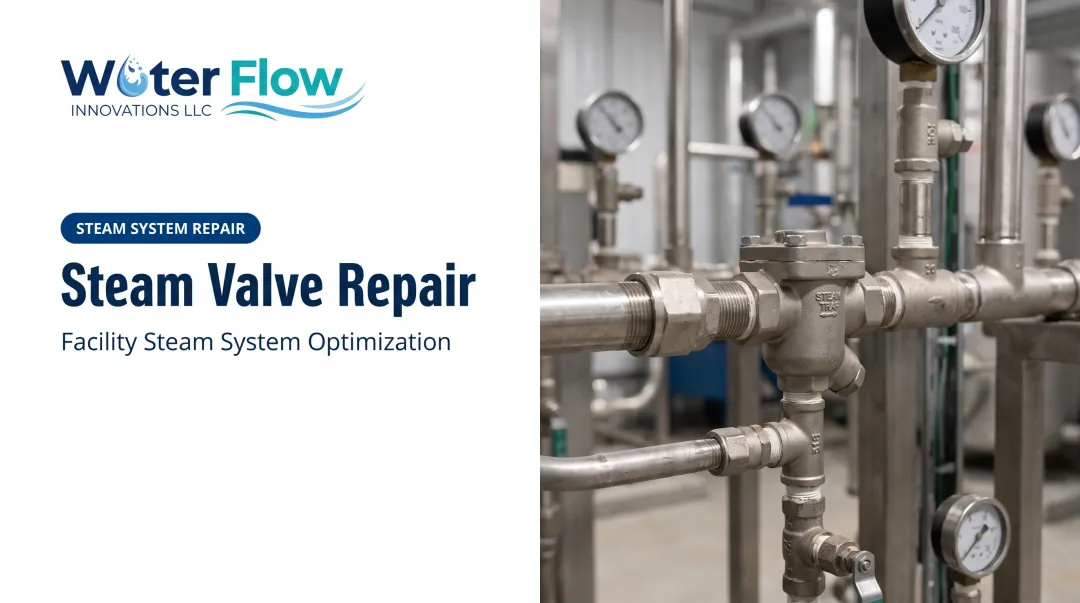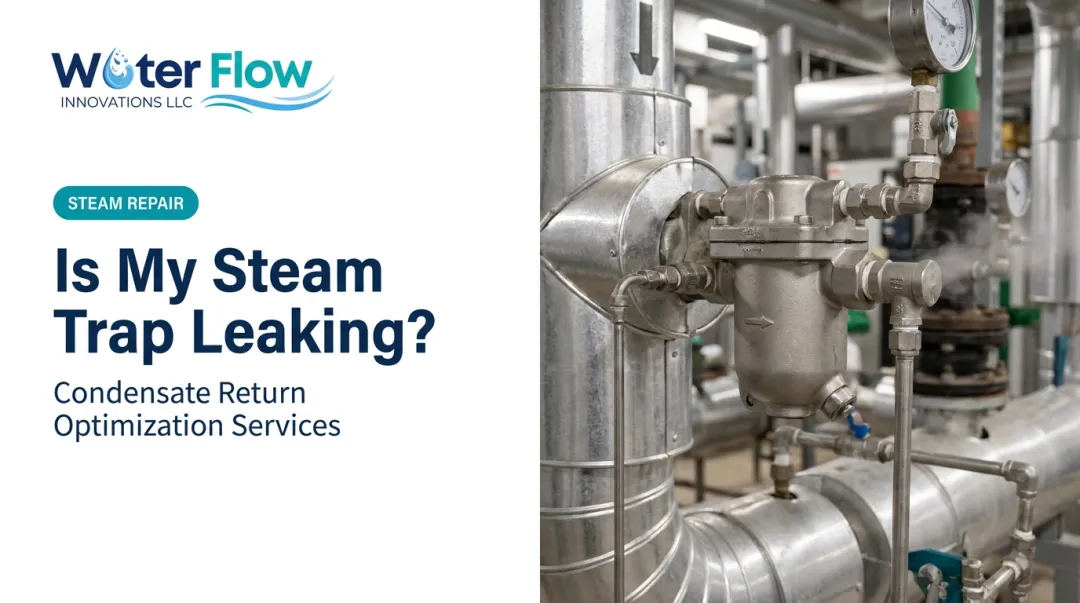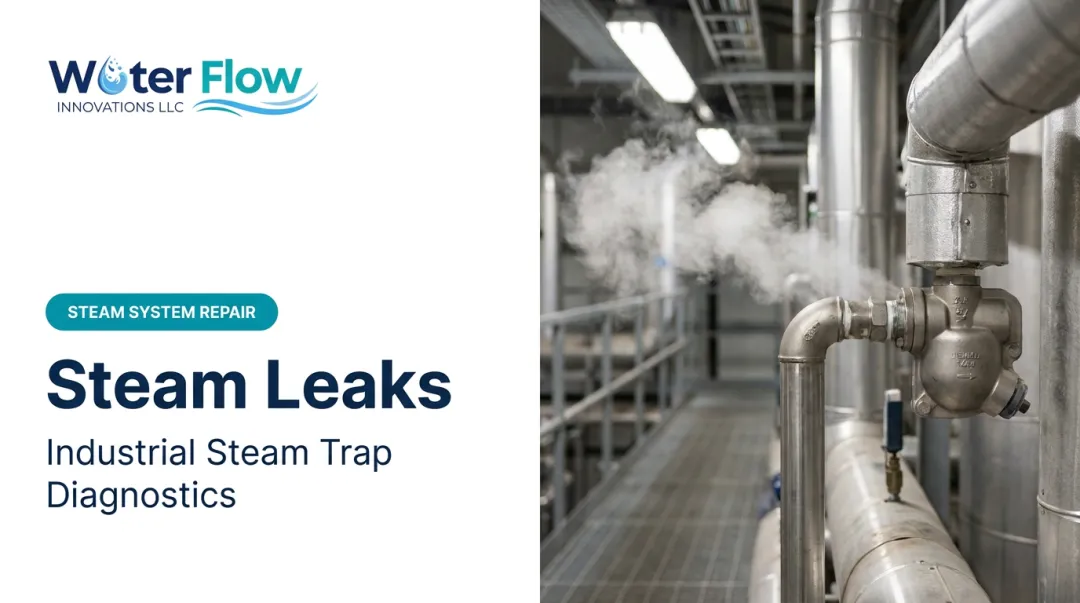
Leaks are common. Erosion, thermal cycling, corrosion, and worn valve packing all take their toll over years of service. A small hiss today can become a safety hazard and a fuel-cost drain tomorrow if it's ignored.
This guide walks through the most common steam pipe problems, a step-by-step repair process, and how to know when a patch job is enough versus when you need a certified professional on site.
Key Takeaways
- Most leaks trace back to erosion, thermal fatigue, corrosion, or failed valve packing/joints
- Small pinhole and packing leaks are usually fixable with clamps or repacking
- Heavily corroded or thinned sections need full replacement, not a patch
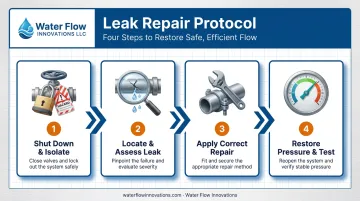
- Fix process: isolate & depressurize → locate & assess → repair → test & restore
- Call a certified welder or a steam specialist like Water Flow Innovation for high-pressure systems, weld repairs, or recurring leaks
What Is a Steam Pipe Leak?
A steam pipe leak is the escape of pressurized steam or condensate through a compromised point in the piping, a valve, a joint, or a fitting. It sounds simple, but the mechanics behind it explain why these leaks show up where they do.
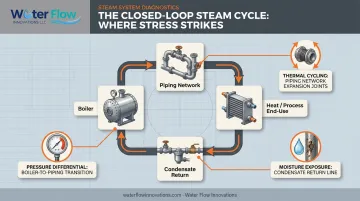
Here's the basic system: a boiler generates steam, which travels under pressure through a network of pipes to deliver heat or process energy. Once it gives up that energy, it condenses back into water and returns through condensate lines to the boiler, where the cycle starts again.
That constant cycle of heating, cooling, and pressurization is exactly what wears piping down over time. Three stress factors do most of the damage:
- Thermal cycling causes metal to expand and contract thousands of times over a system's life
- Moisture exposure invites corrosion at welds, threads, and fittings
- Pressure differentials stress welds and joints, gradually loosening connections
Steam piping isn't a "set it and forget it" system. It degrades gradually and needs periodic inspection to catch small problems before they become big ones.
Common Steam Pipe Problems and Why They Happen
Most steam pipe failures follow a handful of predictable patterns. Once you know what to look for, diagnosing a leak gets a lot faster.
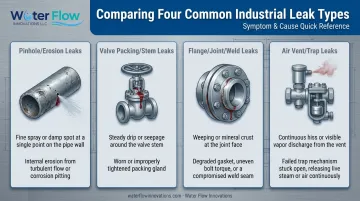
Pinhole Leaks from Erosion or Wet Steam
Symptoms: A hissing sound, a visible steam plume, or wet and stained insulation at one specific spot.
Likely cause: High-velocity wet steam eroding the pipe wall over time, particularly at tees, elbows, and bends where flow direction changes. Entrained water and undischarged condensate moving at high velocity are the primary drivers of piping erosion, and that erosion thins pipe walls until a hole eventually forms.
Leaks at Valve Packing or Stems
Symptoms: Steam or water seeping around the valve handle, or a stem that wiggles or feels loose to the touch.
Likely cause: Dried-out or worn packing material combined with repeated thermal expansion and contraction, which gradually loosens the seal around the stem.
Leaks at Flanges, Joints, or Welds
Symptoms: Dripping or mineral staining at bolted connections, or a faint hissing near weld seams.
Likely cause: Gasket degradation, bolts loosened by thermal cycling, or defects from the original welding or installation.
Whistling Noises and Leaking Air Vents
Symptoms: A high-pitched whistle from a radiator or vent, or water pooling near the vent fitting.
Likely cause: A clogged or failing air vent bellows that can no longer close properly as pressure rises.
This one deserves attention because it's often symptomatic of a bigger issue: failed steam traps. DOE research found that 15% to 30% of steam traps fail within three to five years without regular maintenance, compared to less than 5% in facilities that maintain them on schedule.
A single failed trap orifice as small as 1/8 inch at 150 psig can waste roughly 75.8 lb/hr of steam. That adds up to thousands of dollars a year in wasted fuel from one trap alone. Water Flow Innovation's steam system repair service includes trap replacement and condensate return optimization, catching failures like these before they drain your budget.
How to Repair a Leaking Steam Pipe (Step-by-Step)
Attempting a repair before confirming safety and diagnosing the true cause risks injury, wasted parts, and a leak that comes right back. Follow these four steps in order, every time.
Step 1: Shut Down and Isolate the System
Report the leak immediately and close valves upstream and downstream to cut off steam supply to that section.
- Bleed the pressure. Open steam traps or drain valves and confirm the gauge reads zero before touching anything.
- Let it cool. Allow the pipe to reach room temperature naturally. Don't rush this with water or fans.
- Secure the area. Cordon it off, post warning signs, and suit up in heat-resistant gloves, a face shield, and protective clothing.
Isolation is mandatory. OSHA investigated a case where a worker attempted repairs on a 250-psi, 700-800°F steam line without locking out the system.
The line separated, and the worker suffered burns over 95% of his body, an outcome OSHA's own accident record documents in detail. Skipping isolation is never worth the time saved.
Step 2: Locate the Leak and Assess Severity
Pinpoint exactly where the leak is coming from, whether that's a pinhole, a joint, a weld seam, or valve packing. Then check the surrounding pipe wall thickness to determine if the damage is localized or spread across a larger section.
Categorize the likely root cause:
- Erosion (thinning near bends or tees)
- Thermal fatigue (cracking near cyclic-stress points)
- Corrosion (widespread pitting or staining)
- Vibration (loosened joints near rotating equipment)
- Installation defect (leak appears soon after commissioning)
Getting this diagnosis right determines everything that happens next.
Step 3: Apply the Correct Repair Method
The right fix depends entirely on the leak type and severity. Most repair mistakes happen here, usually from grabbing whatever clamp or gasket is on hand instead of matching the repair to the failure mode.
For minor pinhole leaks or small cracks:
- Clean the pipe surface down to bare metal
- Install a high-temperature-rated repair clamp with a heat-resistant gasket sized precisely to the pipe diameter
- Tighten bolts evenly in a diagonal pattern to the manufacturer's specified torque
For valve packing or stem leaks:
- Remove the packing nut and extract the old, worn packing material
- Wrap new graphite or PTFE packing around the stem and reinstall the packing nut
- Reattach the handle and confirm smooth, leak-free operation
For weld, joint, or severely corroded sections:
This level of damage requires full shutdown, cooling, and a certified welder working to ASME/NBIC code. The damaged section gets cut out and replaced, or repair-welded according to code after proper surface prep.
Emergency under-pressure clamps or composite wraps exist for situations where shutdown isn't immediately possible, but treat these as temporary measures until a permanent repair happens.
Facilities without an in-house welding crew can bring in a specialized steam system repair provider. Water Flow Innovation offers this service alongside trap replacement and condensate return work, handling the job safely on your behalf.
Step 4: Restore Pressure and Test the Repair
Slowly reopen the inlet valve to warm the repaired section gradually. This prevents thermal shock, which can crack a fresh repair before it's even had a chance to prove itself.
- Watch the repair point and nearby joints closely as pressure builds
- Bring the system to full operating pressure and confirm zero leaks before restoring insulation
- Check back on the repaired area over the following days and weeks to make sure it holds under normal conditions
Repair vs. Replace: When to Fix and When to Call a Professional
Cost, safety, and long-term reliability should all factor into the fix-or-replace decision. Here's how that plays out across four common scenarios.
| Scenario | Fix | Replace |
|---|---|---|
| Small, isolated pinhole leak | A properly sized repair clamp is usually sufficient | Only if wall thickness loss exceeds a safe threshold |
| Valve packing or stem leak | Repacking usually resolves it | If the stem is bent/corroded or the valve body is cracked |
| Widespread corrosion, multiple leak points | Patch repairs offer only short-term relief | Full section or pipe run replacement is safer long-term |
| High-pressure, welded, or code-regulated equipment | Only a certified welder/technician following ASME/NBIC standards | Professional evaluation required; DIY risks serious injury and code violations |
There's no universal "percent wall loss" number that triggers automatic replacement. Industry inspection practice (API RP 574) relies on calculated pressure-design thickness, structural minimums, and corrosion rate rather than a one-size-fits-all rule. When wall thickness approaches that governing limit, the options are a code-compliant repair, a section replacement, or a documented fitness-for-service assessment, not guesswork.
Call a licensed steam or mechanical contractor when:
- A pressure-relief valve needs repair
- Welding repairs are required on pressurized lines
- The same leak keeps recurring in the same spot
Recurring leaks usually mean the root cause wasn't fixed the first time. Providers such as Water Flow Innovation offer steam system repair services, including trap replacement and condensate return optimization, for facilities needing ongoing support beyond one-time pipe fixes.
Common Mistakes to Avoid and Preventive Maintenance Tips
A few repair mistakes show up over and over in facility maintenance logs:
- Repairing under pressure or before the pipe has fully cooled
- Skipping surface preparation before installing a clamp
- Using standard rubber gaskets that aren't rated for steam temperatures
- Tightening bolts unevenly instead of in a diagonal pattern
- Patching the symptom without addressing why the leak happened in the first place
On the prevention side, a few habits go a long way:
- Schedule regular visual and wall-thickness inspections
- Exercise valves quarterly so packing doesn't seize or dry out
- Insulate joints and bonnets to reduce thermal cycling stress
- Keep steam traps and condensate return systems maintained to cut down on water hammer and erosion
That last point matters more than it might seem. Facilities working to cut steam-system waste often discover that hidden losses aren't limited to fuel. Many of the same over-cycling, pressure-event, and turbulent-flow patterns that stress steam piping also cause water meters to over-register usage at the facility's main line.
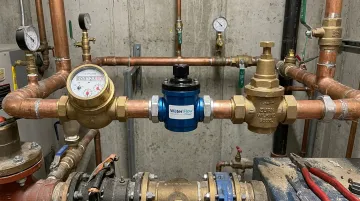
This is where a certified flow conditioning solution like Water Flow Innovation's FCD becomes a natural complement to steam maintenance work. The FCD corrects water meter over-reading without touching internal piping, steam components, or condensate systems.
Most facilities see a 5–30% drop in water and sewer bills, with 46% as the highest documented result. The device carries IAPMO, NSF, ANSI, CAN 61, KIWA, GMP, and SQF certifications, and installation requires only a brief meter-area shutoff — easy to schedule alongside an existing maintenance window rather than as a separate disruption.
Frequently Asked Questions
What is a steam leak?
A steam leak is the escape of pressurized steam through a compromised point in a pipe, valve, joint, or fitting. It's typically caused by wear, corrosion, or physical damage to the pressure boundary.
How much does steam leak repair cost?
Cost depends on leak severity, location, and shutdown requirements. Clamp repairs cost less than weld repairs or section replacement, which involve more labor and outage time. Request a site-specific quote instead of relying on generic price lists.
Can a leaking steam pipe be repaired without shutting down the system?
Specialized online clamps and composite wraps allow repairs without an immediate shutdown, though they're not casual patches. A permanent fix should follow once the system can be safely taken offline, ideally through an engineered repair provider like Water Flow Innovation.
How long does a steam pipe repair last?
A properly installed clamp or code-compliant weld can last for years if it's sized for the pipe's pressure and temperature and the root cause is fixed. Repairs that only mask symptoms tend to fail again quickly.
What is the most common cause of steam pipe leaks?
Erosion from wet steam and thermal fatigue from repeated expansion and contraction cycles are the two leading causes seen across industrial and commercial systems.
Is a leaking steam pipe dangerous?
Yes. High-temperature steam can cause severe burns instantly, and condensate buildup may trigger water hammer strong enough to fracture piping. Left unaddressed, a leak can escalate into a major pressure-boundary failure.
Which facilities are most exposed to steam pipe leaks?
Sites running steam continuously across long distribution runs: centralized district energy plants, hospitals and healthcare facilities, universities and dormitories, paper mills, textile mills, breweries and distilleries, dairy plants, and food and beverage processors.
Does a steam leak also inflate the water bill?
Yes. Steam is generated from treated water, so every pound lost has to be replaced with makeup water drawn through the metered municipal supply. A leak therefore shows up on the fuel bill and the water bill at the same time. Correcting meter over-reading on that same supply has produced documented reductions averaging 5–30%, peaking at 46%.