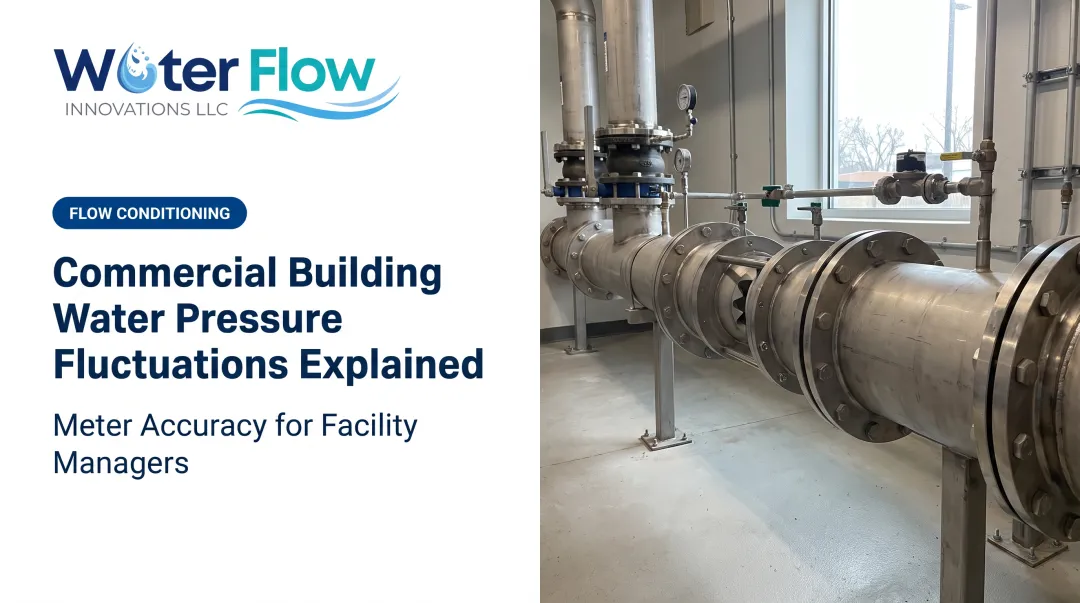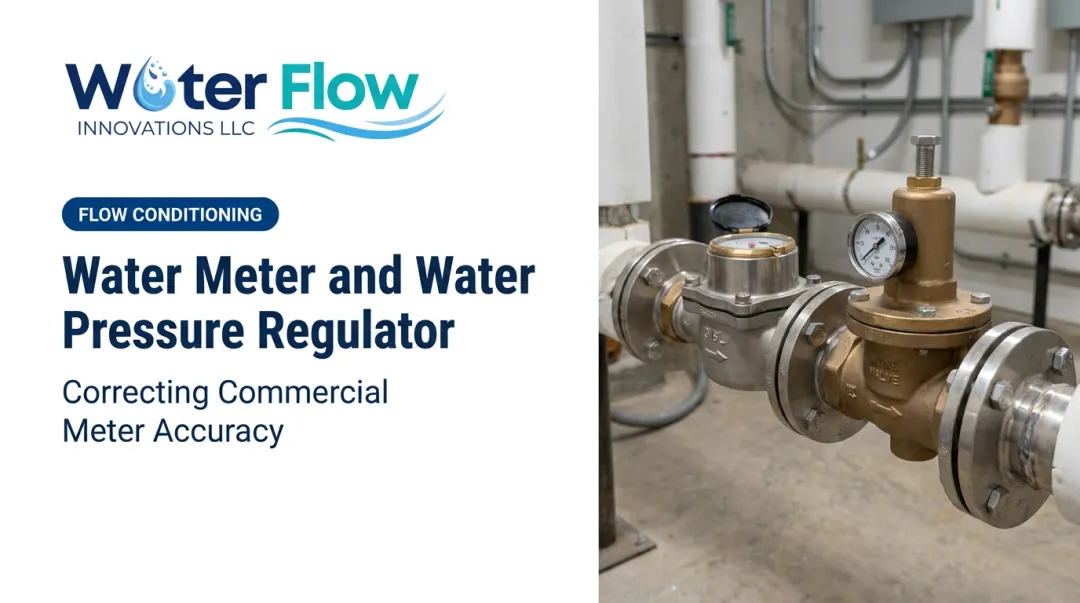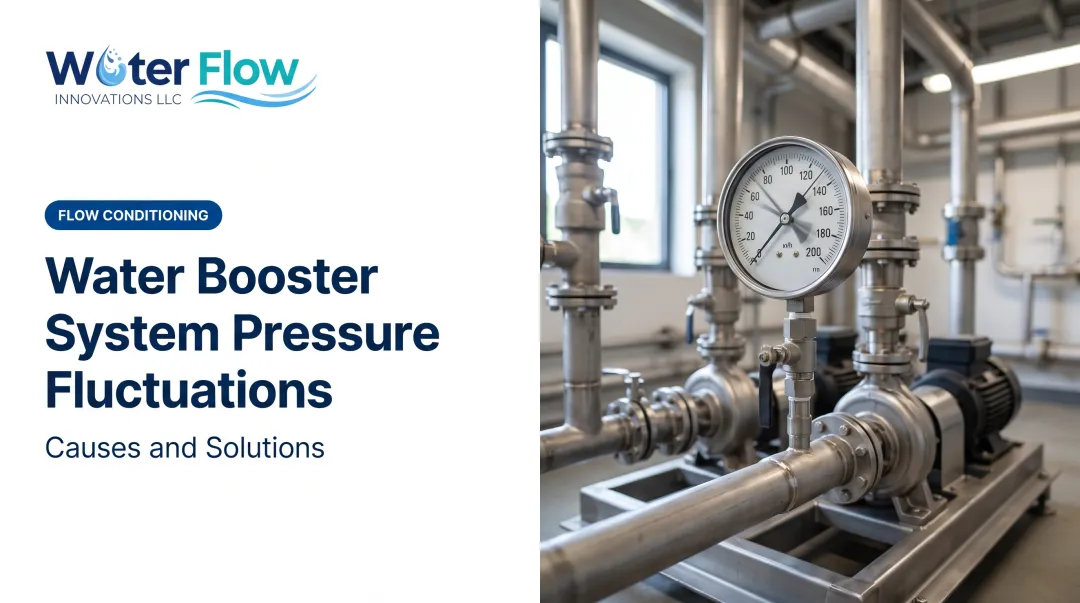
Water meter pressure loss — the permanent pressure difference between a meter's inlet and outlet — is a well-defined hydraulic phenomenon governed by international standards like ISO 4064. Yet for facility managers, engineers, and operations teams running hotels, hospitals, manufacturing plants, universities, and data centers, the full implications rarely make it into daily conversation.
That's a problem. Pressure loss at the meter compounds with losses from pipes, valves, and backflow preventers throughout your system. And the same turbulent flow conditions that increase pressure loss can also cause your meter to over-register consumption, inflating your water and sewer bills independent of actual usage.
This article breaks down what pressure loss actually is, why it matters more at peak demand than average flow, and what facility teams can do about it.
Key Takeaways
- Pressure loss (Δp) is the permanent drop caused by a meter's internal flow resistance.
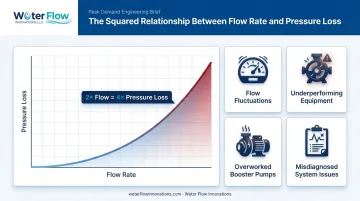
- Pressure loss scales with the square of flow rate — doubling flow quadruples the loss.
- Meter type, sizing, and installation conditions determine how much pressure a meter consumes.
- Turbulent flow and air entrainment drive both pressure loss and meter over-registration, inflating utility bills.
- ISO 4064 defines pressure-loss classes (Δp63 through Δp10) that cap allowable loss at rated flow.
What Is Water Meter Pressure Loss?
Water meter pressure loss is the irreversible pressure difference between what enters a meter and what comes out the other side. As water moves through the meter's internal passages, strainers, and measuring mechanism, some of its pressure energy gets permanently consumed. That energy isn't recovered downstream — it's simply gone.
This isn't a design flaw. Every meter creates some resistance to flow. The engineering goal is keeping pressure loss low enough to protect downstream performance and metering accuracy.
Pressure Loss vs. Differential Pressure
These two terms get confused constantly, but they describe different things:
| Term | What It Is | Recoverable? |
|---|---|---|
| Differential pressure | Intentional restriction (e.g., in DP flowmeters) that creates a measurable pressure difference used to calculate flow rate | Yes, partially downstream |
| Pressure loss | Energy consumed by a meter's internal passages, strainers, and measuring mechanism | No, permanently gone |
If your meter is losing pressure, you can't get it back by adjusting anything downstream.
ISO 4064 and the Pressure-Loss Classification System
International standards give facility teams a way to evaluate whether a meter's pressure loss falls within an acceptable range. The framework behind ISO 4064 defines pressure loss as the irrecoverable pressure decrease caused by the meter and sets maximum allowable thresholds at the meter's rated flow rate (Q3), organized into five classes:
| Pressure-Loss Class | Maximum Loss at Q3 |
|---|---|
| Δp63 | 63 kPa |
| Δp40 | 40 kPa |
| Δp25 | 25 kPa |
| Δp16 | 16 kPa |
| Δp10 | 10 kPa |
A lower class number means less pressure consumed at rated flow. Facilities in North America should also check applicable AWWA product standards (C700, C701, C702, C708, C712). These set performance requirements by meter technology rather than one universal PSI limit, so the right threshold depends on which meter type you're evaluating.
Why Water Meter Pressure Loss Matters in Commercial and Industrial Facilities
In a large commercial or industrial building, the water meter is just one link in a long chain of pressure-consuming components. Pipelines, valves, backflow preventers, elevation changes: they all take their share. Add a meter consuming more pressure than it should, and even a modest contribution can leave insufficient residual pressure for critical end-use equipment.
Hotels, hospitals, manufacturing plants, universities, and data centers are especially exposed. These facilities run water-intensive systems around the clock: sterilization equipment, HVAC cooling towers, laundry operations, process cooling, and CIP (clean-in-place) cycles, all dependent on adequate residual pressure to function correctly.
The Peak Demand Problem
Meter pressure loss doesn't behave the same way at every flow rate, which makes it tricky to diagnose.
Because pressure loss scales with the square of flow rate, a meter that performs fine at average flow can generate disproportionately high pressure loss the moment demand spikes.
AWWA's M22 sizing guide models this relationship directly, showing meter head loss rising sharply as flow increases. This is exactly why sizing decisions based only on average flow tend to fail during peak periods.
The practical consequences show up as:
- Flow fluctuations during high-demand periods
- Underperforming end-use equipment, from low pressure at fixtures to strained process lines
- Booster pumps working harder than necessary, shortening equipment life
- Facility teams misdiagnosing the cause as a pipe or valve issue instead of the meter
The Overlooked Billing Implication
Here's the part that rarely makes it into standard pressure-loss discussions: the same turbulent flow conditions and air entrainment that increase pressure loss can simultaneously cause mechanical meters to over-register actual water consumption.
That means a facility dealing with pressure-loss symptoms at the meter may also be paying for water it never received.
Since sewer charges are typically calculated from metered water usage, that over-registration hits both sides of the utility bill at once. It's a compounding effect that adds up fast in a hospital or hotel running 24/7 systems with constant pressure cycling.
How Water Meter Pressure Loss Occurs
Water entering a meter doesn't move through in a straight, unobstructed line. It passes through strainers, flow guides, the measuring element itself, and outlet passages, and each one forces the fluid to expend energy. By the time water reaches the outlet, its pressure is measurably lower than it was at the inlet.
The Governing Relationship: Δp = k × Q²
The math behind pressure loss follows a predictable pattern: Δp = k × Q², where k is a resistance coefficient set by the meter's design and Q is the flow rate.
This is a squared relationship, not a linear one. Doubling the flow rate doesn't double pressure loss; it quadruples it. A meter losing 4 kPa (about 0.6 psi) at a given flow rate will lose roughly 16 kPa (about 2.3 psi) if that flow doubles. This is precisely why testing a meter only at average flow tells you very little about peak-demand performance.
Mechanical Obstruction and Velocity Changes
A meter's measuring mechanism, whether it's an impeller, turbine blades, an oscillating disc, or a measuring chamber, acts as a localized flow restriction by design. Water has to physically displace or drive these components to register flow, and that takes mechanical energy.
The more complex or restrictive the internal geometry, the higher the resistance coefficient k, and the more pressure the meter consumes at any given flow rate.
As water moves through the constrictions and chambers inside a meter, it accelerates and then decelerates, sometimes sharply. Each velocity change converts kinetic energy into heat and turbulence instead of useful downstream pressure.
This process is irreversible, and it worsens at higher flow rates, compounding the squared relationship already at work.
Turbulence and Air Entrainment
Disturbed upstream flow, whether from pumps, elbows, sudden pressure changes, or dissolved gas separating out of solution, introduces turbulence and air pockets into the meter. That creates two separate problems:
- Higher friction losses inside the meter, adding to pressure loss
- Faster-spinning metering components in mechanical meters, registering more volume than actually passed through
That second point deserves attention on its own — it's a billing accuracy problem hiding inside what looks like a purely hydraulic one.
Key Factors That Affect Water Meter Pressure Loss
Not every meter loses pressure at the same rate. A handful of variables determine how much any given meter consumes in your system.
Meter Type and Internal Design
Meter technology has a measurable effect on pressure loss, but performance still varies by specific model rather than by category alone.
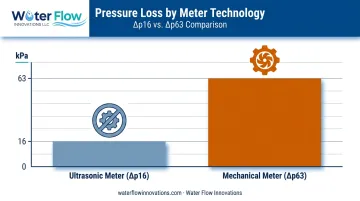
- Ultrasonic meters have no moving parts. Diehl's HYDRUS 2.0 BULK, for instance, is certified at Δp16, meaning it consumes relatively little pressure at rated flow.
- Mechanical meters (positive displacement, multi-jet, turbine) rely on moving components that create more internal resistance. Itron's Flostar M single-jet meter is rated at Δp63.
- Actual performance still varies by specific model, so the certified class or manufacturer curve for your selected meter is what matters, not a generalization about an entire technology.
Strainer design, internal flow path geometry, and manufacturing precision all factor into a meter's resistance coefficient, regardless of technology type.
Flow Rate and Meter Sizing Relative to Demand
Sizing a meter for average flow when peak demand runs well above that average sets you up for disproportionate pressure loss exactly when reliable performance matters most.
PNNL's water metering guidance puts it plainly: undersized meters can create a large pressure drop, while oversized meters lose accuracy at low flow. The goal is matching the meter to your facility's minimum, maximum, and continuous-duty flow, not just pipe diameter.
Operating Conditions, Water Quality, and Installation Environment
Pressure loss doesn't stay fixed after installation. Several conditions push it higher over time:
- Sediment accumulation on inlet strainers
- Scale buildup on internal passages
- Wear on mechanical measuring components
- Upstream pipe configurations, such as close-coupled elbows or pumps discharging directly into the meter
These same conditions often worsen turbulence and air entrainment, layering a billing accuracy problem on top of a hydraulic one.
Common Misconceptions About Water Meter Pressure Loss
Facility teams often carry a few assumptions about meter pressure loss that don't hold up under scrutiny.
Misconception: Pressure loss is the only hydraulic concern at the meter. Turbulent flow and air entrainment, the same conditions that increase pressure loss, also cause mechanical meters to over-register consumption. This billing dimension rarely gets discussed alongside pressure loss, but it often represents the bigger financial risk for commercial and industrial facilities.
Misconception: Acceptable system pressure means the meter isn't a problem. Because pressure loss scales with flow squared, a meter that consumes negligible pressure at partial load can create significant losses at peak demand. Facility teams often blame other system components for a pressure drop that actually traces back to the meter.
Misconception: All meter types produce similar pressure losses. Meter technology genuinely matters. An ultrasonic meter certified at Δp16 and a mechanical meter rated at Δp63 consume very different amounts of pressure at the same flow rate — a real consideration for facilities with continuous high-flow demand.
Misconception: Pressure loss is fixed at installation and stays constant. Strainer clogging, scale accumulation, and component wear increase pressure loss progressively. A meter that met spec at commissioning can develop far higher resistance years later without triggering any obvious alarm.
Misconception: Fixing flow quality upstream will just add more pressure loss. This assumption makes intuitive sense, but it doesn't hold for engineered flow conditioning equipment. Water Flow Innovation's Flow Conditioning Device (FCD) combines air and gas separation, pressure regulation, a check valve, and turbulence elimination in a single unit built around a negligible-pressure-loss design.
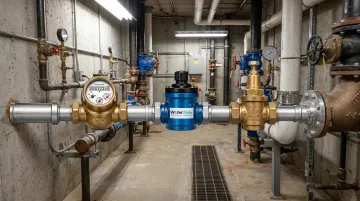
Rather than adding resistance, it addresses the turbulence and air entrainment that cause meters to over-read, with only a slight pressure loss (typically 0–3 psi) at downstream connections.
Conclusion
Water meter pressure loss is a well-understood, manageable hydraulic phenomenon. It's governed by meter design, flow rate, and installation conditions.
Standards like ISO 4064 give facility teams a clear framework for evaluating whether a meter's pressure consumption falls within an acceptable range.
Understanding the squared relationship between flow and pressure loss is key to sizing and maintaining meters that hold up across your actual operating range, not just at average flow.
Still, for most commercial and industrial facilities, the bigger concern is what accompanies pressure loss: turbulent flow and air entrainment. These conditions cause meters to over-read consumption, inflating water and sewer bills.
Addressing those root-cause flow conditions with a properly engineered, negligible-pressure-loss solution protects both system performance and billing accuracy.
Frequently Asked Questions
What is an acceptable level of pressure loss for a water meter?
ISO 4064 and OIML R 49 cap most mechanical meters at Δp63 (63 kPa at rated flow). AWWA sets PSI-based limits for North America, while ultrasonic meters can reach Δp16 or even Δp10.
How does flow rate affect water meter pressure loss?
Pressure loss scales with the square of flow rate (Δp = k × Q²), so doubling flow roughly quadruples the loss. That's why sizing decisions should account for peak demand, not just average flow.
Can water meter pressure loss cause low water pressure in my facility?
Yes. A meter consuming excessive pressure reduces the residual pressure available downstream, especially during peak demand. Combined with losses from pipes, valves, and elevation changes, an undersized or degraded meter can contribute to pressure complaints.
Does water meter age affect pressure loss?
Yes. Strainer clogging, internal scale buildup, and wear on mechanical components all increase effective pressure loss over time. Periodic inspection matters most in facilities where meters handle continuous, variable demand.
What is the difference between water meter pressure loss and differential pressure?
Differential pressure describes the difference between two points in a system and can be created intentionally for measurement, with some pressure recoverable downstream. Pressure loss is permanent energy dissipation that can't be regained.
Can turbulent flow cause my water meter to over-read water consumption?
Yes. Turbulent flow and air entrainment cause mechanical meter components to spin faster than actual water velocity, registering more volume than actually passed through. That inflates both water and sewer charges on your bill. This over-registration is exactly what Flow Conditioning Devices are engineered to fix.
How much pressure does a flow conditioning device itself consume?
Negligible pressure loss is a fundamental design characteristic of the FCD. Downstream pressures and flow rates are unchanged, which is what separates it from a pressure reducing valve or a flow restrictor — it corrects measurement, not supply.
What reduction follows once turbulence at the meter is corrected?
Documented installations average a 5–30% cut in combined water and sewer bills, with a highest documented single result of 46%, appearing on the very next billing cycle.