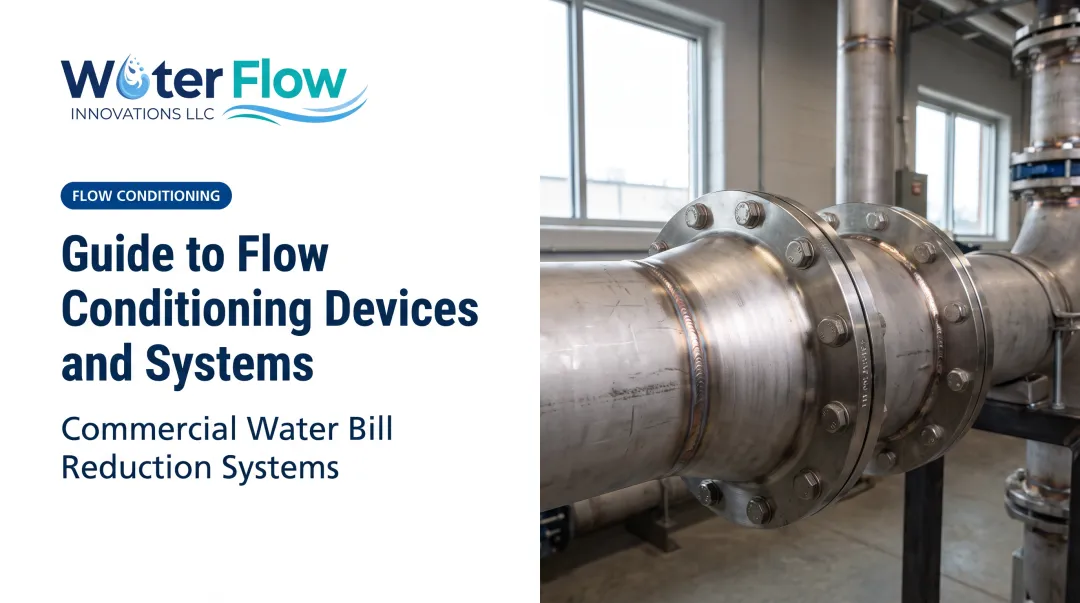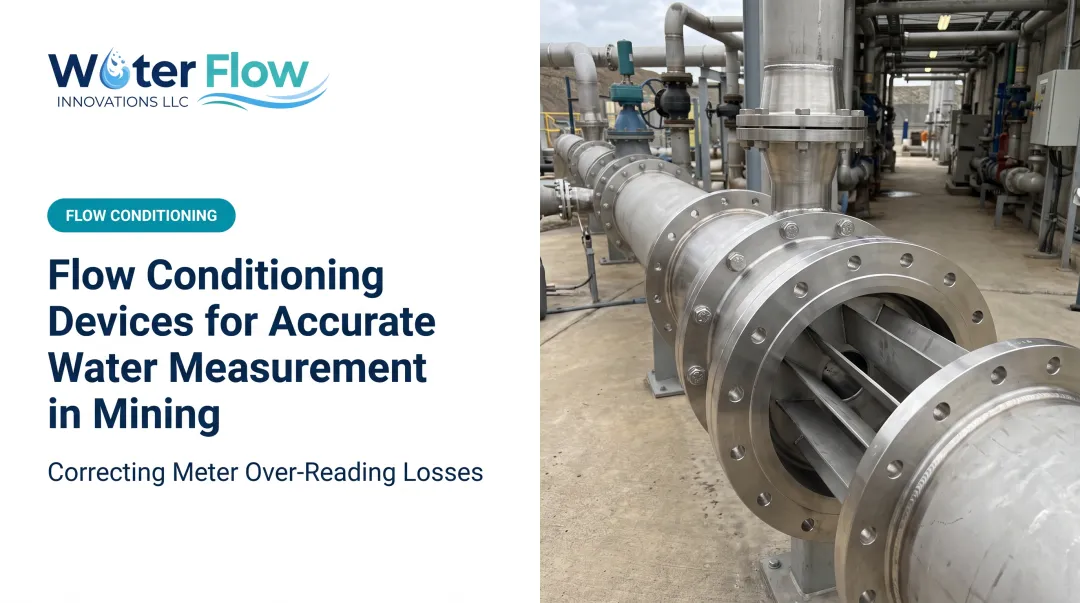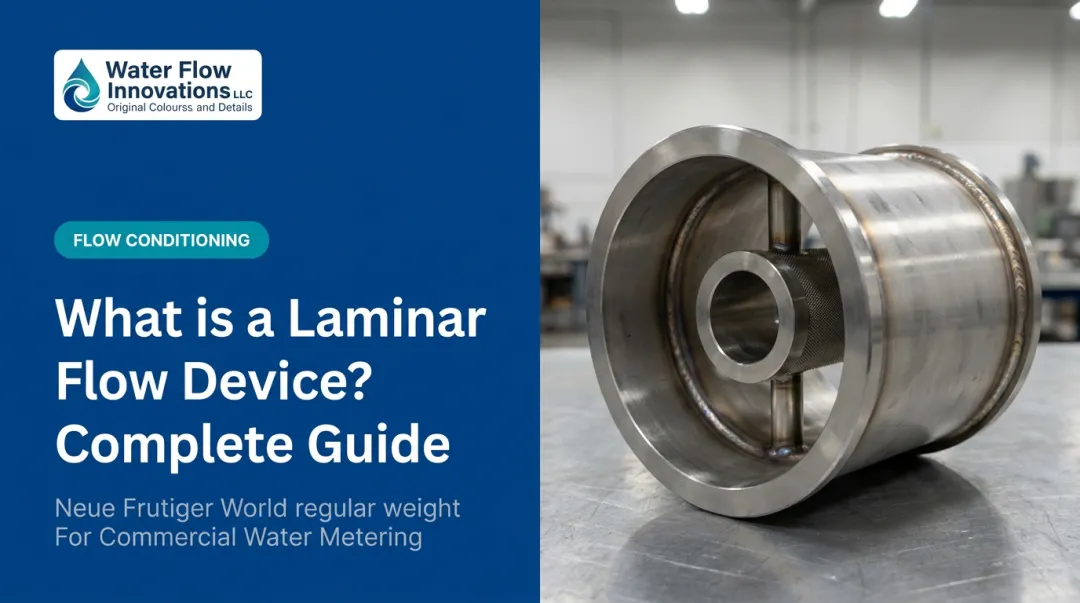

This guide breaks down what laminar flow conditioning devices are, how they work, the main types, and where they show up across industries, from aerospace to your own utility room. If you're a facility manager, engineer, or business owner wrestling with fluid systems and rising water costs, this one's for you.
Key Takeaways
- Laminar flow is smooth, parallel fluid movement; conditioning devices restore or approximate this state
- Turbulence and swirl in pipes distort meter accuracy and cut system efficiency
- Water Flow Innovation's FCD corrects air-entrainment meter over-reading for 5–30% average bill cuts (up to 46% documented)
- Primary uses include aerospace, cleanrooms, and water utility metering
What Is Laminar Flow? Understanding the Science
Laminar flow was first described in 1883, when engineer Osborne Reynolds published his study on whether water in a pipe moves in a "direct" (straight) or "sinuous" (chaotic) pattern. His experiment injected dyed water into a clear pipe to observe flow behavior at different speeds.
That work gave us the Reynolds Number, a ratio of inertial to viscous forces in a fluid. Low Reynolds numbers mean smooth, layered flow. High numbers mean chaotic mixing.
In smooth pipes, laminar flow generally holds below a Reynolds number of roughly 2,300, according to Princeton's engineering research, though this is a benchmark, not a hard rule.
Boundary Layers and Friction
Near any pipe wall, fluid velocity drops to zero at the surface and increases toward the center. NASA calls this the boundary layer. In laminar flow, this layer stays smooth and organized, reducing friction and drag. In turbulent flow, it breaks apart into chaotic eddies.

Think of a calm river versus whitewater rapids:
- Laminar: Water moves in smooth, parallel layers with minimal mixing
- Turbulent: Water churns, swirls, and mixes unpredictably
What Causes Turbulence in Real Pipes
Most industrial and commercial piping systems are far from ideal. Turbulence forms from:
- Elbows, tees, and pipe bends
- Valves and strainers
- Pumps and variable-speed equipment
- Air entrainment from tank filling or intermittent flow
- Obstructions near meters (protruding gaskets, weld projections)
According to petroleum measurement standards from the API, swirl and non-uniform velocity profiles caused by upstream fittings are common culprits behind meter accuracy problems.
Two Main Types of Laminar Flow
Engineers generally split laminar flow control into two categories.
Natural Laminar Flow (NLF) uses passive shaping with no moving parts and no power input. Surface geometry alone maintains a favorable pressure gradient that keeps flow smooth. Aircraft wings designed with specific curvature to delay turbulent transition are a classic example.
Forced (Active) Laminar Flow Control uses mechanical or device-based intervention. That includes suction systems that pull boundary-layer air away from a surface. In piping, it often means physical conditioning devices that reorganize flow for a sensitive component like a meter.
Both approaches solve the same problem: reducing drag, turbulence, or measurement error. One gets there through design. The other relies on equipment.
Types of Laminar Flow Conditioning Devices
Not all conditioners work the same way. These are the main mechanical types used in piping systems.
Perforated Plate Conditioners
These use a plate with dozens of small holes fitted in the run serving a meter. As fluid passes through, the holes force a more uniform velocity profile. Research on the Zanker flow straightener shows this graded-perforation design paired with a honeycomb structure effectively removes swirl at the metering point.
Tube Bundle Conditioners
Picture a cluster of parallel tubes inserted longitudinally into the pipe. Each tube channels a portion of the flow, breaking up large-scale swirl and turbulence. AWWA's technical taxonomy identifies tube bundles as a standard swirl-mitigation device in water measurement applications.
Vane-Type Conditioners
Vanes redirect angled or asymmetric flow back toward centerline alignment. They're especially useful when flow enters at an angle from an upstream elbow or tee, which would otherwise skew meter readings.
Air/Gas Removal and Pressure-Regulating Systems
This is where water utility applications diverge from aerospace or industrial gas lines. Air entrainment, tiny bubbles mixed into the water column, is a major source of meter distortion in commercial and industrial water systems.
Water Flow Innovation's FCD tackles this directly with a 4-component design:
- Air/gas removal – creates static back pressure that forces bubbles back into the main line for a homogeneous water column
- Pressure regulation – smooths surges from on-off cycling and variable demand
- Check valve (where specified) – limits water hammer and prevents reverse flow that could reintroduce air
- Turbulence elimination – slows velocity near the meter to eliminate vortex flow during clean-in-place (CIP) cycles or irrigation bursts

Device-Based vs. Distance-Based Conditioning
All of these devices exist because the older alternative—long straight pipe runs—rarely fits real mechanical rooms. Traditional layouts often need 10 pipe diameters upstream and 5 downstream for turbine meters, according to PNNL's metering guidance.
Device-based conditioners deliver the same correction in a fraction of that space, which is why they are the practical choice for retrofits and tight mechanical rooms.
How Laminar Flow Conditioners Are Used Across Industries
Laminar flow shows up in cleanrooms, aerospace, and water metering—three fields that use the same steady-flow idea for very different goals.
Cleanrooms and pharmaceutical manufacturing rely on unidirectional airflow (UDAF) paired with HEPA filtration to keep spaces particle-free. Semiconductor fabs and drug production both depend on that steady, non-turbulent air movement.
Aerospace has spent decades on laminar flow control for drag reduction. NASA's X-21 program used slotted-suction wings and achieved laminar flow over 95% of the intended wing area during late-program testing.
Airbus's BLADE demonstrator, flown in 2017, targeted up to 50% lower wing friction as a program goal. Those figures remain projections rather than confirmed in-service fuel savings.
Water utility and commercial metering is where flow conditioning hits your operating budget. Turbulent flow, swirl, and air entrainment near a meter can distort readings. Correcting that distortion—without changing your actual water use—is what FCD technology delivers for commercial and industrial facilities.
Why Laminar Flow Conditioning Matters for Your Water Bill
Here's the mechanism in plain terms: mechanical water meters use spinning components to estimate flow. When air pockets or turbulent eddies pass through the meter, the internal mechanism can spin faster than the true water flow rate. The result is a bill that reflects more water than actually moved through the line.
Flow conditioning corrects that over-spin before it shows up on your bill.
The FCD Solution
Water Flow Innovation offers a certified Flow Conditioning Device that combines all four components described earlier into a single unit. Each device is custom-fabricated in 316L stainless steel (titanium and specialty alloys available by special order) for pipe sizes from 1/2" to 12" NPS.
Key documented outcomes:
- 5-30% average reduction in water and sewer bills
- 46% highest documented reduction in a single case
- 90% of customers reach ROI in under 12 months
- Next billing cycle — savings typically appear

Built for Zero Disruption
The FCD installs on the consumer side, immediately after the municipal meter. That means:
- Compatible with any meter type and any standard pipe size (½-inch to 12-inch)
- Installation takes about one hour for straightforward configurations
- Negligible pressure loss — downstream equipment performs the same as before
- No process, cooling, or production systems are touched
For facilities tracking ESG metrics or pursuing LEED certification, documented before-and-after billing data also supports sustainability reporting.
Variable-flow processes—CIP cycles, guest-driven demand spikes, and similar loads—make turbulence and air entrainment especially common in:
- Food & beverage (breweries, dairy, bottling)
- Healthcare (hospitals, surgery centers, long-term care)
- Hospitality (hotels, resorts, extended-stay properties)
Choosing the Right Flow Conditioning Solution
Not every conditioning device is built the same, and getting the wrong fit can undercut results. Consider these factors:
- Pipe size compatibility — confirm the device matches your NPS range and flange configuration
- Meter type — mechanical, compound, and ultrasonic meters respond differently to conditioning
- Certification standards — look for IAPMO, NSF, ANSI, CAN 61, KIWA, GMP, and SQF
- Installation complexity — some retrofits require more planning than a one-hour shutoff
Why Certifications Matter
Third-party certifications confirm a device is safe for potable water and compliant with plumbing codes.
- NSF — suitability for potable water systems
- IAPMO — plumbing-code compliance
- CAN 61 — drinking-water contact safety under Canadian standards
- KIWA — European testing benchmarks
- ANSI, GMP, and SQF — quality and food-safety requirements for regulated facilities
Together, these marks give facility managers confidence a device will not introduce contamination or safety risk into a potable water line.
Buy vs. Lease
After you confirm fit and certifications, the next choice is how to acquire the unit. Water Flow Innovation offers both purchase and lease options, with every unit custom made to size and quotes prepared per site for multi-site operators. Every FCD includes a six-month money-back guarantee and a lifetime transferable warranty, so the device and its coverage move with the property if ownership changes.
Frequently Asked Questions
What are the common uses and real-life examples of laminar flow?
Laminar flow principles apply to cleanroom air systems in pharmaceutical and electronics manufacturing, aerospace drag-reduction programs, and water flow conditioning for accurate utility metering. In each case, smooth, organized fluid movement improves precision, efficiency, or measurement accuracy.
What are the two main types of laminar flow?
Natural Laminar Flow (NLF) uses passive shaping, like curved aircraft wings, to maintain smooth airflow without mechanical intervention. Forced or Active Laminar Flow Control uses devices, such as suction systems or flow conditioners, to actively manage turbulence.
How do I know if my facility has a turbulent flow problem affecting my water meter?
Unusually high water bills relative to your actual usage patterns are the most common sign. A water bill audit or professional consultation can identify whether meter over-reading from turbulence or air entrainment is contributing to the issue.
Does installing a flow conditioning device affect water pressure or system performance?
Water Flow Innovation's FCD is engineered for negligible pressure loss. Downstream equipment and operations continue running as before, with no detectable performance impact.
How quickly can a business see savings after installing a laminar flow conditioning device?
Savings typically appear on the very next billing cycle since the meter begins reading accurately immediately after installation. About 90% of customers reach full return on investment in under 12 months.
What inputs does a bill audit need to confirm the cause?
Recent water and sewer bills, meter size, pipe size, line pressure, and PRV configuration. Those five together establish whether over-reading conditions exist and what device size the connection requires, and the review is free.
Why does an inflated reading raise two separate charges?
Sewer is normally calculated from metered intake rather than measured discharge, commonly at 80–120% of the water charge. A single over-registered gallon therefore appears on the water line and the sewer line together.