Introduction
Cooling towers, chillers, and closed-loop systems can account for up to 30% of a facility's total water use, according to the EPA's WaterSense at Work program. That's a significant chunk of any utility budget, and it often flies under the radar.
Rising water and sewer rates mean HVAC-related water costs can become one of the largest line items on a facility's utility bill. Depending on system size, age, and how closely it's monitored, that expense might be minor — or it might be draining thousands of dollars a year.
HVAC water use isn't inherently expensive. The cooling process itself is efficient. Costs balloon because of leaks, inefficient blowdown, poor visibility into usage, and inaccurate metering.
This guide breaks down how these costs build up, what drives them, and which practical fixes cut HVAC water spend fastest—from operating decisions and day-to-day management to facility factors you can act on right away.
Key Takeaways
- HVAC water costs build up gradually through evaporation, blowdown, and leaks, often invisible until the bill spikes
- Biggest cost drivers are cooling tower evaporation and blowdown, closed-loop leaks, sewer fees, and meter over-reading
- Fixes fall into three buckets: smarter equipment choices, tighter daily management, and meter accuracy fixes
- Some of the fastest savings come from fixing how usage is measured, not just how it's consumed
- Combining strategies compounds savings across both the water and sewer portions of your bill
How Water Costs Around HVAC Systems Typically Build Up
HVAC water costs rarely show up as one obvious expense. Instead, they accumulate continuously through cooling tower evaporation and blowdown, cycle after cycle, day after day.
On any given day, nothing looks unusual — the tower runs, the chiller cycles, the bill arrives roughly where you'd expect.
That's the trap. These costs compound quietly:
- Scale buildup reduces heat transfer efficiency, forcing systems to run longer
- Poor cycles of concentration waste water through excess blowdown
- A slow leak in a closed loop or valve worsens gradually, not overnight
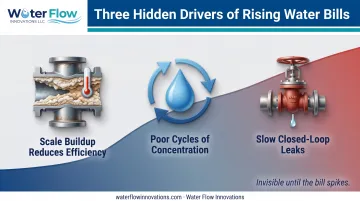
None of these issues announce themselves. A facility manager might not notice anything wrong until they pull up 12 months of billing history and see a steady upward creep that doesn't match occupancy or production changes.
By then, the cost has often been compounding for months.
Key Cost Drivers for HVAC Water Costs
Not all HVAC water costs come from the same source. Understanding which driver applies to your system (open cooling tower versus closed loop) determines which fix actually works.
Evaporation and Blowdown
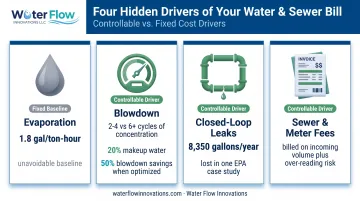
Evaporation is the baseline, unavoidable cost of running a cooling tower. The EPA estimates roughly 1.8 gallons evaporate for every ton-hour of cooling, regardless of how efficient the tower is (EPA Water Efficiency Management Guide). That water is doing its job, not going to waste.
Blowdown is a different story. Many towers operate at just 2-4 cycles of concentration (COC) when 6 or more is often achievable. Moving from 3 to 6 cycles cuts makeup water by 20% and blowdown by 50%. That cost is controllable; it is not locked in by physics.
Leaks in Closed Loops
Closed heating and cooling loops should consume close to zero water when running properly. Any measurable makeup water is a red flag, not routine operation. In one documented EPA case, two leaks in a closed ground-loop system required an average of 8,350 gallons per year just to refill. That waste went unnoticed until submetering caught it.
Sewer Fees and Meter Accuracy
Two more drivers compound the bill without touching a single valve:
- Sewer discharge fees often track incoming water volume, even when much of that water evaporates and never hits the sewer
- Water meter over-reading from turbulent flow and air entrainment inflates billed consumption with no real change in use
That second driver matters more than most facilities realize, and we'll come back to it below.
Cost-Reduction Strategies for HVAC Water Costs
Effective strategies depend on where you are in the system's lifecycle: designing or procuring equipment, actively managing daily operations, or dealing with external factors like water source and metering setup.
Design and Procurement Choices That Lock In Lower Costs
These are the choices made before a system ever runs — and they set the ceiling on how much you'll spend for years to come.
- Specify high-efficiency equipment upfront. Choosing efficient cooling towers and chillers during procurement minimizes baseline water demand before the system is even installed.
- Design in alternative water sources. Condensate reuse, rainwater harvesting, and reclaimed water are far cheaper to build into original system design than to retrofit later. One EPA case study found a facility sourced 11% of its total cooling water from recovered sources like condensate and rainwater.
- Negotiate rebate eligibility early. Talk to your local water authority about evaporation credits or sewer rebates during the initial planning and metering phase, not after the fact.
- Select water treatment chemistry upfront. The right treatment program supports higher cycles of concentration without risking scale or corrosion down the line.
Operational Controls Once the System Is Running
Once a system is running, ongoing management determines whether it drifts toward waste or stays efficient.
- Install dedicated submeters on cooling tower makeup and blowdown lines. You can't fix what you can't see, and submetering is the most reliable way to spot where water is actually going.
- Run routine leak detection audits on pump seals, expansion tanks, relief valves, and air vents — don't wait for a visible failure to check these components.
- Actively manage cycles of concentration through regular water chemistry testing instead of running blowdown on a fixed, overly conservative schedule.
- Document and apply for evaporation credits or sewer rebates using your cooling tower makeup and blowdown data.
Metering and Supply-Side Fixes Facilities Often Miss
This is where a lot of facilities miss savings entirely, because the fix isn't about the HVAC system at all — it's about what's happening at the meter.
Water meter over-reading is a real, measurable problem. Cooling tower makeup cycling creates sudden high-volume demand at the supply connection. That pattern drives turbulent flow and air entrainment in the piping, and meters register more water than actually passes through.
The billing impact matches a leak, except the water was never lost. It was simply miscounted.
Certified flow conditioning devices, like those manufactured by Water Flow Innovation, address this directly at the source. Here's how it works:
- The device installs immediately after the municipal water meter — not on the cooling tower or chiller lines themselves
- It creates laminar, bubble-free flow conditions that prevent the vortex flow and air entrainment responsible for over-counting
- Cooling tower makeup pressure, chiller performance, and every downstream system parameter remain completely unchanged
- Installation typically takes about an hour, with no cooling system shutdown required
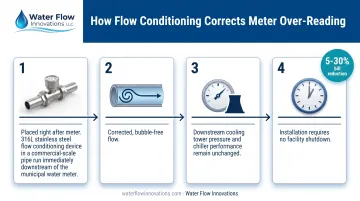
Facilities running cooling towers often see results at the higher end of the 5-30% average bill reduction range (46% is the highest documented single result), because makeup cycling creates strong air-entrainment conditions the device is built to correct. Savings typically show up on the very next billing cycle, and roughly 90% of customers reach full ROI within 12 months.
Beyond metering fixes, cut municipal demand with condensate reuse or reclaimed water for cooling tower makeup. Also check supply-side pressure and pipe configuration. Both steps can lower energy waste and the turbulence that drives meter inaccuracy.
If over-reading is the driver, the HVAC system isn't using more water at all. Usage-focused fixes like better blowdown management won't move this needle—the issue lives in measurement and delivery, not the cooling process.
Conclusion
Reducing HVAC-related water costs starts with correctly identifying where the cost actually originates: evaporation, blowdown, leaks, or meter over-reading. A higher bill does not always mean higher usage.
Lasting savings come from stacking approaches: smarter equipment decisions at procurement, consistent day-to-day operational management, and fixing issues like water source and meter accuracy. No single fix covers every driver, but when combined, they compound across both the water purchase and sewer discharge portions of your bill.
Frequently Asked Questions
Can an HVAC leak cause a high water bill?
Yes. Leaks in cooling towers or closed loops — float valves, pump seals, blowdown valves — can silently waste large volumes of water. A shutoff test or a review of meter readings during off-peak hours can help confirm one.
How can I lower my HVAC bill?
Fix leaks, optimize blowdown and cycles of concentration, integrate alternative water sources, and check for water meter over-reading. Each addresses a different cost driver, so combining them delivers the biggest impact.
How much water does a commercial cooling tower use?
Usage varies by tonnage and load, but a rough benchmark is 1.8 gallons evaporated per ton-hour of cooling. A 100-ton system running for one hour at full load evaporates roughly 180 gallons — a useful starting point for your own estimates.
What is water meter over-reading and how does it affect HVAC water bills?
Turbulent flow and air entrainment in supply piping can cause a meter to register more water than actually passes through. Makeup water cycling with cooling load is a particularly strong trigger, and it inflates both water and sewer charges even though actual consumption hasn't changed.
Are there rebates or credits available for reducing HVAC water costs?
Many utilities offer evaporation credits, sewer discharge rebates, or blowdown-related billing adjustments. Contact your local water authority directly to confirm documentation requirements and eligibility.
How quickly can facilities see savings after implementing water-saving strategies?
Leak fixes and blowdown optimization typically show savings within one or two billing cycles. Metering corrections, like flow conditioning devices, often appear on the very next bill.
Which cooling-intensive buildings show the strongest case?
Data centers, HPC and supercomputing centers, healthcare facilities, hotels and hospitality, commercial office buildings, shopping malls, and centralized district energy plants — anywhere cooling makeup water cycles constantly against one metered connection.
Can the fix be scheduled outside the cooling season?
It can be fitted any time. A licensed plumber or mechanical contractor installs the custom-built device at the supply meter in about an hour, with a brief water shutoff at the meter connection, so chillers and towers need no shutdown beyond that window.