
Introduction
Leaks waste more water than most people realize. The average U.S. household loses more than 9,300 gallons per year to undetected leaks, and nearly 9% of homes waste at least 50 gallons a day, according to EPA WaterSense.
Here's the part that hits twice: every wasted gallon gets billed as water and as sewer, since most utilities calculate wastewater charges from metered water use.
For hotels, food plants, and multifamily buildings running thousands of gallons a day, that double charge eats into margin fast. In some cities, like Chicago, the sewer charge equals 100% of the water charge — meaning a leak or inefficiency doesn't just double your water cost, it doubles your total utility bill.
Sewer bills aren't inherently expensive. They escalate because of unmanaged usage, quirky billing rules, and measurement issues almost nobody inspects. This guide breaks down how those costs build up and what you can actually do about it.
Key Takeaways
- Sewer charges track metered water volume, fixed base fees, and often a separate stormwater fee
- Leaks, inefficient fixtures, and heavy water use drive most preventable sewer costs
- Cut costs in three tiers: smarter purchase decisions, day-to-day water management, and infrastructure corrections
- Leak adjustments and deduct meters recover costs conservation alone cannot
- Commercial and industrial sites can cut bills further by correcting meter over-reading from turbulent flow
How Sewer Bill Costs Typically Build Up
Sewer costs rarely arrive as one dramatic spike. Most of the increase builds quietly through everyday water use. Restroom traffic, laundry operations, kitchen equipment, and process rinse cycles compound across a billing period without looking alarming on their own.
Other jumps are episodic. A hidden pinhole leak, a pool or spa refill, cooling-tower makeup, or a heavy irrigation stretch can suddenly push usage well above normal, and the bill reflects it a month or two later.
The real problem is timing. Much of this cost stays invisible until the bill lands, and by then you often cannot reverse the charge.
Here's why: many cities set your annual sewer rate using a winter-averaging calculation. They review water use during a low-usage window (often December through February) and lock that average in as your billing basis for the rest of the year.
If a leak ran during that window, you could overpay for sewer service for months after the leak is already fixed.
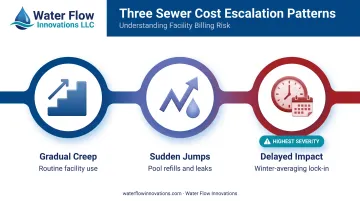
That's the pattern to watch for:
- Gradual creep: routine facility use adding up unnoticed
- Sudden jumps: leaks, pool refills, or seasonal irrigation spikes
- Delayed impact: winter-averaging windows that lock in an elevated baseline long after the cause is gone
Key Cost Drivers for Sewer Bills
Sewer bills are built from a handful of moving parts, and most people only ever look at the total. Understanding each piece makes it obvious where the actual savings opportunity sits.
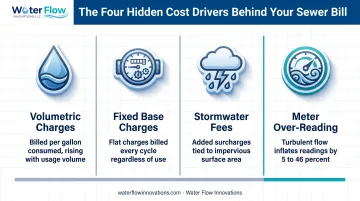
Volumetric and Fixed Charges
Sewer charges are primarily volumetric, based on metered water use. Anything that increases flow through your meter increases your bill. Portland, for example, charges $14.24 per ccf for sewer volume alone.
On top of that sits a fixed base charge tied to meter size, billed whether you use water or not. It sets a cost floor every single cycle, and it doesn't move no matter how much you conserve.
Stormwater Fees and Winter Averaging
Many cities also charge a separate stormwater fee based on impervious surface area (roof, parking, pavement) rather than water use at all. Baltimore, for instance, bills non-residential parcels $78 per ERU per year, calculated at one ERU per 1,050 square feet of impervious area. None of that is tied to what your facility actually uses.
Then there's winter averaging: a past leak during your utility's review window can inflate your rate for the next 12 months, regardless of current usage.
The Overlooked Driver: Meter Over-Reading
Here's the one almost nobody checks. Commercial and industrial water meters can register more volume than actually passed because of air entrainment and turbulent flow inside the plumbing — from valve cycling, pressure surges, and vortex flow near the meter. That inflates both the water bill and the sewer bill without any real increase in consumption.
Where commercial and industrial facilities feel it most:
- Volumetric charges inflated when meters over-read turbulent flow
- Fixed base charges locked to meter size, with or without conservation
- Stormwater fees tied to impervious area, not metered use
- Winter averaging that locks in a high rate after one bad review window
Cost-Reduction Strategies for Sewer Bills
Not every fix belongs in the same category. Some savings come from decisions made before water ever flows. Others come from managing usage day-to-day. And some come from correcting infrastructure or billing context, even when you already conserve carefully.
Strategies That Change Decisions
These are choices made before or around water use that shape your cost baseline permanently.
- Install WaterSense-labeled fixtures at build or renovation. WaterSense toilets use 1.28 gallons per flush or less (20% below the 1.6-gallon standard), saving nearly 13,000 gallons and $170 a year per high-use fixture set
- Choose ENERGY STAR appliances when replacing washers or dishwashers (certified clothes washers use about 14 gallons per load versus 20 for standard models)
- Install a separate irrigation or deduct meter at the design stage so outdoor water never enters the sewer calculation in the first place
- Set written water-use standards for procurement teams so efficient fixtures become the default, not an afterthought
Strategies That Change How Usage Is Managed
Once systems are in place, ongoing visibility is what keeps costs from creeping back up.
- Run leak checks regularly: a two-hour no-use meter test, or a toilet dye test (color in the bowl within 10 minutes means a leak)
- Set facility use standards: full laundry and dishwasher loads, shorter shower defaults in housing or hospitality, taps off during routine tasks
- Track billing trends and meter readings over time, especially during winter-averaging windows that set your annual rate
- Request adjustments proactively (leak credits, pool-fill credits, winter-average appeals) when unusual usage inflates a cycle
Strategies That Change the Context Around Sewer Bills
Sometimes infrastructure or billing rules, not actual water use, drive the cost.
- Pursue stormwater credits by installing rain gardens, permeable pavement, or rain barrels where local programs allow it
- Document non-sewer volumes with your utility so irrigation, cooling, or pool fills approved on a deduct meter stay out of sewer charges
- Correct meter over-reading at the source on high-volume commercial, industrial, and multifamily lines where air entrainment and turbulence inflate registered flow
- Evaluate system-wide plumbing (pipe sizing, pressure regulation, meter placement) when scaling operations; infrastructure waste can outweigh behavioral fixes
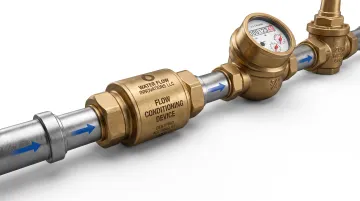
Water Flow Innovation builds a certified Flow Conditioning Device (FCD) that conditions the flow the meter sees so bills reflect water actually used. Documented results are typically 5–30% lower water and sewer bills (highest verified case 46%), often on the next cycle. Facilities that want a baseline first can use a free water bill savings analysis covering current bills, meter type, and pipe layout.
Conclusion
Lower sewer bills start with a diagnosis, not a blanket effort to "use less water." The real driver might be a habit, a fixed charge you didn't know existed, or a meter over-reading every billing cycle.
Lasting savings come from combining all three tiers: smarter decisions up front, tighter day-to-day management, and property-specific fixes like stormwater credits or meter correction. Apply them where they matter for your facility, not everywhere at once.
If meter accuracy may be inflating your charges, a free water bill review can show whether over-reading is part of the problem before you invest in other changes.
Frequently Asked Questions
How can I save money on my wastewater bill?
The fastest savings come from fixing leaks, running full loads in laundry and kitchen equipment, and installing low-flow fixtures. Wastewater and sewer charges track metered water use, so every gallon you cut lowers both bills.
How do I reduce the water that goes to the sewer?
Cut water that actually enters drains with shorter showers, efficient appliances, and taps that aren’t left running. Divert non-sewer water like irrigation through a deduct meter when your utility offers one.
Why is my sewer bill higher than my water bill?
Wastewater treatment needs gravity-fed pipelines, pump stations, and stricter environmental standards. That makes it more expensive to build and operate than drinking water delivery.
What is winter averaging and how does it affect my sewer bill?
Many utilities set your annual sewer rate from winter water usage. A leak or spike in that window can raise your sewer bill for months afterward.
Can I get a credit for outdoor water use like pool filling or irrigation?
Many utilities offer pool-fill credits or deduct meter programs that exclude non-sewer water from billing. You usually need to request or apply for them.
How can commercial or industrial facilities reduce sewer costs beyond basic conservation?
High-throughput facilities should also verify meter accuracy. Certified flow conditioning devices correct over-reading from turbulent flow, cutting water and sewer bills—often 5–30%—without changing operations.
If the sewer charge is never measured, what is it based on?
Metered water intake, typically at 80–120% of the water charge depending on the utility. That is why an over-registering meter produces two inflated charges from a single error, for volume that never reached a drain.
Which municipal and utility operations does this apply to?
Municipal water and wastewater treatment plants, municipal buildings, and waste-to-energy facilities and MSW combustors — sites that both operate the network and pay metered charges on their own service connections.