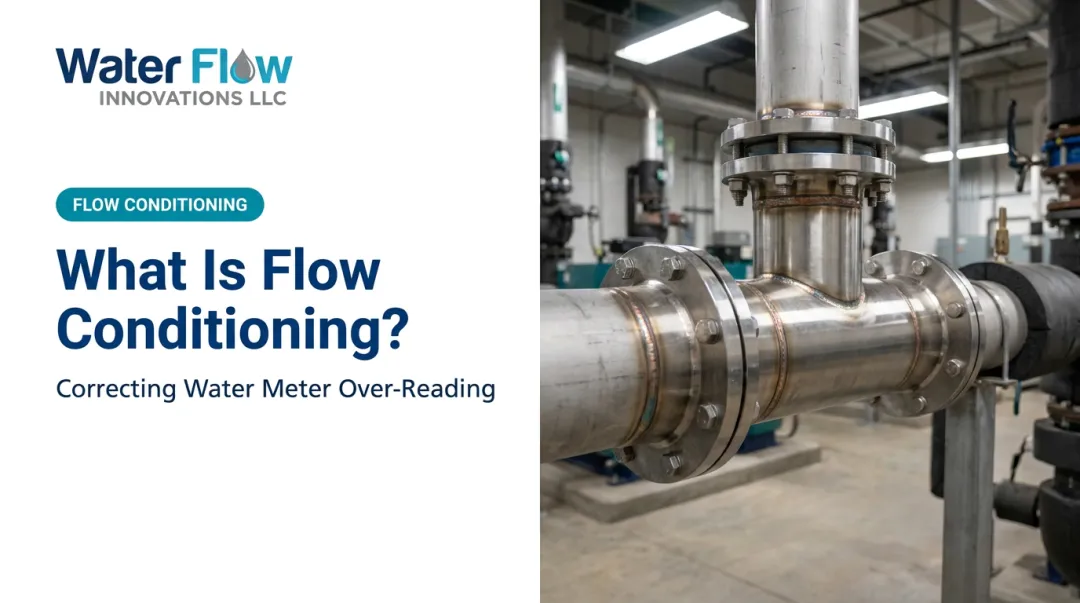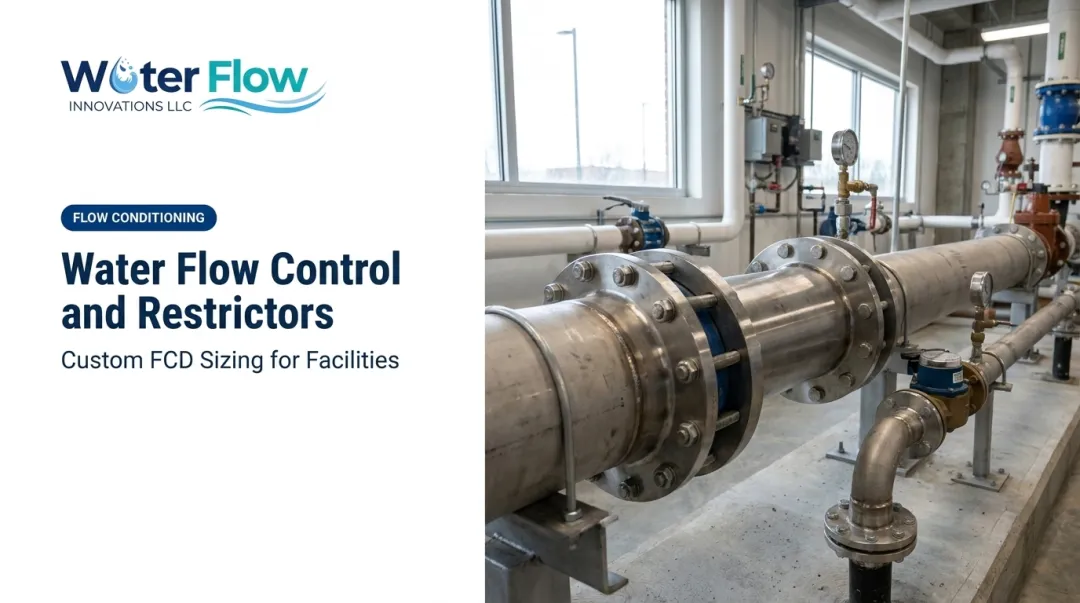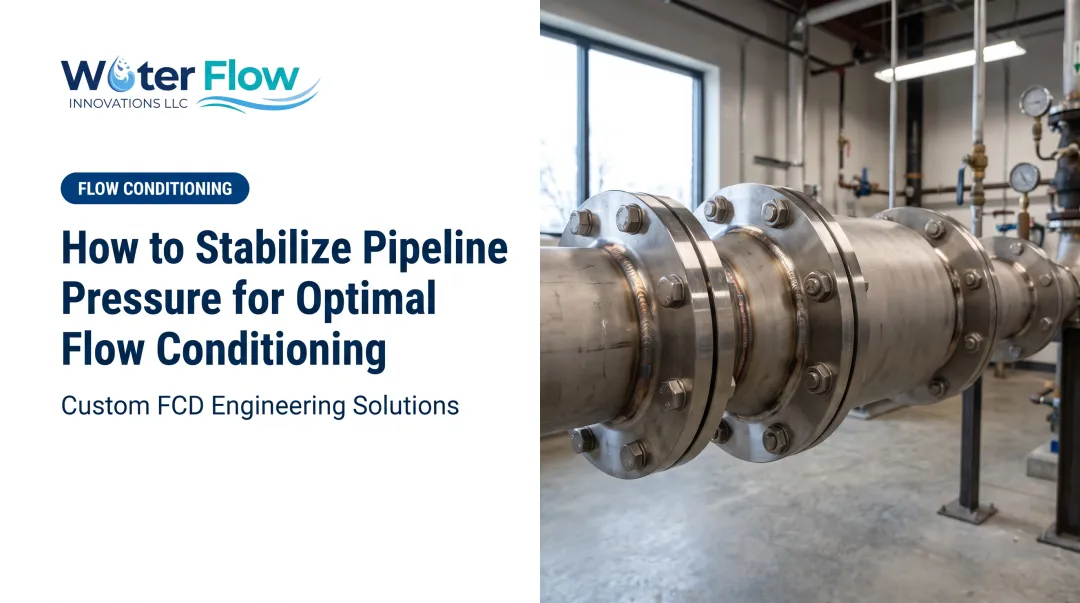

Water flow conditioning corrects turbulence, air entrainment, and pressure irregularities in a pipe at the meter or piece of equipment. For facility managers, engineers, and operators in commercial and industrial settings, this matters because unstable flow directly affects utility costs, equipment performance, and compliance reporting.
The term gets thrown around a lot in plumbing and utility conversations, but rarely explained at a mechanical level. This article breaks down how conditioning works, where it's applied, what affects its performance, and when it actually matters.
Key Takeaways
- Water flow conditioning removes turbulence and air pockets so water moves in a smooth, stable stream
- Turbulent or aerated flow makes water meters over-register, inflating water and sewer bills
- The process combines air/gas removal, pressure regulation, and turbulence elimination
- Industrial, commercial, and municipal systems use it wherever accurate flow measurement and billing matter
- Water Flow Innovation's FCD corrects meter over-reading, with documented savings of 5–30% on average (up to 46%)
What Is Water Flow Conditioning?
Water flow conditioning is the mechanical process of normalizing flow characteristics (velocity profile, turbulence, and entrained air) at the meter, valve, or piece of equipment. The goal is a smooth, laminar-like flow profile that reflects true consumption and reduces mechanical stress on downstream components.
Conditioning is easy to mix up with restriction and regulation, but the three do different jobs:
- Flow restriction reduces volume by creating hydraulic resistance, as when a differential-pressure meter infers flow from a pressure drop
- Flow regulation holds a set pressure or rate, as when a pressure-reducing valve keeps static pressure in range
- Flow conditioning corrects flow quality by reshaping the velocity field and removing air, without changing quantity or setpoint
Understanding this distinction matters when you're diagnosing a problem. A facility with pressure swings needs a regulator. A facility with air entrainment and meter drift needs conditioning. They're not interchangeable fixes.
Why Water Flow Conditioning Is Used in Commercial and Industrial Facilities
Water meters are calibrated assuming a fully developed, single-phase water stream. When turbulent or aerated flow disrupts that assumption, the meter can register phantom volume that was never actually consumed.
AWWA has documented that piping disturbances (bends, short pipe runs, valves, pumps, elbows, and tees) degrade meter performance. AWWA's research on flow conditioning and meter accuracy confirms these disturbances drive measurement error, though no single percentage applies to every installation.
What facilities actually need:
- Accurate billing that reflects real consumption
- Protection for pressure-sensitive equipment
- Stable pressure for consistent process results
Those needs go unmet when flow stays unconditioned:
- Overpaying on water and sewer charges (sewer fees often use the same metered volume)
- Equipment wear from pressure spikes and water hammer
- Inconsistent results in flow-sensitive processes such as CIP cycles or cooling tower makeup
Flow conditioning isn't universally mandated by code. But it's becoming a standard operational practice, especially for facilities tracking ESG or sustainability metrics where verified utility data matters.
This is the problem Water Flow Innovation's Flow Conditioning Device (FCD) was built to solve. The device is certified to IAPMO, NSF, ANSI, CAN 61, KIWA, GMP, and SQF. Documented results show facilities cutting water and sewer bills by 5-30% on average, with a top recorded case of 46%.

How Water Flow Conditioning Works
Water typically enters a conditioning device in a turbulent state, sometimes aerated, from pumps, fittings, or elevation changes upstream. It passes through the conditioning components and exits as a stabilized stream that a meter can measure accurately.
Typical inputs include:
- Raw incoming flow with entrained air pockets
- Pressure fluctuations from pump cycling or demand swings
- Irregular velocity profiles from nearby bends or valves
Most conditioning devices are passive (no power, sensors, or moving parts required), though some active systems use valves or controls for more precise regulation.
Step 1: Air and Gas Removal
The device separates entrained air bubbles from the water stream at the meter. That matters because meters register volume based on flow, and air moving through the measurement zone counts as phantom volume. Water Flow Innovation's designs create static back-pressure that pushes air and gas back upstream, leaving a fully homogeneous water column at the meter.
Step 2: Pressure Regulation
Consistent pressure through the device prevents the spikes and drops that generate additional turbulence downstream. In the FCD's documented arrangement, this component sits ahead of a pressure-reducing valve. One example shows 120 psi entering the FCD and 80 psi after the PRV, which is why sequencing matters.
Step 3: Turbulence Reduction and Flow Straightening
Internal geometry redirects chaotic, swirling flow into a smoother, more linear pattern. Internal passages and flow paths handle that straightening work. In the FCD, this function combines with air removal, pressure regulation, and (where specified) a check valve in a single low-pressure-loss unit rather than four separate inline devices.

Where Water Flow Conditioning Is Applied
Flow conditioning is applied wherever accurate measurement or stable pressure matters most:
- Municipal water mains and distribution systems
- Industrial process lines, including chemical and manufacturing plants
- Cooling towers with separately metered makeup and blowdown lines
- Irrigation systems with variable-demand cycling
- Building meters and submeters near elbows, valves, or pumps
Those same sites usually add conditioning at predictable points in a system's life:
Common lifecycle triggers:
- New construction or meter installation
- Meter upgrades or replacements
- Post-renovation plumbing changes
- Periodic utility bill audits flagging anomalies
- Noisy, vibrating, or unstable pipework
Unlike filtration, which requires ongoing maintenance and cartridge changes, conditioning is typically a one-time installation. Once the device is sized and fitted correctly, there's no recurring service cycle tied to the conditioning function itself.

Key Factors That Affect Flow Conditioning Effectiveness
Not every conditioning device performs the same way in every pipe. Effectiveness depends on:
- Pipe size, material, and meter type: devices must match the specific pipe size (NPS ½" to 12" is a common commercial range) and the meter in place
- Upstream conditions: bends, valves, and pump placement introduce turbulence the device has to counteract
- Pressure range: operating pressure interacts directly with how the conditioning mechanism performs
- Facility scale and flow volume: a small office building and a high-throughput bottling line need very different sizing
- Certification requirements: NSF, ANSI, and CAN 61 matter for potable water and food/beverage contact applications
NSF/ANSI 61 certification confirms a device is safe for drinking-water contact. It does not, by itself, certify hydraulic performance or measurement accuracy—verify those separately before you specify a unit.
Common Issues and Misconceptions
"Flow conditioning reduces water usage." It doesn't. It corrects measurement accuracy. A facility's actual consumption stays the same; the bill reflects what was truly used instead of an inflated reading.
"Any strainer or fitting does the same job." A strainer removes solids and protects downstream equipment from debris. A purpose-built conditioning device reshapes the velocity profile and removes entrained air. That is an entirely different mechanical function.
"Conditioning and restriction are the same thing." They're not. Restrictors reduce volume; conditioners stabilize flow quality without throttling delivery.
"My bill dropped, so I'm using less water." Often the opposite is true. A lower bill after installation usually means the meter is now reading correctly, not that consumption dropped. Water Flow Innovation finds savings from corrected metering typically appear on the next billing cycle when stacked against prior utility statements.
When Flow Conditioning May Not Be Necessary
Conditioning isn't a default fix for every facility. Skip it, or investigate first, when:
- Piping is already well-designed. Adequate straight-pipe runs and minimal turbulence sources mean little added benefit—positive-displacement meters often need no straight-run allowance at all.
- Flow volume is very low. Small residential-scale applications rarely justify commercial-grade conditioning equipment.
- The meter is already verified accurate. If third-party calibration confirms correct readings, conditioning won't fix a faulty meter—you're solving a different problem.
- No turbulence or over-reading has been confirmed. Installing conditioning by default, without confirming the problem first, is the wrong sequence.
Water Flow Innovation addresses this directly through a free water bill review and savings analysis before any purchase. That review examines billing structure, meter configuration, water-use profile, and industry-specific demand patterns to determine whether a facility is a strong candidate. It does not assume every meter needs correcting.
Conclusion
Water flow conditioning stabilizes turbulence, removes entrained air, and regulates pressure so meters can register accurate consumption and systems can run reliably. For facilities managing high water and sewer costs, or building out verifiable sustainability data, understanding this mechanism shows exactly where your utility dollars are going.
Start by evaluating actual flow conditions and metering accuracy. Solutions like the FCD, backed by a 6-month money-back guarantee and lifetime transferable warranty, make the most sense when the underlying problem (turbulence, air, or over-reading) is confirmed, not assumed.
Frequently Asked Questions
What are the three types of flow control?
Flow control falls into three categories:
- Flow restriction — limiting volume
- Flow regulation — holding a set rate when pressure varies
- Flow conditioning — stabilizing turbulence and air content for accurate measurement
What is a water flow controller?
A water flow controller is a device—often a valve—that manages the rate or consistency of water moving through a pipe. Some designs also include flow conditioning components.
How do I know if my water meter is over-reading?
Compare metered usage against actual fixture or process consumption, or have the meter tested for accuracy. Unexplained bill increases with no change in operations are a common warning sign.
Does flow conditioning affect water pressure or system performance?
Properly designed devices, like the FCD, are built for negligible pressure loss. Most installations show no detectable drop; only high-volume, open-discharge setups have shown a documented 3–5 psi pressure drop.
How long does it take to install a flow conditioning device?
Commercial-grade installations typically take about an hour, with a brief water shutoff at the meter connection, and require no major plumbing modifications or process changes. Industrial installations may take somewhat longer.
Is water flow conditioning the same as water filtration?
No. Filtration removes particulates and contaminants, while conditioning addresses turbulence, air entrainment, and pressure stability. They serve different purposes and can be used together.
What reduction does the conditioning category actually deliver?
Documented installations average a 5–30% cut in combined water and sewer charges, with a highest documented single result of 46%, appearing on the very next billing cycle after installation.
What is reviewed before a device is specified?
Your water and sewer bills together with meter size, pipe size, line pressure, and PRV configuration. That review is free, runs remotely from documents you supply, and determines both applicability and sizing.