How does the Flow Conditioning Device help agricultural operations?
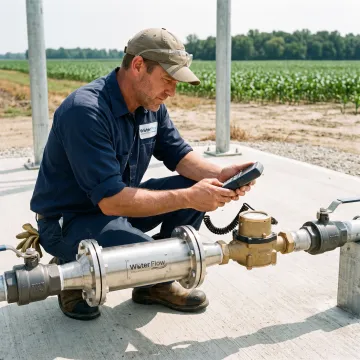
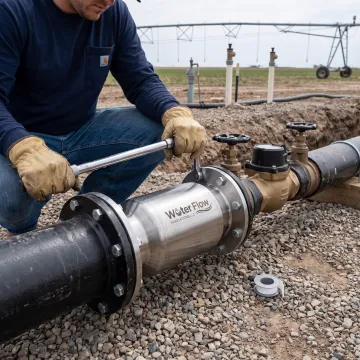
It corrects how the meter records water during demand surges. On agricultural sites surges are frequent: irrigation zone cycling, tank fills, wash-down, and frequent pump starts each speed water up through the meter, pressure inside it drops, dissolved gas comes out of solution and vapor forms, and the meter counts that volume as water. The Flow Conditioning Device installs immediately after the meter and creates a small, controlled back-pressure that extends back through the meter, so far less gas and vapor form and are counted, with no practical change to the water delivered to irrigation equipment, livestock watering, or processing.
Can a Flow Conditioning Device reduce irrigation water bills?
Yes, where the meter is over-registering during demand surges. Documented installations typically show up to a 30% reduction in combined water and sewer costs (46% is the highest documented, a rare case). A free bill review evaluates billing history, meter size, pipe size, line pressure, PRV configuration, and the irrigation profile to project the savings opportunity before installation, and the online calculator models your operation’s 24-hour flow profile with no contact information required.
Will an FCD reduce pressure to sprinklers or irrigation zones?
No. Pressure loss across the FCD is under 0.8 psi across all flow conditions. It installs on the main line immediately after the meter, ahead of the PRV and the distribution system, and is sized to your pipe and meter. Sprinkler and drip zone pressures, pivot performance, and pump duty see no practical change. During the review, the flow profile and operating requirements are used to size the device and plan the installation.
How long does agricultural FCD installation take?
About an hour, with the water off for about an hour. A licensed plumber or mechanical contractor fits the device on the main line immediately after the meter. Work is planned around irrigation schedules, livestock watering, and processing so disruption stays inside the brief shutoff window, and it is commonly scheduled between irrigation cycles. Savings start on the next full billing cycle.
What does the free water bill savings analysis include?
A review of water and sewer billing cycles, meter size, pipe size, line pressure, PRV configuration, and the facility use profile, including irrigation zones, tank fills, wash-down, pump starts, and other frequent demand surges. You receive a projected savings range, facility classification, recommended FCD sizing, estimated ROI, and an installation planning summary. The analysis is free, carries no commitment, and is completed remotely from uploaded bills. On-site visits are available but billed separately.
Does flow conditioning work with our water meter and pipe size?
The FCD is sized to each facility’s pipe and meter; the review confirms sizing, and no meter replacement or main-line redesign is required. That matters on agricultural properties, which often combine large irrigation mains, multiple meters, and specialized water systems across a single operation. The savings analysis and installation planning process identify the correct device sizing for each metered connection individually.
Can agricultural facilities lease a Flow Conditioning Device?
Yes. Purchase and lease options are both available, including volume arrangements for multi-location operators. A bill review projects savings and ROI so a farm, dairy, greenhouse, hydroponic grow, or packing operation can compare financing approaches against current utility costs. Each metered connection is a separate installation opportunity, and each device is sized to its meter and main line.
How can I request more product information about the FCD?
Contact Water Flow Innovations to discuss your facility’s requirements and request further product information.
Which agricultural operations see the largest reduction?
Those with the most frequent demand surges, because every pump start, valve opening, and zone change speeds water up through the meter, drops pressure inside it, and lets gas and vapor form and be counted as water. Irrigation operations switching between zones, dairy parlors running wash-down and cooling cycles, hydroponic grows on continuous fertigation schedules, greenhouse operations, meat, poultry, or seafood processing on the same connection, and packing houses with high-volume produce wash lines all show this pattern. A bill that climbs faster than acreage or throughput, especially at peak times, is a strong signal.