Introduction
Walk onto any commercial job site and ask three engineers to define a "pressure regulator" versus a "pressure reducing valve," and you'll likely get three different answers. These terms get used interchangeably across plumbing, industrial, and process piping systems, and that ambiguity causes real problems.
Specify the wrong device and you risk under-protected equipment, plumbing code violations, or missed opportunities to cut water and energy costs.
This guide breaks down what each term actually means, where they overlap, and how proper pressure management connects to something facility managers often overlook: utility bill accuracy.
Key Takeaways
- A PRV is a specific device that reduces and holds downstream water pressure at a safe, fixed level
- "Pressure regulator" is the umbrella term, covering PRVs, back-pressure regulators, and differential regulators
- Water and plumbing systems usually treat the two terms as the same device
- Industrial and process settings use "regulator" for many subtypes—always name which one you need
- Neither device fixes water meter over-reading, a separate bill driver worth checking on its own
Pressure Reducing Valve vs Pressure Regulator: Quick Comparison
Here’s a side-by-side snapshot before the full definitions.
| Category | Pressure Reducing Valve (PRV) | Pressure Regulator |
|---|---|---|
| Primary function | Reduces high incoming pressure to a fixed, lower downstream setpoint | Maintains a target pressure (upstream, downstream, or differential) using load and sensor mechanisms |
| Typical install point | At the water meter or building main entry | Anywhere in a fluid/gas system needing precise control |
| Common industries | Residential, commercial, and municipal water systems | Oil & gas, chemical processing, compressed gas, HVAC, water systems |
| Terminology scope | A specific device subtype | An umbrella term including PRVs and other subtypes |
Scope is the real distinction. A PRV does one specific job. “Regulator” is the broader category that includes PRVs and other pressure-control devices.
What is a Pressure Reducing Valve?
A pressure reducing valve is a self-contained mechanical valve. It uses a spring-loaded diaphragm or piston to automatically reduce and stabilize downstream water pressure, regardless of how much the incoming supply pressure fluctuates.
For facilities, this matters beyond simple mechanics. Under the Uniform Plumbing Code, an approved pressure-reducing regulator (PRV) is required whenever static water-supply pressure exceeds 80 psi. That device must bring pressure down to 80 psi or less at building outlets, according to IAPMO's plumbing code guidance. Skip this step and you're not just risking equipment damage. You're out of code.
Operational benefits of a properly sized PRV include:
- Reduced water hammer and pipe stress
- Fewer leaks and emergency service calls
- Lower water and sewer consumption from reduced flow rates at fixtures
- Extended service life for appliances like water heaters and washing machines
Direct-Acting vs. Pilot-Operated PRVs
Not all PRVs are built the same way, and the distinction matters for sizing.
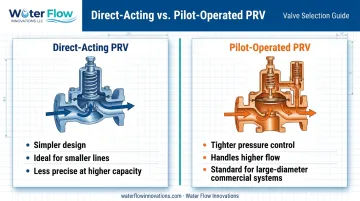
- Direct-acting PRVs use a diaphragm that moves directly against an adjustment spring. They're simpler and work well for smaller lines, but they offer less precise regulation at higher capacities.
- Pilot-operated PRVs use a smaller pilot valve to modulate loading pressure on a larger main diaphragm. This gives tighter pressure control and handles much higher flow, which is why they're standard on large-diameter commercial systems.
Where PRVs Are Typically Installed
PRVs are typically installed right after the water meter and backflow preventer, before water distributes throughout the building. This positioning protects everything downstream in one shot.
Facilities where PRVs are standard equipment:
- Multifamily housing and high-rise apartments
- Hotels and extended-stay properties
- Hospitals and healthcare facilities
- Schools and university dormitories
The conservation upside is measurable. In Asheville's Gravity West Zone, engineers modeled advanced pressure control across four supply-point PRVs. Dropping average zone pressure from 130 psig to 70 psig (a 60 psi reduction) was projected to cut annual leakage from 189 million gallons to 80 million gallons.
That is roughly a 58% reduction, according to analysis published in Valve Magazine. The figure is a model projection, not a post-installation measurement, but it shows how much high static pressure drives waste through leakage alone.
What is a Pressure Regulator?
A pressure regulator is the broader category. It's any device using load, sensor, and control components—think springs, diaphragms, or poppets—to hold either upstream or downstream pressure at a specific setpoint.
In industrial and process environments, this distinction matters for equipment protection. According to Emerson's technical guidance on pressure regulation, regulators prevent equipment damage from pressure spikes, keep process output consistent, and reduce unplanned downtime tied to pressure instability.
Three main regulator subtypes:
- Pressure-reducing regulators — hold downstream pressure steady (functionally identical to a PRV in water service)
- Back-pressure regulators — hold upstream pressure steady, cracking open to bleed off excess
- Differential regulators — maintain a fixed pressure difference relative to a reference point
That third bullet is where a lot of confusion starts. Calling something "a regulator" without specifying which of these three functions it performs is a bit like calling every vehicle "a car" and expecting someone to know if you mean a sedan or a dump truck.
Use Cases of a Pressure Regulator
Regulators show up anywhere a fluid or gas system needs tight, specific control, not just at a building's main entry point.
Common deployment points:
- Gas distribution skids in oil & gas operations
- Chemical dosing lines in process manufacturing
- Compressed air systems in industrial plants
- Analytical sampling systems in semiconductor and lab environments
Here's a concrete example. In an analytical sampling system, a back-pressure regulator sits near the end of the sampling line and controls the inlet pressure feeding an analyzer. As source pressure shifts, the regulator diverts unused flow into a bypass line, keeping pressure at the regulator's inlet constant.
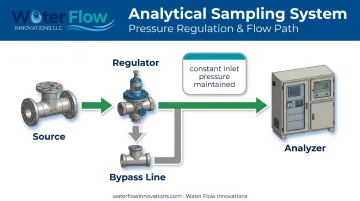
The analyzer gets steady, reliable flow no matter what's happening upstream. That is a completely different job than a PRV performs, even though both devices fall under "pressure regulator."
Key Differences Explained: Which One Do You Need?
Here's the direct answer: in residential and commercial water systems, a PRV is a type of pressure regulator. That's why the terms get used interchangeably in plumbing. Nobody's wrong—they're using the specific term (PRV) and the umbrella term (regulator) for the same downstream-reducing function.
The scope difference is what trips people up outside of plumbing:
- "Regulator" covers multiple pressure-control functions (upstream, downstream, differential)
- "PRV" refers specifically to downstream pressure reduction, almost always in a water context
Devices That Get Confused With Both
A few related devices show up in the same searches but do different jobs entirely:
| Device | What It Actually Does |
|---|---|
| Pressure relief valve | Vents excess pressure once a threshold is exceeded (safety bleed-off, not continuous control) |
| Pressure-restricting valve | Limits flow volume through adjustable restriction, not static pressure |
| Pressure control valve | Electronically or pneumatically actuated based on a control loop signal |
Mixing these up isn't just a terminology issue. Specifying a relief valve where you need continuous downstream reduction leaves your system unprotected during normal operation, since relief valves only act during emergency overpressure events.
Situational Recommendations
- Protecting a building's water supply? Use PRV terminology and equipment.
- Managing industrial gas, chemical, or process fluid lines? Use "regulator," and specify the subtype (reducing, back-pressure, or differential).
Signs Your Facility Needs a PRV
Watch for these indicators:
- Static pressure readings above 80 psi on a gauge test
- Frequent water hammer (banging pipes when fixtures shut off)
- Premature appliance or fixture failures
- Splashing or spraying at faucets and showerheads
Even a correctly sized, properly functioning PRV won't catch every water-related cost problem. A separate issue still shows up on most commercial utility bills.
Real-World Application: Pressure Management and Water Bill Accuracy
Here's what a PRV or regulator will never fix: water meter over-reading.
Turbulent flow and air entrainment inside the water line cause meters to register more volume than actually passes through.
Your pressure could be perfectly regulated at a textbook 65 psi, and your meter could still be over-counting every gallon—inflating both water and sewer charges. Pressure control and metering accuracy are two separate problems.
This is where Water Flow Innovation's Flow Conditioning Device (FCD) comes in as a complementary solution, not a competitor to your PRV.
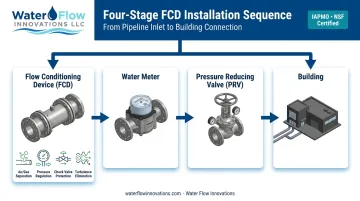
The FCD combines four functions in one unit:
- Air and gas separation, creating laminar flow back through the meter
- Pressure regulation at the meter entry point, dampening surges from on-off cycling
- Check valve protection, preventing reverse flow from reintroducing air
- Turbulence elimination, stopping the vortex flow that causes over-counting
The recommended sequence is FCD → Water Meter → PRV → Building. Installing the FCD immediately after the meter and ahead of your existing PRV lets it work with full incoming pressure, which can mean roughly 50% more savings potential compared to placing it downstream. Your PRV keeps doing exactly what it's always done, unmodified.
Documented results across hotels, hospitals, and multifamily buildings show a 5-30% average reduction in water and sewer bills, with a documented high of 46% at a district energy facility. Savings show up on the very next billing cycle, and 90% of customers hit full ROI in under 12 months.
If your facility still sees high water bills with pressure under control, request a free flow conditioning assessment from Water Flow Innovation and find out what a correctly conditioned meter reading could save you.
Frequently Asked Questions
What is the difference between a pressure reducing valve and a pressure regulator?
A PRV is a specific type of pressure regulator designed to reduce and hold downstream water pressure. "Pressure regulator" is the broader term that also includes back-pressure and differential regulators used across industrial applications.
Do I need a pressure reducing valve?
Most US plumbing codes require a PRV when incoming municipal water pressure exceeds 80 psi. If your facility sees water hammer or premature fixture wear, have supply pressure checked with a gauge.
Can a pressure regulator be used instead of a PRV?
In water systems, a pressure-reducing regulator functions identically to a PRV. Back-pressure or differential regulators serve different purposes entirely and shouldn't be substituted without matching the application.
What is a pressure relief valve and how does it differ from a PRV?
A relief valve is a safety device that vents excess pressure only once a set point is exceeded. A PRV continuously reduces and maintains lower operating pressure under normal, everyday conditions.
What is the typical lifespan of a pressure reducing valve?
PRVs often last the life of the building. Most performance issues are fixed with an inexpensive service kit rather than full replacement.
How do I know if my water pressure is too high?
Watch for banging pipes, splashing at fixtures, or unusually fast fixture wear. Have a licensed plumber verify pressure with a gauge—readings above roughly 80 psi typically warrant a PRV.
Where does a flow conditioning device fit among these valves?
It is not a member of the family. Every regulator here changes the pressure your building receives; a conditioning device deliberately does not. Negligible pressure loss is a fundamental design characteristic, and it corrects only what the meter registers.
What does that measurement correction return financially?
Documented installations average a 5–30% reduction in combined water and sewer charges, with a highest documented single result of 46%, appearing on the first billing cycle after installation.