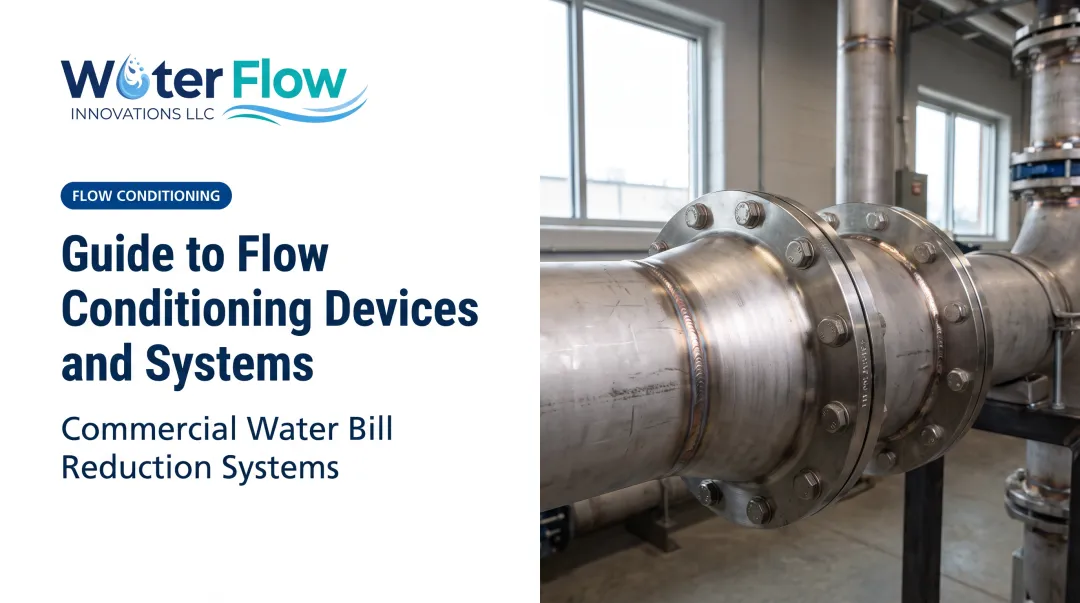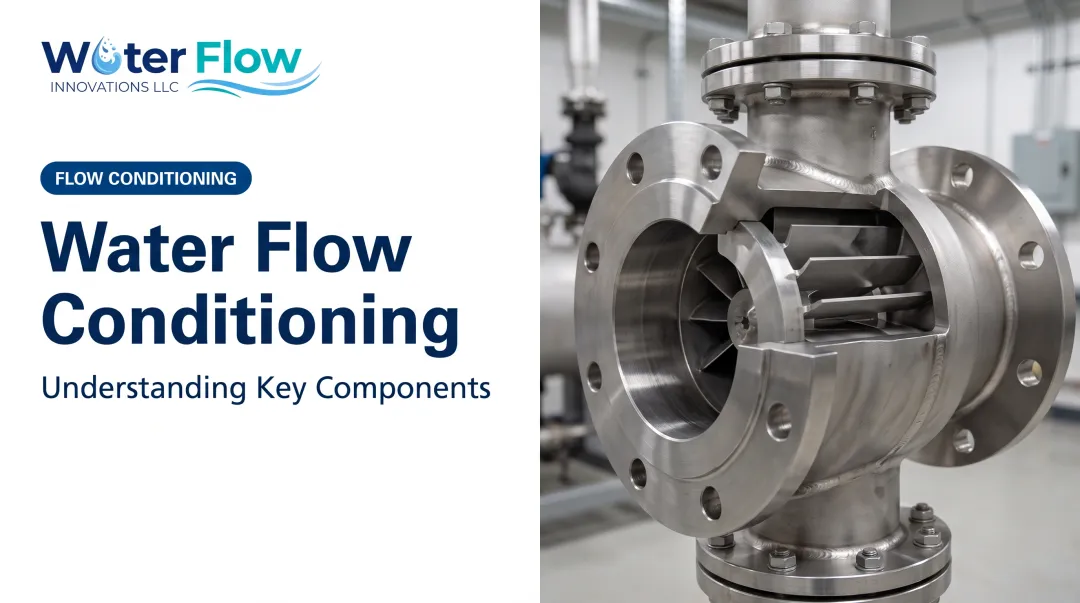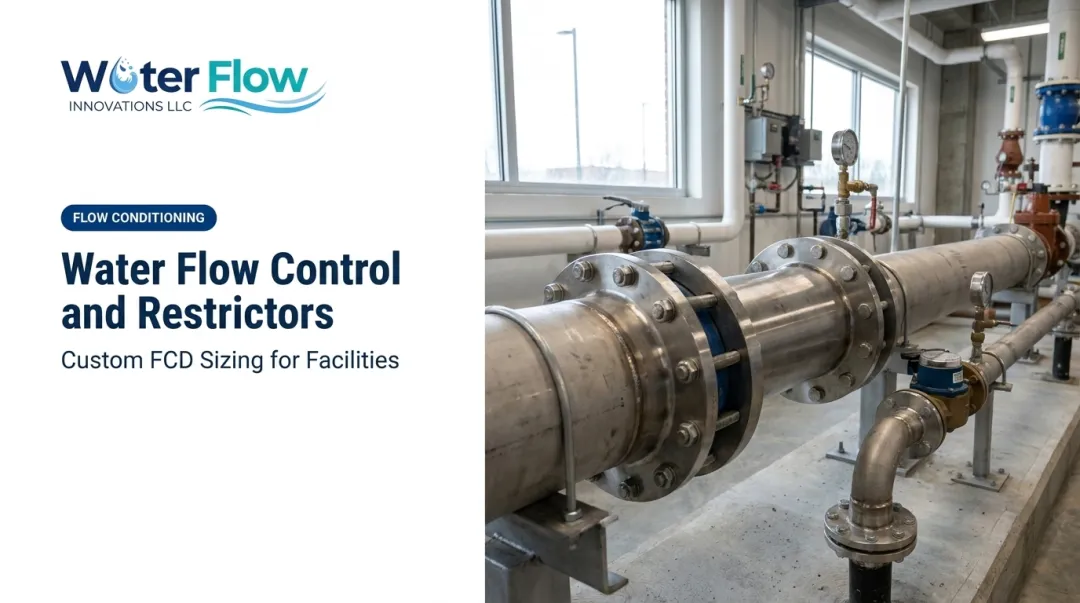

This guide breaks down what upstream flow conditioning systems actually do, why turbulence and air entrainment throw off meter accuracy, and how facilities across manufacturing, hospitality, and healthcare can correct it. This applies whether you're running a 200-room hotel or a semiconductor fab.
Key Takeaways
- Flow conditioning smooths turbulent, aerated flow at the meter, improving measurement accuracy
- Bends, valves, and pumps too close to a meter are common causes of distorted readings
- Manufacturer straight-pipe runs often can't be met in real layouts; conditioning devices close that gap
- Water Flow Innovation's certified, custom-built FCD corrects meter over-reading without affecting production or performance
What Is Upstream Water Flow Conditioning?
Upstream water flow conditioning is the process of taking turbulent, swirling, or air-entrained water and normalizing it into smooth, uniform streamlines at the meter or process point. Think of it as giving the water a chance to "calm down" before it gets measured.
Upstream refers to piping conditions before the meter. Downstream refers to piping after it. Upstream conditions matter more for accuracy because that's where turbulence, swirl, and air pockets form. A meter can only measure what's actually flowing past it in that moment.
What Causes Poor Upstream Flow
Most disturbances trace back to a handful of usual suspects:
- Elbows and tees installed too close to the meter, creating swirl
- Partially open valves that choke flow unevenly
- Pumps cycling on and off, generating pressure spikes
- Pressure-reducing valves (PRVs) positioned right before the meter
Turbulence vs. Laminar Flow
In laminar flow, water moves in smooth, orderly layers. In turbulent flow, it moves chaotically, and that chaos can pull in air bubbles—a phenomenon called entrainment. Meters can misread those air pockets as additional water volume, meaning you get billed for volume you never actually consumed.

Meter manufacturers publish specific straight-pipe requirements for their equipment. AWWA guidance points installers back to those specs rather than one blanket rule.
In practice, many facility layouts simply can't provide that much unobstructed straight run. Pipe chases are tight, equipment rooms are cramped, and retrofits rarely have extra pipe length.
Why Flow Conditioning Matters for Accurate Water Metering
Here's the mechanism in plain terms: when aerated or turbulent water passes through a meter, the meter can interpret air pockets and velocity spikes as more water than actually flowed through.
A 2016 peer-reviewed simulation study on ultrasonic and electromagnetic meters found inflow-related bias ranging from 1.5% to 4.5% for some meter configurations. Disturbed approach conditions can measurably skew readings.
That over-reading doesn't stop at your water bill. Many municipalities calculate sewer discharge fees based on metered water volume, so an inflated meter reading can inflate both charges at once.
How the FCD Addresses This
Water Flow Innovation's Flow Conditioning Device (FCD) is built around four integrated components:
- Air and gas separation — displaces entrained air/gas so it doesn't reach the meter
- Pressure regulation — reduces surges and water hammer from demand cycling
- Turbulence elimination — slows and stabilizes velocity to prevent swirl
- Check valve — guards against reverse flow reintroducing air (specified when needed)

The design targets negligible pressure loss, so facility operations, production lines, and fixtures aren't affected.
Documented bill corrections can also support ESG reporting, LEED water-efficiency documentation, and sustainability program goals. Before-and-after utility bills provide auditable proof of reduced metered consumption.
Core Components of a Flow Conditioning System
A complete flow conditioning system combines four functions at the meter. Each targets a different source of measurement error—skip one, and residual distortion can still inflate readings.
Air and Gas Removal
Turbulent pipe flow, especially around pumps, tank fills, or intermittent supply, can pull air or gas into the water stream. If that air reaches the meter, it can register as billable volume. Separating air at the measurement point is one of the most direct ways to correct over-reading.
Pressure Regulation
Pressure fluctuations from pumps cycling, pressure-reducing valves (PRVs), or variable demand create flow spikes. Left unmanaged, those spikes distort readings and stress downstream piping. Regulating pressure at the meter entry point steadies the flow profile at the point of measurement.
Turbulence Reduction / Flow Straightening
Internal baffles or straightening vanes convert chaotic, swirling flow into parallel streamlines. The same idea shows up in open-channel measurement. The U.S. Bureau of Reclamation's Water Measurement Manual notes that devices shouldn't sit near turbulent, surging, or unevenly distributed flow: approach conditions matter as much as the device itself.
Check Valve Function
A check valve prevents backflow and protects the conditioning process over time. Reverse flow and pressure surges can reintroduce air into the line, undoing the correction the rest of the system just performed.
Where and How Upstream Conditioning Systems Are Installed
The FCD is installed directly after the water meter, on the consumer side of the connection — right after the municipal meter and before the building's internal distribution system. Because it sits on the supply side, technicians don't touch production equipment, fixtures, or internal plumbing.
Installation typically involves:
- Reviewing water bills, meter type, and pipe configuration
- Conducting a site survey of pipe diameter, flow direction, and nearby fittings
- Shutting off water, installing the device, and restoring service (usually about one hour; complex setups may take 1–2 hours)
- Verifying operation and documenting before/after readings

The device accommodates pipe sizes from NPS ½" to 12" as standard, with custom sizes available up to 32", and any meter type.
For facilities with strict water-quality requirements (food & beverage, healthcare, pharmaceutical), certifications including IAPMO, NSF, ANSI, CAN 61, KIWA, GMP, and SQF support code-compliant installation. Pharmaceutical-grade units use 316L stainless steel, the material specified under ASME BPE standards for pharma piping.
Industries That Benefit Most from Flow Conditioning
High-water-use sectors with frequent pressure changes and start-stop cycling see the greatest correction potential:
- Food & beverage processing — breweries, dairy, bottling, CIP-intensive operations
- Hotels and hospitality — the EPA identifies hotels among the highest water-use-intensity property types
- Healthcare facilities — EPA Portfolio Manager data shows a median hospital use of 315 gallons per bed per day
- Schools and universities — dormitories and campus buildings with variable demand
- Data centers — cooling systems with continuous flow demands
- Multifamily properties — high-rise buildings with shared meter infrastructure
Facilities with complex piping near the meter (frequent bends, pumps, PRVs) tend to see the highest over-reading rates. Shipyard hydro-blasting and express tunnel car washes, for example, generate hundreds of daily pressure events, making them strong candidates for correction.
Beyond lower bills, facilities already tracking LEED or ESG metrics gain a second benefit: verifiable water-efficiency documentation alongside the cost savings.
Measuring the Financial Impact: What Facilities Can Expect
Because flow conditioning corrects a billing error rather than reducing actual water usage, the effect isn't gradual — it shows up almost immediately.
What facilities typically see:
- Bill reductions in the 5-30% range, with the highest documented case of 46%
- Savings appearing on the next billing cycle, since the correction is immediate, not cumulative
- 90% of customers reaching full ROI in under 12 months, based on Water Flow Innovation's customer data

To reduce adoption risk, Water Flow Innovation backs its FCD with a 6-month, no-questions-asked money-back guarantee on the device purchase price, plus a lifetime transferable warranty that stays with the property through ownership changes. Buy or lease options mean facilities aren't locked into a large upfront capital expense.
A free water bill review and savings calculator can estimate a facility-specific range before any commitment is made.
Frequently Asked Questions
What is a water conditioning system?
General water conditioning usually means softening or treating water for quality. Flow conditioning is different: it corrects turbulence and air entrainment so meters measure usage accurately.
How do I know if my facility has an upstream flow problem?
Warning signs include short straight-pipe runs near the meter, pumps or PRVs installed close to it, or unexplained spikes in your water bill. A flow audit or bill review can confirm whether turbulence is affecting your readings.
Does flow conditioning affect water pressure or system performance?
The FCD creates negligible pressure loss, so fixtures, production equipment, and system performance stay unaffected. In some high-volume scenarios, it can even trim excessive incoming pressure by a few psi.
How long does installation take and does it require downtime?
Installation typically takes about one hour, with a brief water shutoff at the meter connection, or up to two for complex setups. There is no disruption to internal operations afterward.
Can flow conditioning work with any meter or pipe size?
Yes. The FCD is custom-fabricated for pipe sizes from ½" up to 12" (larger sizes available on request) and is compatible across commercial, industrial, and municipal meter types.
How quickly will I see savings after installation?
Since the correction is immediate rather than usage-based, savings typically appear on the very next billing cycle after installation.
What size of reduction do upstream corrections deliver?
Documented installations average a 5–30% reduction across combined water and sewer charges, with a highest documented single result of 46%, achieved without any change to consumption.
Which sectors most often have disturbances right at the meter?
Sites with cramped mechanical rooms and heavy cycling: hotels and hospitality, healthcare facilities, multifamily and apartment buildings, commercial office buildings, laundromats, car and truck washes, and food and beverage plants.